

This Diwali, Swap UNO and Dobble for Koku and FATAC
This Diwali, put UNO and Dobble away and play Koku and FATAC, two Indian card games built for family nights, kids’ tables and office Diwali parties.

Rooftop
Author
There is an UNO deck in your house right now. It has been on every road trip, every birthday sleepover and every power cut for years, and at least one Draw Four has a bite mark on it. If you are lucky, there is a Dobble tin somewhere too.
They are good games, and we play them all year. But Diwali comes once, the whole family sits in one room for five evenings, and the deck on the table could say something about where you are. That is the case for switching to Indian card games for the festival. Rooftop’s Koku and FATAC fit the swap neatly, one for each of the decks you already own.
Diwali falls on Sunday, 8 November 2026, with Dhanteras on the 6th and Bhai Dooj on the 10th. Here is how to trade your everyday decks for those five nights.
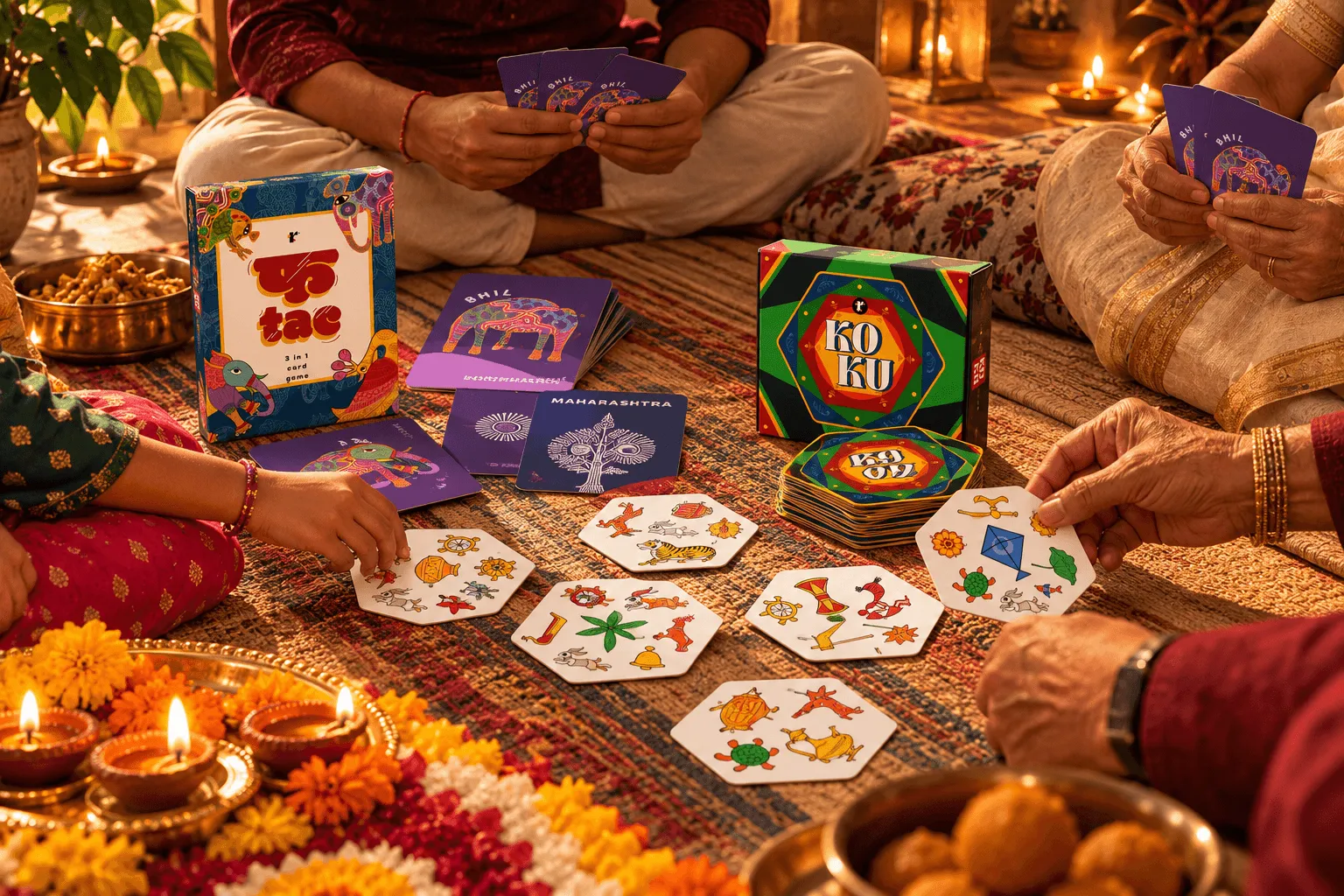
Diwali night, 8 November 2026. The everyday decks get the night off.
Why switch decks for Diwali
- The cards carry the festival. Koku’s symbols include a rangoli, a shankh and a dholak, and FATAC’s cards are drawn from Warli, Gond, Bhil, Cheriyal, Mata ni Pachedi and Phad art. An igloo on a Dobble card has nothing to say about Diwali.
- Grandparents can play from the first round. Nobody has to learn what a Wild Draw Four does, and the supda in Koku is the one symbol elders tend to spot before anyone else.
- More people fit at the table. Koku plays up to 12, where UNO stops at 10 and Dobble at 8.
- The youngest cousin gets a seat. FATAC’s product page starts the age at three.
Swap 1: put Dobble away, bring out Koku
Koku and Dobble run on the same maths. A Dobble deck has 55 cards with 8 symbols each, drawn from 57 symbols, and any two cards share exactly one. Koku uses 57 symbols, 8 to a card, with the same one-match rule. So anyone who has played Dobble already knows how to play Koku.
What changes is what you are hunting for. Instead of an anchor and a snowman, it is a Warli bird, a camel, a supda, a peacock feather and a tarpa, printed on hexagonal cards. Say the symbol out loud when you spot it, in whatever language your family uses. Supda, soop and chhaj all count.
Koku comes with three ways to play. The classic race has you matching your top card to the centre card and dropping it on the pile, and the first player to empty their pile wins. Neighbours Envy flips it, so you snatch matched cards from opponents and running out first means you lose. Reverse Koku stacks the deck into a face-up tower, players draw one card at a time, and whoever holds the most cards at the end wins.
If your Diwali crowd is a mix of ages, Koku Cards is the deck that seats all of them.
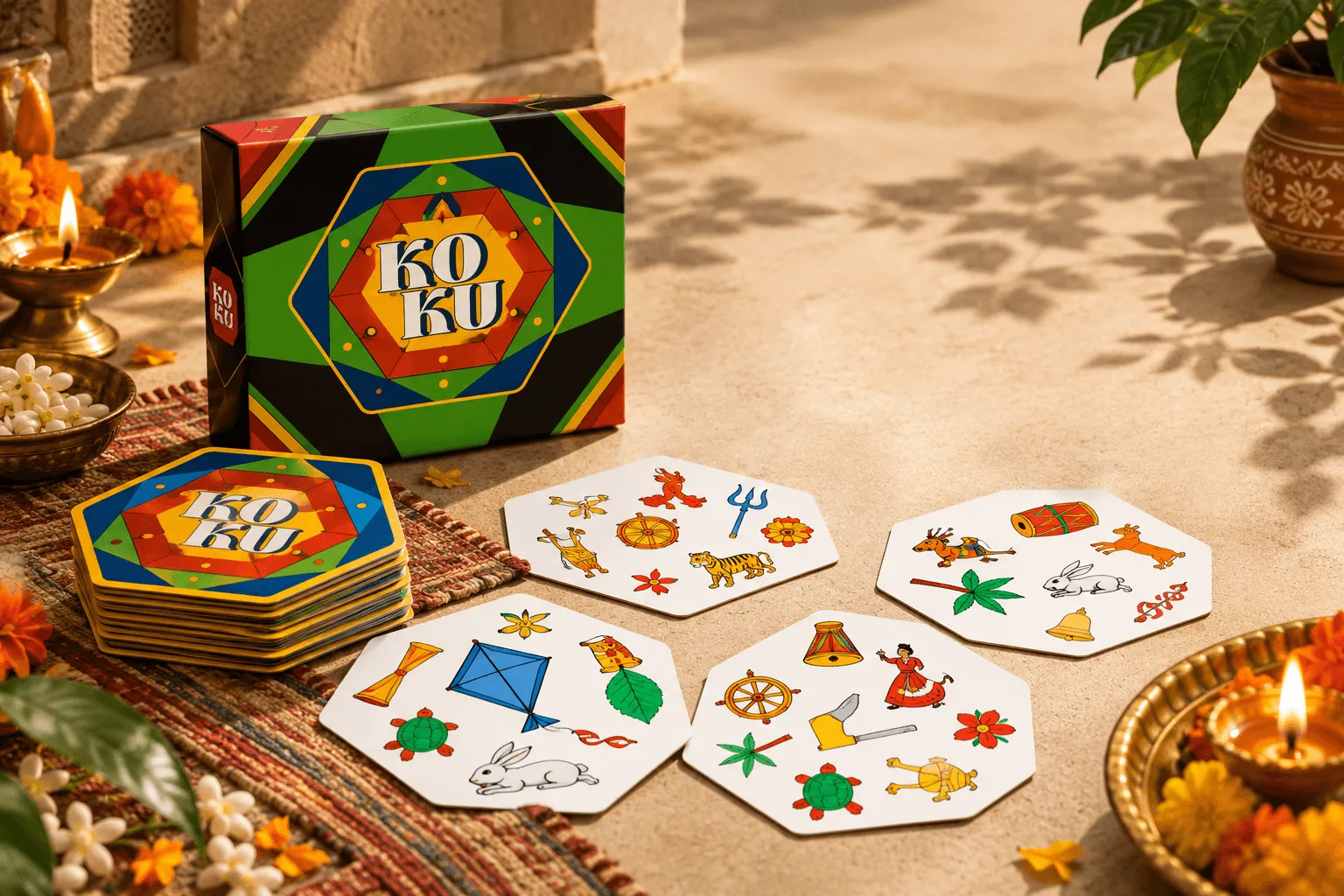
Koku, the Indian answer to Dobble: 57 folk symbols, 3 game modes, 2 to 12 players, ages 6 and up.
Swap 2: put UNO away, bring out FATAC
UNO and FATAC’s Slap Dash want the same thing from you. Get rid of your cards first. UNO gets there with colours, numbers and action cards. Slap Dash gets there with a palm and a pile. Everyone flips onto the centre, you slap when you spot a match, and the last hand down takes the whole pile.
The same deck plays two more games. In the FATAC snap game, players flip onto a central pile and the first to call a match wins it, until one player is left holding every card. In Memory, the cards go face down, you flip two a turn, and you keep the pairs you find. Memory is the quiet one, which makes it the game for a three-year-old and a grandparent to play together.
The name is Mumbai slang for quick, and it is also the sound a hand makes on the pile. Keep one habit from UNO. When you are down to your last card in Slap Dash, shout FATAC. Forget, get caught, and you pick up two cards from the pile.
For the kids’ table, and for anyone buying Diwali gifts for kids, FATAC is three games in one small deck.
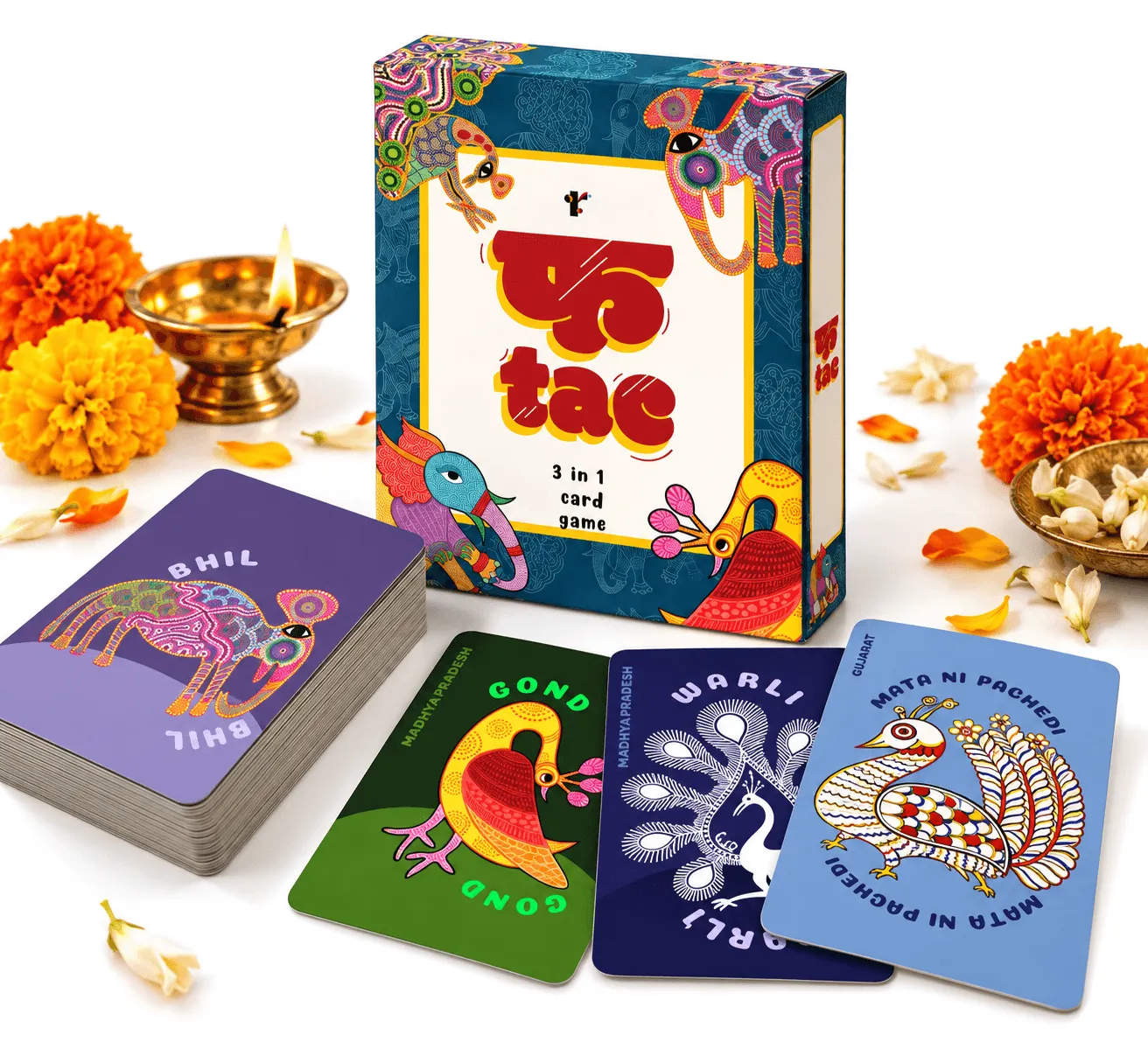
FATAC, the Indian answer to UNO night: Snap, Memory and Slap Dash, illustrated from six Indian art forms.
How to run a Koku and FATAC Diwali game night
- Start right after the puja, while everyone is still in one room and nobody has gone back to their phone.
- Split the tables. FATAC goes to the kids, Koku goes to everyone else, and you swap after half an hour.
- Play for mithai, never cash. The winner of each round picks first from the kaju katli box.
- Teach Koku with one open round, every card face up, so the younger players learn the symbols before the speed arrives.
- Once the group passes eight, stack the Koku deck into a tower and switch to Reverse Koku. People can drift in and out without breaking the game.
- When the energy drops around midnight, finish with FATAC Memory.
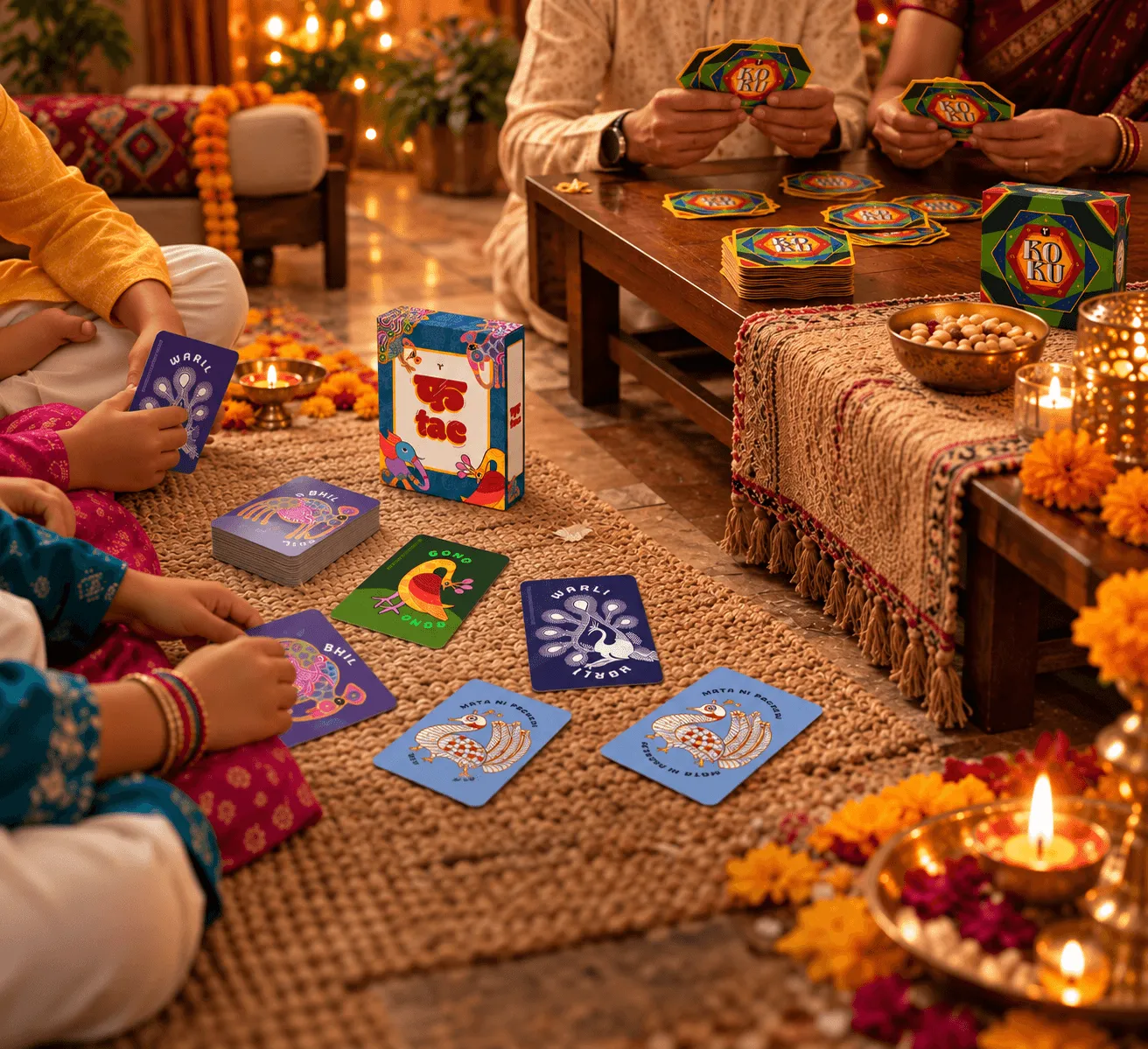
Two tables, two decks. FATAC for the kids, Koku for everyone else, swapped halfway through the evening.
The swap works beyond Diwali night
Navratri runs from 11 to 19 October 2026, and the nights after garba suit a quick round of Koku before everyone falls asleep. Bhai Dooj on 10 November is made for a sibling Koku race with the gift as the prize.
For an office Diwali party, Koku handles twelve colleagues from one deck, and Neighbours Envy lets the intern take cards off the manager without anyone filing a complaint. Children’s Day on 14 November is a FATAC day, and the deck makes a good return gift for a school party. By Christmas and New Year’s Eve you will know which of the two your family reaches for first.
Keep the UNO deck for the terrace
Nobody is asking you to throw anything away. Around midnight the teenagers will head upstairs with the UNO deck, and they should. Downstairs, where Nani is still sitting with the kaju katli, the Koku deck should already be out. Both decks, and the rest of Rooftop’s games and puzzles, are ready before the 8th.