

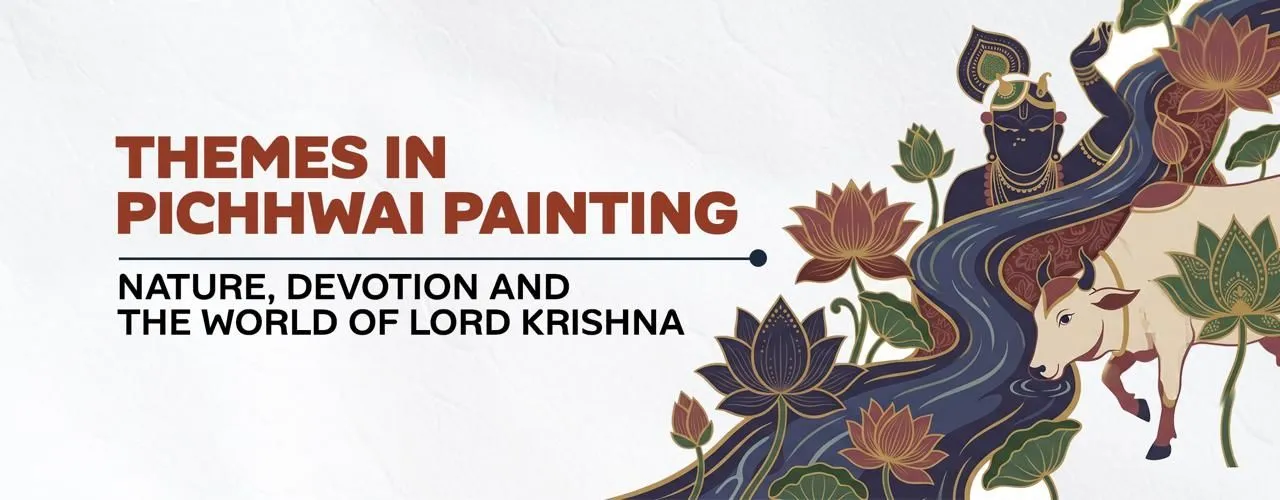
Themes in Pichhwai Painting: Nature, Devotion and the World of Lord Krishna
Decode the symbols, festivals, and devotional themes of Pichhwai painting, from cows and the Yamuna to Sharad Purnima, Annakut, and the Gopis of Vrindavan.

Rooftop
Author
Pichhwai painting is a 400-year old traditional Indian art form that originated in Nathdwara in Rajasthan, India. It is said that Lord Krishna himself, through divine guidance, chose Nathdwara as his seat of residence. The term ‘Nathdwara’ literally means ‘doorway to God.’ These are exclusively made to depict the likeness of Shrinathji who is the seven-year old version of Lord Krishna.
The form of Shrinathji first came in the form of a divine ‘darshan’ in the dream of Mahaprabhu Vallabhacharyaji, a 15th century Hindu saint and the founder of the Pushtimarg sect of Vaishnavism. The Pushtimarg tradition focuses on ‘bhakti’ or loving devotion towards Shrinathji. Devotess from this tradition believe that changing the Pichhwai is a form of ‘seva’ or service to Shrinathji and bestows divine grace.
Pichhwai literally means ‘that which comes from behind’. The form gets it’s name from the tradition of hanging the same behind the idol of Shrinathji in the main temple of Nathdwara. This main idol of Shrinathji was consecrated in the year 1672 CE. Pichhwai as such are believed to hold immense spiritual significance as the keepers and portrayals of the ‘leela’ or divine play of Lord Krishna.
The Pichhwai tradition, with it’s seat at Nathdwara, Rajasthan is spread across India and is prevalent in states like Gujarat, Maharashtra, Andhra Pradesh and Telangana. Pichhwais are classified under the Nathdwara school of painting which is considered as a sub-style of Mewar school of painting. Pichhwai artists typically belong to the Adi Gaur, Jangid and Mewaras sub-castes. Many of the 19th century Pichhwai paintings bear artists’ names. Typically, there are two types of Pichhwais, one that is made for temples and one that is made for ‘haveli’ or the residence of the priest.
Pichhwai paintings are created in the name of Lord Krishna and as such, the form, iconography and motifs are all in accordance with the spiritual intent of the making and development of this art form. The main figure of a Pichhwai is the form of Lord Shrinathji who has almond-shaped eyes and a peacock feather in his ‘mukut’ or crown. Each element is intricately decorated and painted with precision that is testament to years of mastery. Since Lord Krishna is a ‘Chandravanshi’ or a descendant of the clan of the moon, the Pichhwais mostly depict him at night time against star-strewn skies.
Seasonal Themes of the Composition
Pichhwais are traditionally painted according to the Hindu ‘Panchang’ or traditional Hindu calendar. The compositions are styled according to the seasons as charted by the Hindu calendar. The colour palette is also altered to depict a particular seasonal mood. The various seasons are known as ‘baras’ and Shrinathji is portrayed in the midst of it.
Pichhwai paintings that portray the Sharad Purnima, the full moon night in the month of Ashwin according to the Hindu calendar which falls typically in the month of October are shown as landscapes illuminated by the glow of the bright full moon. The Maha Raas is depicted in the Pichhwai depicting the Sharad Purnima with Lord Krishna at the centre playing his divine flute, symbolizing the flow of Maya and universal entanglement.
Summer is indicated with the presence of pink lotuses. In the summer, lightweight Pichhwais are preferred that depict shady groves and cool streams and lotus ponds. Pichhwais that portray the monsoons are called Varsha Pichhwai and are characterised by the presence of rains and a cloudy skies. The Morakuti Pichhwai that depicts dancing peacocks under an overcast sky is also connected to the rainy season. Monsoons are depicted with flourishing greenery around Shrinathji. In winter, Shrinathji is adorned with rich, warm hues to counter the cold and attract the eye subliminally. During winter, scenes are also stitched onto a heavy cloth or patterned in brocades instead of being painted. In this way, through compositional choices, the appropriate ambience and the feel of the season is recreated in each Pichhwai.
The Lotus Motif
The Lotus flower or ‘padma’ is a recurring motif that can be observed in Pichhwai paintings. They are often used to frame the central figure of Shrinathji or are shown growing in abundance in a pond. The lotus embodies purity, spiritual awakening, wisdom and divine beauty. It is often portrayed in different stages of blooming symbolising the different stages of the devotee’s spiritual evolution. The ‘kamal talai’ or a lotus pond is a popular compositional choice to use as a backdrop for the main image of Shrinathji playing the flute.
This type of a composition depicts a ‘jal vihar’ or a leisurely excursion of Shrinathji to the lotus pond which evokes a sense of divine serenity and purity. In contemporary times, Pichhwais utilising lotus compositions are popular as interior decor among the masses.
Cows and the Pastoral World of Vrindavan
Cows are also a popular motif that occur in Pichhwai paintings. They symbolise Lord Krishna’s status as the ‘gwala’ or divine cowherd and his connection with Nature, the landscape of Vrindavan and the Gopas and Gopis who symbolise his devotees. Lord Krishna is also known as ‘Gopala’ or the ‘Protector of Cows.’ Cows, in Hindu tradition, are worshipped as symbols of purity, prosperity and motherhood. They are considered as representations of the Kamdhenu cow, the celestial cow in Hindu mythology that represents Mother Earth and symbolises fertility, abundance and spiritual grace. Besides Shrinathji, Kamdhenu also features as the central figure in many Pichhwai paintings.
Popular themes in Pichhwai painting tradition includes ‘Gocharan Leela’ or the playful interaction between Lord Krishna and the grazing cows. The affection depicted between Shrinathji and the cows instantly creates an atmosphere of an idyllic setting of divine perfection that connects with the ‘bhakti’ of the devotee viewing the artwork.
The Yamuna River
Natural elements form an intrinsic part of the landscape of a Pichhwai painting. And the Yamuna river holds a special position in this assemblage. It is present in almost every Pichhwai painting and is of great significance as one of the three pillars of the Pushtimarg tradition, the other two being Shrinathji himself and Mahaprabhu Shri Vallabhacharyaji. The Yamuna is revered as the sacred source of water that sustains life and is said to embody a spiritual connection to the divine.
Compositions often feature an abundance of life forms and flora and fauna around Yamunaji symbolising continued growth and prosperity. The Yamuna is also sometimes depicted in the form of a blue lotus or in the anthropological form. In her anthropological form, she is placed to the left of Shrinathji. The Maha Raas theme portrays Krishna doing the Raas Leela with the Gopis by the Yamuna river’s banks. In most Pichhwais though, Yamuna is depicted as gentle waters in a flat tone of dark blue or grey with wavy lines in black denoting the surface.
Festivities in Pichhwais
Festivals are a popular compositional theme for Pichhwai paintings and the most prevalent of these is Hindola, Janmashtami and Sharad Purnima. Other popular festive themes include Holi and the Daan Leela. The Hindola is a theme that celebrates the joyous festival of Janmashtami where Lord Krishna is depicted in his infant form as Lalanji in a cradle which is known as ‘Hindola’. The cradle is shown as being swung by his parents Nand Baba and Mata Yashoda.
Another popular festive theme is the ‘Annakut’ in which mountains of cooked food and fruits are shown as offering to Shrinathji on the day of Govardhan Pooja which is also the fourth day of Diwali. This offering is made in gratitude to the Lord for lifting the Govardhan Parvat. It also marks and celebrates the harvest season.
The Sharad Purnima is a favourite festive theme as well. Sharad Purnima is the full moon night that falls in the month of Ashwin according to the Hindu calendar. It marks the end of the monsoon season and the beginning of autumn or ‘sharad’. The theme of Maha Raas Leela is depicted as occurring on the night of the Sharad Purnima. Pichhwais depicting the Sharad Purnima showcase Shrinathji in adornment or ‘shringar’ that is typical to the occasion.
Gopasthami theme is a special feature of Pichhwai paintings. It celebrates the occasion where Lord Krishna was given the task of herding cows for the very first time. It is celebrated on the eight day of the Shukla Paksha, the bright fortnight of the Kartik month. This is a beautiful compositional theme that encapsulates the endearing bond between Shrinathji and the cows, ‘gopas’ and the ‘gopis.’
Gopis as the Dedicated Devotees
The Gopis are the eternal devotees of Lord Krishna and Shrinathji is often depicted as flanked by Gopis, in awe of the Lord. The Gopis are considered as the beloved of Lord Krishna. They are shown as holding the ‘chauri’ for the Lord, holding an earthen pot over their heads signifying their status as a milk maid or dancing with one hand raised above. Sometimes, they may also be shown holding offerings of food. The prominent themes where depictions of Gopis are incorporated into the composition are Sharad Purnima, Annakoot, Janmashtami and Daan Leela.
The Daan Leela compositional theme is especially a tribute to the special bond shared between the Gopis and Lord Krishna. In this theme, Shrinathji is often depicted as Banke Bihari, or the form fo Shrinathji that is ‘tribhanga’ or bent in three places, namely the neck, waist and knees. This is the form that is considered to be the manifestation of the joint energies of Lord Krishna and Radha Rani. The divine Lord demands a ‘daan’ from the Gopis of milk, butter, curd and buttermilk. They bring this offering to him which signifies a dissolution of their ego and surrender to the divine will of the Lord.
Pichhwai - A Living Tradition
The painting of a Pichhwai is a living tradition which is still being painted today in centres all over India by artist families who have hereditarily transmitted this art form through generations. The thought behind each element, the form of each element, each colour chosen for the element and each motif and pattern is the product of the spiritual connection and artistic evolution of the artist.
Each artist gains mastery not only through hours and years of dedicated practice but also through their own god-giften talent and divine connection with God. A Pichhwai is thus a repository of not only centuries of transmitted information in the painted form but has also come to embody divinity itself, gaining global recognition and an international platform as a traditional art form in current times. It is now the challenge of the Pichhwai artist to preserve it’s spiritual essence yet suite contemporary demand.