

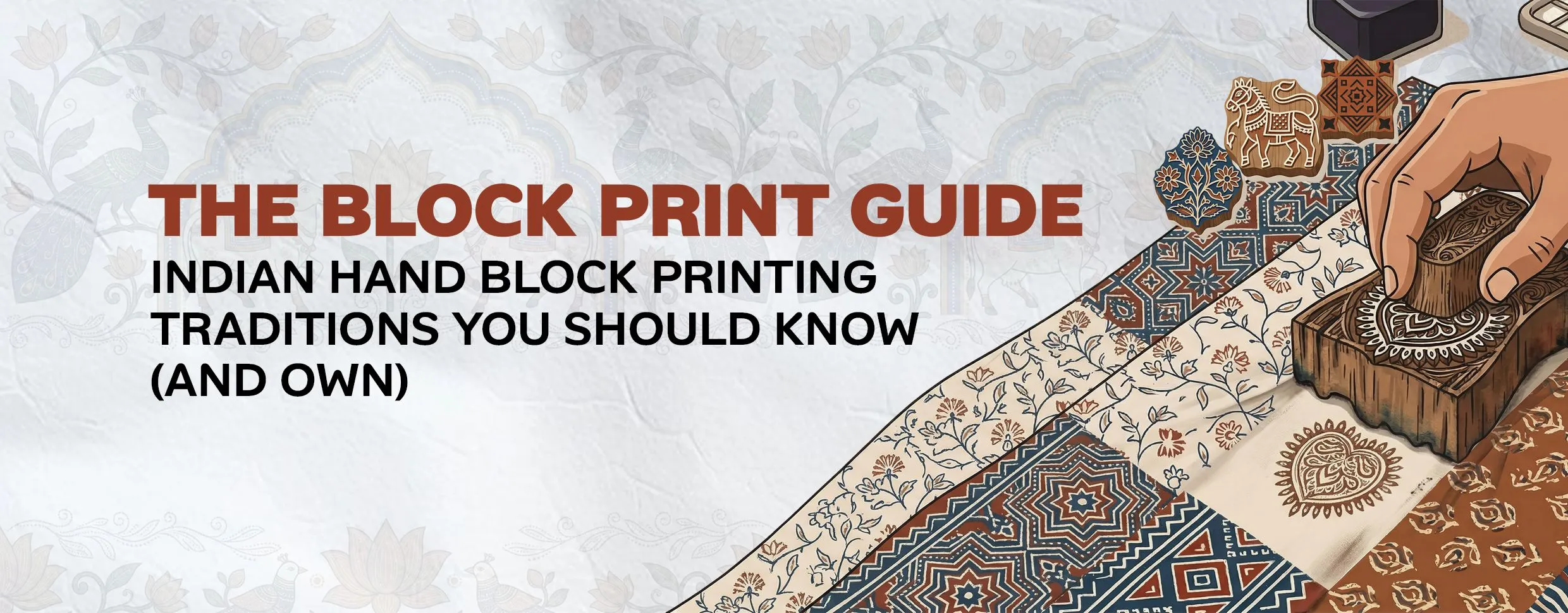
The Block Print Guide - Indian Hand Block Printing Traditions You Should Know (and Own)
From Sanganeri florals to Ajrakh geometry, explore India’s major hand block printing traditions. Learn how to identify genuine prints, care for them, and shop authentic block-printed fabrics and carved printing blocks.

Rooftop
Author
You have probably seen it without giving it much thought. A bedsheet with tiny flowers repeating in perfect rhythm. A dupatta with indigo patterns that feel hand-drawn but are surprisingly consistent. A cushion cover that looks too detailed to be machine-made, yet somehow softer and more lived-in than anything from a factory.
That is Indian hand block printing. A textile tradition that has survived over 500 years through changing tastes, industrial mills, and digital printing. It survived because it offers something machines still cannot replicate. Depth, irregularity, and character.
Behind every block-printed fabric is a slow process. Wooden blocks carved by hand. Dyes are mixed from natural ingredients. Fabric stamped one impression at a time. A single bedsheet can take hundreds or even thousands of impressions. That rhythm, repeated over generations, is what gives block-printed textiles their unmistakable look.
This guide walks you through India’s major block printing traditions, a few closely related techniques, how to identify genuine handwork, and what to look for when buying. If you have ever wondered why block-printed textiles feel different, this is where it starts.
What Makes Hand Block Printing Different from Machine Printing?
At its simplest, hand block printing is exactly what it sounds like. A carved wooden block dipped in dye and pressed onto fabric. Lift, reposition, repeat. The process is slow and precise.
Machine printing works very differently. Rotary screens and digital printers apply colour uniformly. The result is clean, consistent, and fast. But it also lacks variation.
Hand block printing leaves subtle markers. Slight overlaps. Tiny variations in colour density. Minor misalignments where blocks meet. These are not mistakes. They are proof of handwork.
Natural dyes behave differently, too. They soak into the fibres rather than sitting on the surface. This gives block-printed fabric a softer feel and a depth that improves with washing.
Once you notice these details, you start spotting the difference instantly.
India’s Major Block Printing Traditions
India’s block printing traditions developed across regions, each shaped by local materials, climate, dyes, and cultural influences. Below are some of the most recognised styles that define Indian handblock printing today.
Sanganeri: Delicate Florals from Jaipur
Sanganeri printing comes from Sanganer, near Jaipur. It is known for delicate floral motifs and fine detailing. The patterns often feature small flowers, thin vines, and repeating clusters arranged with precision.
Traditionally, Sanganeri prints used natural dyes from pomegranate, indigo, turmeric, and madder root. The whites were famously bright due to washing in local river water. While modern workshops may use a mix of dyes, the hand-printing method remains unchanged.
Sanganeri textiles feel light and airy. They work well for bedding, clothing, and home textiles. The subtle detailing makes them easy to layer into everyday spaces.
Ajrakh: Bold Geometry from Kutch
Ajrakh printing comes from the Kutch region of Gujarat. It is known for bold geometric patterns and layered dyeing processes.
Ajrakh is technically complex. A single piece may go through multiple rounds of dyeing, washing, and resist printing. Natural dyes play a central role. Indigo creates deep blues. Madder root creates reds. Iron-based dyes create blacks.
The final fabric feels rich and layered. Ajrakh improves over time. With washing, the colours soften and deepen rather than fading.
Bagru: Earthy Palette and the Dabu Technique
Bagru printing originated in Rajasthan and is known for its earthy colours and bold motifs. Reds, blacks, indigo, and mustard dominate the palette.
The defining feature is the dabu resist technique. A mud paste is applied using carved blocks. The fabric is dyed, and the paste prevents colour from reaching certain areas. Once washed, the design appears.
This creates textured prints with a distinctly handmade character.
Bagh: Natural Dye Printing from Madhya Pradesh
Bagh printing originates from Madhya Pradesh. It is known for red and black prints on white backgrounds.
The process uses natural dyes and multiple washing stages. Fabric is treated before printing to improve dye absorption. After printing, it is boiled to fix the colours permanently.
Bagh prints are bold and structured. They often feature geometric or floral motifs.
Kalamkari Block Printing
Kalamkari is often associated with hand painting, but block printing is also used in many Kalamkari traditions. The designs feature mythological scenes, animals, and floral motifs. Natural dyes and cotton fabric are common. The result is storytelling through textiles.
Leheriya: Not Block Printing, But Closely Related
Leheriya is a tie-dye technique from Rajasthan. It creates diagonal wave patterns through resist-dyeing.
While not block printing, it belongs to the same family of traditional textile crafts. Many artisans practise both techniques.
Leheriya adds movement and colour to the broader textile landscape.
What’s Available at Rooftop?
You can bring these traditions home through finished textiles or through the tools used to create them.
The Double-Sided Block Printed Cotton Comforter in Blue Floral Pattern features Sanganeri-style florals on both sides. The cotton is breathable and softens with washing.
The Hand Block Printed Kota Doriya Dupatta in Soft Pink Floral Motif combines delicate printing with lightweight Kota Doriya fabric. It is easy to wear and versatile.
If you want to try block printing yourself, carved blocks are available. The Gurjan Wood Block with Tree of Life Motif is carved using traditional methods and works on fabric, paper, and clay.
You will also find block-printed cushion covers, bedding, and fabric by the metre.
How to Identify Genuine Hand Block Printing
Start by checking the fabric's back. Genuine block printing usually shows colour penetration on both sides.
Look for slight irregularities. Tiny overlaps or shifts indicate hand printing.
Feel the fabric. Natural dye prints often feel softer.
Perfect uniformity usually means machine printing.
Care Instructions for Block-Printed Fabrics
- Wash separately for the first few washes. Some colour bleeding is normal.
- Use mild detergent and cold water.
- Avoid direct sunlight while drying.
- Iron on the reverse side.
- Hand block-printed textiles soften with time and washing.
Buying Hand Block Printing Supports Artisan Communities
Each piece involves multiple artisans. Block carvers, dyers, printers, and finishers all contribute.
Buying hand-block printed textiles supports craft traditions.
These crafts survive through demand.
Choosing hand block printing helps keep these traditions alive.
Explore hand-block-printed textiles and carved printing blocks on Rooftop!!