

Thangka Painting: History, Iconography, Significance and the Meditative Art of the Himalayas
A Thangka is not a painting of a deity but a functional instrument of Buddhist practice. A candid, in-depth guide to the history, iconography, materials, and meditative discipline of Thangka painting in Ladakh, Sikkim, and Dharamsala.

Rooftop
Author
The first time I really looked at a Thangka, I was standing in a small prayer hall at a monastery in West Sikkim during a winter afternoon when nothing much was happening. The painting hung on the side wall, framed in deep red and gold brocade, and at first glance it looked like the kind of decorative scroll you might see at any Buddhist site. Then a young monk walked in, glanced at the painting, paused for a moment with his palms together, and walked on. He had not stopped to admire it. He had used it. The Thangka, in that moment, was not on the wall to be looked at. It was a doorway.
That distinction is the entire essay you are about to read. A Thangka is not a painting of a deity. It is a functional instrument of Buddhist practice. Every decision made in its making, from the preparation of the canvas to the placement of the final gold line, is governed by a theological precision that turns the act of painting into an act of meditation, and the finished object into a tool the practitioner uses to do something specific with their mind.
Understanding what a Thangka is requires understanding what it is for, and what it is for is harder and more interesting than the souvenir-stall version of the form would suggest.
Key terms used in this blog
- Thangka: A Tibetan Buddhist scroll painting on cotton or silk, mounted with brocade and designed to be rolled up when not in use. From the Tibetan thang meaning unfurled and ka meaning painted.
- Vajrayana: The tantric branch of Mahayana Buddhism practiced across Tibet and the Himalayan region, in which visualisation of deities and mandalas is a core meditative method.
- Mandala: A geometric and cosmological diagram, often depicting the palace of a particular deity, used as a focus for visualisation practice.
- Iconometric grid: The system of precise proportions that governs the depiction of every Buddhist deity in a Thangka. Each figure must be built to specific measurements derived from scriptural sources.
- Avalokiteshvara, Tara, Vajrapani: Three of the most frequently depicted bodhisattvas, the enlightened beings who delay their own final liberation to assist others toward awakening.
The Origins and Geographic Spread of Thangka Painting
The Thangka tradition has roots that go back at least to the seventh century in the Himalayan region, with strong Newari influence from the Kathmandu valley and a parallel development inside Tibet itself. Buddhism reached Tibet in the seventh and eighth centuries, carried by Indian masters and absorbed into a local culture that already practised forms of indigenous shamanism. The scroll painting tradition that emerged from this fusion served a practical purpose. Tibetan monks, teachers, and itinerant lamas needed to travel across enormous distances of difficult terrain, and a portable painted scroll that could be rolled up and carried in a saddle bag was perfectly suited to a Buddhism on the move.
From Tibet, the form spread to wherever Tibetan Buddhism took root. In the Indian Himalayas, this means principally Ladakh, the Buddhist regions of Sikkim, Arunachal Pradesh, and Spiti, and the Tibetan diaspora communities of Dharamsala and parts of Karnataka around Bylakuppe and Mundgod where the major monastic universities have been reestablished since the 1959 exile. Each region developed variations in palette and line work while maintaining a shared iconographic foundation transmitted through scriptural texts that govern how every Buddhist deity must be depicted.
The patronage that sustained the tradition for over a millennium came from two sources. The first was the monasteries themselves, which commissioned Thangkas for their teaching halls, shrine rooms, and ritual cycles, and which trained generations of painters within their walls. The second was wealthy patrons, lamas, royal families, and merchants, who commissioned Thangkas as offerings, as merit-making acts, or as personal devotional objects. Those who commissioned thangkas supplied the materials, so the financial standing of the patron determined the quality of the pigments, the amount of gold used, and the richness of the brocade mount.
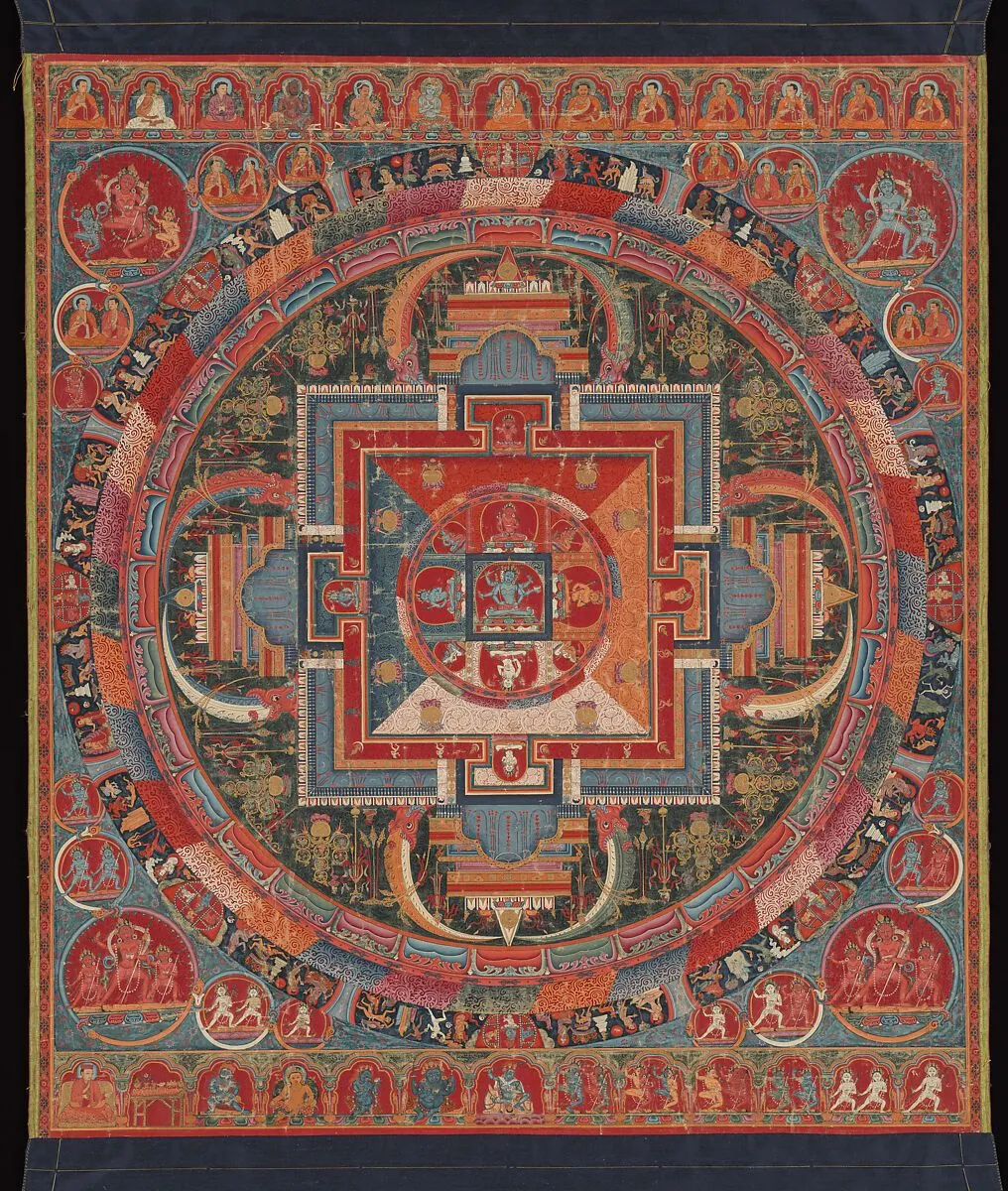
A 1375-1380 Thirteen-Deity Mandala of Jnanadakini from the Vajravali set commissioned in memory of Lama Dampa, central Tibet, Sakya tradition. Distemper on cotton, with original brocade mount. Source: The Metropolitan Museum of Art, New York
A practitioner’s note. The brocade mount around a Thangka is not just decoration. The cloth framing the painting is itself part of the consecrated object, and the proportions of the silk borders are governed by their own iconographic rules, with specific colour combinations used for specific subjects.
The Iconography of the Thangka: Deities, Mandalas, and Sacred Narratives
Open the door of a Thangka workshop in Sikkim or Dharamsala and the first thing that strikes you is the sheer specificity of the visual repertoire. Every deity has a fixed iconographic identity. The painter cannot improvise the colour, the number of arms, the hand gestures, the seat the deity rests on, or the implements held in each hand. All are fixed by scriptural sources and transmitted through painter-lineages, and to depart from them is not artistic licence. It is theological error.
The primary subjects of Thangka painting fall into a small number of recognisable categories. Meditational deities or yidams are the most numerous, including Avalokiteshvara the bodhisattva of compassion, Tara in her green and white forms representing swift action and longevity, Manjushri the bodhisattva of wisdom carrying a flaming sword and a text, Vajrapani the wrathful protector who clears obstacles, and wrathful deities like Mahakala and Yamantaka who appear in fierce forms to subdue ignorance. Each deity is associated with a specific Tibetan Buddhist sect, and the presence of particular figures in the corners or upper register indicates which monastic order commissioned the work.
Mandalas are the second great category. A mandala Thangka is a geometric diagram of a particular deity's palace, drawn in two-dimensional plan view from above, with concentric squares and circles representing the architecture, the surrounding precincts, the protective vajra wall, and the cosmic landscape in which the palace sits. The practitioner, having received the relevant initiation from a qualified lama, uses the mandala in meditation to construct a complete imagined three-dimensional palace around themselves, with each architectural feature corresponding to an aspect of enlightened mind. The painted mandala is not the meditation. It is the score the meditation is built from.
Narrative Thangkas form the third category, depicting the life of the Buddha across multiple panels, the Wheel of Life or Bhavachakra showing the realms of cyclic existence held in the jaws of Yama, lineage portraits of the great teachers of a particular tradition, and the Tibetan Medical Tangkas that depict anatomy, pharmacology, and the system of subtle energy channels. Each is a visual scripture, a way of presenting doctrinal content in a form that monks, lamas, and lay practitioners could study and meditate on directly.
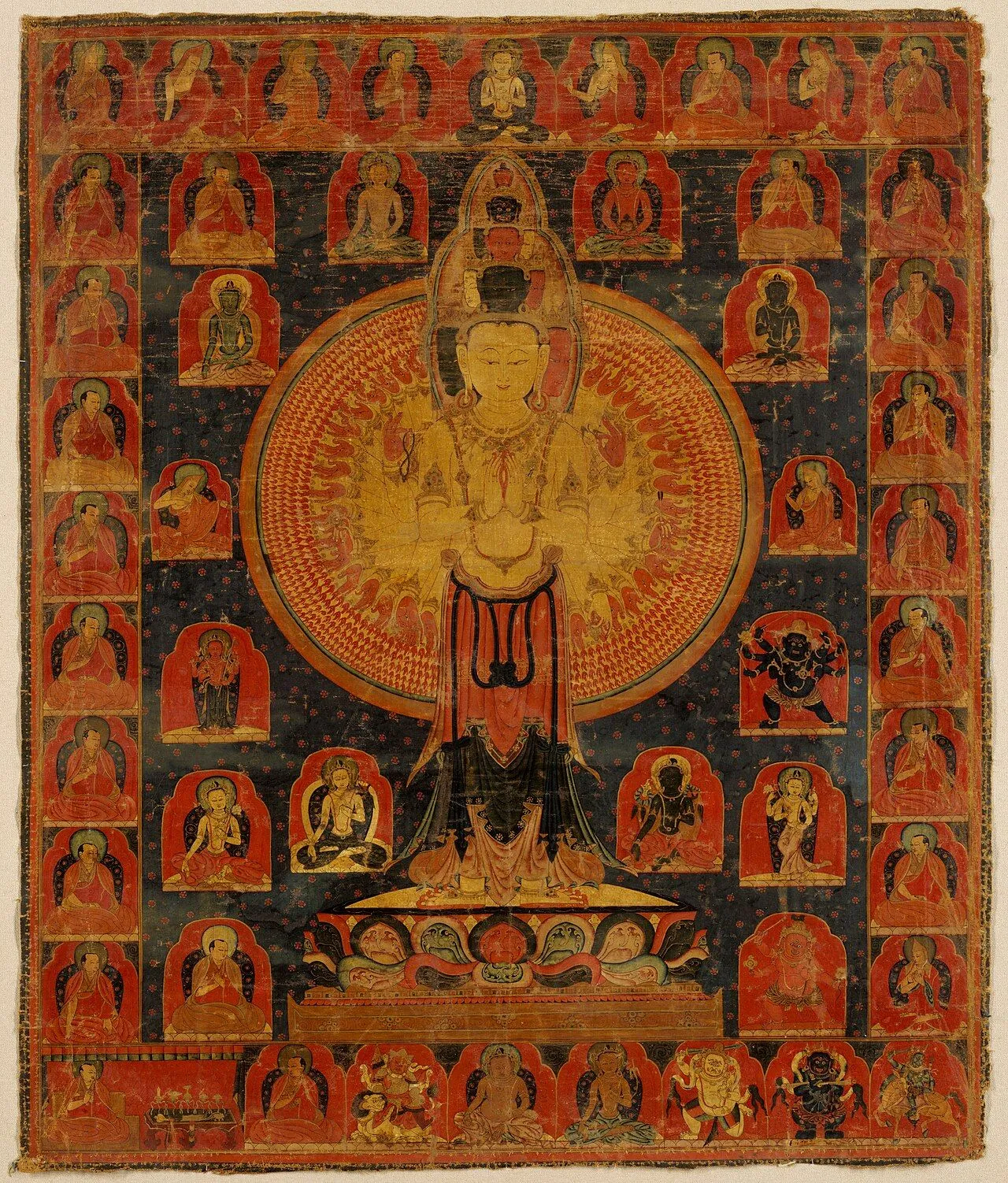
A Thangka of the thousand-armed cosmic form of Avalokiteshvara, the bodhisattva of compassion, central to Tibetan Buddhist meditative practice. Distemper and gold on cotton. Source: Wikimedia Commons

Reading the Visual Language: Proportion, Colour, and Symbolic Meaning
Every figure in a Thangka is built on an iconometric grid. Before a single line of the deity is drawn, the painter constructs a network of horizontal and vertical reference lines on the prepared canvas, with proportions derived from scriptural texts that specify how many units high the figure should be, where the eyes sit relative to the crown of the head, the width of the shoulders relative to the hips, the placement of the hands relative to the navel. These proportions are not the painter's preference. They are part of the painting's theological correctness, and a Thangka in which the proportions are off is not simply a less beautiful painting, it is a less functional one.
Colour carries equally specific meaning. Each of the five Buddha families in Vajrayana iconography is associated with a particular colour: white for Vairocana, blue for Akshobhya, yellow for Ratnasambhava, red for Amitabha, and green for Amoghasiddhi. Each colour corresponds to a particular wisdom, a particular elemental quality, a particular direction in the symbolic cosmology, and a particular psychological poison transmuted into its corresponding wisdom. A wrathful deity painted in the wrong colour scheme is, theologically, a different deity, and the painter who makes that mistake has either failed to understand the iconography or has committed an error serious enough to require the painting to be redone.
Composition encodes hierarchy. The principal deity occupies the central position, larger than any other figure on the cloth, with surrounding deities, lineage teachers, and protective figures arranged in registers and corners that indicate their relationship to the central figure. The upper register typically contains the lineage of teachers through whom the practice was transmitted. The lower register contains protective deities and the donor or commissioning figure. To read a Thangka is to read its hierarchy, its lineage, and the doctrinal tradition it belongs to, all encoded in the placement of figures and the conventions of their depiction.
A practitioner’s note. Gold is not merely decorative. In the iconographic logic of the form, gold marks what is enlightened or divine, applied to the bodies, ornaments, and architectural details of deities and palace structures. The amount of gold determined by the patron is a literal record of devotion expressed in material terms.
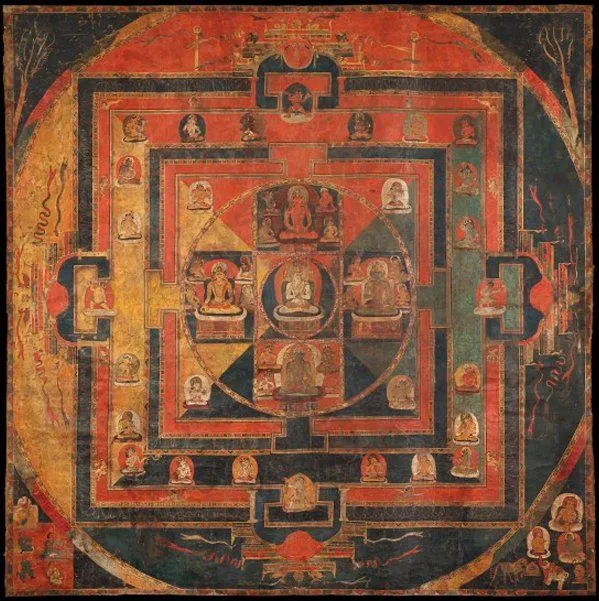
Caption: An eleventh-century Vajradhatu mandala thangka on cotton, showing the precise geometric organisation that governs the form, with concentric squares and circles structuring the cosmic palace of the deity. Source: Wikimedia Commons

8th century the approximate period when the Thangka tradition consolidated in Tibet, drawing on Newari Buddhist art from the Kathmandu valley and on the rising influence of Indian Vajrayana Buddhism, particularly the lineages associated with Nalanda and Vikramashila monastic universities.
Materials, Ground Preparation, and the Making of a Thangka
The technical process of making a Thangka is methodical and slow. A complete painting can take anywhere from several weeks to many months, and a major commissioned Thangka with detailed iconography and extensive gold work can take a year or more. The seven-stage process below is the broad outline, taught by master painters in the Sikkim, Ladakh, and Dharamsala traditions.
- STEP 1: Stretching the canvas. A length of cotton or silk is washed, then stretched onto a wooden frame using fine cord laced through holes at the edges. The cloth is held under tension throughout the painting process so the surface stays flat.
- STEP 2: Priming the ground. A mixture of chalk and animal-skin glue called gesso is rubbed into the cloth in several thin coats, each polished with a smooth stone after drying. The result is a hard, smooth surface that takes pigment cleanly without bleeding.
- STEP 3: Constructing the iconometric grid. The painter lays out the reference grid in charcoal, marking centre lines, proportional units, and the placement of the principal deity. This is the stage at which an error costs the most, and senior painters often supervise junior painters here.
- STEP 4: Underdrawing. Using a fine brush and dilute ink, the painter draws the principal figures on top of the grid, working from the central deity outward. There is no overpainting in the traditional method, so the line drawn at this stage will eventually be the line under the final paint.
- STEP 5: Colour from background to foreground. Mineral pigments ground from lapis lazuli for blue, malachite for green, cinnabar for red, orpiment for yellow, and other natural materials are mixed with animal-glue binder and applied in flat washes, starting from the sky and landscape behind the figures and working forward to the figures themselves.
- STEP 6: Shading and detailing. Subtle tonal modelling is applied to the figures, robes, and ornaments. Fine line work is added to crown jewellery, lotus petals, and the textures of clouds and rocks. This is the slowest stage and often takes the largest portion of the total time.
- STEP 7: Faces, eyes, and final gold. The faces of the central deities are completed last. The eyes are painted in a single concentrated session, often accompanied by ritual purification of the workshop. Gold is applied to the body, ornaments, crown, and sacred symbols. The painting is then formally consecrated by a lama before it can be used in practice.
The Painter’s Discipline: Training, Ritual Preparation, and the Ethics of Making
Becoming a Thangka painter in the traditional system takes years. A student typically begins as a child or young adolescent in a workshop attached to a monastery or run by a master painter. The first several years are spent learning to grind pigments, prepare canvases, and copy the iconometric grids for hundreds of different deity forms. Only after the student has internalised the iconometry, the colour symbolism, the iconographic conventions, and the basic technical methods are they permitted to begin painting deity figures themselves. A student does not paint the face of a major deity until they are ready, and what ready means is something only the master painter is qualified to judge.
Before each session of painting, the practitioner is expected to perform certain preparations. The workshop is cleaned. The painter washes, often takes vows of abstinence for the duration of a major commission, and may recite prayers or mantras associated with the deity being painted. The time of day at which certain features are painted carries ritual significance, particularly for the most sacred elements like the eyes of the central deity, completed only after specific ritual purifications.
A practitioner’s note. In the most traditional understanding, a Thangka painter does not become qualified to paint by skill alone. The painter must also undertake the practices associated with the deity being painted, so that the qualities the painting embodies are also being cultivated in the painter’s own mind. The painting and the painter are meant to develop together.
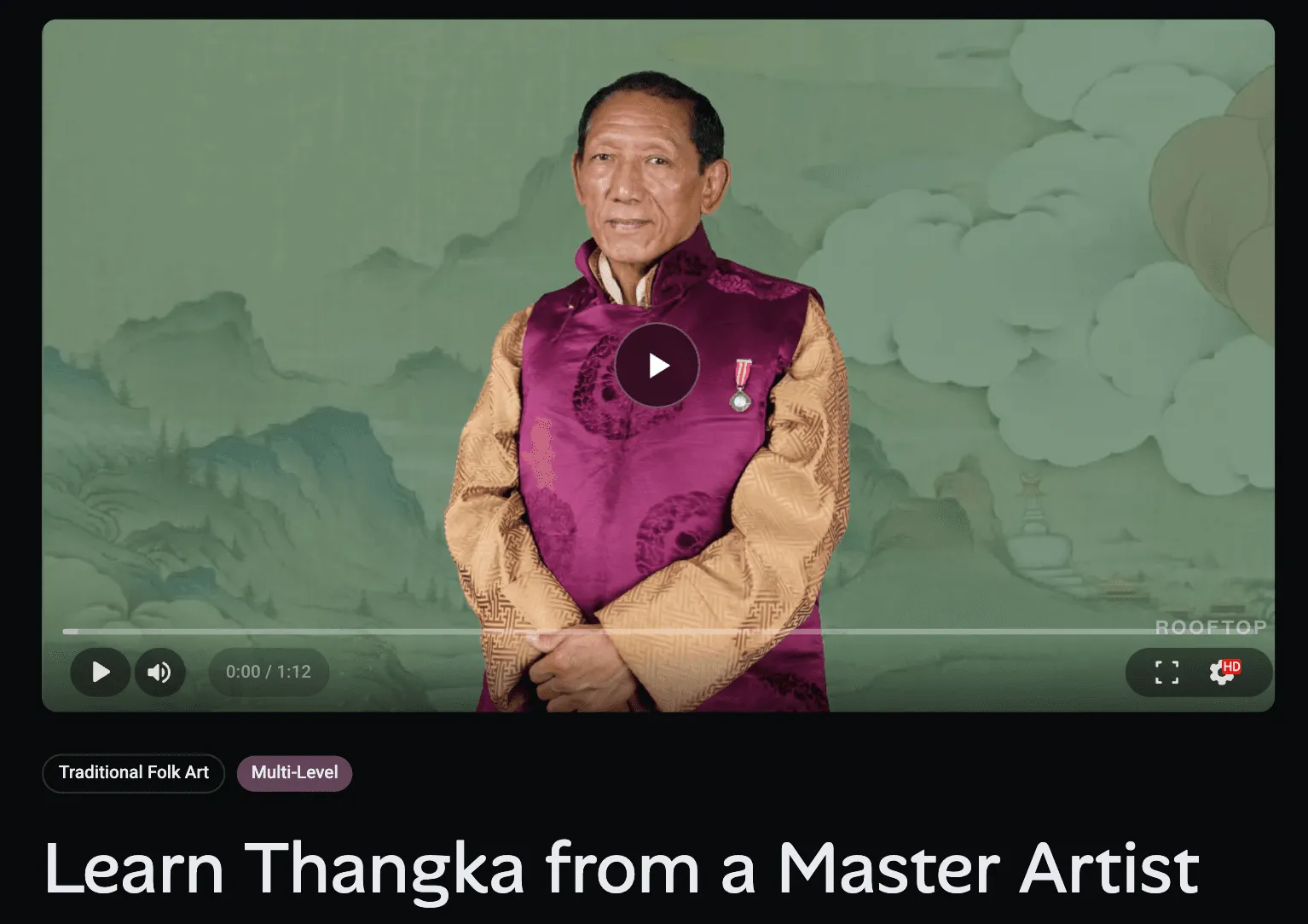
This is why the Thangka tradition insists that the quality of the painter’s mind and practice is as important as the quality of their brushwork. Khandu Wangchuk Bhutia, born in Sakyong in West Sikkim in 1959 and ordained at Pemayangtse Monastery, trained under Dungzin Rimpoche, the late Jigme Wangchuk Lama, Phuntsok Sangpo, and Zapa Acho before establishing his own practice. He received the Padma Shri in 2022 in recognition of his work as an eminent Thangka painter from Sikkim specialising in traditional Buddhist paintings on cotton and silk. He has trained over 350 students at his Kanchendzonga Handicrafts Centre in Namchi, and one of them, Yeshey Zangpo Bhutia of Pelling, won the National Award in 2008. The chain of teachers and students is itself part of how the tradition transmits.
Thangka Painting in Contemporary India and the Question of Authenticity
Practicing Thangka painters in India today work in a handful of geographical concentrations. Sikkim, particularly around Pemayangtse Monastery and Namchi where Bhutia and his students teach, is one major centre. Ladakh, where monasteries like Hemis, Thiksey, and Alchi maintain active painting traditions, is another. Dharamsala in Himachal Pradesh, home to the Tibetan government-in-exile since 1959 and to the Thangde Gatsal Thangka Studio established by Master Locho and Sarika Singh in 2001, has become one of the most important Thangka-painting centres in the broader Tibetan exile world, with the Himalayan Art Museum founded by the same couple in 2019 dedicated to contextualising contemporary work within the longer tradition.
The honest difficulty of the contemporary moment is the question of authenticity. The Thangka tradition exists today in two parallel registers. One is the living tradition of trained painters working within full monastic, iconographic, and ritual discipline, producing Thangkas for use in Buddhist practice and for collectors who understand what they are receiving. The other is the tourist-trade Thangka, mass-produced on cheap canvas with industrial pigments, often outsourced to workshops that have minimal training in iconography and no ritual context. Both register as Thangkas in casual usage. They are not the same object.
Telling the difference takes some attention. The materials are the first clue: a traditional Thangka uses mineral pigments and real gold, both visible on close inspection. The line work is the second: in an authentic painting, the iconometric proportions are exact and the line is confident and unbroken. The brocade mount is the third: a serious Thangka comes with a proportional silk brocade in colours that match the iconography. And the fourth and most important is the painter. Knowing who painted the work, where they trained, and what their relationship to the tradition is, makes the difference between an object you have bought and an object you have actually been given access to.
Rooftop’s directory of practising master artists, which includes Khandu Wangchuk Bhutia with 45 years of working experience and five awards, connects buyers and learners directly with painters who carry the full living tradition. The 18.5-hour Thangka Maestro Course taught by Bhutia covers the lineage history, the technical foundations, the iconography, and the religious context within which the painting actually functions.
For collectors, authentic Thangka paintings by trained painters working within the living Himalayan Buddhist tradition carry the full weight of what the form was made to carry. They are functional instruments of a contemplative practice, made by practitioners for practitioners, and bringing one into a home is, properly understood, taking on the responsibility of treating it the way the tradition treats it.
Approaching a Thangka
Return for a moment to the small prayer hall in West Sikkim. The young monk who walked through, paused in front of the painting, and walked on, was doing something the Thangka was designed to support. He was using the painting as the kind of doorway it was intended to be. The painting was not his audience and he was not the painting’s audience. They were two parts of a single contemplative system, working together in a way that has nothing to do with the painting being beautiful and everything to do with the painting being correct.
That is the orientation worth bringing to any Thangka, whether you encounter one in a monastery, in a museum, in a teacher’s home, or on your own wall. The question is not whether the painting is pleasing to look at. The question is whether the painting was made the way the tradition makes them. Whether the painter trained in the lineage. Whether the iconometric proportions are right. Whether, in the most basic sense, the painting will do what a Thangka is for. The form, at its best, is one of the most disciplined and one of the most ethically demanding visual traditions anywhere in the world. The painters who carry it deserve to be met on its terms, not on the terms of the souvenir trade.