

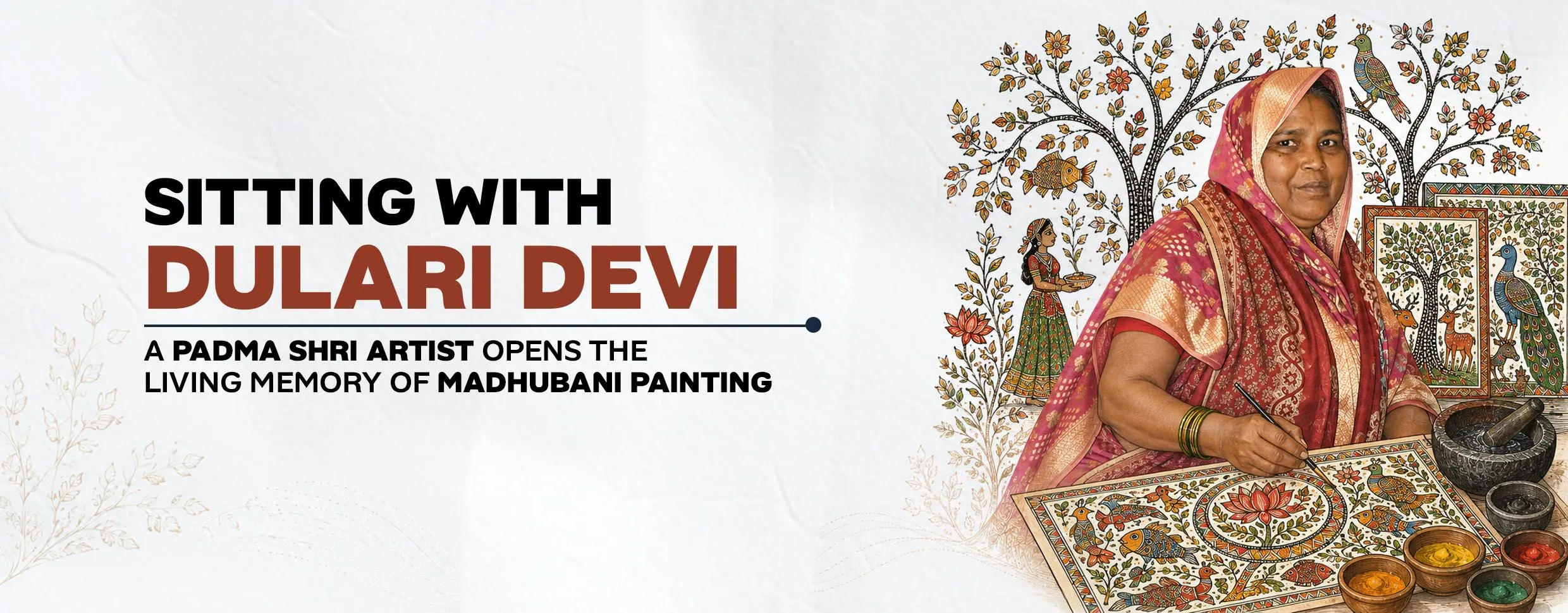
Sitting With Dulari Devi: A Padma Shri Artist Opens the Living Memory of Madhubani Painting
Padma Shri Dulari Devi on Madhubani painting history, the five styles, kohbar symbolism, Naina Jogin, aripan and natural colours, in a rare in-depth interview.

Rooftop
Author
This piece is drawn from a long conversation Rooftop recorded with Padma Shri Dulari Devi in Hindi and Maithili. Her answers have been translated and lightly edited for clarity. Everything she describes here, the caste histories of the styles, the reading of the kohbar, the songs, the colours, comes from her own memory of a tradition she has lived inside for five decades.
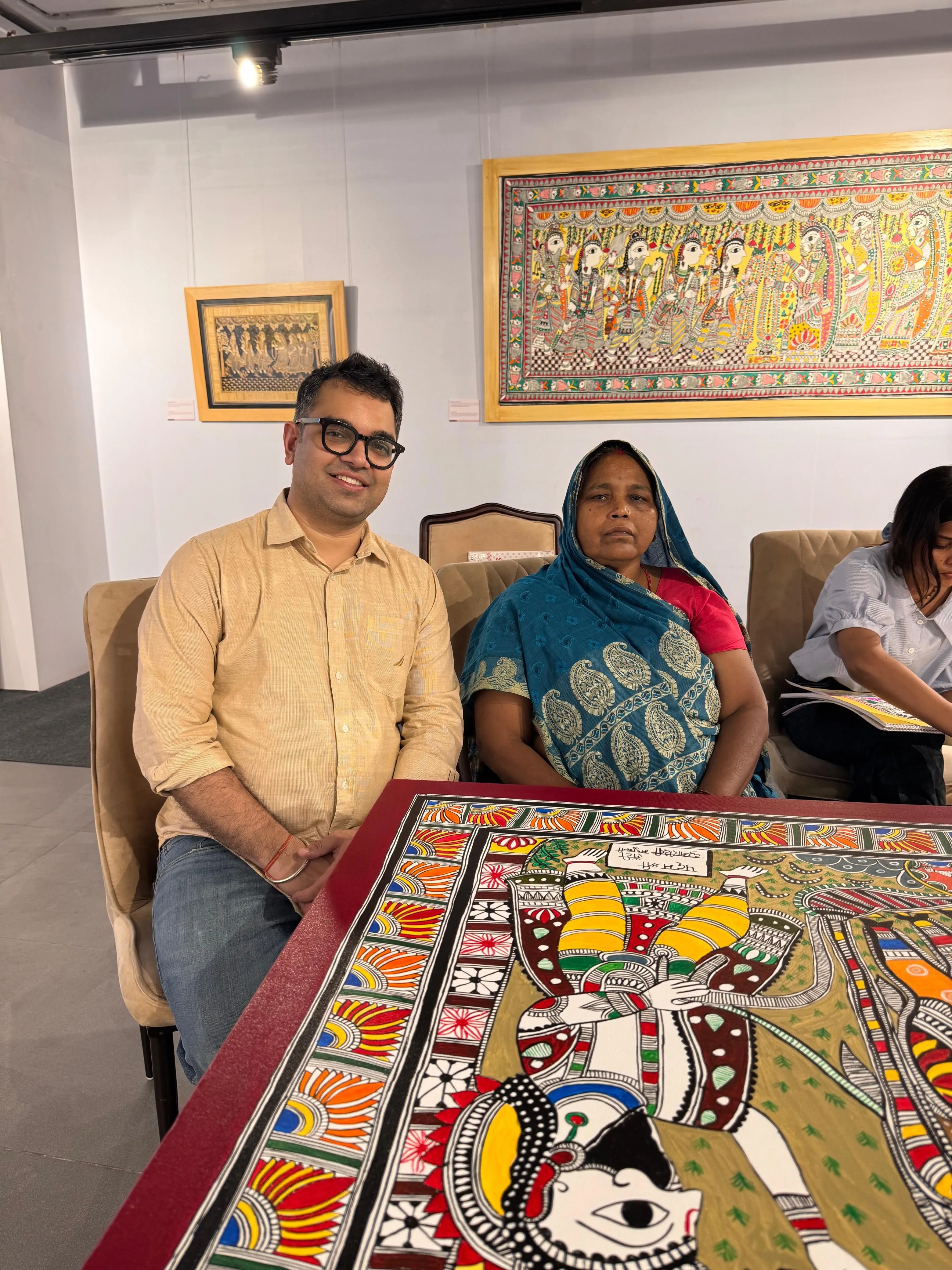
Rooftop's Founder Kartik Gaggar with Padma Shree Dulari Devi Ji
There is a version of Dulari Devi's story that fits in one sentence, and it is already famous. A woman from the Mallah fishing community, married at twelve, widowed of her only child, unable to read or write, washed dishes in the household of a great Madhubani artist for a hundred rupees a month, learned by watching, and in 2021 received the Padma Shri from the President of India. That sentence is true, and it is the least interesting thing about her.
The more interesting thing becomes clear within minutes of sitting down with her. Dulari Devi is not only a painter. She is a walking archive of Madhubani painting, one of the last people alive who learned the tradition inside the households where its modern history was made, in the village of Ranti in Bihar's Madhubani district. Ask her a question about a motif and you do not get an answer. You get a song, a ritual, a caste history and a memory of her teachers, all braided together, because in her head they were never separate things. What follows is that archive, opened.
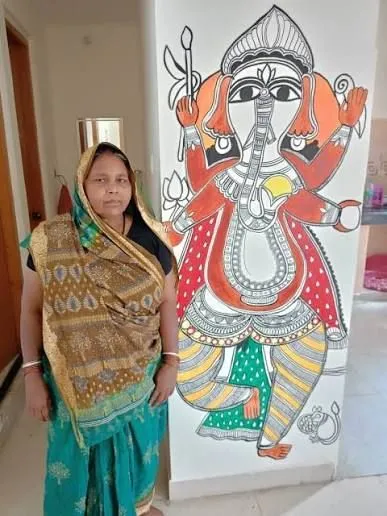
Padma Shri Dulari Devi, who learned Madhubani painting in the household where she once washed dishes.
Two Villages, Two Teachers, One Lineage
Every conversation about Madhubani painting eventually arrives at two villages a few kilometres apart, Ranti and Jitwarpur, and Dulari Devi belongs body and soul to the first. Ranti is the village of Mahasundari Devi, the legend who broke purdah in 1961 to paint publicly, founded a cooperative for Mithila's artists, and received the Padma Shri in 2011. It is also the village of Karpuri Devi, Mahasundari's sister-in-law, a master in her own right. The two women were jethani and devrani, wives of brothers in one household, and it was in their home that a young domestic worker named Dulari first held a brush.
ROOFTOP: You worked in the household of Karpuri ji and Mahasundari ji. What did that actually look like?
DULARI DEVI: I did the chauka bartan, the dishes, at Mahasundari Devi's house for a hundred rupees a month. Dai ji would give me four rotis. We lived in great poverty. I took that money and went for training. Everything I learned, I learned watching those two. Whatever they made, that is what I make.
She maps the lineage of that household from memory, and it is a map of modern Madhubani itself. Mahasundari Devi's three daughters-in-law, Vibha, Abha and Runa, all paint. Her granddaughter Pushpa Kumari, the daughter of her daughter, learned at her grandmother's side and now works in a style Dulari describes as her own thing, older motifs handled in a newer way. Across the fields in Jitwarpur sit the other great names, Sita Devi, Baua Devi, Godavari Dutta. And behind all of them stands Jagdamba Devi, the first Mithila painter honoured with the Padma Shri, an award that came in 1975 and opened the door every artist since has walked through.
When she talks about the present, the defensiveness that outsiders sometimes expect is simply not there. Asked whether the tradition is thinning, she laughs the question off. The Mithila Chitrakala Sansthan now runs certificate and degree courses, and she notes with obvious pride that a recent three-year degree batch graduated around fifty students. Artists are not scarce, she says. Come to Bihar, stay a week, wander Ranti and Jitwarpur, and then tell me where the artists have gone.
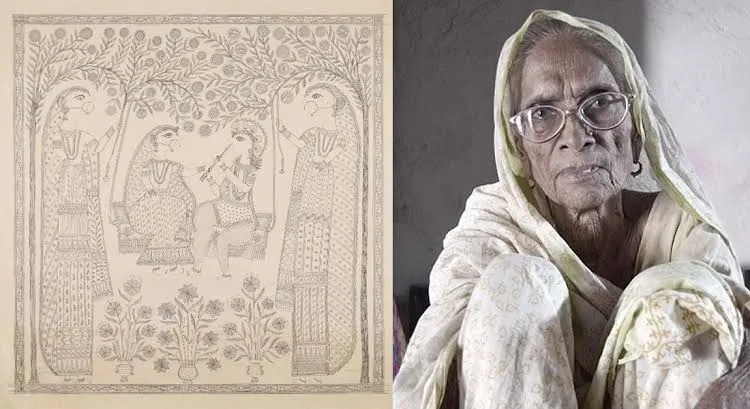
Mahasundari Devi of Ranti, who left purdah in 1961 and taught a generation, including the young Dulari.
Five Styles, and the Caste Lines Between Them
Textbooks list Madhubani's five styles in a tidy row, Bharni, Kachni, Tantrik, Godna and Kohbar, as though they were flavours on a menu. Dulari Devi's account is far less tidy and far more honest, because in her telling the styles are not aesthetic choices. They are social history, drawn along the caste lines of old Mithila.
ROOFTOP: What is the real difference between Bharni, Kachni, Tantrik, Godna and Kohbar? Did particular communities paint particular styles?
DULARI DEVI: The Kayastha and the Brahmin each have their own path. It is not one thing. In a Kayastha kohbar the snake is given, the kauch, everything. In a Brahmin kohbar the snake is not given. The fish is given, the sun and moon are given. Every community has its own riti riwaz, its own way.
ROOFTOP: And Godna? Who painted that?
DULARI DEVI: Godna, people used to say everyone made it, and they did. The communities who paint it tell the story of Raja Salhesa. They would not do Bharni and Kachni. Bharni and Kachni had a different rutba, a different standing. The bright colours, the chatak rang, those were not given to us.
That last sentence lands hard, and it should. The colour-filled Bharni style and the fine-lined Kachni belonged historically to Brahmin and Kayastha women. Godna, built from the geometry of tattoo patterns, grew among the Dusadh community, whose painters carried the epic of Raja Salhesa, a folk hero the upper-caste repertoire never touched. And communities like Dulari's own were, for generations, simply outside the frame. When she says the bright colours were not given to us, she is describing a hierarchy of pigment, a world in which even colour was rationed by birth. Part of what makes her Padma Shri historic is that she crossed that line, mastering both Kachni and Bharni from inside a household that chose to teach her.
She recites the Kachni lineage the way other people recite family trees. Ganga Devi first, the great mistress of the line. Then Mahasundari Devi and Godavari Dutta. Then Pushpa, who learned from her grandmother. She mentions the celebrated Santosh Kumar Das as an artist who takes Kachni somewhere personal, folding new things into old, a little of this era and a little of the last. There is no jealousy in the observation. In her world, style is inheritance, and she can tell you exactly who left what to whom.
How to Read a Kohbar
The kohbar is the ritual heart of Mithila painting, the dense wedding mural made for the kohbar ghar, the nuptial chamber where a newly married couple spends their first days. To an outsider it reads as a beautiful tangle of lotus leaves, bamboo, fish, birds and figures. To Dulari Devi it reads like a sentence, and she can parse every word of it.
ROOFTOP: The puren, the lotus, that appears in every kohbar. What is it doing there?
DULARI DEVI: It is in the songs. The song says your mother wants the leaves of the lotus, your brother wants the shoots of the bamboo, your husband wants the lotus flower. The lotus is the fertility side, the side of the mother. At the wedding, the same sindoor is applied. It has all come down from Puran times, from the old stories.
ROOFTOP: And the four creatures, the fish, the parrot, the tortoise and the snake. Why are they given in the kohbar?
DULARI DEVI: The kohbar belongs to Vishnu Bhagwan. The fish is Vishnu, his matsya form. The fish is shubh, auspicious. Where there is no fish, things become thehar, stopped, stuck. So the fish is given in everything. In the paag, in the kohbar, in the dasavatar. The parrot is Sita ji's bird, the one she kept and called by her daughter's name. The tortoise is Vishnu again, the kachhua form. Everything on this earth rests on the tortoise, man, bird, beast, snake, all of it lives on his back.
Scholars have written entire chapters trying to decode this iconography, and here it is, delivered in three breaths by someone who absorbed it as songs before she ever thought of it as symbolism. The lotus stands for the feminine line and fertility, the bamboo for the male lineage, and the two are painted intertwined because a marriage is exactly that. The fish, parrot, tortoise and snake are not decoration but blessings, each one auspicious, each one anchored to a story, and their presence or absence shifts by community, snake for the Kayastha kohbar, fish and the sun and moon for the Brahmin one. The couple then lives with this painted blessing, traditionally staying in the kohbar ghar for the four days ending in the chaturthi rite, when the sindoor is worshipped and the marriage is sealed.
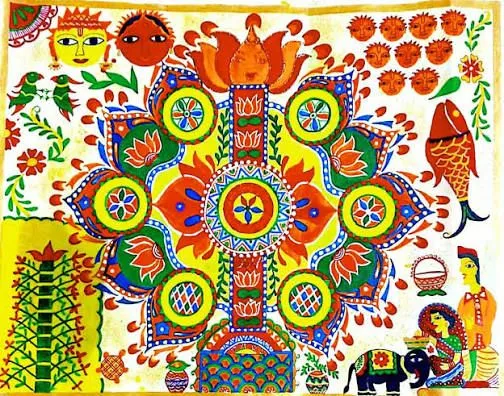
A Madhubani kohbar composition dense with lotus, bamboo, fish and birds
The Naina Jogin, Guardians at the Corners
Ask about the Naina Jogin, the mysterious female figures with enormous eyes who stand at the corners of a kohbar, and Dulari Devi does not give you an art-historical answer. She gives you the wedding itself.
ROOFTOP: What is the Naina Jogin's role, and why are her eyes so important?
DULARI DEVI: When the groom first enters at the wedding, after the parichhan, the Naina Jogin stand at the four corners. There is a song for it. The women sing to the labra, the son-in-law, they tease him, they give playful gaari to his mother and his kin. And the Naina Jogin takes away the nazar. She removes the evil eye. She stands there to protect.
ROOFTOP: So she is protecting the groom?
DULARI DEVI: She protects the couple. She stands like a guard at the corners so that nothing crooked can enter. That is her work. It is a Kayastha and Brahmin tradition, the songs and the teasing. Ours is different.
It is a startlingly complete little institution. The Naina Jogin is at once a painted figure, a ritual function and a piece of theatre. Her exaggerated eyes are the point, eyes wide enough to absorb any malicious glance aimed at the vulnerable new couple. Around her, the wedding songs do the same protective work socially, roasting the groom with affectionate insult so that no one else's envy can touch him. The painting and the singing are two halves of one machine, and Dulari Devi, who cannot read the scholarship about either, can operate the whole machine from memory.
Aripan: The Painting Under Your Feet
Long before Mithila's images climbed onto walls, and long before they migrated to paper, they were drawn on the ground. The aripan, Mithila's cousin of the alpana and the rangoli, is a floor diagram made with pithar, a paste of ground rice and water, laid down by hand for specific rites on specific days. Dulari Devi treats it as the root of everything.
ROOFTOP: What exactly is aripan, and how is it different from the wall painting?
DULARI DEVI: Aripan comes down through parampara, through tradition. It is bhumi chitra, earth drawing. The Vishnu alpana is made below, on the ground, and the puja happens on it. From bhumi chitra it went to bhitti chitra, the wall. From the wall it went to canvas, paper, saree, everything.
ROOFTOP: Is there a different aripan for different occasions?
DULARI DEVI: For all twelve months there are different aripans. Dev Uthan Ekadashi has its own bhumi chitra, when the god wakes. Diwali has its alpana, Chaurchan has its own, the chaturthi has its own, Bhaiya Dooj has its own. Sama Chakeva is not a vrat, it is Bhaiya Dooj, you celebrate the brother, you sing, you feast. Chhath is the great one, the whole world does Chhath puja for the Sun. We know which aripan belongs to which day. The elders told us, and that is how we learned, and now we teach the children.
What she is describing is a ritual calendar written in rice paste, twelve months of festivals each with its own prescribed geometry, from the waking of Vishnu at Dev Uthan Ekadashi to the sun worship of Chhath and the brother-sister feast of Sama Chakeva. She keeps sketchbooks of them all, every design recorded in her own hand, and says so with the firmness of an archivist. Come to Bihar, she says, and I will show you the sketches, every pattern, every implement, down to what a paati is, the writing slate the old teachers used, because the children no longer know the words.
On the question everyone asks, whether the move to paper killed the tradition, she is almost amused. Aripan is not finished, she insists. It has expanded across the world. First there were five artists, then ten, then twenty, growing the way a family grows. The floor drawing did not die when it climbed onto paper. It multiplied.
From five artists to a global tradition
Dulari Devi remembers a time when a handful of painters carried the art commercially. Today the Mithila Chitrakala Sansthan runs certificate and degree programmes, a recent three-year batch graduated around fifty students, and she herself teaches at the Mithila Art Institute, a tradition growing, in her words, the way a family grows.
Wall Versus Paper, and What Fear Has to Do With It
Because she came up painting on mud walls and now works across paper, canvas and cloth, Dulari Devi is one of the few people who can compare the surfaces from lived experience. Her answer to which motifs survive the journey is unexpected, because for her the difference is not in the motifs at all. It is in the nerve.
ROOFTOP: Which composition works on the wall but cannot come to paper? And which one became easier on paper?
DULARI DEVI: Nothing is impossible. Everything can be made on paper, everything can be made on the wall. But not everyone can run a brush on the wall. On paper the children sketch first, rubbing and erasing, learning with the rubber. The wall is direct. You must think first about how you will make it. There is fear in it. On paper there is no fear, only a little more time.
The wall, in other words, is the tradition's real examination. There is no pencil stage and no eraser, only a loaded brush, a prepared surface and a composition that must be held complete in the head before the first stroke. She mentions, with a hostess's pride, that a visiting interviewer from Delhi once painted a fish on the wall of her house and did it beautifully, and that her own home wall stands deliberately part-finished, a living work in progress. The children at the institute sketch brilliantly on paper, she says, better than brilliant. The wall is where they will learn what their grandmothers knew, which is how to be certain.
The same certainty applies to subject matter. She cannot read the Ramayana, and says so plainly. Then she explains that she paints the Sundar Kand and the Ayodhya Kand by watching and listening, the epic absorbed whole through recitation and song. Literacy, in her tradition, was never the price of knowledge.
The Colours She Still Grinds by Hand
If one part of the conversation should be preserved for the record, it is her account of the natural palette, because she does not list the colours from a book. She lists them from the kitchen, the hedgerow and the puja shelf, exactly as she watched her chachi dai, Karpuri Devi, prepare them half a century ago.
ROOFTOP: Where did the natural pigments come from, in the old days?
DULARI DEVI: Soot and kajal for the black. Chachi dai made the colours from flowers and leaves, and we stayed beside her and watched. The wet paste of haldi for yellow. The colour of the bougainvillea flower. Sindoor for red. The kusum flower. The leaves of the seem bean for green, ground on the silaut and lorhi, the grinding stone. Gum, the gond, to bind it. A wash of gobar, cow dung, for the ground.
ROOFTOP: And you still work this way?
DULARI DEVI: A hundred artists went for the phulpatti workshop at the Bihar Museum, the flower and leaf colours. I carried it all from the village. Seem leaves, haldi, sindoor, gum, the silaut and lorhi, even a basket of gobar. And there we taught all of them.
Picture that scene for a moment. India's newest museum, glass and climate control, and an artist arriving from Ranti with turmeric, bean leaves, vermilion, tree gum, a grinding stone and cow dung, then teaching a hundred trained artists how colour was made before art shops existed. It is the entire story of Madhubani painting in a single image, the village supplying what the institution cannot, memory.
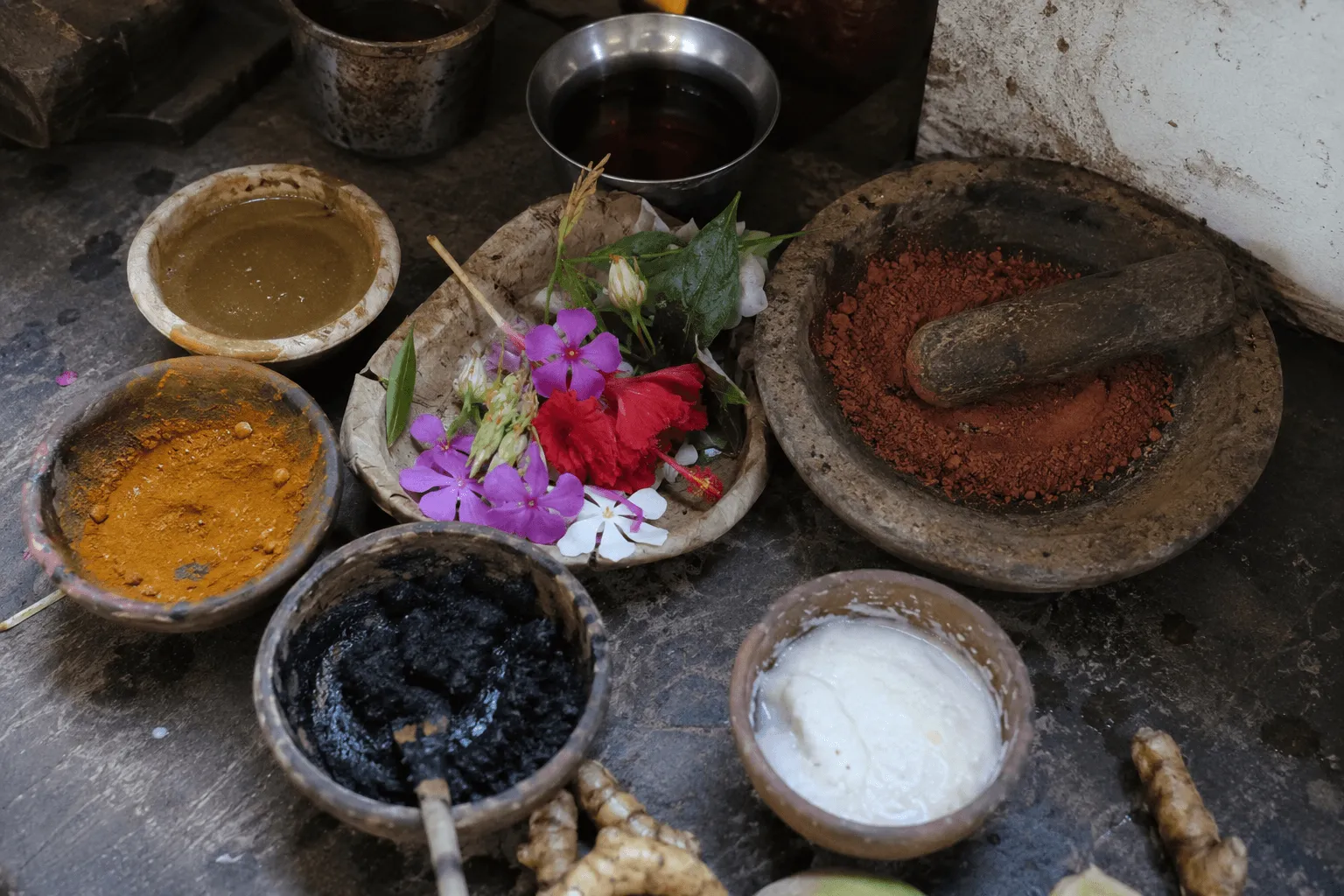
Turmeric, soot, flower extracts and rice paste, the hand-ground palette Dulari Devi still teaches.
This is also, remarkably, knowledge you can now learn from her directly. Rooftop's Madhubani Maestro course taught by Dulari Devi runs about ten hours across skill levels, with Dulari ji herself teaching the borders, the outlining, the colour logic and the festival themes, including a painting built around Chhath puja, the great sun festival she names as Mithila's most beloved.
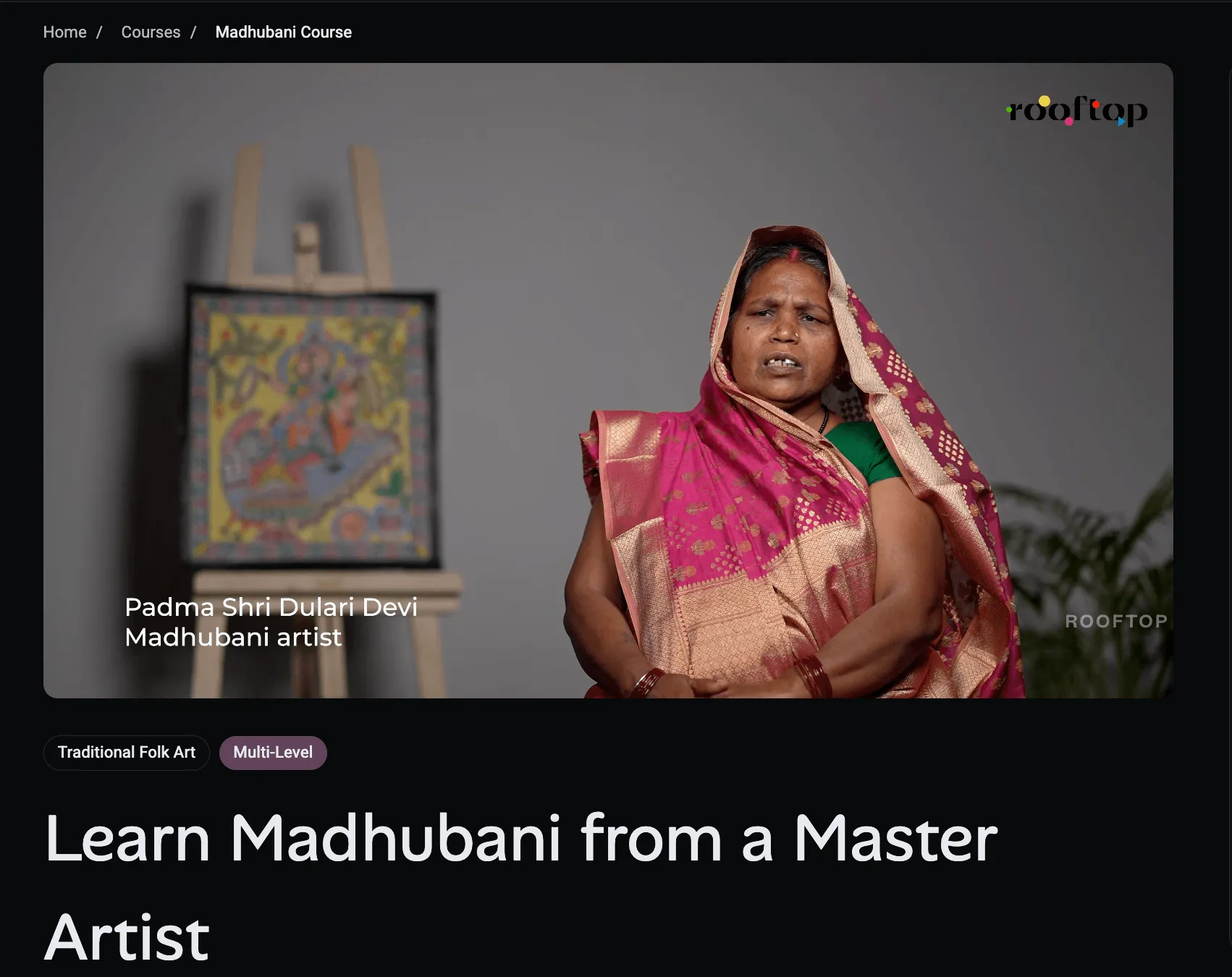
Madhubani Art Course with Padma Shri Dulari Devi, a multi-level maestro course on Rooftop. View on Rooftop
From Women's Walls to the World's Market
The transcript of our conversation carries one exchange that historians of the art form will recognise instantly, because it compresses the great transformation of Mithila painting into a few plain sentences.
ROOFTOP: This was a women's art. The walls were painted by women. How did men come to dominate it?
DULARI DEVI: When the market came, the men began. In the market they carry it, they sell it. At home the women made it. The men did not make it at home. The market made the men painters.
The history behind her shorthand is well documented. For centuries the painting lived on interior walls, made by women for weddings and festivals, invisible and unsold. After the terrible Bihar drought of the 1960s, the All India Handicrafts Board began encouraging Mithila's women to move their wall art onto paper so that it could earn, and a domestic ritual became a livelihood. Money changed who painted. Men entered a tradition their mothers owned, and today some of its biggest commercial names are male. Dulari Devi reports this without bitterness, the way she reports everything, as a fact of how the world moved. She was a child during the drought years and remembers nothing of the relief efforts, only that by the time she began working in Mahasundari Devi's house, painting had already become work that could feed a family.
Her own arc completes the story. The first canvas she ever sold went for five rupees. Her illustrated autobiography, Following My Paint Brush, made with the writer Gita Wolf, travelled the world. Her painting of the Prime Minister arriving by helicopter hung in the Asian Art Museum in San Francisco in 2018, in an exhibition whose very title, Painting Is My Everything, was taken from her own words. Princeton University acquired her lockdown paintings documenting the pandemic in her village. And in 2021 the girl who was paid a hundred rupees a month to wash dishes received the Padma Shri, the third for tiny Ranti alone, after Mahasundari Devi and before, she hopes, whoever is watching an aunt paint right now.
Why This Conversation Matters
Near the end, we asked what she would paint with her teachers if Karpuri Devi and Mahasundari Devi were alive today. Her answer was immediate. Everything, she said, and we would begin from the beginning. It is the answer of someone who understands that a tradition is not a style to be preserved under glass but a conversation between generations, and that her role now is the one her teachers once played for a hungry girl doing the dishes.
Almost nothing in this interview exists in the books, the caste map of the kohbar's animals, the Naina Jogin's corner post, the aripan calendar, the basket of cow dung carried into the Bihar Museum. It lives in Dulari Devi, and in the students she teaches, and now, a little, on this page. If it has made you want to go closer, her artist profile on Rooftop holds her story, and the fuller account of her journey sits in Rooftop's spotlight on her life and work.
And if you want to meet the tradition itself rather than only read about it, the paintings are the door. Rooftop's Madhubani collection carries original works in the styles this conversation walked through, each with its artist named, which, as Dulari Devi's whole life argues, is where the meaning of this art has always lived, in the person holding the brush.