
Pattachitra Paintings
Pattachitra Paintings Are Made on Cloth Treated with Chalk and Tamarind: Here Is Why That Changes Everything
Discover the sacred stories behind Pattachitra, Odisha’s intricate cloth painting tradition, and learn how its artists prepare canvases, create natural pigments, and preserve centuries-old techniques.

Rooftop
Author
When you look at a Pattachitra painting, your eyes are naturally drawn to its intricate figures, fine lines, and vivid colours. You might notice the deities at the centre, the stories unfolding around them, or the decorative borders that frame the composition. But long before any of these details take shape, the artist has another task to complete. The cloth on which the painting will be made must first be prepared by hand, through a process that takes time, patience, and considerable skill. Pattachitra, a traditional painting form associated with Odisha, carries a history closely connected with religious storytelling and devotion. Its name comes from the Sanskrit words patta, meaning cloth, and chitra, meaning picture.
However, the cloth is much more than a surface on which an image is drawn. It is carefully treated and smoothed until it can hold the fine lines and layers of colour that give the painting its distinctive character. The finished work depends as much on this preparation as it does on the artist's hand. Think about the care that goes into making something before anyone else even gets to see it. The hours spent preparing the cloth may never be noticed by someone admiring the finished painting, but they are part of what makes that painting possible. In Pattachitra, the act of creating begins well before the first deity or decorative motif appears. It begins with the artist preparing the material, working with it until it is ready to carry a story that has been told and retold across generations.
How a Simple Piece of Cloth Becomes a Pattachitra Canvas
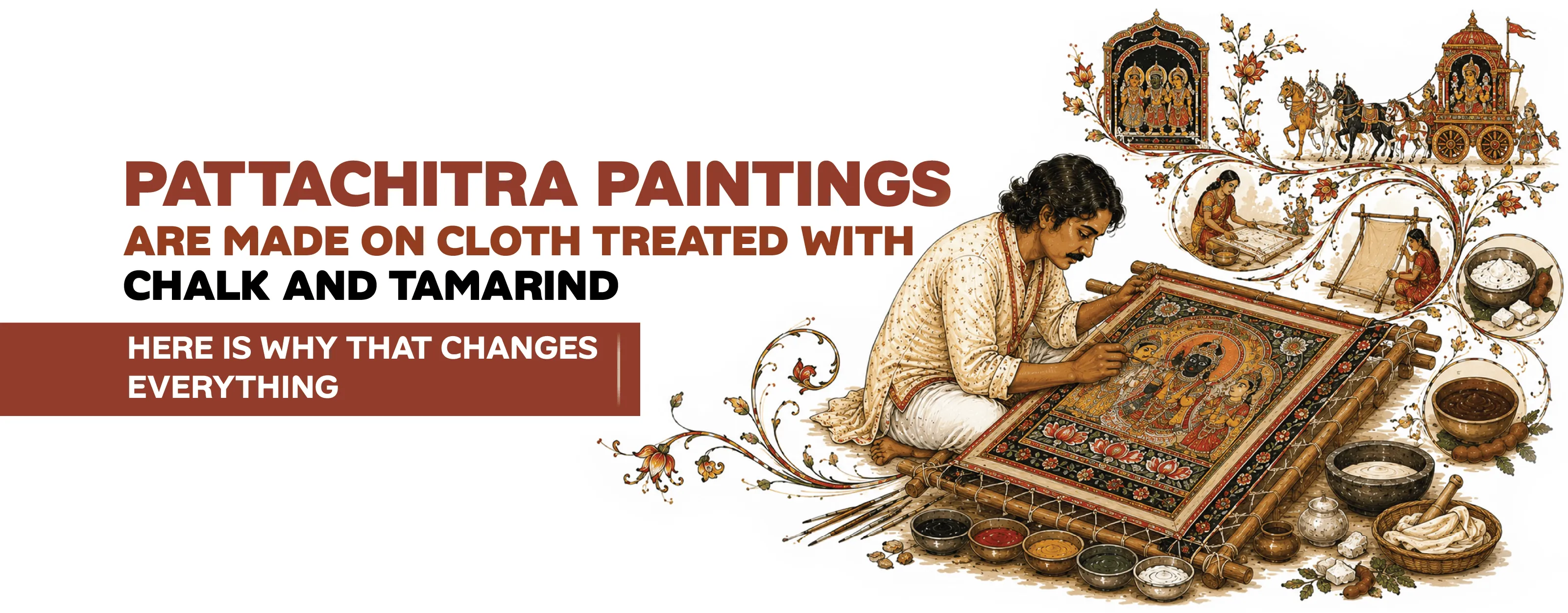
Pattachitra Canvas Credits - D' Source
The word Pattachitra comes from the Sanskrit words patta, meaning cloth, and chitra, meaning picture. But between an ordinary piece of cloth and the surface that eventually carries a Pattachitra lies a process that demands patience, precision, and a feel for the material. Every layer must be prepared carefully, because once the painting begins, the surface needs to hold the artist's fine lines and colours without losing their clarity.
First, the cloth is bound together
Traditionally, two pieces of fine cotton cloth are joined using a natural adhesive prepared from boiled tamarind seeds, known locally as tentyuli katha. The paste helps bind the layers, giving the cloth the strength needed for the work ahead. It is a humble beginning, using materials drawn from the natural world to prepare something that will eventually become a sacred image.
Next comes the chalk coating
Once the cloth has dried, a mixture of powdered soft chalk stone, known as khaddi gundi, and tamarind paste is applied to its surface. This coating fills the gaps between the cotton fibres and creates a more even base for painting. The cloth is then left to dry again. What began as a flexible, woven material is gradually becoming a surface on which intricate details can take shape.
Finally, the surface is polished by hand.
After the coating dries, the cloth is placed on a wooden plank and rubbed with stones to smooth out its roughness. A coarser stone helps remove raised fibres, while a smoother stone is used to polish the surface further. This process, known as burnishing, takes time and careful attention. Too much roughness can interfere with the brushwork, while an evenly prepared surface allows the artist to work with greater control. It is easy to look at a finished Pattachitra and admire the precision of its lines without thinking about the work that came before them. Yet every detail depends on this preparation.
The artist must know when the cloth is ready, how much pressure to apply, and how to work with the materials at each stage. Much of this skill is built through practice and observation, passed from one generation of artists to another. Therefore, by the time the first brushstroke is made, the cloth has already been through a transformation of its own. The preparation may remain invisible in the finished painting, but it is part of the knowledge that gives Pattachitra its distinctive character. Before the artist brings a deity or a sacred story to life, they must first create a surface worthy of carrying it.
The Work Behind Every Pattachitra
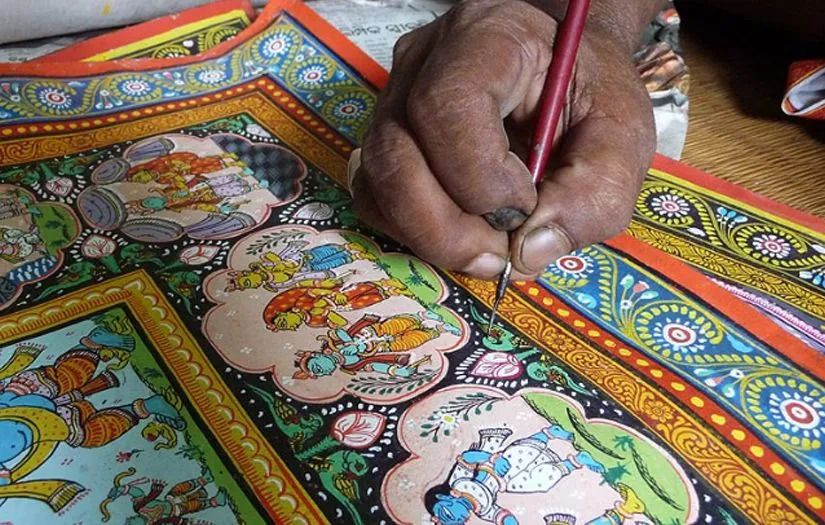
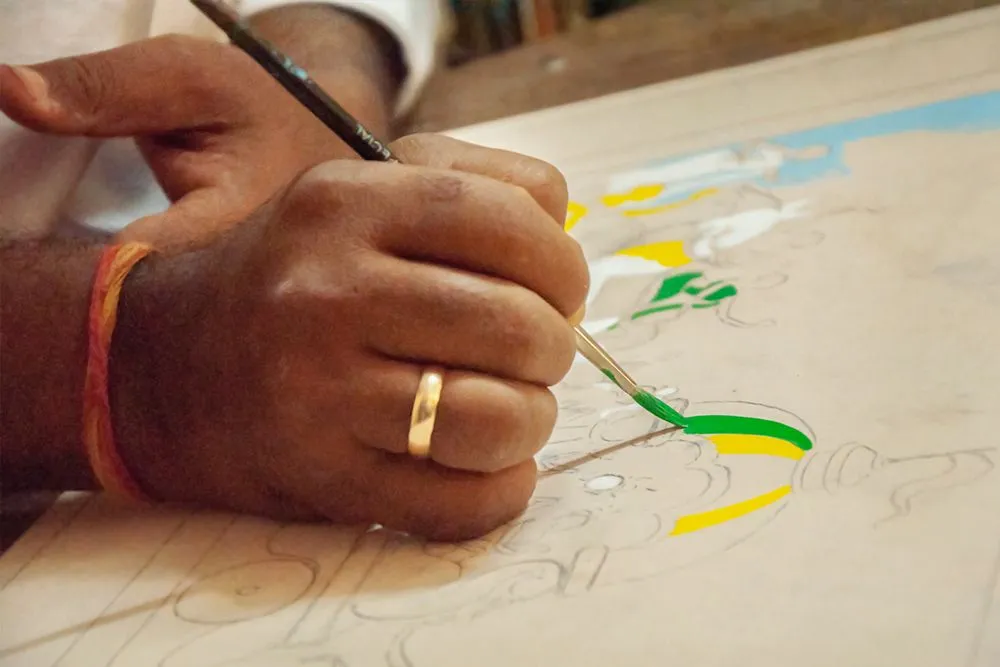
Pattachitra Careful Work Credit - Gaatha
In Raghurajpur, the heritage crafts village in Odisha's Puri district, Pattachitra is a tradition that has been practised by generations of artists. Here, preparing the patta is far more than a task to finish before the real work begins. The artist spends time binding, coating, and polishing the cloth, knowing that every stage will affect the painting that eventually takes shape on it.
For a Chitrakar, the traditional painter, the relationship with a painting begins long before the first figure is drawn. The cloth is prepared by hand, using materials that have a place in the surrounding natural world and in the knowledge passed down through generations. This kind of work asks for patience, but it also creates a familiarity with the surface itself. By the time the artist is ready to paint, they have already invested hours of care into preparing it.
That same attention continues when it comes to colour. Traditionally, Pattachitra artists prepared their pigments from natural materials, using family recipes and methods developed through practice. Stones, shells, plant sources, and the soot collected from oil lamps could all find a place in the palette. These materials had to be processed and mixed before they were ready to meet the cloth. The colours we admire in a finished painting, then, are part of a much longer process of making.
How Pattachitra Artists Traditionally Made Their Colours
White from conch shells
White has an important place in Pattachitra, helping define figures, create details, and bring contrast to a composition. Traditionally, it could be prepared from conch shells, which were ground into a fine powder and processed into a usable pigment. What looks like a simple white line on the finished painting may therefore begin with a material gathered from the sea and carefully prepared by hand.
Black from the soot of oil lamps
Black was traditionally made by collecting soot from the flame of an oil lamp. The fine residue was gathered and mixed with a natural binder to make it suitable for painting. In the hands of a skilled artist, this dark pigment becomes the precise outlines that define figures, ornaments, and intricate patterns. Those lines may be among the first things we notice in Pattachitra, but producing the material behind them required its own knowledge and care.
Yellow from mineral pigments
Mineral pigments were also used to create the yellows found in traditional palettes. One such pigment, haritala, is associated with orpiment, a naturally occurring yellow mineral. Its colour could bring warmth and brightness to a composition, although working with mineral pigments required knowledge of their properties as well as skill in preparing them.
Red from mineral earth and stone
Red is often striking in Pattachitra, particularly in the backgrounds that frame its figures and decorative details. Traditional recipes could draw on materials such as red ochre and, in some practices, hingula, a red mineral pigment. These sources produced different shades, each contributing to the visual character of the painting.
Blue from natural sources
Blue pigments were more difficult to obtain than some of the other colours. Depending on the tradition and materials available, artists could use natural indigo or other mineral and plant-based sources. The precise recipes varied, reflecting the knowledge and resources available to different artists.
These colours were traditionally mixed with natural binders, including gum obtained from the wood-apple tree, to help them adhere to the prepared surface. The choice of materials and the way they were processed mattered as much as the colours themselves. Preparing a pigment meant understanding how it behaved, how it mixed, and how it would sit on the patta.
When we look at a finished Pattachitra, it is easy to focus on the vivid reds, luminous whites, and fine black outlines. But each colour has its own story, one that may begin with a shell, a stone, a plant, or the soot from a lamp. Alongside the preparation of the cloth, this work reminds us how much knowledge sits behind a painting that might otherwise appear effortless. The artist is not simply choosing colours from a palette. They are drawing on a tradition of making, learning, and careful observation that has been carried forward through generations.
Pattachitra and the Worship of Lord Jagannath
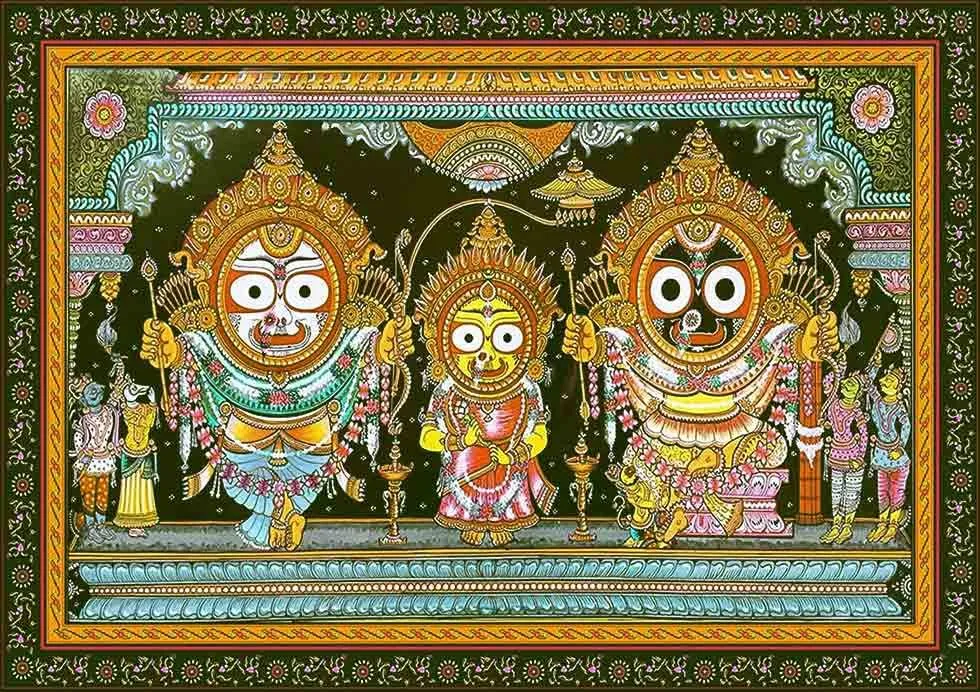
Pattachitra and the Worship of Lord Jagannath Credit - Cottage 9
To understand Pattachitra's place in Odisha's culture, it helps to look at its close connection with the worship of Lord Jagannath at the Jagannath Temple in Puri. The tradition has long served religious purposes, with painted images playing a role in rituals and helping devotees maintain their connection with the deities. One of the most significant examples comes during the annual Snana Yatra, the ceremonial bathing of Lord Jagannath, Balabhadra, and Subhadra.
During Snana Yatra, the wooden deities are bathed with water drawn in 108 pots. According to temple tradition, they then enter a period of rest and seclusion known as Anasara. During this time, the deities are not available for public viewing in their usual form, and the temple's regular darshan routine changes. For devotees who come to Puri to seek the blessings of Lord Jagannath, this is an important moment in the religious calendar.
This is where a special form of Pattachitra, known as Anasara Patti, becomes significant. Traditionally painted cloth images of the deities are used during this period, allowing worship to continue while the wooden idols remain out of public view. The paintings are associated with the divine forms of Jagannath, Balabhadra, and Subhadra, and are treated with religious reverence rather than as ordinary works of art.
Consider what this means for the artist creating one of these paintings. The work is connected to a living ritual, a temple tradition, and the faith of countless devotees. The image must be made with care because it will become part of a sacred occasion. Its significance extends beyond the skill involved in drawing the figures or preparing the colours. It also lies in the role the painting plays within a community's practice of worship.
This connection helps explain why Pattachitra has never been only about how a painting looks. Its intricate details and vivid colours deserve admiration, but so does the purpose the art has served over generations. In the tradition surrounding Lord Jagannath, a painted image can become an important part of how devotees experience faith, especially during a time when the deities are not visible in their familiar form.
Keeping Traditional Art Alive Through Learning
Pattachitra is one of the many traditional Indian art forms that deserve to be understood, practised, and passed on to future generations. Across the country, artists continue to carry forward techniques and stories they have inherited from those before them. Preserving these traditions means supporting the people who keep them alive and making sure their knowledge reaches those who want to learn.
Rooftop works towards this through its efforts to preserve traditional Indian art forms and bring them closer to a wider audience. Its curated art courses give experienced artists a platform to share their knowledge, teaching learners the techniques, histories, and cultural significance behind each art form. This also creates an opportunity for artists to be recognised and compensated for the knowledge and skills they have spent years developing.
For anyone who wants to learn Pattachitra, explore the courses available on Rooftop and learn directly from artists who carry these traditions forward. Every new learner who takes the time to understand an art form helps keep its knowledge alive.