

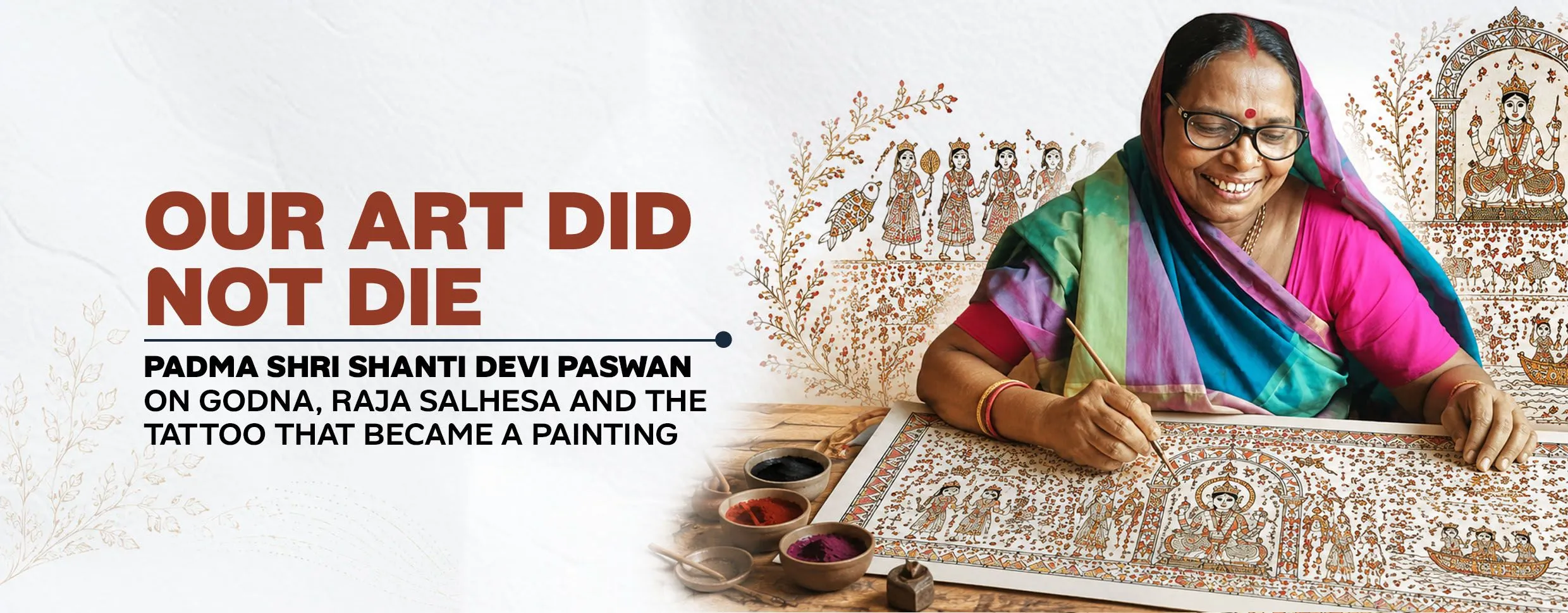
Our Art Did Not Die: Padma Shri Shanti Devi Paswan on Godna, Raja Salhesa and the Tattoo That Became a Painting
Padma Shri Shanti Devi Paswan on Godna painting, Raja Salhesa, caste and the tattoo art of the Dusadh community, in a rare in-depth interview with Rooftop.

Kartik Gaggar
Author
This piece is drawn from a conversation Rooftop recorded with Padma Shri Shanti Devi Paswan in Vadodara, in Hindi and Maithili. Her answers have been translated and lightly edited for clarity. She speaks here about things almost never written down, the first two rupees she ever earned from a painting, the night her community claimed the right to paint its own god, and how a tattoo tradition walked off the body and onto paper.
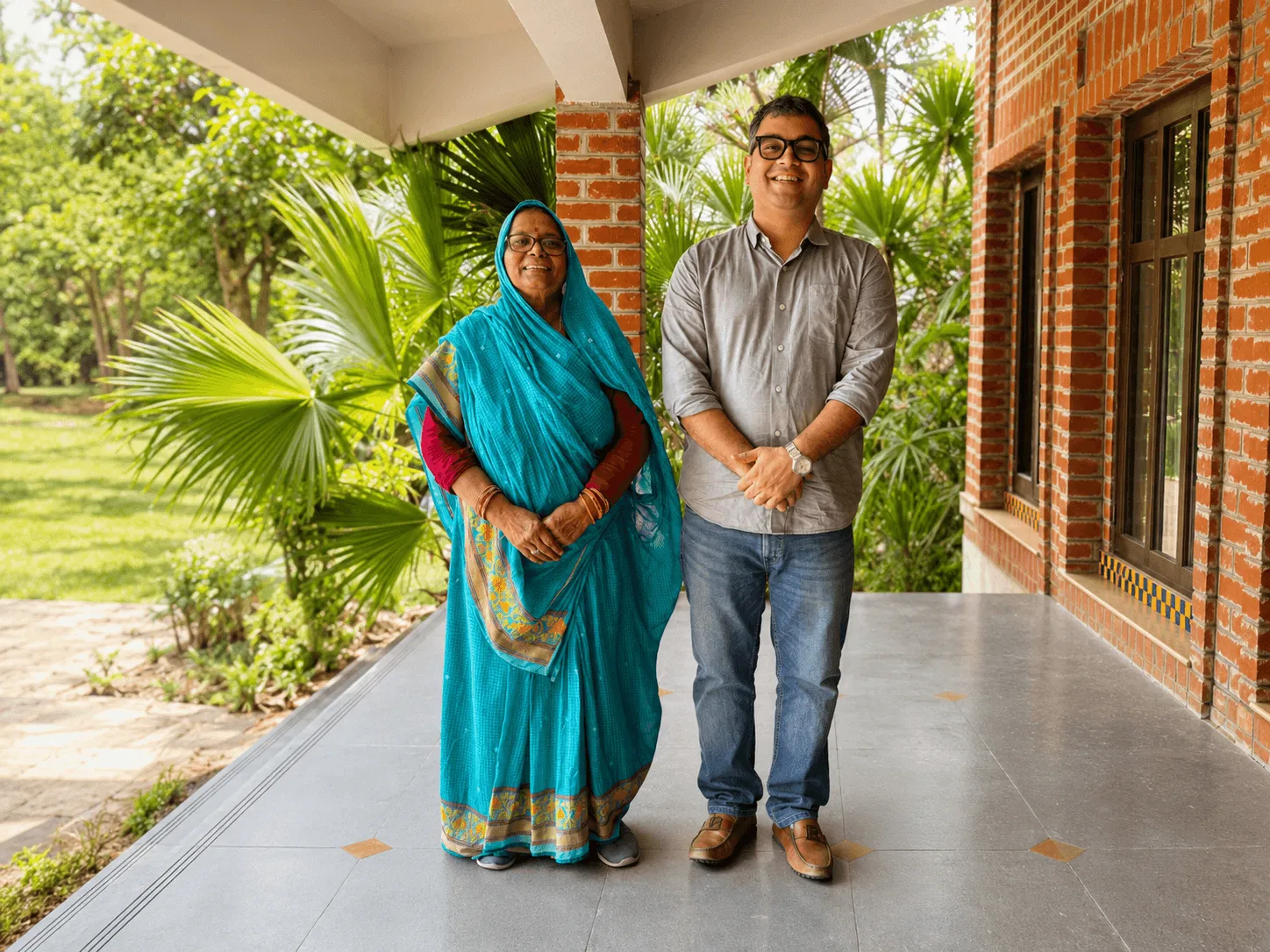
Rooftop's Founder Kartik Gaggar with Padma Shri Shanti Devi Paswan
There is a sentence Shanti Devi Paswan returns to again and again, the way other people return to a prayer. Hamara kala mara nahi. Our art did not die. She says it about Godna painting, the tattoo art of her Dusadh community, an art that very nearly did die, twice, once when people stopped tattooing their bodies and once under the slower pressure of caste itself. That it lives instead, taught to thousands and honoured with a Padma Shri in 2024 for both Shanti Devi and her husband Shivan Paswan, is substantially because of the woman across the table.
The bare outline of her life is remarkable enough. A girl from the village of Simri near Kapileshwar Asthan in Bihar's Madhubani region, married in 1976 into Laheriaganj, a woman who was once refused drinking water in her own village because of her caste, went on to see her painting displayed at the G20 Summit in New Delhi and her work exhibited in the United States, Japan, Denmark, Germany, Malaysia and Hong Kong. But the outline is not the story. The story is in how she tells it, in a voice that keeps no bitterness and wastes no words, and it begins with a pencil, a wall's worth of memory, and one hour.
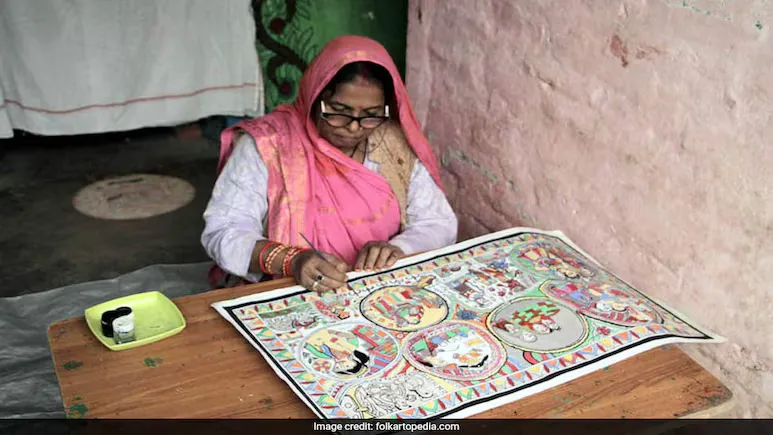
Padma Shri Shanti Devi Paswan, who carried the Dusadh tattoo tradition from the body onto paper.
A Kohbar in One Hour
Her mother painted, as most Maithil women of her generation did, on the walls of the family home. Nothing was sold. Nothing could be sold. She had heard that somewhere people sold paintings, the way one hears rumours of another country. Then in 1976 she was married to Shivan Paswan of Laheriaganj, and within her first months in her sasural, the rumour walked through the door.
ROOFTOP: What was your routine before painting entered your life, and how did it begin?
SHANTI DEVI: My mother made paintings on the house. They were not sold, we did not understand selling, we only heard that some people sell. Then I came to my sasural in 1976, and Raudi Paswan ji brought Dr. Raymond, the American, who had come to Jitwarpur. He said, Shanti, quickly, make a big painting and show us, foreigners have come. So quickly, quickly, I drew a kohbar in pencil and gave it to them inside one hour.
ROOFTOP: And what did they say?
SHANTI DEVI: Raudi Paswan bhai said, she will become a first-class artist. My sasur was the pajiyar, the village headman side of the family, and they told him, pajiyar ji, let her move forward. He said yes, yes, if she makes them, we will let her go ahead. The American liked it very much, he said this is beautiful, and he gave two rupees. I bloomed with happiness at those two rupees. Then another said, make one for me also, ask for another paper. So I made another, and he also gave two rupees. Four rupees for four hands of work.
The names in her memory are not incidental. Raudi Paswan was the pioneering Godna artist of Jitwarpur, the man whose household, with his wife Chano Devi, first carried the Dusadh tattoo tradition onto paper in the 1970s. The visitor she remembers as Dr. Raymond was the American researcher then working in Jitwarpur, part of the small wave of foreign scholars whose interest, and whose small payments, first told Mithila's painters that the wall art of their mothers had value in the outside world. A kohbar drawn from memory in one hour, judged first class by the man who invented her genre's future. Few artists can date their beginning so precisely, down to the coin.
Colours From a Broken Roof
Recognition came quickly by the standards of any artist. A Bihar state award arrived within a few years, in the early 1980s. What did not arrive was money for materials, and her account of how she solved that problem is a small masterclass in the resourcefulness that folk art has always run on.
ROOFTOP: Where did the colours come from in those days? You could not have bought them.
SHANTI DEVI: There was great difficulty. Where would colour come from? So we ground things. The khapra, the roof tile of the house, we ground it fine and fine for the red. The bougainvillea flower. The dubi grass, ground and ground for green. We tried every natural colour there was.
ROOFTOP: And you were teaching at that time as well?
SHANTI DEVI: There was a school for the children of poor and Dalit families, and no teacher would go there. I had studied a little. I asked, can I go as the teacher? My sasur and sasu ma had very good hearts, both of them. They gave me one rupee and sent me. I went, I taught the children, and with the colours there I kept doing my research.
Hold those two images together, because they are the same woman in the same year. In one, she is grinding a broken roof tile into pigment because geru red must come from somewhere. In the other, she is walking to a school no trained teacher will enter, with one rupee from her father-in-law in her hand, to teach Dalit children and quietly continue her colour experiments after hours. Nothing about her later fame makes sense without this period, in which art, education and sheer stubbornness were all the same daily activity.
Denmark, With a Baby Left Behind
In 1983 the machinery of official India arrived in Mithila in the form of Pupul Jayakar, the great patron of Indian handicrafts, scouting artists for the international festival circuit. Ten artists were to be sent abroad, and every candidate had to submit work. Shanti Devi tells what happened next with the flat delivery of someone who still finds it slightly unbelievable.
ROOFTOP: How were you chosen to go abroad?
SHANTI DEVI: Pupul Jayakar came in 1983. Bhaskar Kulkarni I met later. Ten artists were to be sent abroad, and paintings were needed from everyone. They brought work from the school as well, and among the ten, my paintings were selected. They said, send this artist. Denmark. The way one goes from village to city, that is how we went. First to Delhi, and from Delhi they sent us to Copenhagen.
ROOFTOP: What was that journey like for you?
SHANTI DEVI: My baby was in my lap, a year and a quarter old, and I had to leave him. In the village we nurse a child for at least a year and a half, and I was still nursing. We even boarded the same aircraft as Indira Gandhi ji and her family, all in one plane. In Copenhagen the culture there, for two or four days I watched and managed. The visit was for fifteen days, a month. But I could not stay. The way of life there did not sit well with me, and so I came back.
It is worth pausing on what that paragraph contains. A woman who had never left her district boards an aircraft for Scandinavia, leaving a nursing infant behind, at a time when almost no woman of her community had crossed the sea for any reason. And then, homesick and unmoved by Copenhagen, she simply comes home early, unimpressed by the thing that was supposed to impress her. The following year brought the reward for all of it, and it brought the detail that defines this household. The National Award of 1984 went to both of them, husband and wife together, for work so alike that, as she puts it, people had to look closely to tell whose painting was whose.
Behind her personal story sits the larger one that made it possible. After the Bihar droughts of the 1960s, government and foreign interest pushed Mithila's wall painting onto paper so that it could be sold, and by the mid-1970s researchers and buyers were walking village lanes looking for hands worth backing. The two rupees Dr. Raymond paid her were part of that turning of the tide, the exact moment a bride's wall skill became an income, and eventually a career that two governments would honour.
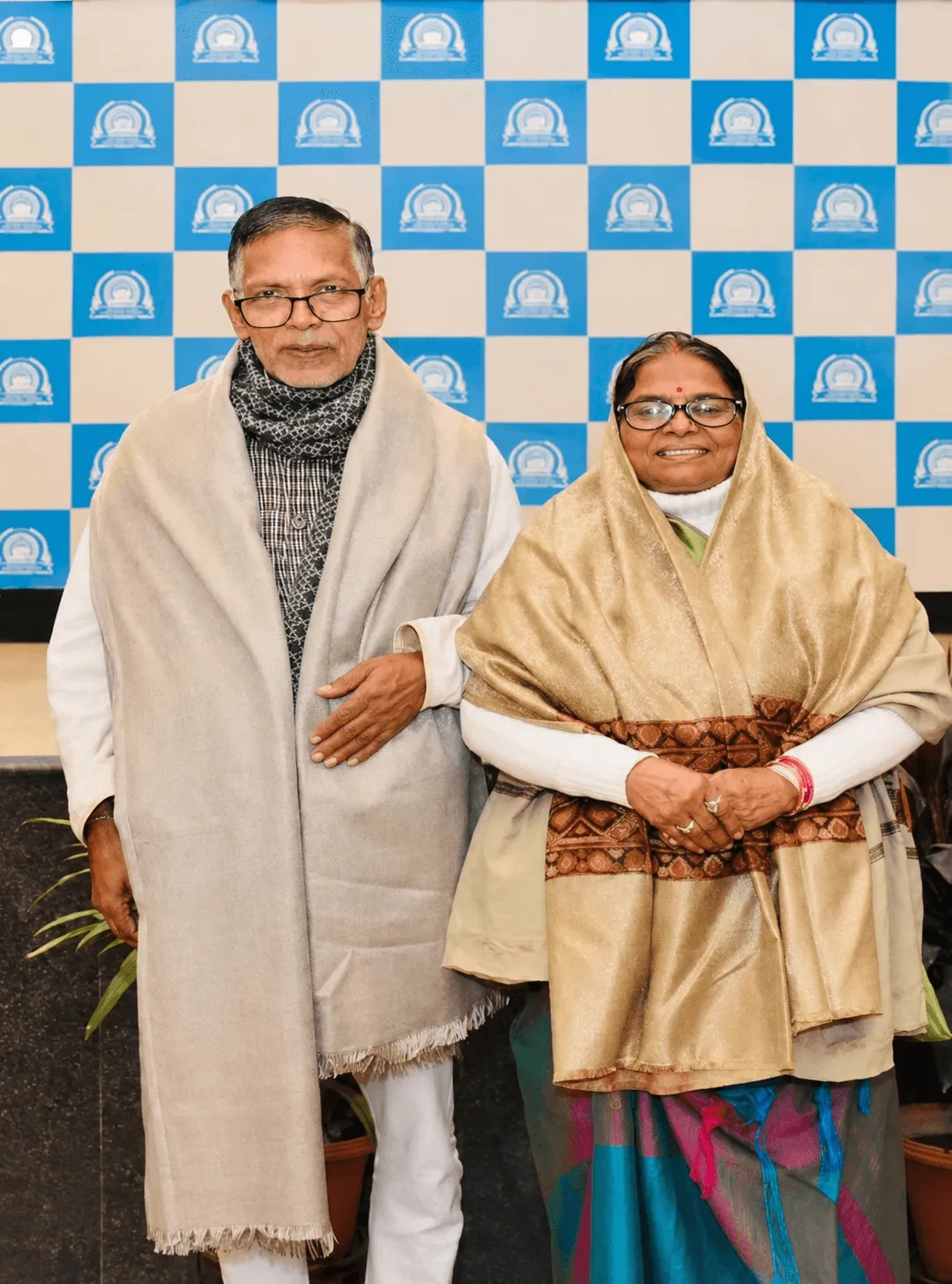
Shanti Devi Paswan and Shivan Paswan, the Godna painter duo honoured together with the Padma Shri in 2024.
State award, National Award 1984, Padma Shri 2024, always as two
Shanti Devi received Bihar's state award in the early 1980s, and in 1984 she and Shivan Paswan received the National Award together. Four decades later, in 2024, the Padma Shri again honoured them as a pair, a duo citation for the Godna painters who broke social barriers through art.
The Night They Claimed Raja Salhesa
The turn that made her historic came at a gathering, a goshthi, convened by a scholar she remembers as Lakshmi Mishra. The question on the table sounds innocent and was anything but. Which gods do you worship? For a Dusadh artist the question was loaded, because the unwritten rules of the tradition held that the gods of the great temples belonged to the upper-caste styles, to the Brahmin and Kayastha painters of Bharni and Kachni. Her community's answer changed the art form.
ROOFTOP: How did you come to paint the story of Raja Salhesa?
SHANTI DEVI: Lakshmi Mishra ji held a big goshthi and asked, which god do you people worship? We have our Kali ji, our Durga, our Dina Bhadri, our Mahadev, and we worship the snake. But ours is Raja Salhesa. Raudi bhai said yes. No one else can make him. Our dehati, our village people, can make him. From that time I took the story of Raja Salhesa forward. My husband began the Godna painting, and I painted alongside, both of us in the same manner, Kachni and Bharni both, so equal that people would test themselves on whose painting was whose.
ROOFTOP: You still sing his story as you paint?
SHANTI DEVI: First I painted Krishna ji, I sang of Radha. Then we came to Raja Salhesa, and the songs came with him. The four ponds where his brother was caught in three and escaped from one. Dina Bhadri brought by his power. In Sawan the deity comes into our homes and the puja happens. He said, I am Surma Salhesa, I am Motiram. He is of a raja's line, a Rajvanshi. The whole story is long. I will tell it slowly, and I will sing it.
Raja Salhesa is the great hero-king of the Dusadh community, a guardian deity worshipped across Mithila and the Nepal Terai in open-air shrines called gahwars, his epic carried for centuries not in books but in sung performance, precisely the way Shanti Devi still carries it. When she and her husband put him into Godna painting, they were doing something without precedent, giving a Dalit community's own god a visual tradition of his own, in an art world that had told them the gods were not theirs to paint. The Padma Shri citation four decades later would single out exactly this, honouring the couple for depicting the legend epics of the Dusadh. The establishment eventually caught up to what was decided at that goshthi.
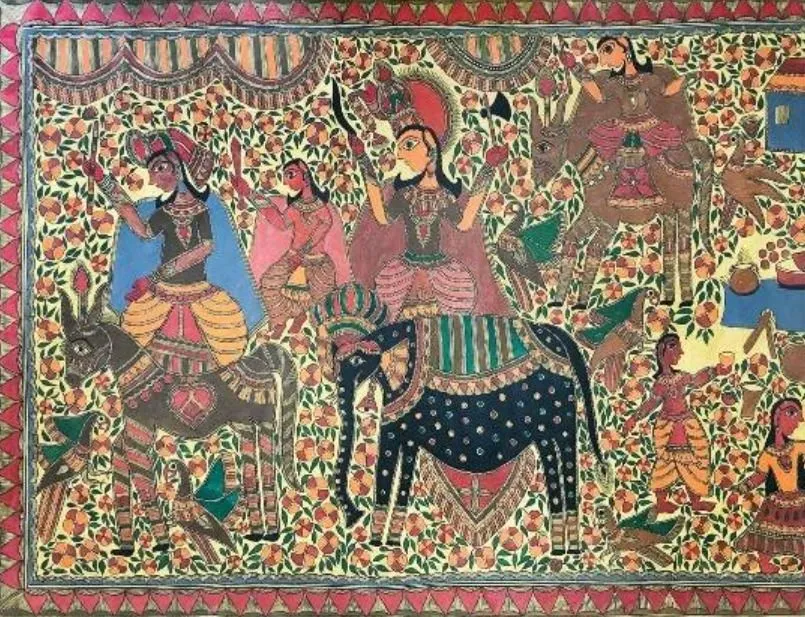
The Raja Salhesa epic in Godna painting, a Dalit community's own god given his own visual tradition.
The Tattoo That Refused to Die
To understand what Godna painting is, you have to start on the skin. Godna means tattoo, and for generations the geometric rows of dots, flowers, fish and figures that define the style existed only on the bodies of Dalit women, applied in childhood and carried for life. It was an art form the caste system pushed literally onto the flesh of its lowest rung, and Shanti Devi's account of what it meant, and how it nearly vanished, is the heart of this conversation.
ROOFTOP: Godna lived on the body. What was lost and what was gained when it came to paper?
SHANTI DEVI: Godna was made by Dalit women, only Dalit women made it and wore it. But the tattoo itself was in every community. So we would say to them, there is a godna on your arm and a godna on ours. Tell us, did untouchability not apply to the tattoo? Slowly, as people studied and understanding came, the chhua chhut has come down. In the city there is some equality now. In the villages it is still there.
ROOFTOP: And the art itself, on the body?
SHANTI DEVI: People stopped putting it on the body. People have become delicate now, no one wants the needle. So we thought, our art will die. What are we doing? And we lifted that art onto paper. We brought it onto canvas, onto jute, onto sarees, onto everything, little by little, and it began to sell. And Godna did not die. Our art did not die.
There it is, the sentence she keeps. Hamara kala mara nahi. Notice what the argument underneath it does. The tattoo was shared by every caste, worn on Brahmin arms as surely as Dusadh ones, and she used that shared skin as a weapon of logic against untouchability itself. If the mark is on both of us, what exactly is it that cannot be touched? And when modern squeamishness threatened to end the tradition anyway, needle by abandoned needle, she and Shivan Paswan performed the rescue that folk art historians will be writing about for a century. They moved the canvas. The body gave the art up, so the art walked onto paper, cloth and jute, and survived its own medium.
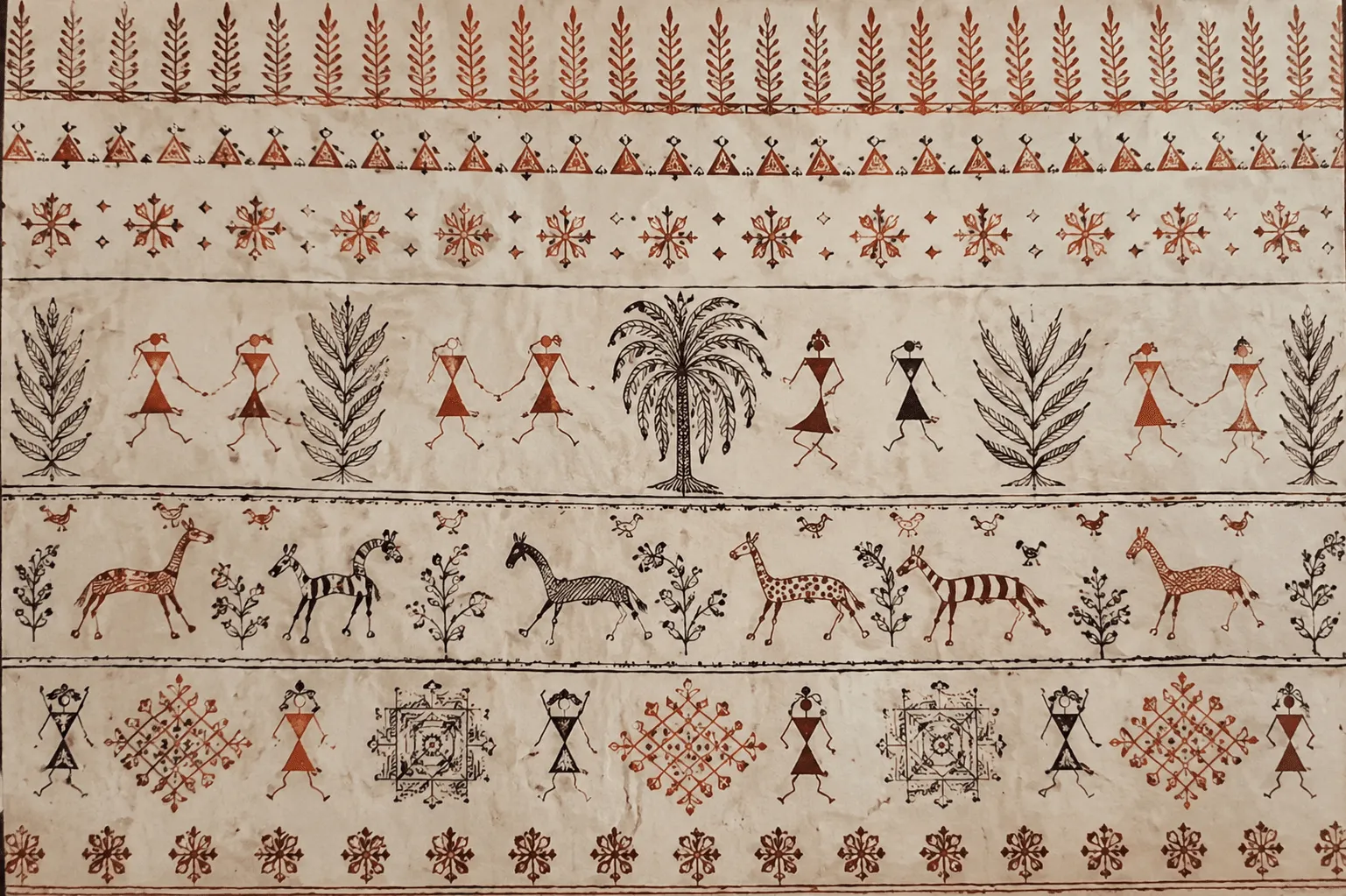
Godna's tattoo rows carried onto paper, in the tradition's spare palette of geru, black and flower colour.
Three Colours and a Matchstick
Ask her about technique and the answers are as spare and exact as the art. Godna painting is built from small repeated motifs marching in rows and rings, a unit she calls the tilanga, and it is drawn not with a fine brush but, in the tradition she keeps, with the humblest instrument imaginable.
ROOFTOP: What do you actually make the paintings with, and what are the rules of the style?
SHANTI DEVI: We make it with the stick of a matchbox. The motifs are small, the tilanga runs to one side, in rows. Many artists cannot make Godna properly small, not everyone can make it. And the border is compulsory. In Mithila painting the border comes from Sita's story, the line that Lakshman ji drew. In Godna the border is exactly like where the tattoo ends on the body. The painting stops the way the tattoo stops.
ROOFTOP: And the colours?
SHANTI DEVI: Three colours go into Godna. The geru, the red of the earth and the ground tile. The black. And the colour of the bougainvillea flower. Others now use all seven colours of the rainbow, and let them. I say let the tradition remain, let the parampara stay. That is what is special. We worship in Sawan and Bhado, we worship the snake, and the art stays with its rules.
The border theory alone is worth the interview. In one sentence she connects the compulsory frame of every Mithila painting to the Lakshman rekha, the protective line of the Ramayana, and in the next she gives Godna's border a completely different genealogy, the edge where a tattoo ends on a human arm. Two framing traditions, one from epic and one from skin, coexisting in the same district. And her three-colour discipline, geru red, soot black and bougainvillea, is a conscious act of conservation in a market that rewards rainbow brightness. The restraint is the signature, and she guards it the way her community guarded the art itself.
The guarding has been anything but passive. By her own count around five thousand artists now work in Godna specifically, and by the public record she and Shivan Paswan have trained more than twenty thousand people in Madhubani painting overall, a teaching effort few institutions could match. The next generation is already selling on its own terms. She mentions Mithilesh Kumari taking commissions online, including a request for the entire Ramayana rendered in Godna painting, an art form once forbidden to depict the gods now being commissioned, digitally, to paint the biggest god story of them all.
The House an Award Built, and the Jealousy That Will Not
Two stories from the conversation sit side by side and refuse to resolve, which is precisely why both belong on the record. The first is about an award ceremony, and it is one of the most quietly devastating anecdotes we have ever been told.
ROOFTOP: You have spoken of the difficulties. What happened when the award came?
SHANTI DEVI: When the award was given, I had no house. What they gave me, I wrapped in cloth and kept close, and at the meal I tried to return it to the saheb. I said, saheb, take this back. I have no house. Where will I keep it? The rain will take it. He said, keep it, a roof will happen. And I leapt, I jumped up with happiness. Then I went to the Bihar office in Patna, and they built my house. Those people made my home.
ROOFTOP: And the discrimination you faced as a backward-caste artist, in recognition, in exhibitions. Do you think it will reduce?
SHANTI DEVI: There is very great difficulty, and the whole of it cannot be told, it would take too much time. Even now there is deep jealousy toward the backward. In the villages it is everywhere. No sir, it will not reduce. You get the Padma Shri and then you see who does what. But I never panicked. Others got this and got that, and I waited. I only said, let it come, and let it come to my husband. He was passed over again and again. Then it came to both of us together.
No sir, it will not reduce. She says it without heat, as a weather report, and it lands harder than any speech could. This is a woman whose painting hung at the G20, whose house was built by a grateful state, whose name now carries the Republic's fourth-highest honour, telling you plainly that the thing she overcame has not gone anywhere. And in the same breath, the other half of her ledger. She waited through years of watching others collect awards, wishing one onto her husband before herself, and when it finally arrived it arrived the only way she would have wanted it, jointly. They still work side by side and separately, he now a teacher at the Mithila Chitrakala Sansthan alongside artists like Dulari Devi, she at home with her younger son and daughter-in-law helping. Her summary of the whole economy of their life is eleven words long. We went toward the work, she says. We never went toward the money.
That institute connection is its own small map of modern Mithila, because the teachers' room now holds the whole story of the tradition's opening, the Dusadh master who painted a forbidden god and the Mallah artist who learned while washing dishes, colleagues where the old rules said neither belonged. The journey of that second artist, Padma Shri Dulari Devi, runs alongside this one, and reading them together shows how completely the women once kept outside Mithila painting have become its centre.
What a Duo Padma Shri Means
Awards to artistic couples are rare, and this one is rarer than it looks. It honours two people, but it also honours a method, the forty-year collaboration in which a husband and wife painted so identically that telling their hands apart became a party game, taught twenty thousand students between them, and together performed the improbable rescue of an art form from the surface it was born on. When the needle stopped, the paper began, and the tattoo of the Dusadh women became a painting the world now collects.
Near the end, she offered to sing the Salhesa epic properly some day, slowly, the way it is meant to be given, and it is an offer worth taking her up on, because in her voice the painting and the song are still one thing, the way they were on the walls and on the skin. Until then, the paintings themselves carry the story. Rooftop's Madhubani collection holds original works from the living Mithila tradition this conversation belongs to, each with its artist named, which is the one courtesy this art was denied for most of its history and the one it can never again be refused.