

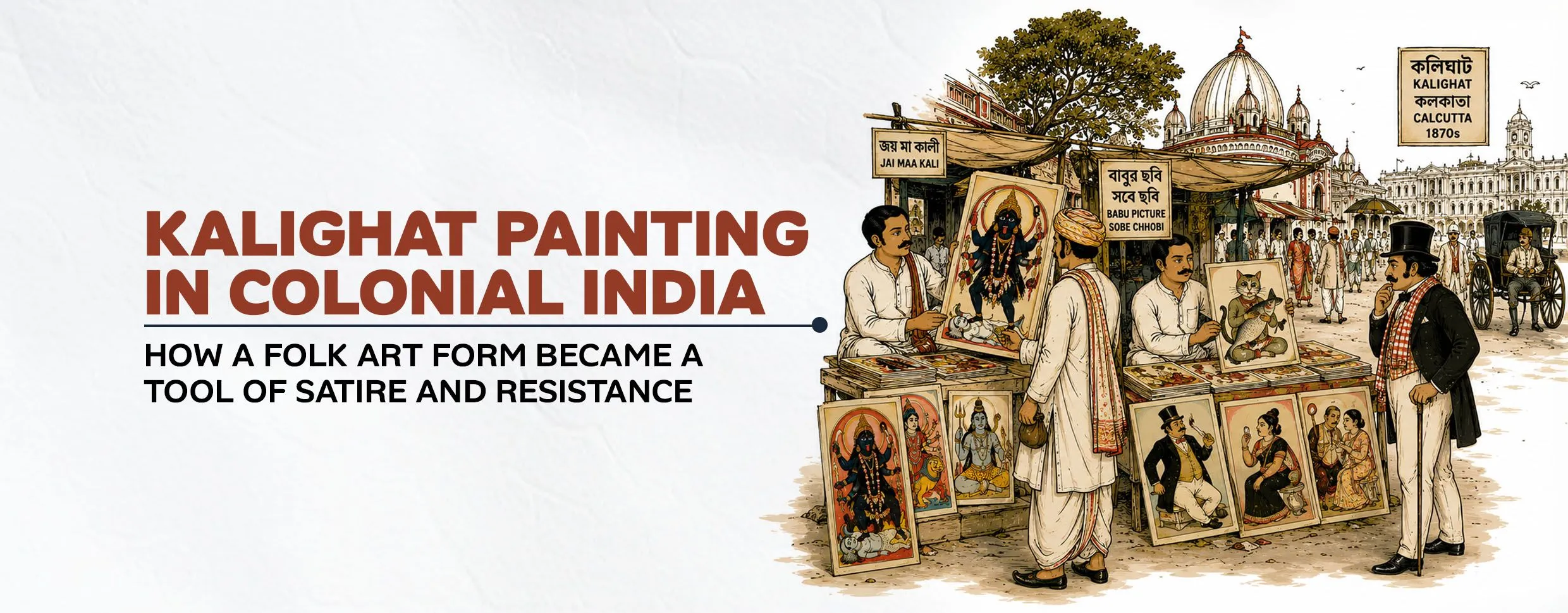
Kalighat Painting in Colonial India: How a Folk Art Form Became a Tool of Satire and Resistance
Kalighat painting in colonial India was not folk art with some satire on the side. It was a genuinely subversive popular medium that used devotional imagery to expose the moral failures of both the Bengali elite and their British rulers.

Rooftop
Author
Stand outside the Kalighat Kali temple in Kolkata at any moment in the second half of the nineteenth century, and you would have seen something the official histories of Indian art have rarely known what to do with. A pilgrim is buying a watercolour of Kali to take home as a devotional object. Two stalls down, a Bengali babu in starched dhoti and English jacket is paying the same painter, or his cousin, for a satirical image of a cat with a fish in its mouth, a stock visual joke at the expense of priests who preach renunciation while consuming what is not theirs. The pilgrim and the babu are buying from the same workshop, in the same week, in the same visual language. Neither finds this strange.
The coexistence of the sacred and the sardonic, often inside the work of a single Patua family, is not a footnote to Kalighat painting. It is the defining character of the tradition in colonial India. The form that emerged in the lanes outside the Kali temple was not a folk tradition that happened to produce some satirical work. It was a genuinely subversive popular medium that used the visual language of devotion to expose the moral failures of both the Bengali elite and their colonial rulers, and that double identity made it one of the sharpest forms of political commentary nineteenth-century India produced.
Calcutta as the Crucible: The City That Made Kalighat Possible
Kalighat painting did not emerge from rural Bengal. It emerged from Calcutta, and the city it emerged from was unlike any other in nineteenth-century India. The capital of British India until 1911 and the second-largest city in the British empire, Calcutta in this period was a place where colonial administrators, Bengali zamindars newly enriched through trade with the British, rural migrants drawn by the prospect of urban work, Marwari bankers, missionaries, and a vast urban underclass all lived in unusually close and often uncomfortable proximity.
The Kalighat temple precinct was one of the few places where all of these communities crossed paths. Pilgrims came from across Bengal and beyond. Resident Bengalis came for daily worship. Wealthy babus came as patrons. European visitors came as curious tourists, drawn by reports of Kali and the dramatic visual culture surrounding the goddess. The market that grew up around the temple served all of them at once. The Patua painters who set up their stalls in this market were therefore working for one of the most socially heterogeneous audiences any Indian art tradition had ever had to address.
This unusual density of audience is what produced the unusual character of Kalighat painting. A village scroll painter in rural Bengal painted for a community that shared a single set of references. A Patua working outside the Kali temple in 1860 was painting for a pilgrim from Birbhum, a babu from Bhowanipur, and a colonial officer's wife from Park Street, sometimes within the same hour. The form had to speak in a register that carried across all of them. The bold, simplified, immediately legible Kalighat style is what that register turned out to look like.
By 1860 Calcutta had become the most populous and culturally diverse urban centre in India, with the Kalighat temple precinct functioning as a daily meeting point for pilgrims, Bengali elites, British administrators, European visitors, and Marwari merchants.
The Patua Painters and Their Adaptation to Urban Life
The Patuas were a hereditary artisan community with centuries of experience in scroll painting, called patachitra, used to accompany the oral narration of mythological and folk stories in rural Bengal. The migration to Calcutta in the first decades of the nineteenth century forced a wholesale reinvention of their practice. The scroll, which depended on a single audience listening to a single performance, made no economic sense in the high-volume pilgrim market. The Patuas adapted, and the adaptation produced Kalighat as a recognisable form.
The shift was practical first, aesthetic second, but the aesthetic consequences turned out to matter enormously. Pressure to produce more paintings, faster, for less money should have diluted the form. It did the opposite. The single iconic figure replaced the narrative cycle. The thick black outline replaced the painstaking line of the older patachitra. The flat colour wash replaced laborious layering. Every shortcut produced visual gain. The constraints did not limit the form. They invented it.
Devotion and Critique in the Same Visual Language
What makes Kalighat genuinely subversive is that the same Patua brush, the same bold black line, the same vermilion ground and the same iconic compositional logic that produced sacred images of Kali also produced devastating satirical portraits of corrupt babus and predatory priests. The form did not maintain a distinction between high and low subjects. It treated all subjects with the same visual equipment. This refusal to separate sacred from secular within a single visual grammar is itself a quietly radical move, and the political work of the tradition flows directly from it.
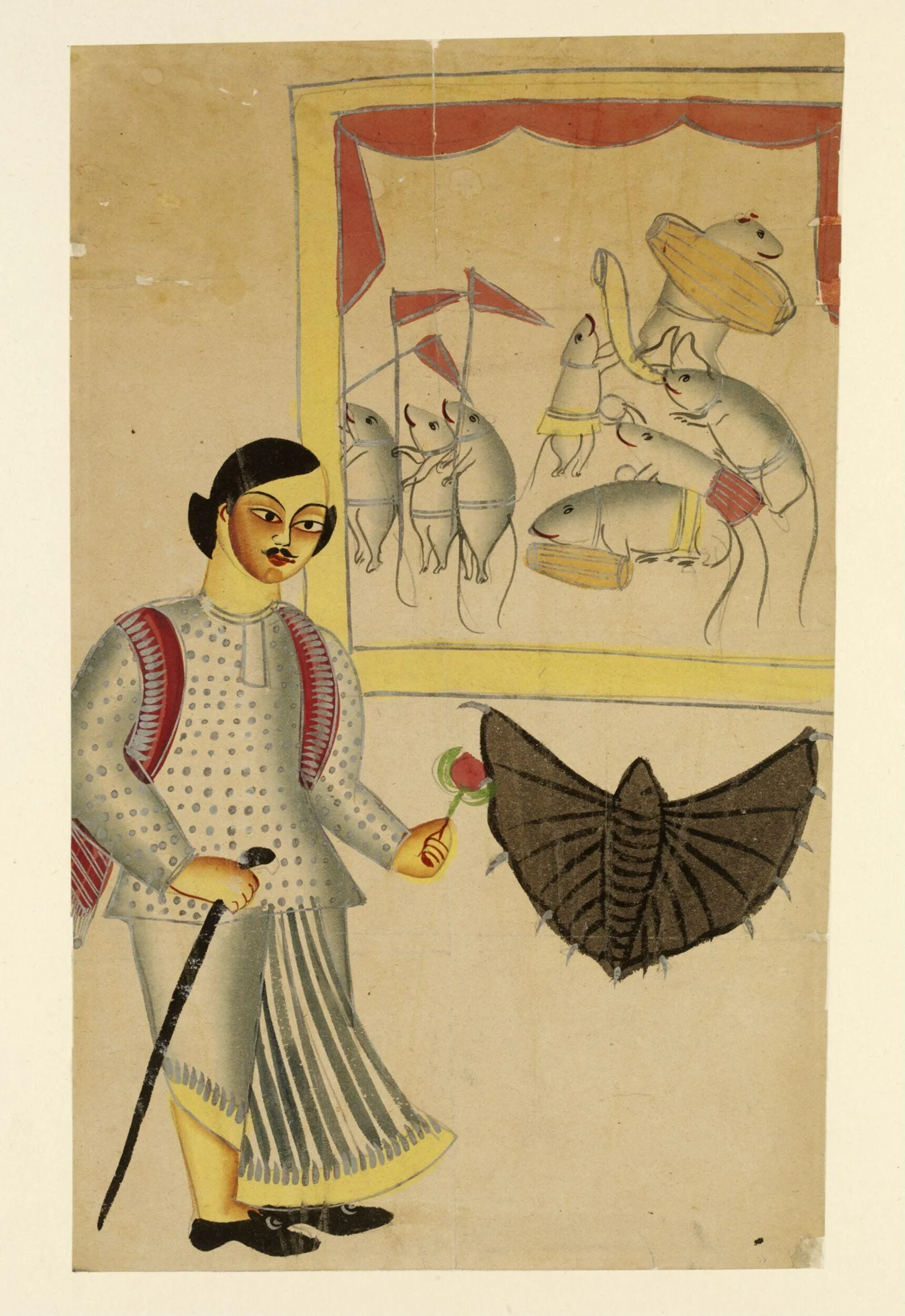
A Bengali babu in pleated white dhoti holds a rose and cane, paired with a chamchika (small bat) to satirise outward show without substance. The home behind him is empty except for musk rats holding a music party. Source: Victoria and Albert Museum, London
Consider what is happening when a Patua paints a wealthy babu seated on a Western-style chair with the same care, the same compositional weight, the same iconic framing the Patua would give to a portrait of Krishna. The visual treatment communicates that the babu has positioned himself as a kind of deity, demanding the visual reverence due to a god. The painting honours that self-positioning literally, and the literal honouring is the joke. The viewer sees a man who thinks he is divine, painted as though he were, and the gap between his self-image and his actual moral standing is what the painting opens up for the laugh.
The Kalighat satirical painting is not a folk drawing of a foppish man. It is a sacred image of someone who has mistaken himself for the sacred.
This is the democratising argument the form's visual style was making, even when its individual paintings made no explicit political claim. By using the same iconic register for the goddess and for the corrupt human, Kalighat was quietly insisting that reverence is something a subject must earn, that the visual privileges of the divine are not transferable to the wealthy by virtue of their wealth, and that the moral judgement of the painter, working from outside both the colonial bureaucracy and the Bengali establishment, was capable of separating the two.
The Targets of Kalighat Satire and What They Reveal
The satirical strand of Kalighat painting had a stable cast of recurring targets, and the choice of targets is itself revealing. The Patuas were not painting at random. They were painting the specific figures whose conduct most exposed the moral contradictions of colonial Bengali life.
The recurring targets
- The westernised babu, the newly wealthy Bengali who adopted English dress, furniture, habits, and vices, while losing what the Patuas read as the moral substance of older Bengali identity. The most frequent subject and the most thoroughly skewered, often depicted with a young mistress, a glass of liquor, or both.
- The duplicitous priest, in the famous cat-with-fish image and in scenes of priests in compromising positions with women who came to them for blessing. The Patuas worked within the religious economy of the Kalighat temple, which gave them the standing to mock priestly corruption directly.
- The unfaithful spouse, of either gender, in scenes including the famous image of a wife beating her unfaithful husband with a broom. The treatment is not moralistic so much as observational, recording the actual gender dynamics of a society where marital fidelity was demanded of women and not always reciprocated by men.
- The hypocritical figure of authority, whether magistrate, landlord, or court official, often depicted in scenes drawn from popular allegories like the Jackal Raja's court, where animals stand in for human power-holders of colonial Bengal in scenes of comically self-important petty rulership.
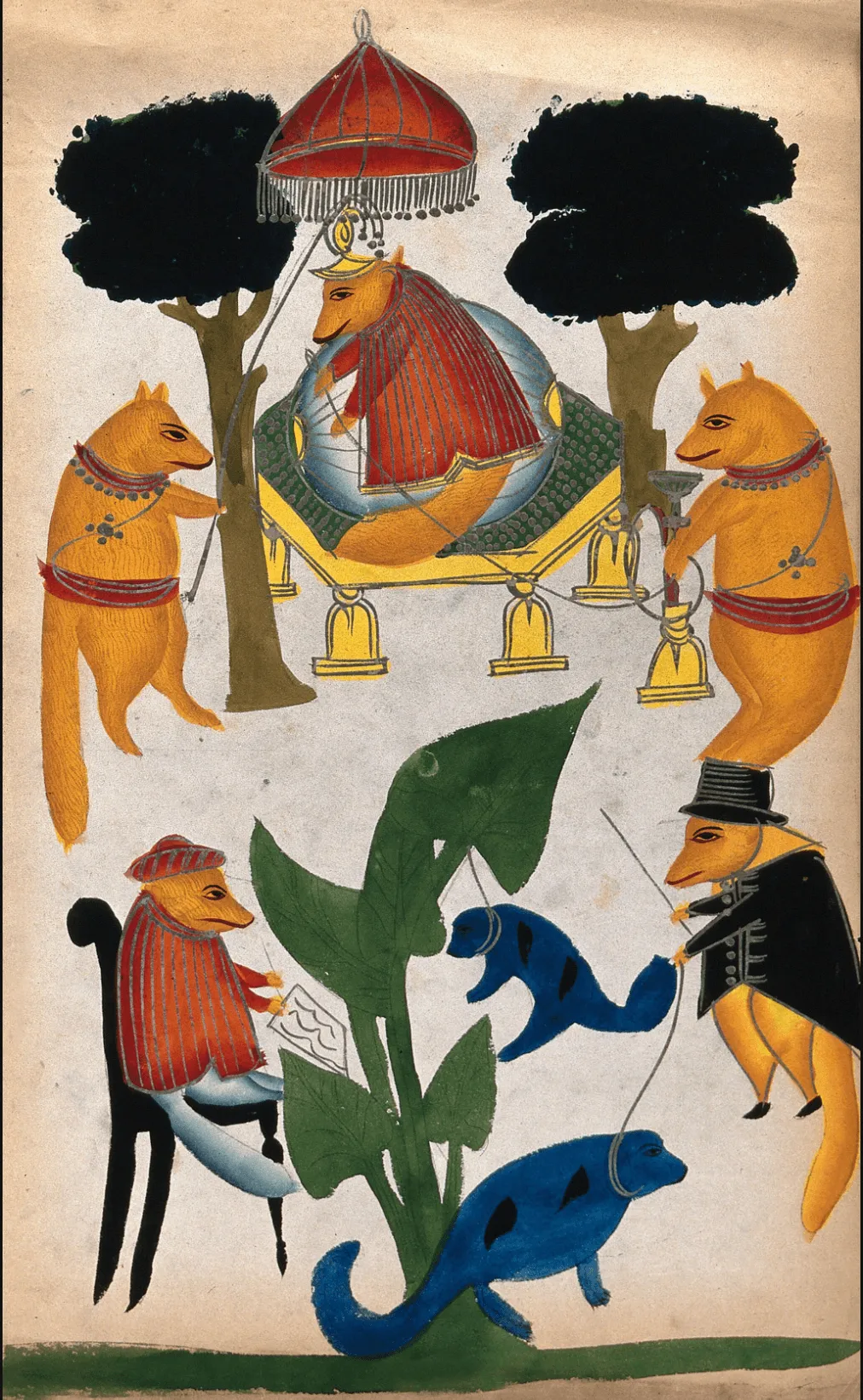
A satirical Kalighat watercolour of the Jackal Raja holding court, drawing on the Bengali saying that even in the jungle a jackal can be king. A coded commentary on petty rulership in colonial India. Source: Wellcome Collection
What links these targets is a shared concern with hypocrisy: the gap between what people claim to be and what their conduct reveals them to be. The babu claims modernity and progress, but the painting shows him squandering his wealth on courtesans. The priest claims renunciation, but the cat in the painting is eating the fish. The court claims justice, but the Jackal Raja is presiding over a parody of it. The Patuas are not condemning modernity, religion, or governance as such. They are condemning the specific persons who use these institutions as masks for self-interest.
Read this way, the satirical Kalighat tradition becomes one of the earliest sustained bodies of visual social criticism produced anywhere in nineteenth-century India. It runs roughly parallel to the social-reformist writing of Ishwar Chandra Vidyasagar and the early Brahmo Samaj, but reaches a different and far wider audience: the pilgrim, the casual buyer, the visiting foreigner, anyone who could afford a few annas and a wall to hang a picture on.
How Kalighat Painting Influenced the Bengali Cultural Renaissance
By the late nineteenth century, the same elite Bengali culture that Kalighat had been so willing to skewer began to recognise the form's serious artistic claims. The figures of the Bengal Renaissance, the broad cultural and intellectual flowering centred in nineteenth and early twentieth-century Calcutta, looked at Kalighat with a combination of embarrassment and admiration. The cultural ecology of the city in this period brought reformers, novelists, painters, poets, and political thinkers into close contact with each other, and the visual culture of the city, including Kalighat, was part of what they all worked with.
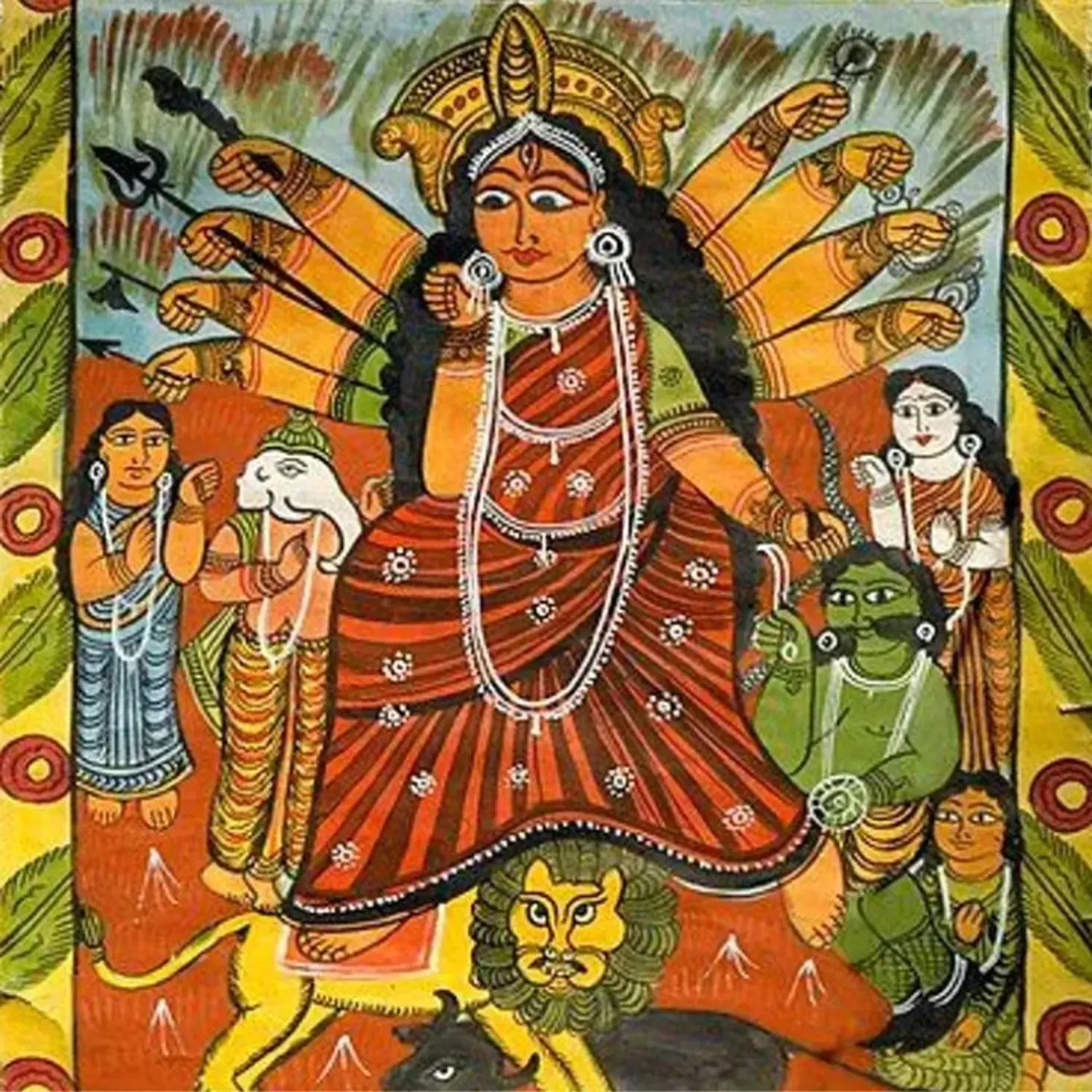
A Bengal pattachitra painting depicting goddess Durga. Image source: Wikipedia
Abanindranath Tagore, nephew of Rabindranath and the founding figure of the Bengal School of Art, drew on Kalighat directly. His 1905 Bharat Mata, painted in response to Lord Curzon's partition of Bengal that same year, became one of the foundational nationalist images of the Swadeshi movement. The visual economy of the work, the simplified figure, the flattened compositional plane, the deliberate refusal of European illusionism, owes a clear debt to Kalighat among other indigenous sources, even where the spiritual register and the moral subject are entirely different.
1905 the year Abanindranath Tagore painted Bharat Mata in response to Lord Curzon's partition of Bengal, forging a nationalist visual language that consciously rejected the academic European style being taught in colonial art schools.
Jamini Roy, working a generation later, took the relationship further. After training in the academic European style at the Government School of Art in Calcutta, Roy turned away from realism in the 1920s and rebuilt his entire mature practice on Kalighat foundations: the simplified figure, the bold black line, the flat unmodulated colour. He received the Padma Bhushan in 1954 and is now recognised as one of the most consequential Indian modernists of the twentieth century. His success demonstrated that a visual language descended from a folk tradition mocked by the colonial Calcutta art establishment could stand on equal terms with anything in international modernism.
The larger point is not about influence in the narrow art-historical sense. It is about what Kalighat's popularity proved before the Bengal School made it official: that a distinctly Indian visual language, built on indigenous compositional principles and techniques, could speak to a contemporary urban audience without leaning on European academic conventions. The Bengal Renaissance project of recovering and revaluing Indian art traditions was, in important respects, doing in the elite register what Kalighat had been doing in the popular register for half a century already.
Why Kalighat's Colonial-Era Significance Still Matters
There is a particular cost to remembering Kalighat only as folk art. Folk art, in the museum convention, is the timeless visual production of a settled rural community, valued for its tradition rather than its contemporary engagement. None of these characterisations fit the Kalighat that actually existed. It was urban, not rural. It was commercially produced for a market, not made for ritual within a community. It was sharply contemporary in subject matter, engaging with the specific political, social, and religious controversies of its decade. It was a form of popular visual journalism, and to call it folk art without qualification is to soften what it was doing.
The framing matters because it shapes how we value folk traditions more broadly. If Kalighat was visual journalism, then the question of whether a contemporary Patua is making work with comparable critical bite, comparable engagement with present-day controversies, becomes a meaningful one. The contemporary Kalighat artist is not simply preserving a visual vocabulary. They are inheriting a position from which to look at the world and call it to account, and the work is more or less serious depending on whether the artist takes that position up.
This framing also matters for collectors. Original Kalighat paintings by working Patua masters are not decorative objects with a heritage backstory. They are statements made by working artists about the world they live in, made within a tradition that has always combined devotional seriousness with sharp social observation. Buying one means choosing to participate, in a modest but real way, in the continuation of that tradition rather than its conversion into museum décor.
A Document of Its Time, A Statement of Its Maker
The pilgrim outside the Kali temple in 1860 buying her devotional Kali painting, and the babu two stalls down buying his satirical cat-with-fish, were both participating in the same tradition. The tradition held them both, because it was capacious enough to take devotion and critique seriously in the same visual breath. That is what Kalighat actually was, and what the best of the contemporary work in the tradition still is.
To look at a Kalighat painting carefully is therefore to look at two things at once: a document of its specific historical moment, with all the colonial frictions and social anxieties of nineteenth-century Calcutta visible inside it, and a statement by the maker about how the world should be looked at. Read this way, no Kalighat work is decorative. Every one of them, devotional or satirical, is an argument.