

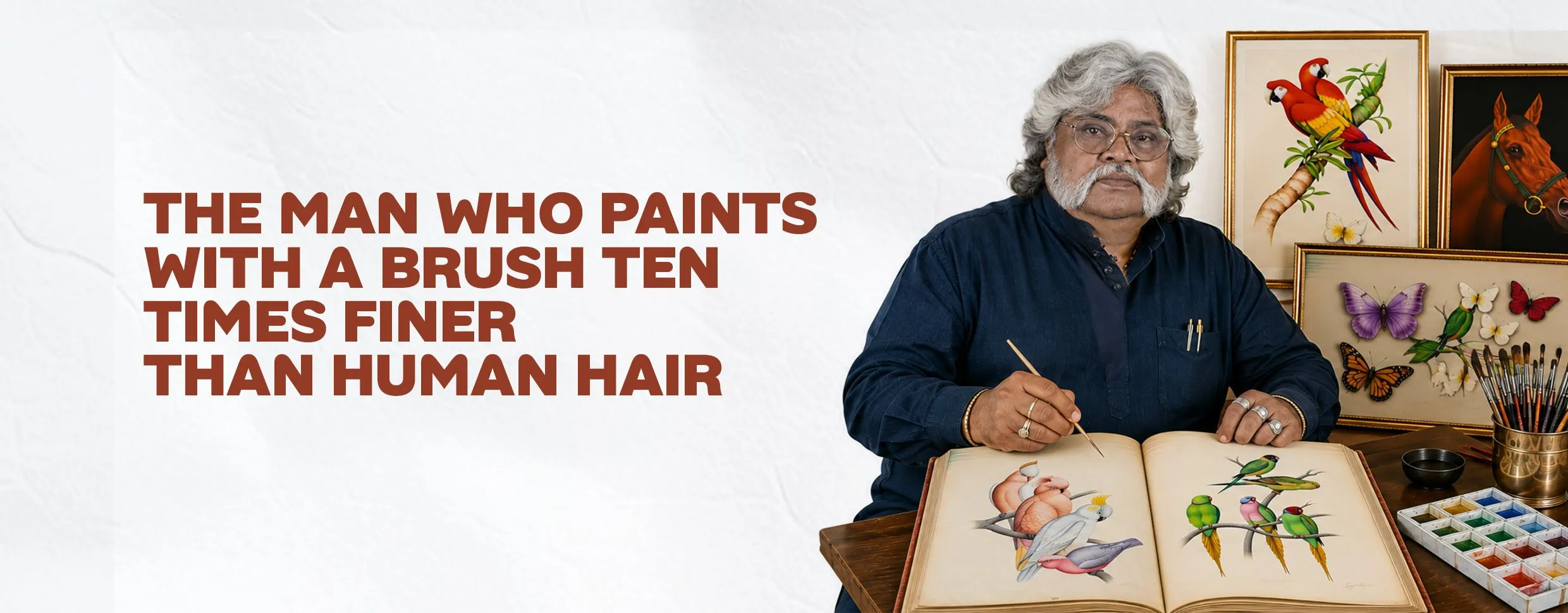
Jaggu Prasad: The Man Who Paints With a Brush Ten Times Finer Than Human Hair
Jaggu Prasad's paintings hang in American museums and Vasundhara Raje's collection. The miniature master names his real technique, corrects the brush myth, and reveals what his guru made him write on a painting.

Kartik Gaggar
Author
This piece is drawn from two long conversations Rooftop recorded with the miniature master Jaggu Prasad at his studio in Jaipur, translated and lightly edited for clarity. Over the two sittings he settled a widely repeated error about his own brush, named a technique that appears nowhere in English, and spoke plainly about what he believes will end with his generation.
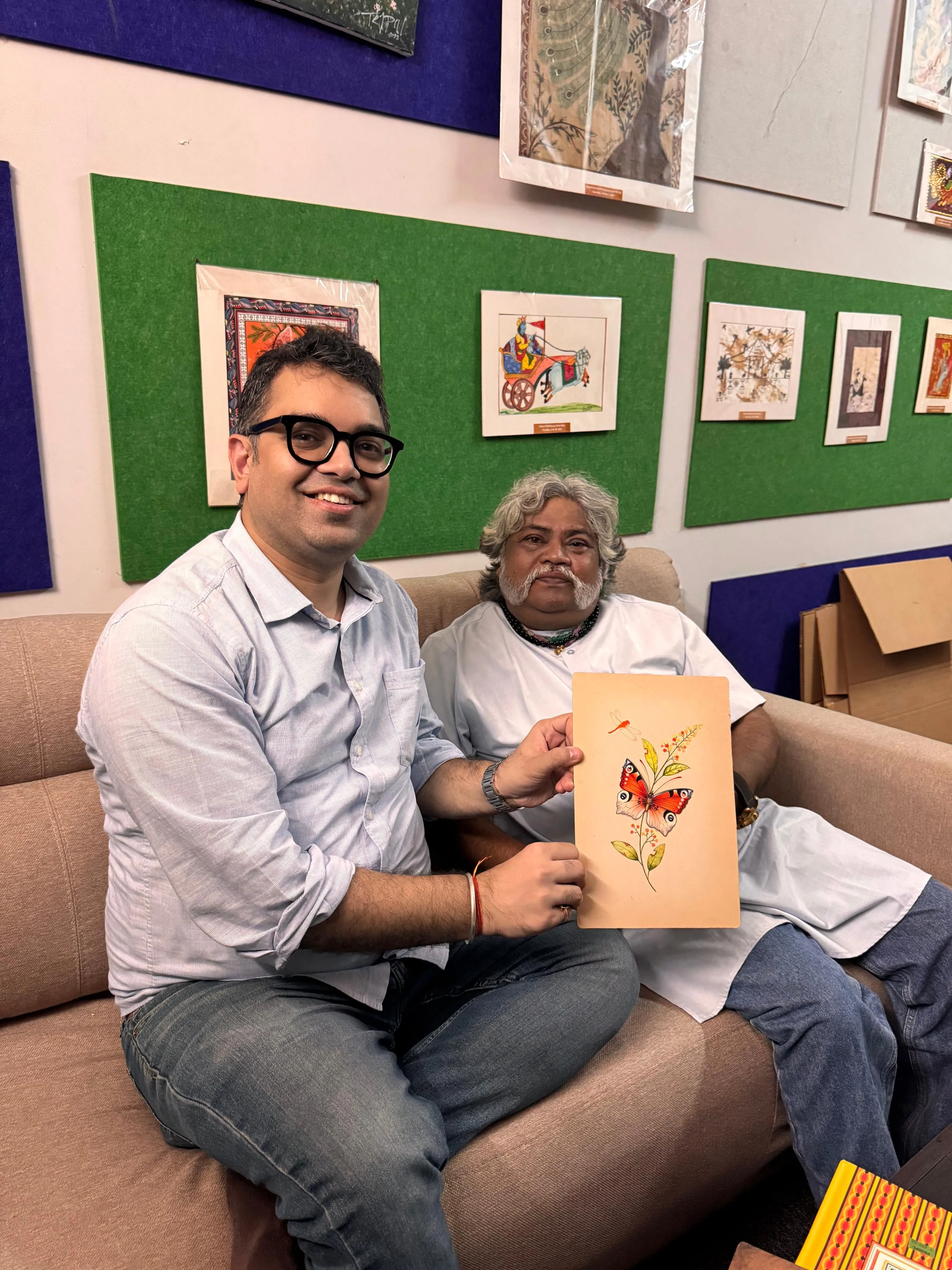
Rooftop's founder Kartik Gaggar with Master Artisian Jaggu Prasad
There is a version of this story that circulates on the internet, that Jaggu Prasad paints with a brush made from a single otter hair. It is close, and it is wrong, and the correction matters more than the myth. It isn't actually otter hair, he told Rooftop, settling the record himself for the first time. It is crafted from the fine tail hair of a squirrel. Inside the ferrule sit roughly five hundred individual hairs bound together, and wet, they converge into one working point that he describes as almost ten times finer than a strand of human hair.
Nobody has printed this correctly because nobody had asked him. That single exchange set the tone for two long conversations, in which one of India's most exacting living painters walked through his tools, his vocabulary, his teacher, his collectors and his fears, and corrected the record at nearly every point where a record existed at all.
W H A T I S R E P E A T E D: That Jaggu Prasad works with a brush made from a single otter hair, a line reproduced across articles, listings and gallery notes for years.
W H A T H E S A Y S: The brush is bound from squirrel tail hair, around five hundred strands, which converge when wet into a point roughly ten times finer than a human hair. Only a small portion of a squirrel's tail carries the resilience and taper the work needs.
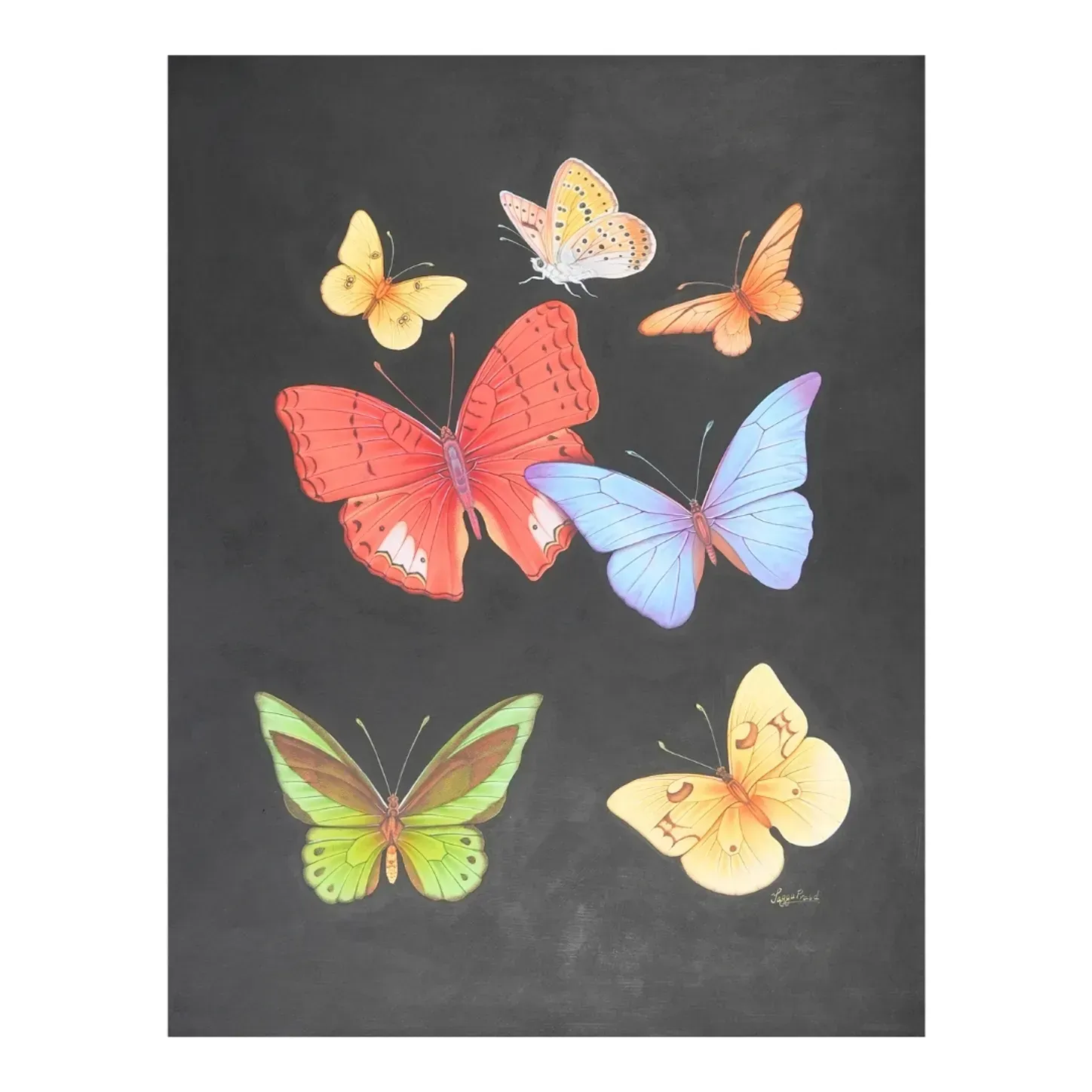
Wings of Harmony, an original watercolour miniature, the scale at which his brush actually works.
A Technique With a Name Almost Nobody Knows
Ask most people what makes his paintings so uncannily lifelike and they will say dot work, or reach for the borrowed English word pointillism. He has a different word, one that belongs to Jaipur's own painting vocabulary, and he spelled it out twice to make sure it was recorded correctly. Partaj. It is the seamless gradient shading built dot by dot into a bird's feather or a fold of drapery, so that tone shifts from light to dark with no visible line at all. The word comes from par, meaning a bird's feather. As far as we can establish, it is essentially undocumented in English anywhere online until now.
The sequence he follows has names too, each one a small piece of a vocabulary most articles never think to ask about. He builds a painting in four named stages, and he named them in order without hesitating.
- The sketch. A light graphite drawing on handmade wasli paper, done with nothing heavier than a 0.5mm mechanical pencil, because charcoal or soft graphite would be far too messy and thick for work at this scale.
- Dharawat. The flat foundational washes, the base colour laid down and locked in before any detail begins.
- Kalam. The fine outlining, the lining stage that defines every form before it is shaded.
- Partaj. The long, slow end of the process, micro-shading, texture, highlight and depth built layer upon layer, dot by dot, with the squirrel-hair brush. Depending on scale and complexity, a single painting takes anywhere from four days to six months.
And he does all of it, he confirmed plainly, without a magnifying glass, a jeweller's loupe or a microscope of any kind. None at all, he said. It is essentially a form of deep visual meditation, a dhyan in which the consciousness shrinks down entirely to the microscopic tip of the brush. If the mind wanders even for a fraction of a second, the line ruins. Hand, eye, breath and brain, in his description, must operate in complete synchronisation. Ambient music or a radio can play, but the visual focus stays locked on the paper. Training the eye and hand to hold that steadiness takes, by his estimate, two to three years of daily practice before the strokes stop shaking.
Four named stages, four days to six months
Wasli paper and a 0.5mm pencil sketch, then Dharawat for the base washes, then Kalam for the outlining, then Partaj, the dot-built gradient shading that gives the work its depth. No magnification is used at any stage.
Ten Feet Away It Is a European Oil Painting. Up Close It Is a Manuscript.
Asked where his work sits between Indian miniature tradition and European hyper-realism, he did not reach for a vague answer about fusion. He has thought about it precisely, because he engineered the fusion himself, deliberately, over years.
Traditional Indian miniatures, he explained, are flat, two-dimensional and meant to be held close to the eyes like reading a manuscript. Mount one on a wall and step five feet back and it fades out. Classical European oil paintings work the opposite way, dramatic from across a room, but mostly heavy, coarse brushwork the moment you approach. His own paintings are built to defeat that trade-off entirely. Stand ten feet away, he said, and the painting has the depth, realism and three-dimensional pop of a European oil. Walk up close and inspect it under a lens and you find the microscopic detail, the delicate line work and the soul of a traditional Indian miniature.
He built that bridge through a decade most artists never get. Early in his career his guru introduced him to a German art connoisseur who commissioned meticulous miniature reproductions of European classical masterworks. Ten years of that discipline taught him European lighting, perspective and atmospheric depth, which he then carried back into watercolour using an Indian miniaturist's brush and an Indian miniaturist's patience.
There is a second, quieter technical secret behind the paintings' glow, and it has nothing to do with the brush. Most artists muddy their watercolours by over-mixing too many pigments on the palette, he said. Mix three or four colours and the paint loses its optical clarity and turns dull. He works instead from a master Winsor and Newton palette of a hundred and five individual colour tubes, so that he almost never has to heavy-mix, applying clean, pure glazes that keep the crystalline brilliance intact. For certain classic earthy tones he still processes traditional Indian mineral pigments, the desi rang, but the imported watercolours earn their place on lightfastness, holding their colour across decades. Nothing is varnished at the end.
Traditional miniature watercolours are left raw, handled carefully, never sprayed with fixative.
Then he offered an observation that reframes what these paintings actually are. A camera lens has a limited depth of field, so if it focuses on a flower in the foreground the background blurs. In his paintings he overrides that limitation, holding foreground, mid-ground and background in crisp, uniform detail across the entire surface. Only a human hand and eye, he said, can achieve that hyper-focused harmony. His paintings are not photographs rendered by hand. They are images a camera physically cannot take.
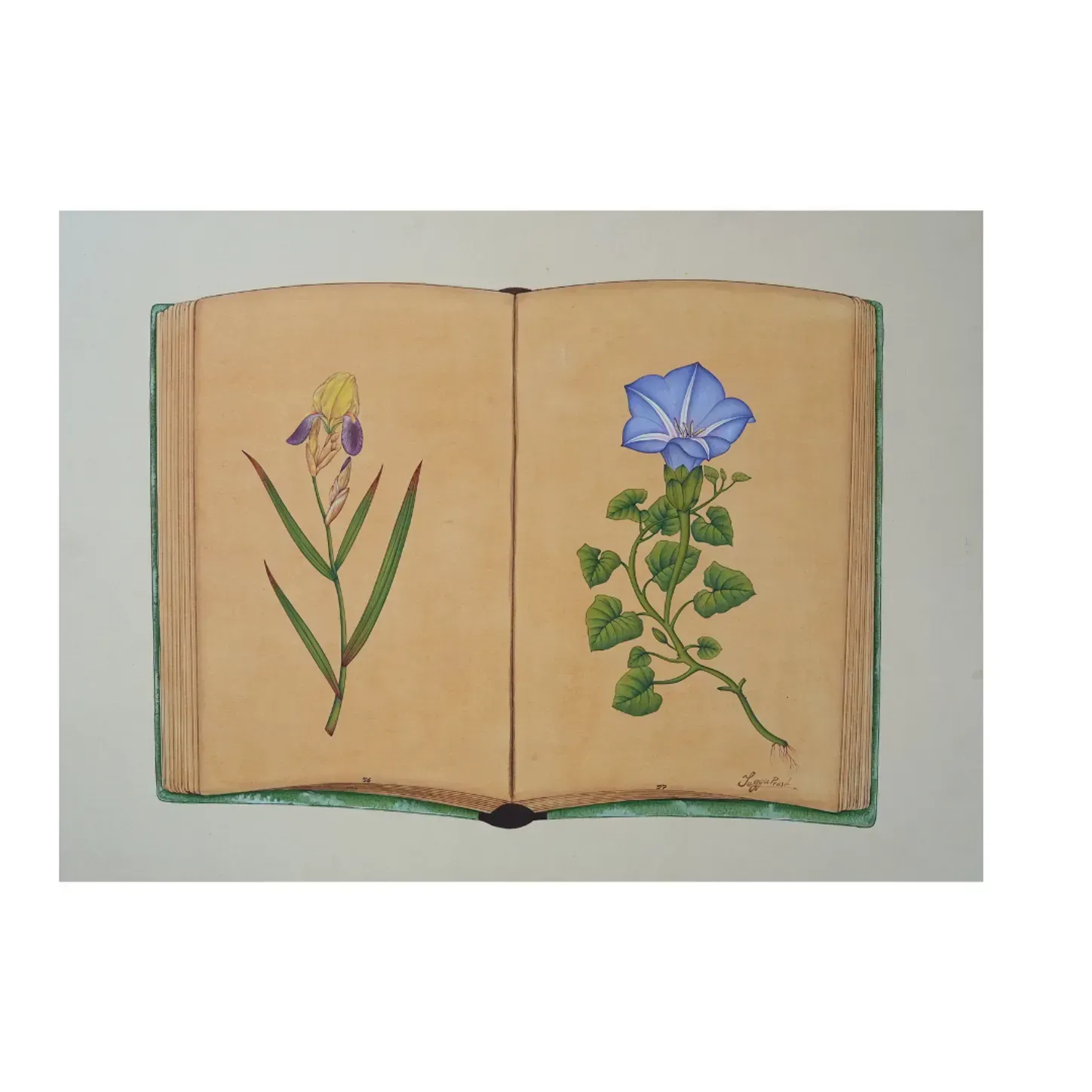
Botanical Compendium, where foreground, page and background all hold the same uniform focus.
This is the quality that only registers properly in person, and it is why his originals reward standing close. A work such as Wings of Harmony, a thirteen by seventeen inch watercolour of six butterflies suspended against a deep, velvety ground, carries the whole argument in a single frame, the European depth at a distance and the Partaj detail at arm's length.
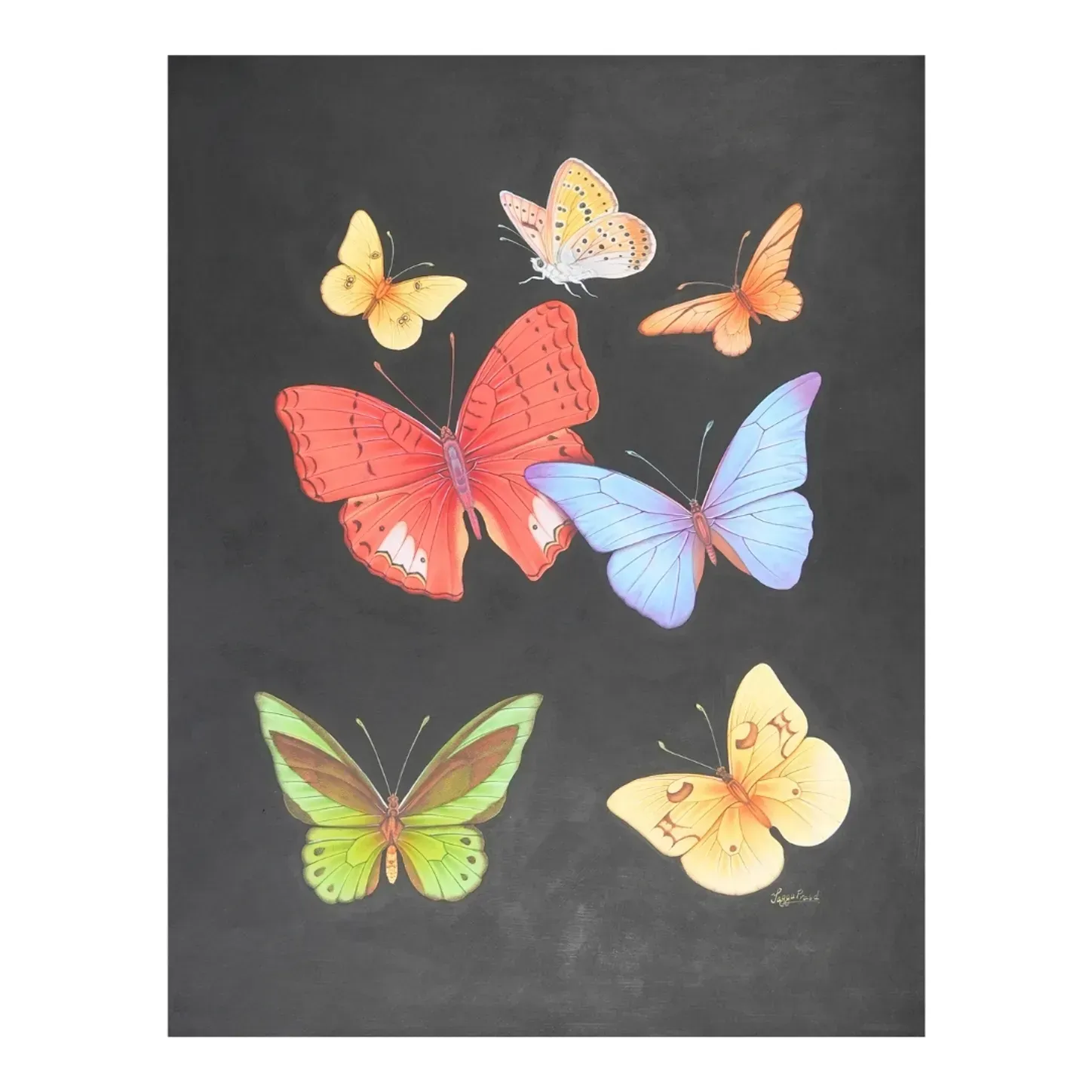
Wings of Harmony, original watercolour miniature, with signed certificate of authenticity.
The Correction His Guru Made Him Write on His Own Painting
Every serious artist has an origin story about the moment discipline replaced pride. His happened under Padma Shri Kripal Singh Shekhawat, and he tells it with visible fondness decades later.
As a young student he painted a detailed study of a flower, worked hard on it and felt proud of it, and brought it to his guru expecting praise. Shekhawat ji looked closely at the painting, then picked up the reference illustration the boy had copied from, and asked quietly how many veins the reference leaf had. Five, sir, the young Jaggu answered. His guru pointed at the painting. Six. Take your pen, he said, and write right here on the corner of your painting, this leaf has one extra vein due to carelessness.
He made him write it, on the painting itself. Nakal me bhi akal chahiye, he summarised, even when you copy, even when you study nature directly in front of you, it demands absolute, flawless observation. He has never forgotten it.
What he took from Shekhawat ji went well beyond that lesson. He absorbed colour harmony, visual balance, classical paper preparation, brush making and the spiritual discipline of the work. And he is careful to distinguish his own path from his teacher's. Shekhawat ji's style was shaped by Nandalal Bose and the Bengal School, characterised by bold sweeping outlines and flat colour washes, without heavy Partaj shading. He took those foundations and evolved them into hyper-realism, which is a rare thing for a student to say clearly, that the inheritance was real and the direction was his own.
Trained under a Padma Shri, then deliberately diverged
Jaggu Prasad learned colour harmony, paper preparation, brush making and discipline from Padma Shri Kripal Singh Shekhawat, whose own style followed the Bengal School's flat washes and sweeping outlines. The dot-built Partaj hyper-realism that defines his work today is his own development from those foundations.
How to Tell a Real One
Ask him how a collector, an auction house or an enthusiast can tell an original from an imitation or a high-resolution print, and precision is the first thing he names. A print or a superficial copyist can never replicate the luminous, multi-layered depth created by thousands of hand-rendered Partaj strokes. The depth is not printed on the surface. It is built into it.
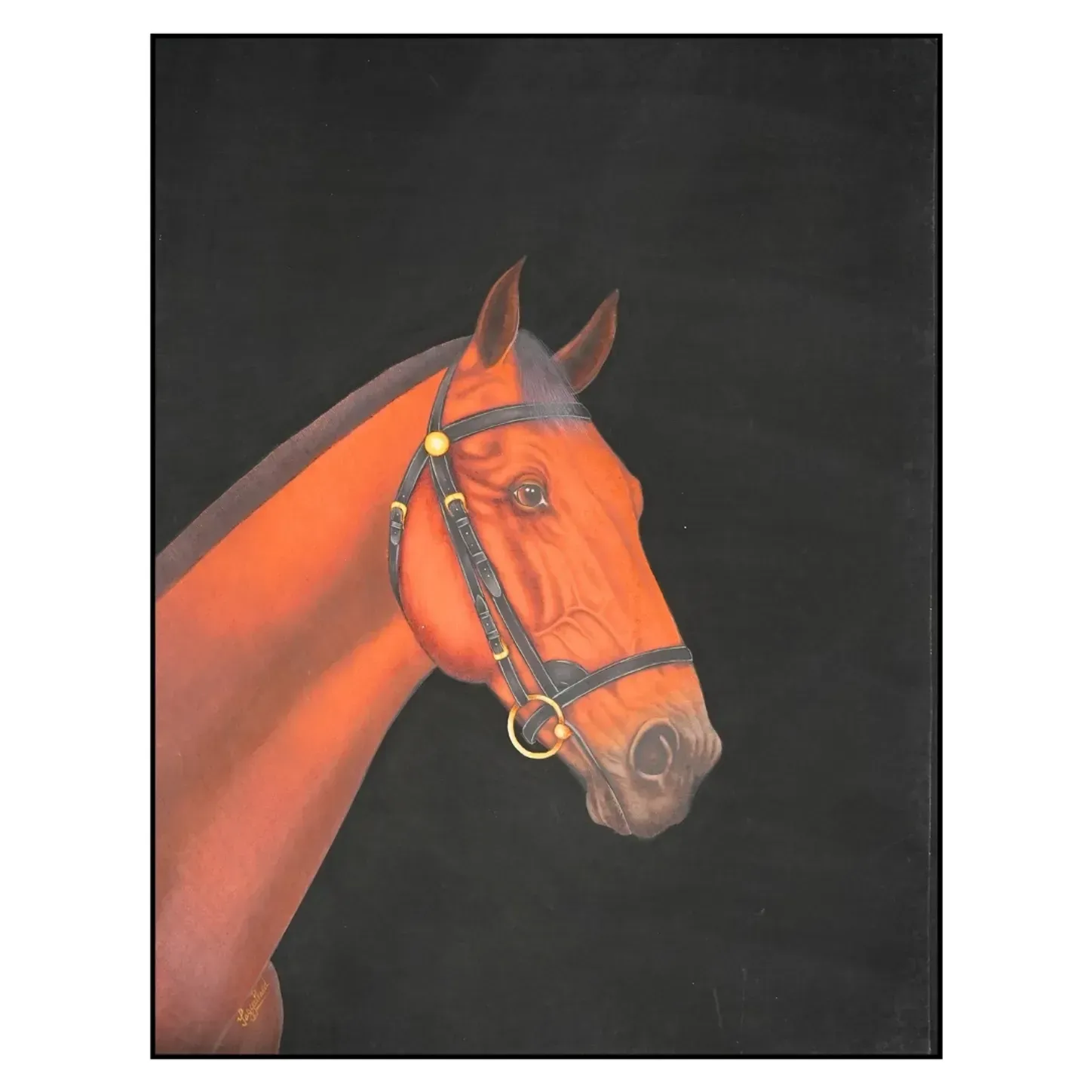
Then he revealed a second, quieter tell. He never signs a painting with a bold, flashy signature across the front. His name always goes down in microscopic, delicate lettering, concealed within the natural shadows or the foliage of the composition, so that it never disrupts the visual harmony of the work. The signature is not a claim stamped on the painting. It is hidden inside it, at the same scale as everything else he does.
W H A T I S R E P E A T E D: That a hyper-realistic miniature can be judged from a photograph or a high-resolution scan.
W H A T H E S A Y S: The proof of an original lies in layered Partaj depth that no print reproduces, and in a signature so small and so deliberately hidden within shadow or foliage that most viewers never find it at all.
The Collection List Nobody Has Printed
Provenance is usually the hardest thing to get an artist to discuss plainly, which is what makes his answer unusual. Former Rajasthan Chief Minister Vasundhara Raje holds somewhere between a hundred and fifty and two hundred of his paintings. The Maharaja of Madhya Pradesh owns his work. In Jaipur, Samode Haveli holds pieces, as does the Dhabai family, along with many prominent art patrons. He has been invited to their homes, shared meals with them, spent time with them. The people who hold his work, as he puts it, truly value art.
He also spoke warmly, and anonymously by his own choice, about a Jaipur collector who has since died. The man was in the fine jewellery trade but had a genuine soul for art, and loved the work from the very beginning, picking up a piece nearly every time he visited. Asked for the name, he declined, out of consideration for the family, which tells you something about how he handles the relationships behind his sales.
And four of his paintings live permanently inside a botanical museum in Pittsburgh, a three-storey institution he describes as packed with botanical masterpieces by top-tier artists from around the world, with standards rigorous enough that he called the placement a monumental milestone. He has seen it in person. That placement happened through Dr Mohammad Faizal, an American collector and champion of his work, who showed his paintings in international galleries, published books featuring them, introduced him to global collectors, and arranged an entirely United States government-sponsored trip.
The details of that trip are worth recording, because they describe a level of institutional respect Indian traditional artists rarely receive. Flights, stay and expenses covered from the moment he left his house. A month-long exhibition. Masterclasses running three to six days at a time, four or five students per batch, for which he received an honorarium of a hundred dollars a day, with students often leaving envelopes of two or three hundred dollars at the end of a workshop. He taught and exhibited in San Francisco, in Kentucky and in Pittsburgh, across three trips abroad in total. The students there, he said, were fascinated by the sheer patience and micro-detail the work demands.
Three international invitations. Zero from within India.
Jaggu Prasad has been hosted, sponsored and paid to teach by institutions in the United States, and four of his paintings sit permanently in a Pittsburgh botanical museum. Asked whether any Indian institution has ever invited him for a residency or a workshop, his answer was direct. None at all.
That last fact sat quietly in the conversation without any complaint attached to it, which somehow made it land harder. A painter whose work is preserved in museum collections in London, Paris and the United States has never once been asked to teach by an institution in his own country.
What He Thinks Will Die With Him
Ask about legacy and the warmth drops slightly, replaced by something more sober. He has a quiet realisation, he said, that this refined art form might end with his generation. No dedicated students are coming forward to master it.
The arithmetic of learning explains why. It takes at least a year simply to train a hand to hold steady, two to three years before eye and hand move in genuine synchrony, and today's students, he said, tire out within an hour or two when asked to render thousands of microscopic dots. People occasionally drop by for a few days to gather surface-level tips, how a brush is held, how pigments are mixed, and then they leave. Nobody is willing to surrender years of their life to the craft.
The economics compound it. Traditional artisans often discourage their own children from the work because returns are slow, dealers take large cuts and payment cycles are unreliable. Formal art college instruction, in his blunt assessment, is deeply flawed, because most instructors themselves lack practical mastery of the traditional micro-techniques. And in the auction market, traditional Indian miniature work, despite requiring a hundred times more labour and skill in his words, still sells for a fraction of what modern or abstract art commands, with auction houses taking around a third in commission besides.
His own family tells the same story. He trained his two younger brothers, and while they practise, the work stayed functional and commercial, without deep mastery or passion. His own son and daughter never took to it at all, despite his best efforts when they were small. He now watches his grandchildren, aged eight, twelve and fifteen, with quiet hope and no expectation, fully aware that across Indian art broadly, by his estimate, barely two percent of an artist's children successfully inherit and continue the legacy. You can pressure a child into engineering or medicine, he observed.
You cannot pressure anyone into becoming an artist.
Even the brush is part of that fragility. Squirrel tail hair can no longer be legally sourced the way it once was, since Indian law bans the trade in wildlife-derived art materials. Today the hair comes only from squirrels found already dead, washed, treated, stored flat in paper, and bound into brushes by the artists themselves. No harm is done to living animals today, he said, and then recalled how, as children, they would gently trap a squirrel under a wicker basket, draw the tail tip through the mesh, trim a few hair tips and release it unharmed, a practice now illegal in itself. Internationally, painters use Kolinsky sable or Chinese animal-hair brushes. In India, squirrel and mongoose hair are both banned, and the commercial market has moved entirely to synthetics.
W H A T I S R E P E A T E D: That traditional miniature technique is simply an inherited family trade, passed down automatically through the generations.
W H A T H E S A Y S: He trained his brothers and tried to teach his own children without success, has no disciple today, and estimates that barely two percent of Indian artists' children carry the legacy forward. The transmission has to be chosen, and almost nobody is choosing it.
The Painting He Says He Could Never Make Again
Of the thousands of works across his life, one sits apart, kept in his own collection at home rather than sold, and he treats it as a benchmark. It is a painting of macaw parrots in the dense Amazonian rainforest of South America, capturing the raw, layered atmosphere of a wild jungle in absolute micro-detail. It took six full months of continuous labour. Looking at it today, he said, he knows his hands could never recreate that level of microscopic precision again.
Age has begun to catch up with the discipline. His hands tremble slightly now, and even after lens surgery he can no longer sustain the twelve to eighteen hour sessions he managed effortlessly in his youth. He paints in shorter stretches, paced to what his body allows, with the output naturally slowed.
What has not changed is the way the work happens. When a piece starts coming alive, he said, you enter a state where time ceases to exist. He described being so lost in the brushwork that hours pass unnoticed, and his wife coming in to scold him, asking whether he intends to sit there all day without eating or drinking. He also described the opposite experience, sitting down with a clear vision that refuses to come together despite endless effort, and then, on another day, approaching a surface casually and watching something remarkable flow out. When a painting starts losing its spirit, he sets it aside untouched until the right inspiration returns. He does not push a failing piece to completion, which is one reason his portfolio holds so few weak works.
Asked whether he has already made his ultimate painting, he said no, and was specific about why. There are complex ideas lingering in his mind that he has not been able to execute, something monumental he wants to make, a piece that would stand out globally. What he lacks now is not the vision but the circumstances and the physical stamina to sit down and bring it into the world.
Lavanya, and the Only Thing He Wants You to See
We ended by asking what no interviewer has ever asked him, the thing he wishes the world understood about his work. His answer was simple, and it is the closest thing to a personal philosophy he offered across two long conversations. His only wish, he said, is that when a person stands in front of one of his paintings, they pause and realise they are looking at human craftsmanship pushed to its absolute physical limit.
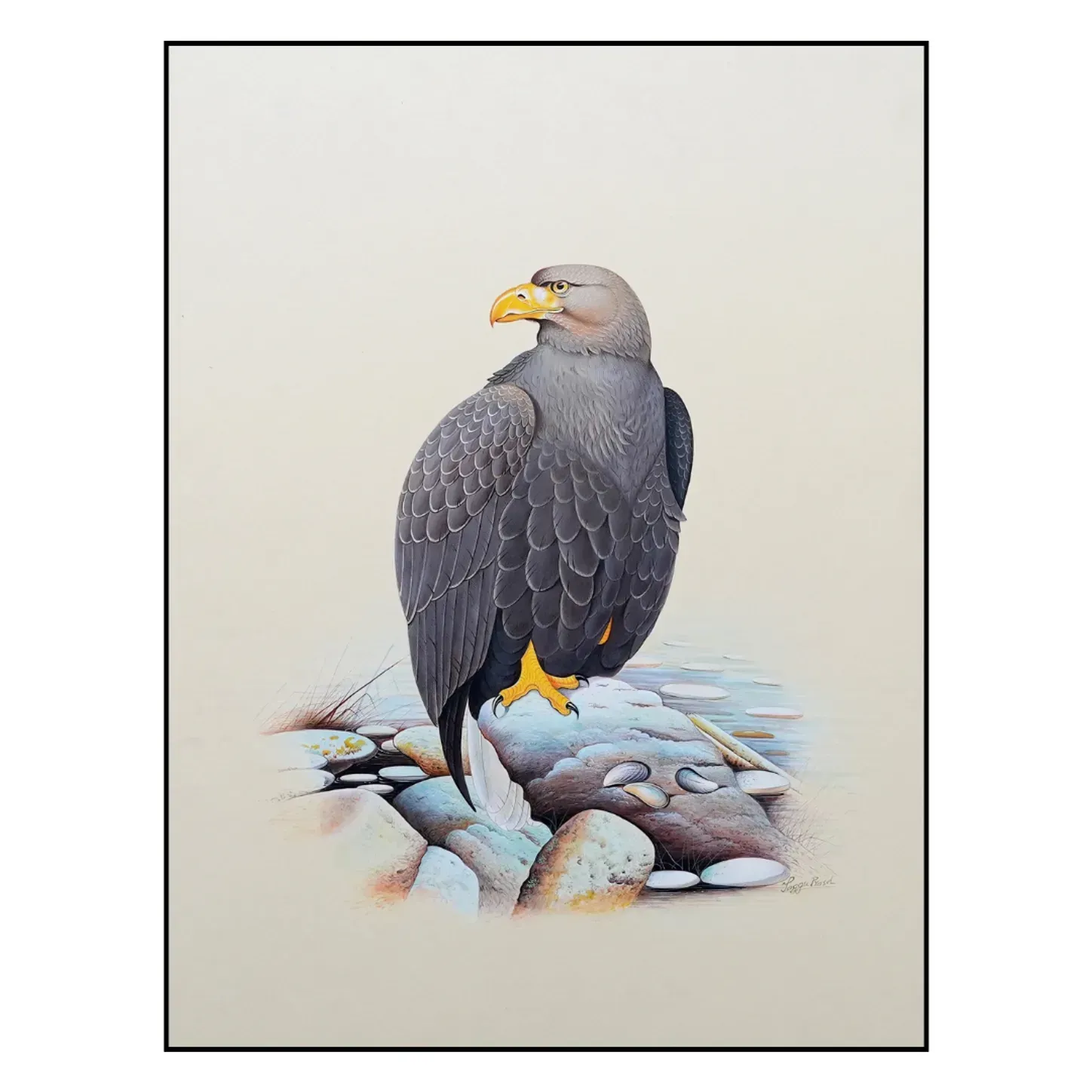
He expanded on it with a word worth keeping. He pays fanatical attention to structural perfection, realistic anatomy and balance, and nothing in his compositions is ever warped or sloppy. Even a tiny insect, something most people find unappealing, he renders with such delicacy that it becomes captivating to look at. That, he said, is the core purpose of art, to manifest Lavanya, pure and graceful aesthetic beauty. It is a classical idea of loveliness, and he uses it as a working standard rather than as decoration on the conversation.
He paints, by his own account, primarily for his own conscience. Money has always taken a back seat. What matters is finding someone who truly understands and cherishes the work, and that connection matters more to him than a price tag. Modern art trade, he observed, has become purely commercial, and those who approach art with a businessman's mind achieve fame faster. He is not built that way. He sits in his studio and paints, a handful of works sell each year, and that is enough to run his household comfortably. It is a quiet, self-sustained rhythm, and he described it without a trace of envy for the other kind.
See the Work, or Learn the Discipline
His originals are available to view and collect through Rooftop, each hand-painted on paper, each carrying a signed certificate confirming the artist, medium and originality. Works such as Botanical Compendium, along with the long Botanicals and Bonsai series, show the range of a painter who has spent a lifetime insisting that a leaf be given exactly the number of veins it actually has.
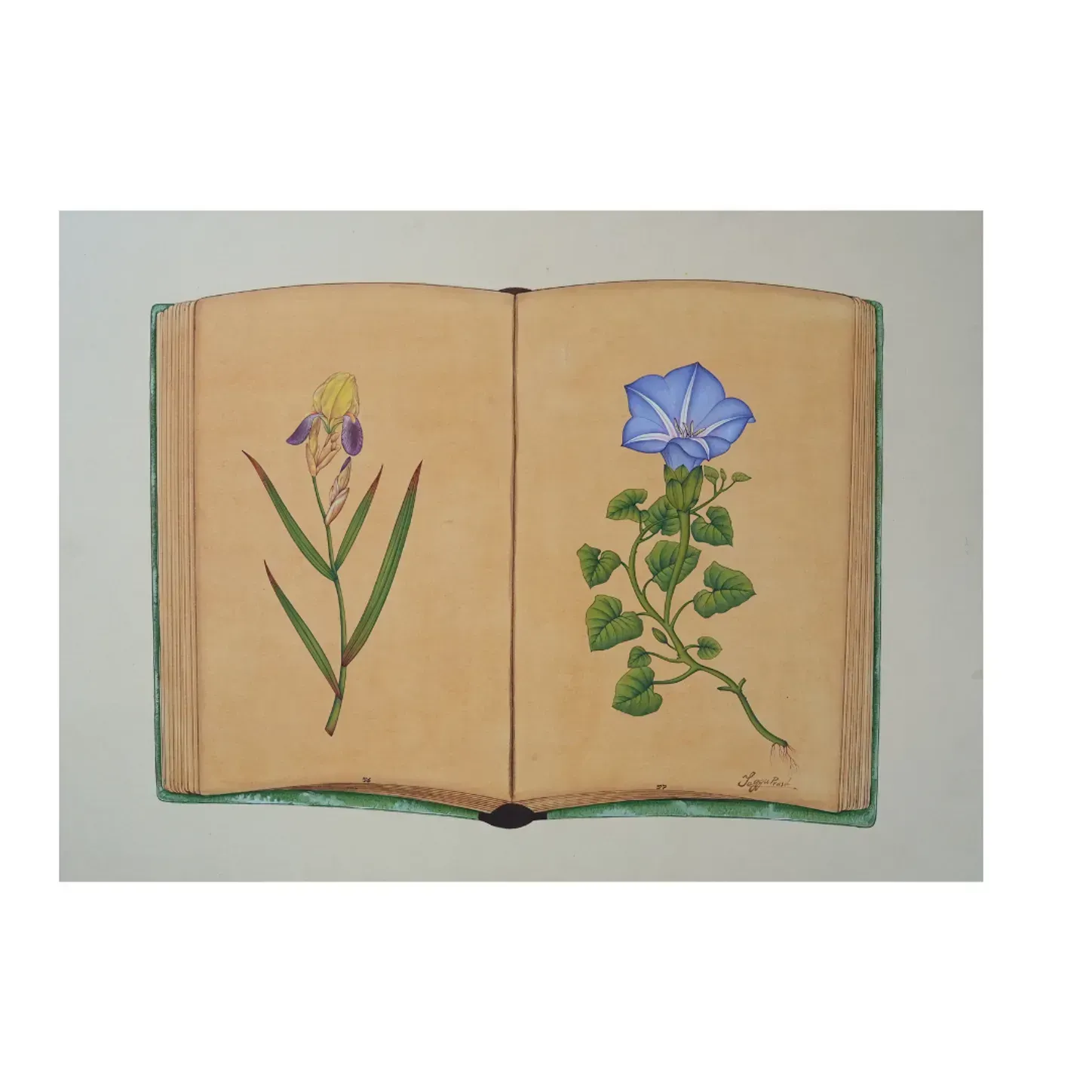
Botanical Compendium, original watercolour on paper, with signed certificate of authenticity.
And the discipline itself is teachable, which is the part he cares about most. He has recorded a full masterclass covering the entire process, from preparing the paper and the initial sketch through to the final micro-details, and it sits alongside the other maestro-led traditional courses on Rooftop, where the miniature schools of Jaipur, Bikaner, Kishangarh, Jodhpur, Kota Bundi and Nathdwara are taught by the masters who hold them. Given how plainly he says that no one is coming forward to learn, a recorded course by a man of his standing is not a convenience. It is a hedge against exactly the loss he described.
There is a closing window here, and he is the one who named it. A brush bound by hand from naturally shed squirrel hair, a shading technique whose name had never been written down in English, a signature hidden inside a shadow, and a painter telling you, without self-pity, that this might end with him. The least any of us can do is stand close enough to see what he actually made.