

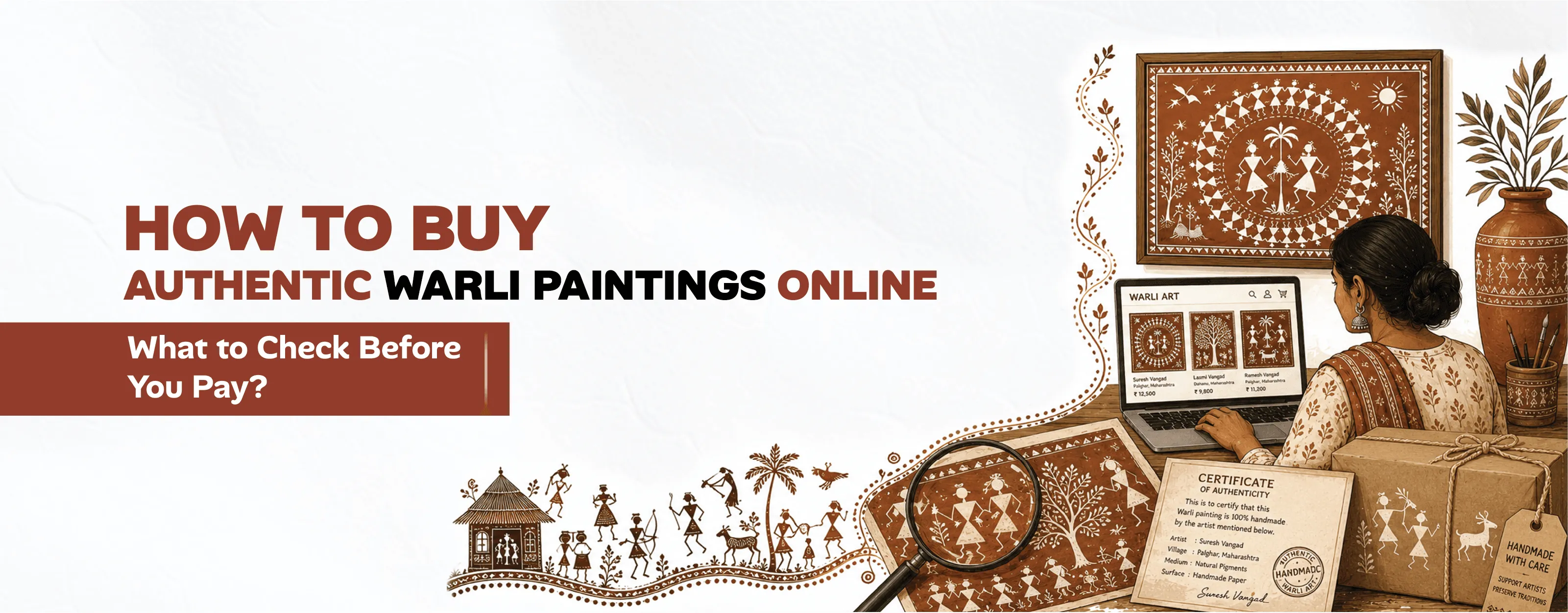
How to Buy Authentic Warli Paintings Online: What to Check Before You Pay
Worried about printed fakes? This guide shows how to buy an authentic Warli painting online, spot handmade vs printed, read the price, and check provenance before you pay.

Rooftop
Author
Let us name the fear out loud, because everyone buying their first Warli has felt it. You find a piece you love, you pay for it, and when the parcel arrives you cannot shake the suspicion that what is now on your wall is a machine print of a Warli design rather than a painting at all. That fear is reasonable. The online market is full of screen-printed Warli on fabric and paper, sold with the same words and often the same photographs as genuine hand-painted originals, and most first-time buyers honestly cannot tell the two apart until it is too late to do anything about it.
This is a practical guide to closing that gap. By the end you will know what separates an authentic hand-painted Warli from a printed look-alike, what actually drives the price, the specific mistakes that catch new buyers, and how to buy online without gambling. None of it needs an art degree. It only needs knowing where to look, so let us start with why the confusion exists in the first place.
##Why This Confusion Exists
Warli is unusually easy to fake, and the reason is built into the art itself. A Warli painting is essentially a clean two-tone line drawing, white figures on a dark ground, with no colour blending and no fine shading to reproduce. That is exactly the kind of image a scanner and a printer handle almost perfectly. A complex oil painting loses itself in reproduction, but a crisp Warli line survives the trip to a printing press with very little visible loss, which is precisely why printed copies are everywhere.
The economics make it worse. At the point of sale, the difference between a screen print and a real painting of the same motif can be as little as a couple of hundred rupees, so the printed version does not even look suspiciously cheap. It just looks like a slightly better deal, which is the most dangerous kind of trap for a first-time buyer.
A few hundred rupees can be the only visible gap Between a screen-printed Warli and a hand-painted original of the same motif, the price difference at checkout is sometimes barely two hundred rupees. The cost is hidden in everything you cannot see in a thumbnail: the artist, the hand, the provenance.
There is also a legal grey zone that very few buyers understand. A Geographical Indication tag protects a product made by approved producers in a particular region, but it does not protect a visual style, which means printing a Warli-style image is not illegal even when it pays the community nothing. Rooftop's explainer on how GI tags and intellectual property rights protect Indian art lays out why the law leaves this loophole open. The platforms where this confusion shows up most are not always bad actors either. Many are large marketplaces that simply aggregate thousands of sellers and have no structural way to verify who actually made a given piece.
It is worth being clear that you are not foolish for getting caught. The traps are well built. Sellers routinely use a genuine artist's photograph to sell a printed copy, so the image you fall for may be entirely real even when the object shipped to you is not. Bulk-printed Warli is often produced far from Maharashtra and drop-shipped, with the word handmade added to the listing as marketing rather than fact. When the photo is honest and only the object is fake, no amount of staring at the screen will save you, which is exactly why you need markers you can verify rather than just a good eye for a nice picture.
##Five Things to Look for Before You Buy
Once you know the tells, a hand-painted Warli and a printed one stop looking alike. Five markers do almost all the work, and you can check most of them from good listing photos before you ever pay.
- Uneven line weight. A bamboo stick loaded with rice paste makes a living, slightly trembling line that swells and thins as the artist's hand moves. A printed line is mechanically uniform from end to end. If every stroke looks identical in thickness, be suspicious.
- A hand-prepared ground. Real Warli sits on a surface that was made by hand, a cow dung or geru-toned ground or genuine handmade paper, with a texture you can almost feel through the screen. A print sits on flat, even machine stock that looks too clean.
- Visible layering. Look for tiny ridges where the paint sits thicker, small overlaps where one stroke crosses another, the faint evidence of a brush. A print is perfectly flat, with no relief at all.
- No perfect repetition. In a hand-painted scene, ten dancers in a row will each differ a little, because no human repeats a shape exactly. In a print, repeated figures are mechanically identical. Hunt for that giveaway sameness.
- A named artist and region. A genuine listing names the artist, their community and their district, usually Palghar or Thane in Maharashtra. A listing that only says tribal art or Warli art, with no human attached, is telling you something by what it leaves out.
Two habits make these markers easy to use in practice. First, always ask the seller for close-up detail shots and, if you can, a short video that pans across the surface in raking light, because layering and brush texture are obvious in motion and invisible in a flat thumbnail. Second, ask a direct question about the artist and the substrate. A genuine seller answers instantly with a name and a material. A reseller of prints gets vague, changes the subject, or sends back a generic paragraph. The quality of that answer tells you almost as much as the painting does.
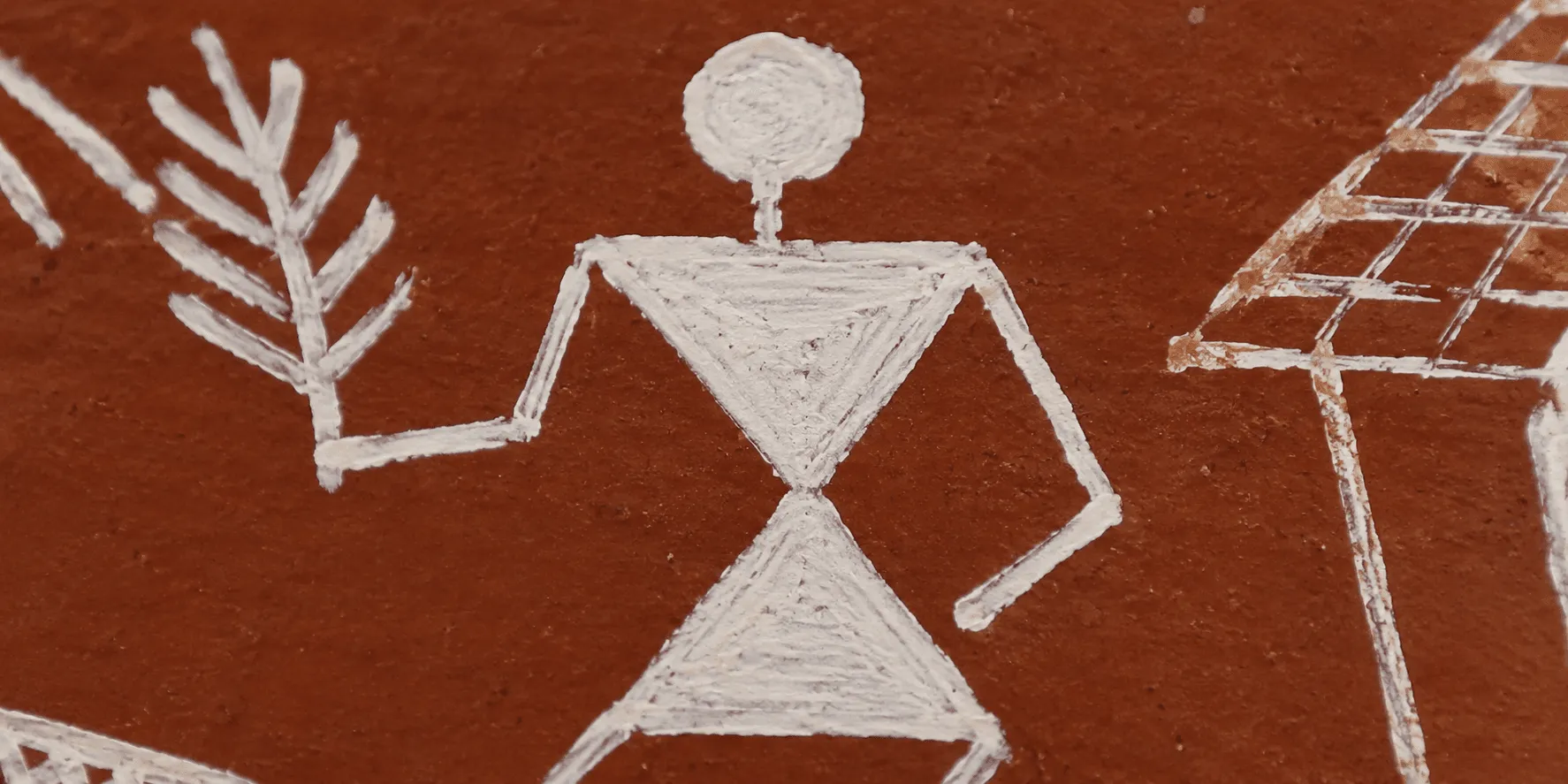
[ Image: macro close-up of a Warli figure showing uneven bamboo-stick brush lines ] The uneven, living line of a bamboo-stick brush, impossible for a print to fake.
It helps to study a verified original closely while the markers are fresh. A certified piece such as The [Delicate Web of Life (https://rooftopapp.com/shop/paintings-indigenous-art-tribal-art/the-delicate-web-of-life) shows all of them at once, the trembling line, the prepared ground and the small irregularities that announce a human hand, with the artist and origin stated plainly on the listing.
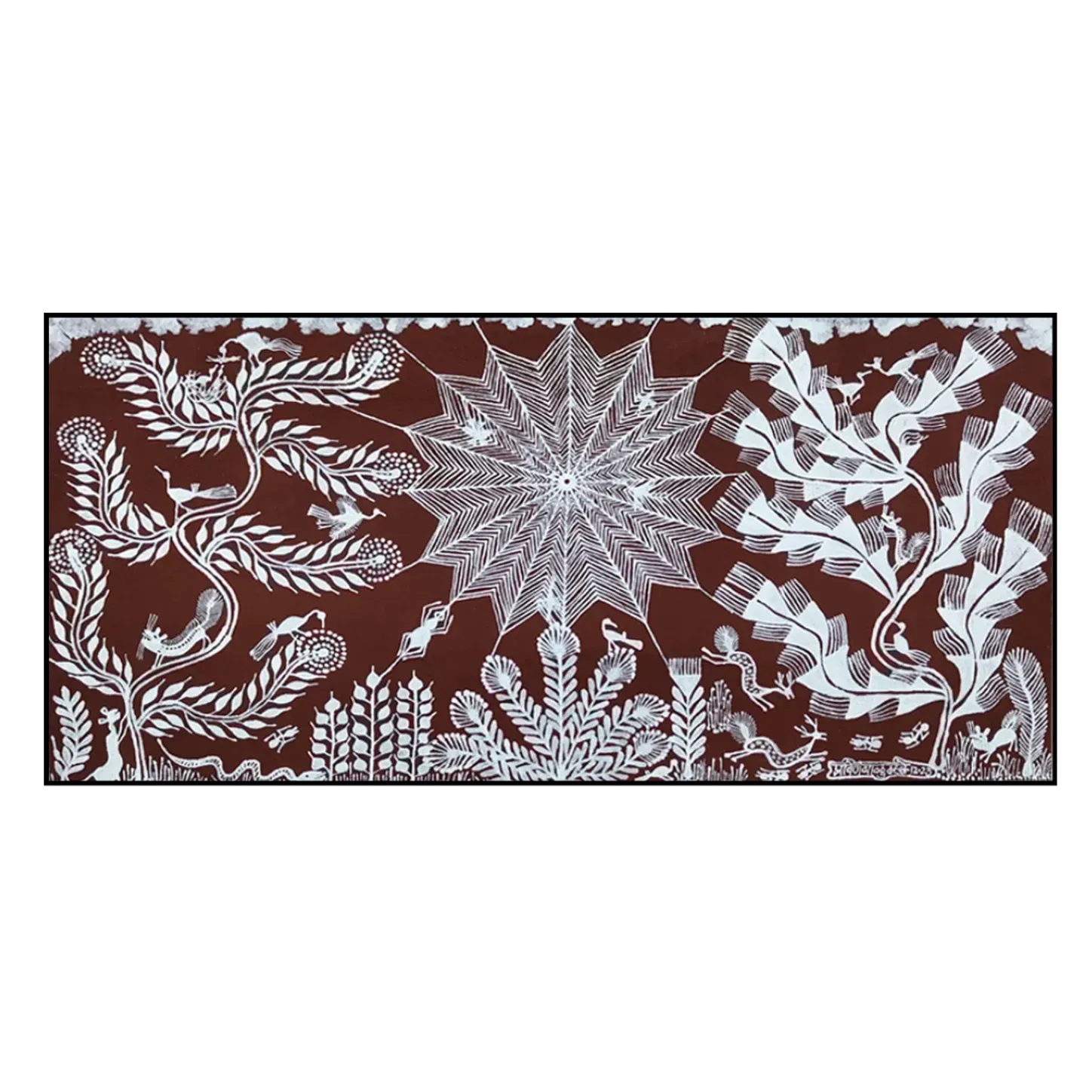
[ Product image: The Delicate Web of Life, certified hand-painted Warli original ] The Delicate Web of Life. Certified original, Rs 7,999, with named-artist provenance. View on Rooftop
What Actually Determines the Price
Once you are sure a piece is genuinely hand-painted, the next question is whether the price is fair. Warli pricing is not random, and four factors explain almost all of it. The seniority and recognition of the artist matter most, because a work by a senior, award-winning name carries both more skill and more provenance. After that come the size and complexity of the composition, the surface it is painted on, whether handmade paper, raw canvas, cloth or board, and finally whether the seller can back the work with an artist certificate or documentation.
Put together, those factors sort genuine Warli into rough price tiers. Knowing the ladder helps you tell a fair price from a padded one at a glance.
Rs 6,000 to 10,000 Entry originals. Smaller, framed hand-painted works, often by younger or emerging artists, with simpler single-scene compositions. A real original in this band costs about what a good printed canvas does, which is the whole point.
Rs 10,000 to 50,000 Established work. Larger and more intricate compositions by recognised artists, usually sold with documentation. You are paying for a more practised hand and a denser, more ambitious scene.
Rs 50,000 and above Collector and signature. Major narrative works by senior, often award-winning artists. These are investment pieces built around a single ambitious story, and the price reflects the name as much as the surface.
None of these bands is the right one in the abstract. The right band is the one that matches what you actually want, a confident first original, a serious centrepiece, or a collector's acquisition. What you should never do is pay a collector-tier price for an entry-tier piece, which is exactly what happens when provenance is fuzzy and you cannot see what you are really buying.
Two of those factors deserve a closer look. Artist recognition is not snobbery, it is provenance you can verify, since a named senior artist with awards, exhibitions and a documented lineage hands you a paper trail that a price tag alone never will. Substrate matters for the long run, because a piece on acid-free handmade paper or a properly prepared cloth ground ages gracefully, while a work on cheap board can warp or yellow within a few years. And while a low price does not automatically mean a fake, a price that seems impossibly low for original handwork almost always is one. Real hands take real time, and time has a floor price.
Three Mistakes First-Time Buyers Make
Mistake one, buying the cheapest version of a motif you liked. You see a design you love, then you search for it and pick the lowest price. That race to the bottom almost always lands you on a print, because no hand-painted original can compete with a mass-produced one on price alone. Cheapest and authentic are rarely the same listing.
Mistake two, confusing souvenir quality with collector quality. Tourist-grade Warli, the quick, loose work made in bulk for gift shops, is not the same as a considered original by a practising artist, even when both are technically handmade. One is a memento. The other is an artwork. Knowing which you are buying, and paying accordingly, keeps you from overpaying for a souvenir or expecting a souvenir to behave like a collector piece.
Mistake three, assuming any Warli-style image is culturally authentic. A label that says tribal art is not a guarantee of anything. Cultural authenticity comes from the work being made by someone inside the tradition, a Warli artist from the community, not from a style being applied by an anonymous studio. The label describes a look. Provenance describes the truth.
The thread running through all three mistakes is the same. Each one quietly substitutes a shortcut, the lowest price, the familiar look, the reassuring label, for the one thing that actually settles the question, which is knowing who made the piece and being able to prove it. Fix that single habit and the mistakes mostly take care of themselves.
And if you have already been burned once, treat it as tuition rather than a verdict on the art itself. The print on your wall is the best possible teacher for spotting the real thing next time, and the next time is exactly where this guide earns its keep.
How Rooftop Removes the Uncertainty
Most of the risk in buying Warli online comes down to a single missing thing, which is verified provenance. That is the specific problem Rooftop is built to solve. Every Warli work on the platform is sourced directly from artists in the Palghar and Thane districts, the heart of the tradition, rather than bought in from anonymous resellers. Each listing shows the artist's name and community, so you always know whose hand made the piece, and every purchase arrives with documentation rather than a guess.
There is a quieter benefit to this that matters if you care where your money ends up. Because the artist is named and sourced directly, they earn a royalty on the sale rather than a one-time pittance from a middleman, which is the difference between a purchase that supports a living tradition and one that slowly drains it. The documentation you receive is not decorative either. It records the artist, the community and the work, which is precisely what gives the piece resale value and what lets you pass it on one day with its story intact.
That approach is part of a deliberate effort to put value back where it belongs, which Rooftop describes in its piece on bringing value back to authentic Indian art. The practical effect for you as a buyer is simple. The questions this guide tells you to ask, who made it, where, on what, and can you prove it, are already answered on the page before you reach for your card.
Named artist, stated community, documentation included
On Rooftop, Warli paintings are sourced directly from Palghar and Thane artists, listed with the maker's name and community, certified, and delivered with documentation, while the artist earns a royalty. A printed reproduction offers none of that.
Buy With Your Eyes Open
Authenticity is not luck, and it is not something you should have to hope for after you pay. It is a set of things you can check, the line, the ground, the layering, the repetition, the name, and the proof behind them. Once you can read those, buying Warli online stops being a gamble and becomes a straightforward decision. When you are ready to buy with that confidence, Rooftop's verified collection of Warli paintings shows provenance, price logic and artist identity clearly on every listing, so what arrives at your door is exactly what you believed you were buying.