

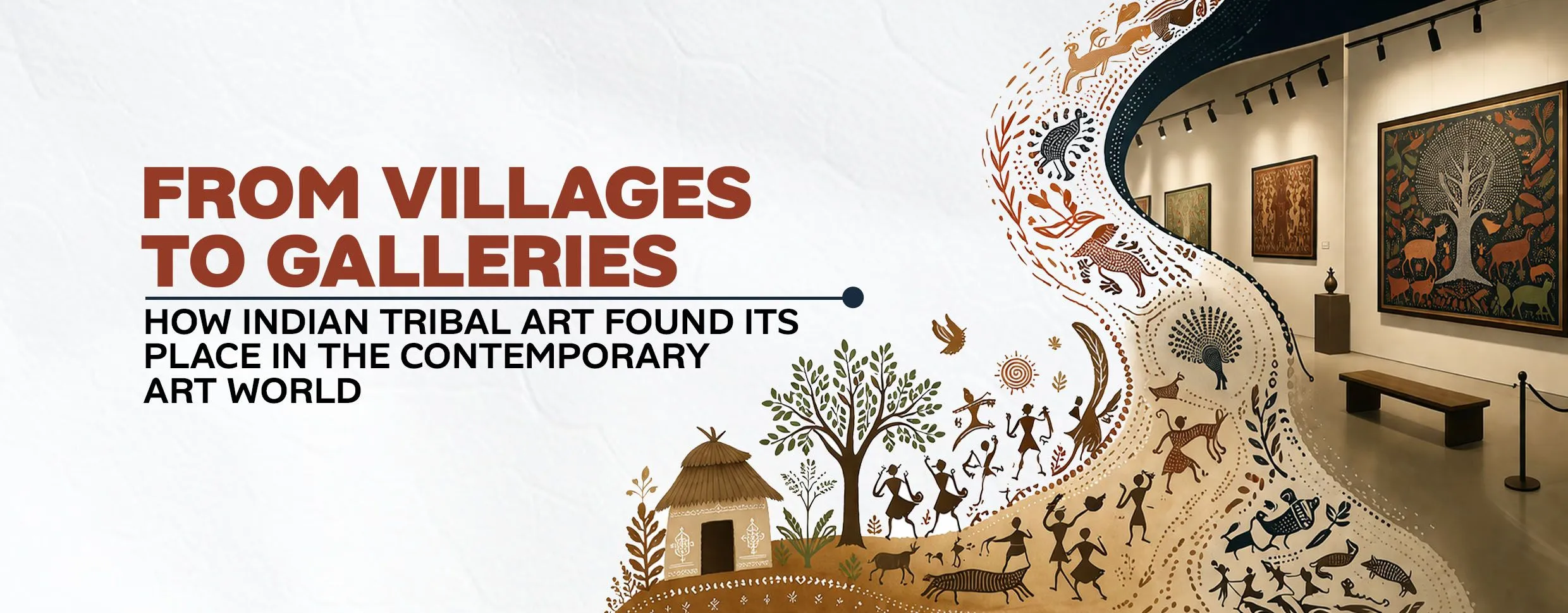
From Villages to Galleries: How Indian Tribal Art Found Its Place in the Contemporary Art World
Indian tribal art did not enter the contemporary art world by abandoning its roots. It forced the art world to expand its definitions. A deep history of how Gond, Warli, Bhil, and Madhubani art arrived in galleries and what their journey means today.

Rooftop
Author
Picture the white walls of a contemporary art gallery, the kind that hosts art weeks and biennales, full of buyers in dark linen and curators with quiet authority. On one of those walls is a painting, dense with figures, fish, peacocks, gods who are not gods exactly but ancestors, motifs that repeat with the discipline of a prayer. The signature in the corner belongs to an artist born in a village in central or western India, who learned to paint from a grandmother who never sold a single work and never expected to.
How did this work get here? Indian tribal art did not arrive in the contemporary art world by abandoning its roots and putting on a different costume. It arrived by forcing the art world to expand what it was willing to recognise as art. That shift is still happening, and it matters deeply for the artists who made it possible, the communities they come from, and the collectors who buy their work today.
A Visual Culture That Predates the Gallery System by Centuries
Long before there was anything resembling an Indian art market, there was painting in tribal India. The Bhimbetka rock shelters in Madhya Pradesh contain images that go back at least 10,000 years, and many scholars argue that the visual traditions of the Bhil, Gond, and Pardhan communities living in central India today carry recognisable continuities with that prehistoric work. Warli painting in Maharashtra has been documented for at least a thousand years. Madhubani, also known as Mithila painting, has been practised by women in Bihar for centuries as ritual mural painting connected to weddings and seasonal festivals.
None of this work was ever meant to hang on a gallery wall, because the concept of a gallery wall did not exist within the worlds these artists came from. A Warli painting on the wall of a hut marked a wedding. A Madhubani aripan on the floor welcomed a deity into a home. A Gond painting carried a song that had been passed down for generations. The image and the occasion were inseparable.
These traditions were not waiting to be discovered. They had a purpose, an audience, and a meaning that worked perfectly well within the cultural ecosystems they belonged to. The reason they did not appear in art books or galleries until the second half of the twentieth century is that the institutions that decide what counts as art were built on a definition that excluded them. The work was anonymous in the colonial gaze, considered craft rather than art, ritual rather than expression. None of these labels were accurate, but all of them stuck.
The Turning Points That Forced Indian Institutions to Reconsider
The shift began slowly and accelerated through the work of a small group of individuals and institutions in post-independence India. The crafts revival movement led by figures like Pupul Jayakar in the decades after 1947 created the first major institutional framework for taking traditional and tribal making seriously, though much of that early work still treated tribal art as craft rather than fine art.
The single most consequential turning point came with the founding of Bharat Bhavan in Bhopal in 1982 and the curatorial vision of J. Swaminathan, who served as its first director. Swaminathan rejected the divide between contemporary urban art and tribal traditions. He argued that tribal art was not a primitive precursor to modern art but a parallel and equally sophisticated visual language with its own coherent logic and authorship. Under his leadership, Bharat Bhavan actively sought out tribal artists and exhibited their work alongside contemporary urban painters. Tribal art became part of the same conversation, no longer a backdrop to modern Indian art history.
It was at Bharat Bhavan that Jangarh Singh Shyam, a Pardhan Gond artist from a village in Madhya Pradesh, was first invited to paint on paper and canvas. Until that moment, Jangarh had painted on the walls of his home using natural pigments, depicting the stories and deities of the Pardhan oral tradition. The transition fundamentally changed what was possible for Gond art. He invented a new visual vocabulary that retained the spiritual core of Pardhan storytelling while developing techniques of dotted line and densely patterned form that would define a new school of contemporary tribal painting. Generations of Gond artists who came after him work in what is now called the Jangarh Kalam.
In Maharashtra, a parallel transformation was underway through the work of Jivya Soma Mase, the first male Warli painter to take up the form seriously and begin painting on paper. Until him, Warli painting had been done almost exclusively by women, on mud walls, for ritual occasions. His decision to treat the visual language as a personal artistic practice, signed and sold as art, opened the form to international recognition. He received the Padma Shri in 2011. What he and Jangarh did was establish that tribal art could carry an individual artistic identity without losing its rootedness.
How Tribal Artists Navigated the Move to Paper, Canvas, and the Open Market
The shift from wall to canvas was not a simple translation. Mud walls absorb pigment in a particular way that paper does not. Natural pigments made from charcoal, turmeric, leaves, and cow dung behaved differently on commercial surfaces. Brushes had to be reimagined. Compositional habits that worked on a curved hut wall did not translate cleanly to a rectangular canvas.
Beyond technique, there were questions of meaning and authorship. A Warli wall painting made by a household for a wedding belonged to the household and the community. A Warli painting on canvas, signed and dated and sold to a collector, belonged to a different economy entirely. Artists had to make conscious decisions about which elements of the tradition were essential and which were contextual.
Throughout this transition, NGOs, cooperatives, government cultural bodies, and dedicated curators played a critical role. Organisations like the Adivasi Academy in Tejgadh, the Madhubani painting cooperatives that grew from Pupul Jayakar’s early efforts, and various state-supported craft emporiums created the first institutional structures through which tribal artists could access urban and international markets. Some worked beautifully. Others reproduced the same exploitative dynamics they were meant to solve. The debates within tribal communities about what kind of adaptation preserved the tradition and what compromised it remain unresolved.
The Artists Who Became Icons and What Their Recognition Made Possible
The visibility achieved by individual tribal artists in the late twentieth and early twenty-first centuries created a new framework for thinking about Indian folk art. Bhajju Shyam, a nephew and student of Jangarh Singh Shyam, published The London Jungle Book in 2004, an illustrated travelogue that placed Gond visual storytelling in dialogue with contemporary urban life. Durgabai Vyam illustrated Bhimayana, a graphic biography of Dr B. R. Ambedkar that received critical acclaim worldwide. Nankusia Shyam, Jangarh’s widow, continues to develop the Pardhan Gond visual language while exhibiting internationally.
In the Mithila tradition, Sita Devi was among the first Madhubani artists to be widely recognised outside her region, receiving the Padma Shri in 1981. She was followed by Mahasundari Devi, Bharti Dayal, and Dulari Devi, who built the institutional credibility of Madhubani as a contemporary art form. In the Bhil tradition, Bhuri Bai’s journey from a daily wage labourer at the Bharat Bhavan construction site to a Padma Shri awardee is one of the defining stories of how individual recognition can transform an entire artistic community. Her decision to begin painting on paper, with acrylics, was made at Swaminathan’s suggestion, and the visual style she developed became the template for a generation of Bhil artists.
These individual stories matter beyond the success of the artists themselves. Each major recognition created openings for others. Each award and museum acquisition shifted the position of the entire tradition within Indian art history. The labour of authorship, denied to tribal artists for so long, finally began to receive its due.
The Tensions That Have Not Gone Away and Will Not Go Away Easily
None of this means the situation is solved. Cultural appropriation remains a serious problem. Visual languages that belong to specific communities are routinely lifted by designers, brands, and decorative goods manufacturers without credit, compensation, or basic accuracy. Mass-produced reproductions in the style of well-known tribal artists circulate at low prices and undercut the market for original art.
The structural problem of intermediaries continues to extract value from artists at every stage of the chain. A Gond painting that sells for fifty thousand rupees at a high-end retailer in Delhi might pay the artist five thousand. The remaining forty-five thousand passes through dealers, wholesalers, retail markup, and various commission structures the artist neither sees nor controls. This is the central reason why so many tribal art communities remain economically precarious despite the cultural celebration of their work.
There is also the deeper question of who owns a visual language that belongs to a community rather than an individual. Western intellectual property frameworks, built around individual authorship, struggle to protect visual idioms that communities consider collective inheritances. The Geographical Indication tag has helped, with both Madhubani and Gond painting receiving GI status, but the protections remain limited and difficult to enforce. Direct relationships between artists and buyers have become more important than ever, not because the market is bigger but because the alternatives have become more clearly inadequate.
Where Indian Tribal Art Stands in the Contemporary Art World Today
Tribal art today occupies a position in the Indian art market that would have been unthinkable a generation ago. Major works are sold at auction houses and galleries in Mumbai, Delhi, London, and New York. Tribal artists are commissioned for biennales, museum installations, and large-scale public art projects. Younger urban Indian collectors are showing strong interest in tribal and folk art as a deliberate alternative to the inflated prices of the contemporary urban art market.
The buyers driving this shift share a few characteristics. They want cultural integrity, not just visual appeal. They want to know who made the work, where they live, and what tradition they belong to. They care about provenance and ask questions about authenticity. This kind of engaged collecting is exactly the demand that tribal traditions need to thrive economically.
Platforms working in this space have an opportunity to build something different from the older model. Rooftop is a marketplace that connects buyers directly with practising tribal and folk artists across Madhubani, Gond, Bhil, Warli, Pichwai, Cheriyal, Mata ni Pachedi, Phad, and other regional traditions. Every artist is verified, original works come with certificates of authenticity, and the artist receives the majority of what the buyer pays. Browse the paintings collection on Rooftop to see how the platform organises original tribal and folk art with traceable provenance.
Every Direct Purchase Is a Form of Participation in a Living Tradition
The journey of Indian tribal art from village walls to contemporary galleries was not a story of upgrading. The work was always sophisticated. The painting was always serious. What changed was the willingness of the institutions and markets that decide what counts as art to look at it on its own terms. The direction of that shift is now clear, and it has been built by the labour of generations of artists who refused to let their traditions be either erased or condescended to.
When you buy a tribal painting today from a verified platform that connects you directly with the artist, you are participating in that ongoing shift. You are placing a small but real bet that the artists carrying these traditions forward should be able to do so on their own terms, with their own names attached, and with the income they need to keep practising. You are also taking home a piece of art with more depth and visual intelligence than almost anything the mainstream decor industry produces.
Explore original tribal and folk art from verified Indian artists on Rooftop.
If you are a tribal or folk artist looking to sell your work directly to collectors, you can register on Rooftop’s provider page to list your art.