

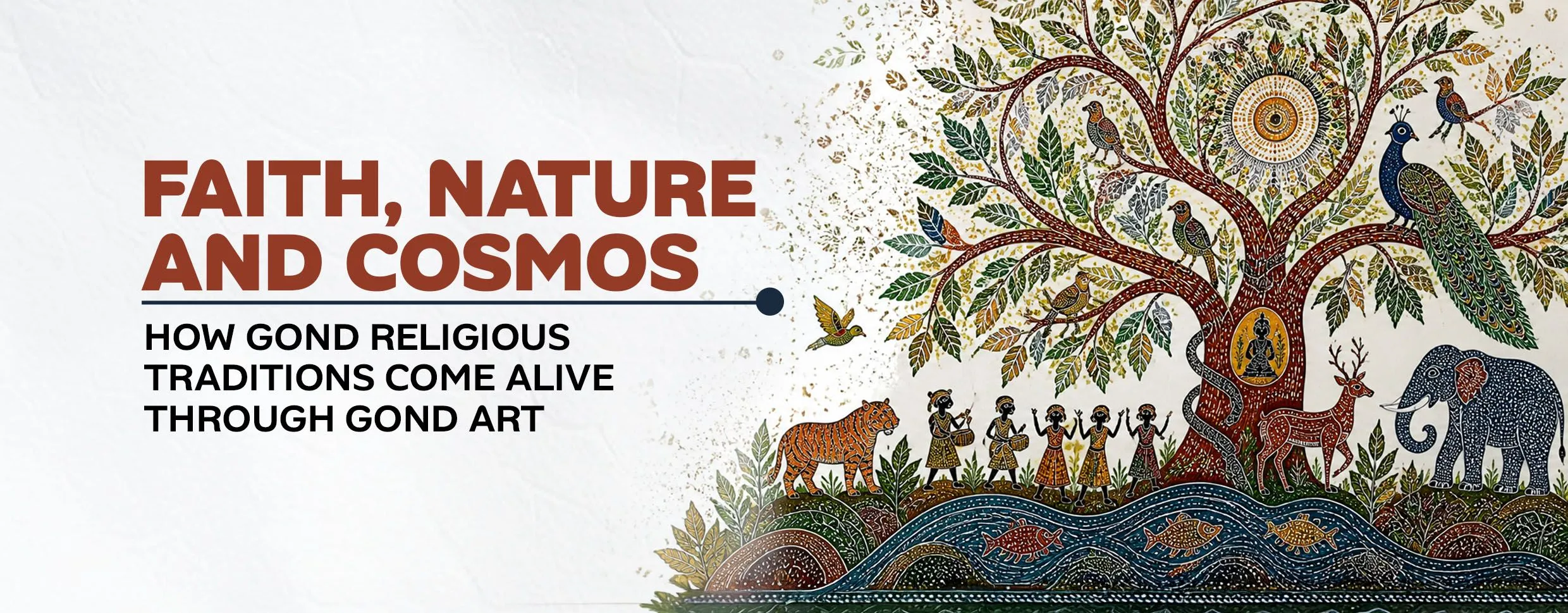
Faith, Nature and Cosmos: How Gond Religious Traditions Come Alive Through Gond Art
Gond art is not an illustration of Gond religion but its living practice. A deep look at how Badadev, the sacred tree, and the spirits of forest and ancestor become visible through Gond painting.

Rooftop
Author
There is a saying among Gond artists that goes something like this: viewing a good image brings good luck. It sounds, at first hearing, like the kind of pleasant cultural superstition a tour guide might mention before moving on to the next stop. It is anything but. The phrase carries the entire weight of a worldview in which seeing and being seen, depicting and being depicted, are not separate from the spiritual life of a person and a community. They are the spiritual life. To paint an animal in Gond visual language is to acknowledge its presence in the world. To paint a tree is to honour the spirit that dwells inside it. To paint a deity is to invite that deity into the home where the painting hangs.
This is the first thing to understand if you want to look at Gond art seriously. Every painting is simultaneously an aesthetic act and a devotional one, rooted in a cosmology that makes no real separation between the natural and the spiritual. The pattern of dots on a peacock’s body is not decoration. The repetition of fine lines across the trunk of a tree is not stylisation. These are visible expressions of an unseen aliveness that the Gond worldview considers to be present in everything that exists.
The Gond Cosmological View of a Living, Breathing World
The Gond community is among the largest tribal populations in India, with significant presence across Madhya Pradesh, Chhattisgarh, Maharashtra, Andhra Pradesh, and Odisha. Their cosmological view is animist, which is a useful but limiting word. What it actually means is that the Gond understanding of the universe is built on the recognition that every meaningful element of the natural world carries soul, intention, and spiritual presence. The forest is not a place where life happens. The forest is alive. The river is not a body of water. The river is a presence. Mountains, animals, birds, even the earth beneath the feet, all of these are participants in a continuous web of relationship rather than passive backdrops to human activity.
At the centre of this cosmology is Badadev, also written as Bada Deva, the supreme creator force in Gond religious life. Badadev is not depicted as a humanlike figure with a face and body. Badadev is understood to reside within the sacred Saja tree, and through it, within the larger living forest. The Pardhan Gonds, a subgroup historically responsible for the religious and storytelling functions of the wider community, traditionally invoked Badadev at the Saja tree by playing a stringed musical instrument called the bana, recording the genealogies and prayers of Gond patrons through song. This practice of musical, spoken, and now painted invocation is part of the same continuous tradition of communicating with the sacred through made things.
Below Badadev sits a wide constellation of clan deities, village deities, and ancestral spirits, each with specific responsibilities and territories. Marahi Devi, Phulvari Devi, Jalharin Devi, Goddess Kali Phulvari, and many others appear across regional Gond traditions. There is also Dulha Deo, often understood as a guardian deity associated with the protection of the household and the well-being of marriages. None of these figures exist in isolation from the natural world. They are inseparable from the trees, animals, and places they inhabit.
How Deities and Spirits Appear in the Visual Language of Gond Painting
In Gond painting, the divine rarely appears as a literal portrait. The visual logic of the form is not concerned with anatomy or facial likeness in the way that, say, classical European religious painting is. A Gond depiction of Badadev, for example, often shows a tree intertwined with musical instruments rather than a figure on a throne. The Bada Dev painting on Rooftop captures this beautifully: a tree at the centre of the composition, threaded with the bana and other ritual instruments, performed under the canopy of the Saja tree itself. The painting is not a picture of a god. It is a description of where the god lives, how he is reached, and what the act of reaching him sounds and looks like.
Sacred animals occupy similarly resonant positions in the visual vocabulary. The tiger appears across Gond paintings as a being of immense spiritual power, often a guardian and a presence to be respected rather than romanticised. The serpent, often shown as the Satbehni Saanp or the seven-sister serpent, carries protective and cosmic associations and frequently weaves through compositions in long undulating curves that suggest both motion and continuity. The peacock, perhaps the most beloved of all Gond motifs, is regarded as a creature of great beauty and is associated with celebration, fertility, and the joy of being alive. The elephant, the deer, the cow, the fish, the lizard, the wild boar, all of these animals appear repeatedly because each carries spiritual meaning beyond its biological identity.
What unifies all of these depictions is the patterning. The dots, the fine repeating lines, the fish-scale textures, the rhythmic geometric units that fill the body of every figure. These are not decorative flourishes added at the end. They are how the artist communicates that the being in the painting is alive in the spiritual sense, that it is a soul-bearing presence rather than an outline. Pattern is presence. The denser the pattern, the more present the being.
Ritual Painting as an Act of Worship and Protection
Long before Gond paintings made their way onto paper and canvas, they were painted directly onto the walls and floors of homes during festivals, marriages, harvests, and seasonal ceremonies. This wall art, known in some places as bitti chitra, served specific ritual functions. The act of painting was itself part of the ceremony, not a preparation for it. To paint Marahi Devi on the wall before a wedding was to invite her presence into the household. To paint a row of birds and animals around a doorway was to ask for protection and good fortune to enter with anyone who crossed the threshold.
The technical preparation of the wall reflected the ritual seriousness of what was being done. The walls and floors were first cleaned and coated with a layer of cow dung, which served as a ritual purifier and a base layer. A coat of white soil called pidor was then applied, providing a smooth surface much like a primed canvas. The motifs were drawn using natural pigments mixed from ramraj soil for yellow, charcoal for black, limestone for white, geru for earthy red, and cow dung for light green. Every material came from the immediate landscape. Every step of the process tied the painting back to the soil, the river, and the forest from which it drew its meaning.
Certain motifs were painted to protect the household from illness or misfortune. Others were painted to ensure fertility for crops, livestock, and women hoping to conceive. Still others were painted in honour of ancestral spirits, especially during the festivals at which the boundary between the world of the living and the world of the ancestors was understood to be thinner than usual. The painting was the prayer. The image was the offering.
The Sacred Tree and the Forest as Theological Centre
If you spend any time looking at Gond paintings, you will quickly notice that trees occupy a position of extraordinary visual and spiritual centrality. They appear everywhere. They tower over compositions, shelter animals beneath their canopies, hold birds and serpents in their branches, and frequently fill the entire canvas as the singular subject of the work. The Blessing of Tree painting on Rooftop is a striking example: a single colossal tree, its visible roots descending into the earth in spiral patterns, its branches and leaves filling the painted space with rhythmic life. This is not landscape painting. It is theology made visible.
Three trees in particular hold special importance in Gond religious life. The mahua tree, often called the Tree of Life within Gond culture, sustains the community in tangible ways through its flowers, fruit, oil, and the alcoholic drink made from its blossoms. Its presence in paintings is rarely incidental. The mahua is associated with feminine sacred energy, and women in particular have a long-standing devotional relationship with it. The sal tree provides timber, leaves used in ritual, and is part of the larger ecology of the central Indian forest. The Saja tree, as already mentioned, is where Badadev is invoked, and its religious importance has placed it at the centre of countless Gond compositions.
Beyond individual trees, the forest as a whole appears in Gond painting as a layered spiritual ecosystem. Animals, deities, ancestors, and natural forces share the visual space without strict hierarchy. The composition of a forest scene reflects an underlying belief that all of these beings exist in mutual obligation to one another. The Cosmic Turtle painting by Sushil Urveti shows this beautifully. A turtle, ancient symbol of creation and stability, carries the Tree of Life on its back. Inside its shell, a meditating figure sits surrounded by elephant, deer, tiger, fish, and snake. The painting is a complete cosmological diagram in a single frame, expressing the harmony of all living beings within a shared spiritual order.
This makes the steady loss of forest land across central India something far more significant than an environmental problem. It is a theological one. When the forest goes, the cosmological imagination that the Gond worldview is built on loses its physical anchor. Painting becomes one of the few remaining places where the full living forest still exists in its proper form.
How Oral Tradition and Mythology Shape the Painted Image
Gond visual culture is inseparable from Gond oral tradition. The Pardhan Gonds, historically the priests, storytellers, and bards of the wider community, were responsible for keeping the mythological and historical knowledge of the people alive through song. Long oral cycles like Gondwani, the legendary histories of Gond kings, and Pandvani, the Gond rendering of the Pandava stories, were sung at festivals and ceremonies. The story of Jhitku Mitki, a tragic and beloved love story, has been retold in song and image across generations.
When Gond painting moved onto paper and canvas in the second half of the twentieth century, it did not abandon this oral inheritance. The compositions that fill contemporary Gond paintings are direct visual translations of stories the artists grew up hearing. Myths about creation, the origins of animals, the ancestral journeys of clans, and the moral teachings embedded in regional folktales become the structural skeleton of the painted image. The artist functions less as an inventor of new images and more as a transmitter of communal sacred knowledge through a different medium.
This is part of why working Gond artists today, including descendants of Jangarh Singh Shyam, Venkat Raman Singh Shyam, Bhajju Shyam, Durgabai Vyam, and others, continue to produce work that carries genuine devotional weight even when it is sold to urban collectors. The image is not separated from its story. The Gaay or Bail painting by Ramesh Tekam shows cows, buffalo, and birds peacefully sharing space under a fruit-laden tree, a composition that draws directly from Gond beliefs about the harmony between domesticated animals, wildlife, and the natural abundance of the world. The painting is not just lovely. It is a statement of faith.
Gond Religious Art in a Contemporary Context
The transition of Gond art from village walls to international galleries, which began with Jangarh Singh Shyam’s discovery at Bharat Bhavan in the early 1980s, created enormous opportunities for the artists. It also created tensions that artists working today still negotiate. The market for Gond paintings has grown, but much of that demand is for decorative imagery: peacocks on canvas, trees of life as gift items, motifs detached from the religious meaning that originally gave them weight. There is a real risk that the form gets reduced to its surface aesthetic while the theological content underneath dissolves.
The artists who continue to paint from within a living spiritual tradition, in Patangarh village in Madhya Pradesh’s Dindori district and in diaspora locations across India, are doing the slow work of holding both ends together. They produce paintings that are visually accessible to international buyers while continuing to embed the older cosmological grammar inside the work. A peacock for them is still a sacred bird. A tree is still Badadev’s dwelling. A composition of animals around a tree is still a statement about the spiritual order of the world.
Platforms that support these artists matter. Rooftop works directly with practising Gond painters from across central India, including artists in the Pardhan Gond lineage who continue to carry the tradition forward. Browse the full Gond painting collection on Rooftop to see original work by artists like Sushil Urveti, Ramesh Tekam, Kala Bai Shyam, Ram Bai Tekam, Venkat Singh Shyam, and others. Every piece is hand-painted, every artist is verified, and every purchase keeps the workshop running for one more season.
Look Again, and You Will See It Was Never Just a Pattern!
The next time you stand in front of a Gond painting, try to see it not as decoration but as devotional practice. The peacock with its body filled in dotted patterns is not a stylised bird. It is a being recognised, named, and honoured by an artist working within a tradition that considers the act of seeing to be sacred. The tree dense with creatures and pattern is not a landscape. It is a description of the dwelling place of a creator force that the Gond world has been in conversation with for centuries. The cow grazing under the fruit-laden tree is not a rural scene. It is a small theological statement about how a properly ordered world feels.
Gond painting is one of the few places left where this older way of seeing is still being actively practised, taught, and passed down. When you bring one of these paintings into your home, you are not buying an object. You are accepting an invitation into a worldview.
Explore original Gond art from practising artists on Rooftop’s Gond collection. Every painting carries forward a tradition of seeing the world as alive.