

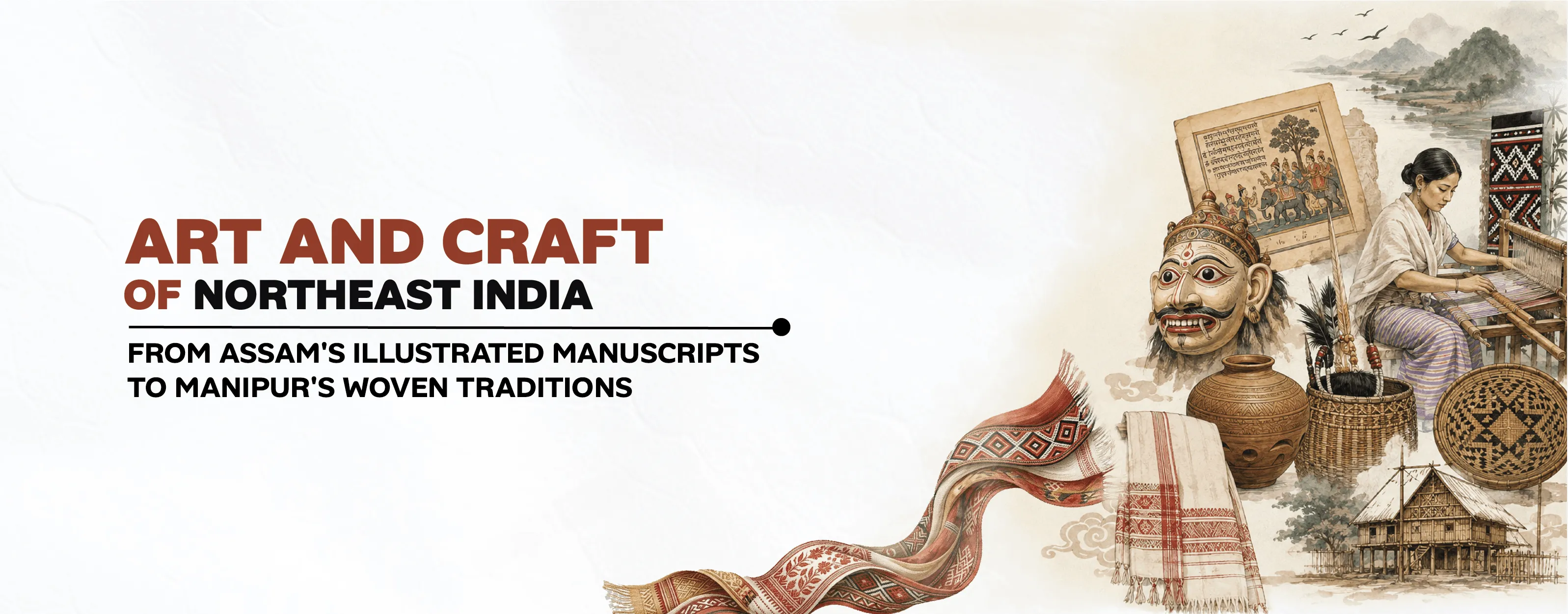
Art and Craft of Northeast India: From Assam's Illustrated Manuscripts to Manipur's Woven Traditions
The art and craft of Northeast India spans Assam's manuscripts, Manipur's sacred looms and Naga warrior shawls. A guide to one of the richest art forms of India.

Rooftop
Author
Spread a map of India and let your eye travel to the far east, past Bengal, to the eight states that curl around the Brahmaputra and climb into the eastern Himalaya. This is Northeast India, and it holds some of the most sophisticated and least understood art forms of India. Here are Assam's illustrated Hastividyarnava manuscripts and the mask-making monks of Majuli. Here are Nagaland's warrior shawls, Manipur's sacred looms, and the cane and bamboo work of the Khasi and Apatani hills. None of it is a footnote. It is one of the richest chapters in the entire history of Indian art, and also one of the quietest.
That quietness is the problem this piece sets out to address. The traditions of the Northeast are not marginal because they are minor. They are marginal because of geography and politics, because the region sits far from Delhi and Mumbai and rarely reaches the national textbooks. The depth was always there. What has been missing is attention.
A regional snapshot
ASSAM Illustrated manuscripts, the masks of Majuli, and three native silks including golden muga. MANIPUR Sacred Meitei weaving, the Moirang Phee border motif, and hand-built terracotta. NAGALAND Warrior shawls whose patterns record clan, rank and earned honour. MIZORAM The Puan, a woven cloth at the centre of dress and ceremony. MEGHALAYA Cane and bamboo craft, from fine baskets to living root bridges and headgear. TRIPURA Loin-loom weaving of the Tripuri and Jamatia, including the risa cloth. ARUNACHAL PRADESH Monpa handmade paper, Buddhist Thangka painting, and Adi and Apatani weaving. SIKKIM Thangka painting, monastery crafts, and Lepcha and Bhutia weaving.
Assam: Manuscripts, Sattriya Culture, and the Crafts of the Brahmaputra Valley
Assam is the natural place to begin, because it carries one of the few painting traditions in the region with a documented courtly history. In the early eighteenth century the Ahom court produced illustrated manuscripts of real ambition, including the Hastividyarnava, a treatise on elephants commissioned during the reign of King Sivasimha. Alongside the court school ran the older Vaishnava tradition of the Sattras, the monasteries founded by the saint Srimanta Sankardev in the fifteenth and sixteenth centuries. The earliest surviving illustrated manuscript of that tradition, the Chitra Bhagavata, dates to the seventeenth century and shows the wide fish-shaped eyes and vermilion grounds that mark the Sattriya style.
The Sattras gave the region more than painting. They gave it the classical dance Sattriya, recognised nationally only in 2000, and the dramatic masks used in its bhaona theatre. The mask-making tradition of Majuli, centred on the Samaguri Satra, builds large figures of gods and demons from bamboo, clay, cloth and cow dung, some of them tall enough to clothe a performer entirely. The first such masks were made by Sankardev himself for a play staged in 1468.
Then there is silk. Assam is the only place on earth that produces golden muga, a wild silk so durable that a garment often outlives its owner, woven for centuries into the mekhela chador that Assamese women wear. Around the weaving town of Sualkuchi, long called the Manchester of the East, thousands of looms still run. This is everyday traditional art, worn rather than framed, and it is as much a part of Assamese identity as the manuscripts.
Assam's weaving and its devotion meet most spectacularly in the Vrindavani Vastra, a sixteenth-century silk textile woven under Sankardev's guidance to illustrate scenes from the life of Krishna across one vast cloth. Much of it was lost over the centuries, but a major section survives in the British Museum's collection, a reminder that the region was weaving narrative into fabric at a level few traditions anywhere could match.
GI tags in 2007 and again in 2024 Muga silk has held a Geographical Indication tag since 2007. On 4 March 2024, both Majuli's mask-making and its centuries-old manuscript painting received GI tags, formal recognition for two traditions that had survived for five hundred years without it.
Manipur: Sacred Weaving, Lai Haraoba, and the Potter's Hand
In Manipur the loom is not a tool so much as a thread running through the whole of life. Among the Meitei people, weaving is woman's work in the deepest sense, tied to marriage, ritual and identity, and certain cloths are woven specifically for the Lai Haraoba, the festival that re-enacts the creation of the world and honours the old sylvan deities. To weave for that festival is to take part in worship.
The patterns themselves carry meaning. The Moirang Phee is known by the distinctive triangular motif that runs along its border, a form tied to traditional Manipuri belief. The fine Wangkhei Phee, a near-transparent cotton woven in the Wangkhei area of Imphal, is prized for its delicacy. These are not decorative flourishes added for the market. They are a visual language with its own grammar, read fluently by the people who wear them.
Weaving is also the economic backbone of Meitei society. The phanek, the wrapped lower garment worn every day, and its finer ceremonial versions are produced overwhelmingly by women, and a household's looms have long been a quiet measure of its self-reliance. For many Manipuri girls, learning to weave is simply part of growing up.
Manipur also holds a quieter craft in its terracotta. The state's potters, including communities who have shaped clay for ritual and household use over many generations, build their vessels largely by hand rather than on a fast wheel, a slower method that links the finished pot to a very old way of working. Pottery here, like weaving, sits inside ceremony rather than beside it.
Nagaland and Mizoram: Warrior Textiles and the Grammar of the Shawl
Among the Naga communities a shawl is never only a garment. It is a record. Patterns, colours and bands of motif mark a person's clan, their standing, and in older times the honours a man had earned through feats in war or through the great feasts of merit that raised his status in the village. To read a Naga shawl is to read a biography.
Each community keeps its own visual code. The Ao are known for the tsungkotepsu, a man's shawl whose central band carries painted and woven symbols of achievement. The Angami, the Lotha, the Sumi and others each weave distinct combinations of red, black and white, often in three strips stitched together. The function has changed as warrior culture gave way to modern life, and the honours a shawl once announced are mostly memory now. The visual authority has not faded with them. A handwoven Naga shawl still commands respect on sight.
The right to wear particular motifs once had to be earned rather than bought. The honour came through hosting the great feasts of merit and through deeds the village formally recognised, and the morung, the traditional men's house, was where this knowledge and standing were passed to the young. A shawl was a public ledger of what a person had given back to the community.
Neighbouring Mizoram weaves the same conviction into the Puan, the wrapped cloth at the centre of Mizo dress. The ceremonial Puanchei, bright with rows of intricate motif, appears at weddings and festivals and is among the most treasured things a Mizo woman owns. Here too the loom is domestic, the weaver usually a woman, and the cloth a marker of occasion and belonging.
Meghalaya, Tripura, and Arunachal Pradesh: Cane, Bamboo, and Woven Identity
Move into the hills of Meghalaya and Arunachal Pradesh and the dominant material becomes cane and bamboo. This is not humble craft. The Khasi, Garo and the many communities of Arunachal split, strip and weave these materials into baskets, mats, hats, fish traps, furniture and even structural parts of houses, with a precision that turns a forest material into engineering. In the wettest hills of Meghalaya, the Khasi and Jaintia take this furthest of all, training the aerial roots of rubber fig trees across rivers over decades to grow living bridges that only strengthen with age, a craft that is at once architecture and ecology. Among the Apatani of Arunachal's Ziro valley, fine cane work and weaving are bound up with a famously ordered agricultural life. The objects are functional, but the patterns and forms carry encoded meaning about who made them and for what.
Tripura adds its own textile voice. The Tripuri and Jamatia communities weave on the loin loom, the body itself providing the tension, producing cloths such as the rignai worn below the waist and the risa worn across the chest. The risa is more than clothing. It is given in ceremony, wrapped as a mark of honour, and tied to coming-of-age rites. Across all three states the lesson is the same. Craft here is not separated from daily life, ceremony and social order. It is the material in which those things are expressed.
The Painted Traditions: Murals, Thangka Influence, and Visual Narrative
Painting in the Northeast does not always sit on paper or canvas, and that is part of why it has been overlooked by people trained to look for framed pictures. Several Naga communities, including the Rongmei, carry traditions of mural and body painting in which design marks ritual, status and belonging. Among the folk paintings of India these are rarely counted, yet they do the same work, encoding cosmology and community memory in line and colour.
Higher up, in the Buddhist belt of Arunachal Pradesh and Sikkim, a very different painted tradition takes over. The Monpa of the Tawang region and the monastery communities of Sikkim practise Tibetan Buddhist Thangka painting, the scroll art of deities and mandalas used as an aid to meditation. It is a formal, codified art with its own canon of proportion, brought across the Himalaya with Buddhism itself. The Monpa also make their own handmade paper, known as mon shugu, from the bark of a local shrub, the very surface on which many of these scriptures and painted scrolls were set down. In a region where many communities kept their histories without writing, painted narrative of every kind, sacred or tribal, did the work that books did elsewhere. It held the cosmology, the genealogy and the law.
Why These Traditions Are Underrepresented, and What That Costs
If the art and craft of Northeast India is this deep, why does it stay invisible? The reasons are structural rather than artistic. The region is physically remote, connected to the rest of the country by a narrow corridor of land, and that distance has shaped everything from trade to attention. National cultural institutions have long centred the courtly and temple traditions of the north and south, and the documentation, scholarship and museum space that build a tradition's reputation have flowed there. Northeast forms have been under-recorded for decades, which becomes a trap, because what is not documented is easily called minor.
The cost of that invisibility is not abstract. It falls on the weavers, carvers and painters who depend on recognition to earn a living, and who watch machine-made copies of their patterns sell while their own slow work goes unseen. Efforts to document these forms properly, including Rooftop's Art Wiki, are part of closing that gap, because attention is the first thing a living tradition needs in order to keep paying the people who carry it.
The encouraging part is that the audience is ready. Interest in handmade, regional and honestly sourced work has grown sharply, and buyers increasingly want to know who made a thing and where. That curiosity is exactly what the Northeast has been waiting for.
Key takeaways
- Northeast India spans eight states and more than two hundred communities, making it one of the most culturally diverse regions on earth.
- Assam alone holds courtly manuscript painting, the Sattriya mask tradition of Majuli, and three native silks led by golden muga.
- Across Manipur, Nagaland, Mizoram and Tripura, the loom carries meaning, recording ritual, rank, clan and occasion in pattern.
- In the hill states, cane, bamboo and painted narrative do the work that writing did elsewhere, holding memory and identity.
- The region's invisibility is a failure of geography, politics and documentation, not a reflection of the work's depth.
A Long-Overdue Encounter
The right way to approach the art and craft of Northeast India is not as exotic discovery, as though these traditions were newly found. They were never lost. They have simply been waiting for the rest of the country to look properly. To meet them is to encounter formal sophistication and living vitality that have always deserved the attention. A good place to start is with the artists and makers Rooftop works with, the people behind the work, and to carry that same attention outward to the weavers, carvers and painters of the eastern hills who have kept these traditions alive without an audience for far too long.