

Yakshagana - The Folk Dance Tradition of Karnataka
Get familiar with **Yakshagana** of coastal Karnataka, a traditional theatre form performances where stories are drawn from the Ramayana, Mahabharata, and Bhagavata Purana...
Introduction
Yakshagana is a traditional theatre form of coastal Karnataka combining dance, music, spoken dialogue, elaborate costume, and painted makeup in night-long or extended performances of stories drawn from the Ramayana, Mahabharata, and Bhagavata Purana. It has developed primarily in the Tulu Nadu cultural region encompassing Dakshina Kannada, Udupi, Uttara Kannada, and Kasaragod districts of northern Kerala, and exists in two main stylistic traditions: Tenkutittu (southern style) and Badagutittu (northern style). Yakshagana is among the most actively practiced and institutionally supported classical folk theatre forms of India, with approximately thirty professional troupes and over two hundred amateur troupes, and is estimated to generate over twelve thousand performances annually.
Etymology
The name 'Yakshagana' combines 'Yaksha,' referring to the celestial beings of Hindu and Buddhist mythology known for their association with music, dance, and forest powers, and 'Gana,' meaning music or song. The term thus signifies 'the music of the Yakshas' or 'singing in the manner of the Yakshas.' The name reflects the form's origin in devotional performance traditions that invoked celestial performers as models. In older usage, the same term was applied to different devotional song-drama forms across South India; the Karnataka tradition's use of 'Yakshagana' as a specific designation for this coastal theatrical form developed from approximately the sixteenth century.
Origin
Yakshagana developed in coastal Karnataka between the eleventh and sixteenth centuries, emerging from the convergence of the Bhakti movement's devotional literature, local folk performance traditions, and the influence of Sanskrit theatre. The earliest clearly datable text in the Yakshagana tradition is Sugriva Vijayam (c. 1570), attributed to Kandukur Rudra Kavi. An important later figure is Parti Subba (c. 1800), whose compositions remain central to the Yakshagana repertoire. The form's development was shaped by the specific cultural geography of coastal Karnataka, including the influence of both Karnataka and Kerala performance traditions, which accounts for the divergence between the Tenkutittu and Badagutittu styles in their use of different regional drum traditions.
Location
Yakshagana's heartland is coastal Karnataka, specifically Dakshina Kannada, Udupi, and Uttara Kannada districts, and the Kasaragod district of Kerala. The Tenkutittu (southern) style is associated with Dakshina Kannada and Kasaragod; the Badagutittu (northern) style with Udupi and Uttara Kannada. Performances occur across a wider Karnataka geography as professional and amateur troupes travel extensively for their performance seasons.
Community
Yakshagana's professional tradition is maintained by performing castes and communities of coastal Karnataka, including Brahmin, Bunt, and other communities associated with the form's specific organizational structures. Historically, the troupes were patronized by temples, with the mela (troupe) affiliated to specific temples whose deity was the formal patron. This temple-affiliated model has given way in the modern period to partially or fully commercial troupes, though many retain temple affiliations. The Bhagavatha, the lead singer who also functions as the director and narrator of the performance, is the central figure of authority in each troupe.
Relevance
Yakshagana is the most institutionally developed and publicly visible folk theatre form of Karnataka, with a scale of practice, production, and spectatorship that places it among the major living theatre traditions of India. It is taught at dedicated institutions, documented in a substantial scholarly literature in Kannada and English, supported by the Karnataka government and the Sangeet Natak Akademi, and performed before large audiences across coastal Karnataka and beyond. Its economic contribution, estimated at generating Rs. 6 crore in annual turnover from twelve thousand performances, reflects a level of commercial vitality unusual in Indian folk theatre.
History
Background
The sixteenth century saw the first consolidated Yakshagana texts and the formation of organized performance troupes. The seventeenth and eighteenth centuries were a period of elaboration in which the costume tradition, makeup conventions, and musical repertoire were developed to their present complexity. In the nineteenth century, tent-based commercial troupes emerged, transforming Yakshagana from a temple-sponsored ritual performance into a more widely distributed entertainment form. Kota Shivaram Karanth (1902 to 1997), a Kannada polymath, undertook systematic study and partial reform of the Yakshagana tradition in the twentieth century, introducing Western instrumentation in experimental contexts and writing on the aesthetics of the form.
Culture and Societies
Traditional Yakshagana performances are organized by local organizing committees (mandalis) and take place from dusk to dawn, typically from October to May, constituting the Yakshagana season. The performance begins with the Bhagavatha's invocation and proceeds through a series of episodes (prasangas) from the chosen narrative. The Bhagavatha, seated at the side of the performance space with tala (cymbals), sings all narrative and dialogue parts; the actors on stage enact the roles through dance, movement, and spoken response to the sung lines. The relationship between the Bhagavatha's singing and the performers' physical expression is the structural heart of the form.
Religious Significance
Yakshagana developed within the Bhakti devotional movement and retains its religious character in traditional contexts. Performances are most frequently organized in fulfillment of religious vows or as acts of devotion to the temple deity affiliated with the performing troupe. The narratives performed, drawn from the Ramayana, Mahabharata, and Bhagavata Purana, are understood as devotional recitation of divine stories. The performance space is treated as sacred during traditional Yakshagana, and the performers are understood as the embodiments of the divine characters they represent. The elaborate makeup and costume are themselves a form of devotional transformation of the human body into a divine form.
Understanding the Art
Style
The two main styles of Yakshagana, Tenkutittu and Badagutittu, differ primarily in their musical and rhythmic conventions. Tenkutittu is performed in the southern coastal districts and Kasaragod and draws on Carnatic music tradition with the Kerala maddalam drum as the primary percussion; Badagutittu is performed in the northern coastal districts and uses the Karnataka chande drum. Both styles share the elaborate costume tradition, the Bhagavatha-as-director structure, and the improvisatory dialogue between the Bhagavatha's sung lines and the actors' spoken responses.
Central Motifs and Their Significance
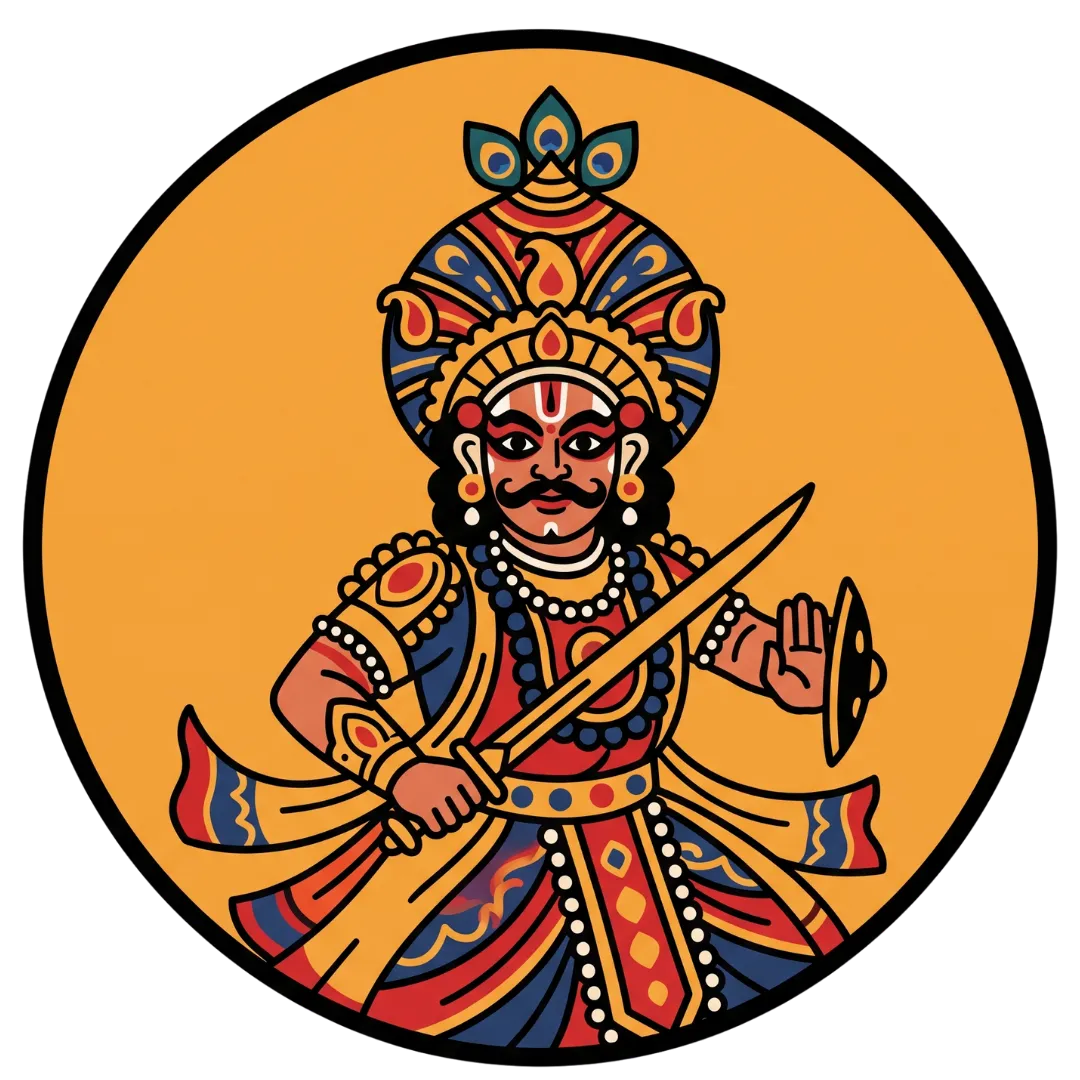
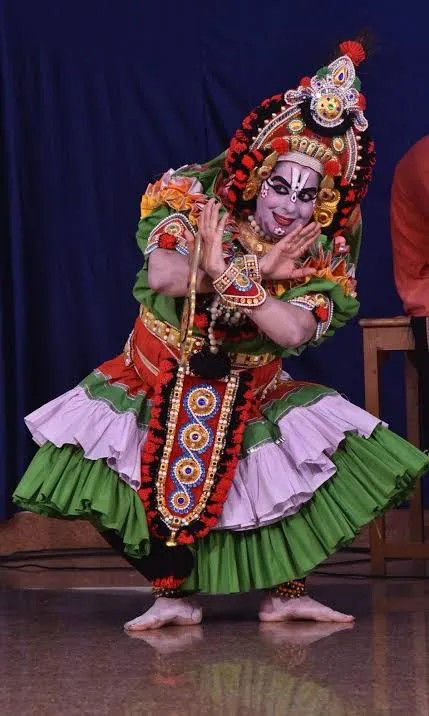
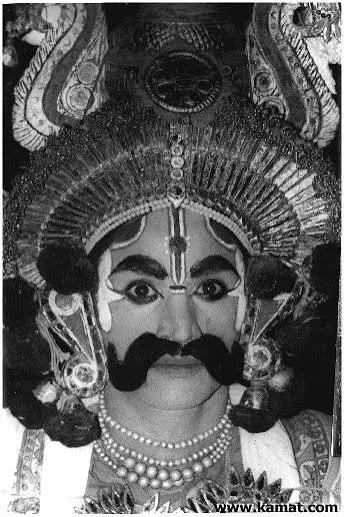
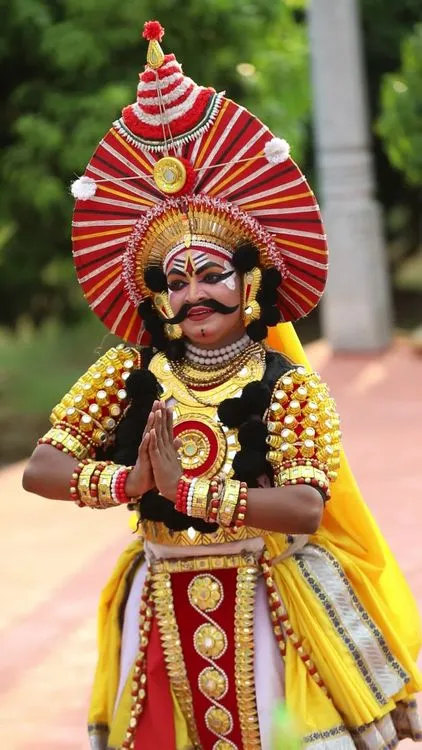
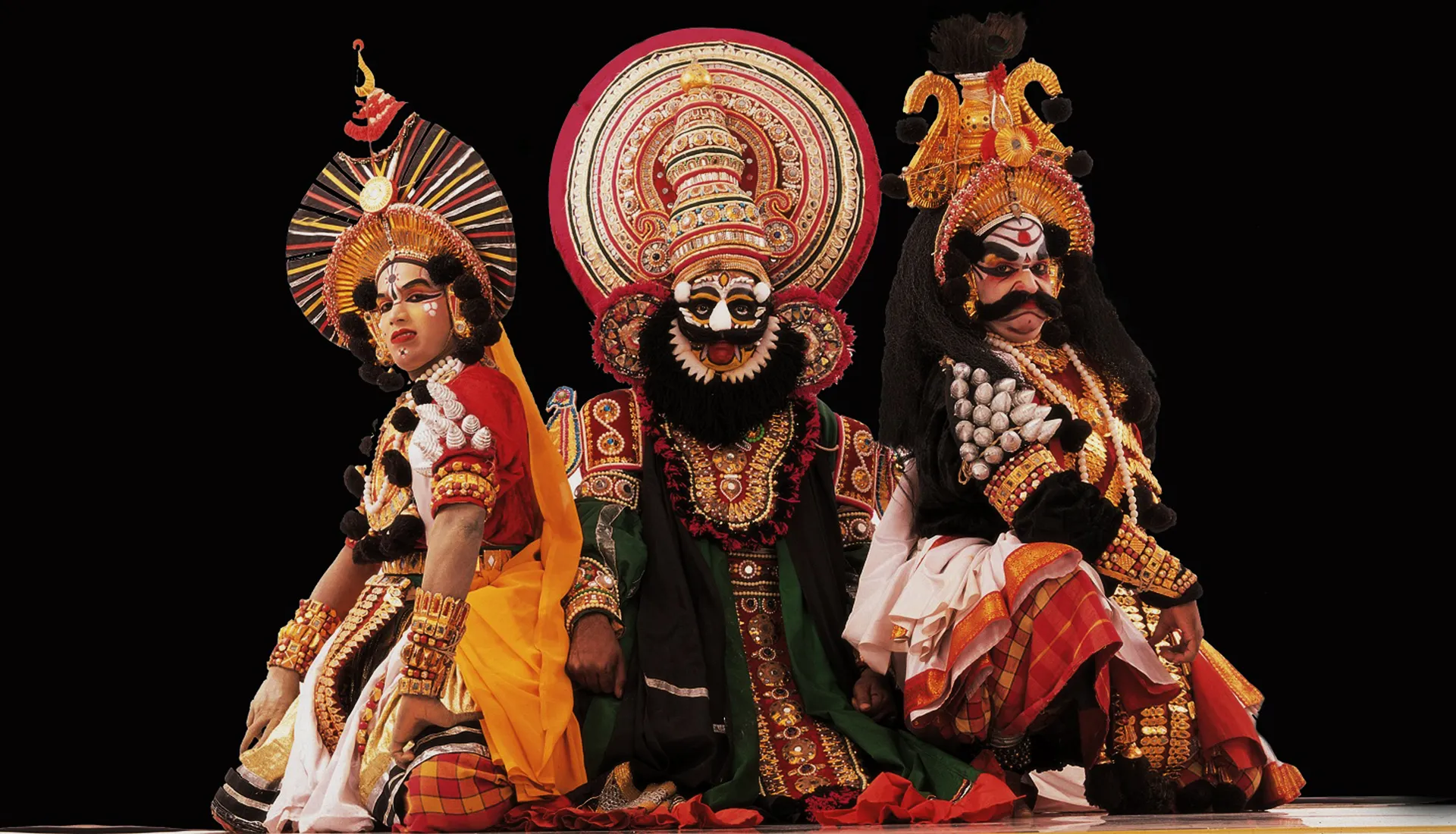
The central motifs of Yakshagana are drawn from the Hindu epic and Puranic narratives: battles between gods and demons, the moral dilemmas of epic heroes, the devotion of great bhaktas, and the divine interventions of Vishnu and Shiva. The elaborateness of the costume and makeup system in Yakshagana is itself a central motif: the large headdress (mundasu), the painted face (made with specific pigments to indicate character type), the gejje (ankle bells), and the layered costume are visual languages that communicate character identity to the audience before a word is spoken.
Process
A Yakshagana performance begins in the early evening with the Bhagavatha's musical invocation. The characters appear one by one, announced by the Bhagavatha's introductory songs, and are received by the audience with recognition. The performance proceeds through the episodes of the chosen narrative, with the Bhagavatha singing and the performers responding. The duration of a traditional performance is from dusk to dawn; contemporary performances are condensed to three to four hours. The preparation of performers, including the elaborate makeup and costuming process, takes several hours before each performance.
Mediums Used
Yakshagana uses an elaborate material culture. Instruments: in Tenkutittu, the maddalam drum, harmonium, and chakratala/jagatta cymbals are primary; in Badagutittu, the chande drum is primary, with harmonium and chengila cymbals. Costume: large headdress (mundasu) made from colored fabrics and ornamental elements, layered body garments, and gejje (ankle bells) are standard for all performers. Makeup: specific painted facial patterns using mineral pigments identify character types, with codes drawn from the broader tradition of South Indian performance makeup including Kathakali conventions that influenced the Tenkutittu style.
New Outlook
Yakshagana is a thriving tradition with strong institutional, community, and commercial support. Dedicated Yakshagana training institutions operate in coastal Karnataka, and the form is taught at universities. The Sangeet Natak Akademi and the Karnataka government actively support the form through awards, documentation, and performance funding. The tradition has generated a substantial scholarly literature in Kannada and is increasingly documented in English-language academic sources. Contemporary challenges include the management of quality across a large volume of performances, the adaptation of the all-night performance format to modern audience expectations, and the transmission of the tradition's specific artistic skills in an environment of competing occupational options for young performers in coastal Karnataka.
Learn Yakshagana
Bibliography
Sources
Ashton, Martha Bush, and Bruce Christie. Yakshagana: A Dance Drama of India. Abhinav Publications, 1977.
Karanth, Kota Shivaram. Yakshagana. Sangeet Natak Akademi, 1997.
Sangeet Natak Akademi. Yakshagana: Documentation and Studies. Sangeet Natak Akademi, various years.
Subramanya, Kambara, et al. Studies in Yakshagana. Karnataka University Press, various editions.
Upadhyaya, U. P., and S. P. Upadhyaya, editors. Yakshagana: Its Studies and Texts. Regional Resources Centre for Folk Performing Arts, 1988.
Image Sources
"How Women Own the Yakshagana Stage in Karnataka." The Hindu, https://www.thehindu.com/entertainment/theatre/international-womens-day-how-women-own-the-yakshagana-stage-in-karnataka/article70702576.ece. Accessed 22 July 2026.
"Vibrant Yakshagana Performer in Traditional Costume." Pexels, https://www.pexels.com/video/vibrant-yakshagana-performer-in-traditional-costume-30858228/. Accessed 22 July 2026.
Kamat, K. L. "Yakshagana." Kamat's Potpourri, https://www.kamat.com/picoweek/052598.htm. Accessed 22 July 2026.
"File: Yakshagana Art Form.jpg." Wikimedia Commons, https://commons.wikimedia.org/wiki/File:Yakshagana_art_form.jpg. Accessed 22 July 2026.
"Yakshagana Art Form – South Indian." PixMemora, https://pixmemora.com/blog/yakshagana-art-form-south-indian. Accessed 22 July 2026.

