

Tikuli Art: Bihar's Distinctive Glittering Folk Art
Let's learn about Tikuli art form!
Introduction and Origin
Tikuli art is one of Bihar's most distinctive and visually striking folk traditions, originating from Patna, the ancient city once known as Patliputra. This 800-year-old art form takes its name from the word tikli or bindi, the small ornamental dot worn between the eyebrows that has deep spiritual and cultural meaning for women in India. Practiced primarily by women artisans in the mahallas of Patna, Tikuli art today stands as both a symbol of Bihar's artistic heritage and a growing medium of women's empowerment.
What Is Tikuli Art?
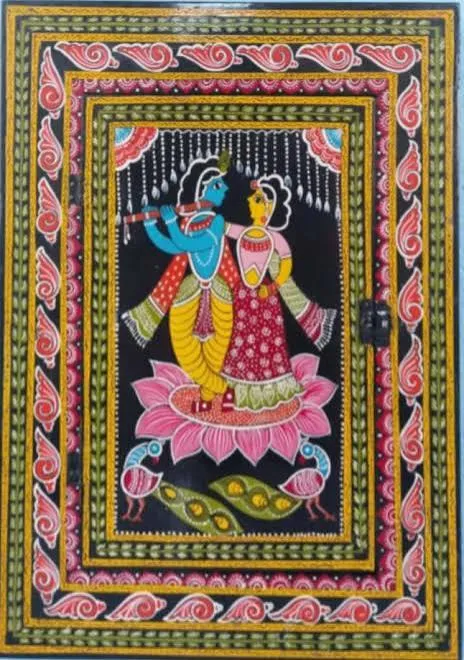
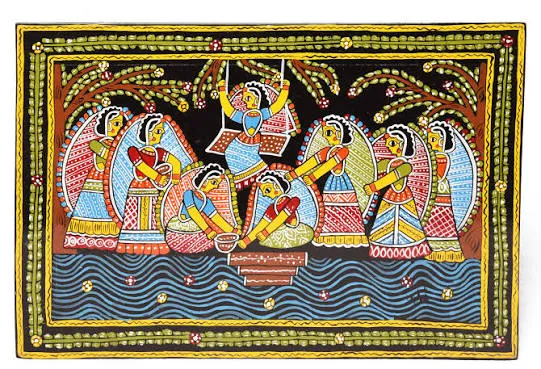
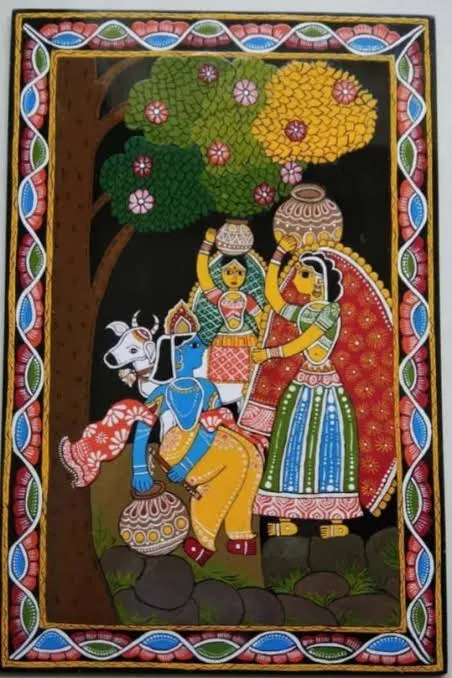
Tikuli art is a decorative folk painting tradition from Patna, Bihar, in which intricate patterns of tiny dots and vivid figures are painted on hard surfaces to create glittering, jewel-like artworks. The name comes from the tikli or bindi, which represents intellectual prowess and spiritual awareness in Indian tradition. Symbolically, the bindi signifies the third eye, associated with spiritual awakening. The paintings typically depict human figures, flora, fauna, and scenes from Hindu epics such as Krishna-Lila, with the figures rendered in bright yellow, orange, red, and blue against deep black backgrounds. Today, these artworks are made on hardboard or MDF boards coated with layers of enamel, and finished with gold leafing and semi-precious stones. They serve both as decorative objects and as a livelihood for 300 to 500 artisan families concentrated in the Digha, Danapur, and Gai Ghat mahallas of Patna.
History and Origin
Tikuli art has roots stretching back approximately 800 years to Patna, built on the site of ancient Patliputra in Bihar. Historically, the tikuli were made from molten glass blown into thin sheets, which were then cut to size, layered with gold foil, and decorated with natural colour pigments. These glass bindis were popular through the Mughal era. After the end of Mughal rule, British-manufactured machine-made bindis, which were cheaper, began displacing handcrafted ones. The enactment of the Gold Act after India's independence further restricted artisans from using gold, and the tradition went into sharp decline. The revival of Tikuli art is credited to Upendra Maharathi, a key figure in documenting and preserving tikuli kala. A visit to Japan showed him how communities there celebrated and shared their local arts with the world, inspiring him to modernise the medium. He replaced the fragile glass base with a hardboard, making the art far easier to learn and produce. This shift kept the tradition alive and opened it to a new generation of artists, particularly women.
Key Features and Famous Artists
Key Features and Visual Style
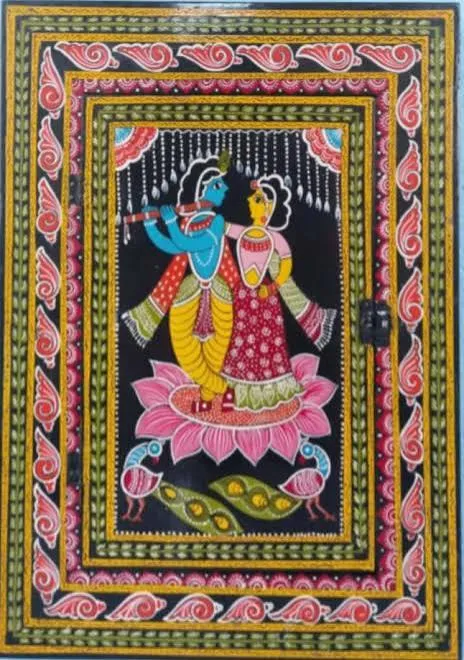
Tikuli art is recognisable by its jewel-bright colours, intricate dotwork, and luminous gold finishing. Several visual characteristics define this traditional Indian art form.
Contrasting colour palette: Artists use vibrant yellows, oranges, reds, and blues set against a black background, which makes human figures and motifs stand out with intensity.
Detailed figural depictions: Human figures are drawn with simplified anatomical forms but their facial features, clothing, and jewellery are rendered with careful precision and elaborate detail.
Gold leafing and stone finishing: The final layer of each artwork includes gold leafing and semi-precious colourful stones or crystals, known as tikulis, applied using gond, a natural adhesive.
Recurring motifs: Common motifs include trees, leaves, flowers, water bodies, and scenes from Hindu epics such as the Ramayana, Mahabharata, and Krishna-Lila narratives.
Multi-step production process: The process involves approximately fifteen steps, simplified into three main stages: cutting and shaping the hardboard, applying four to five layers of enamel with sandpaper smoothing between coats, and painting and finishing with gold and stones.
Traditional tools: Squirrel and sable hair paintbrushes were traditionally used; earlier work also involved sharpened bamboo offshoots to trace patterns and linework.
Famous Artists of Tikuli Art
Several artists have been instrumental in sustaining and popularising Bihar Tikuli art over the past few decades. These practitioners have kept the tradition alive and helped bring it to national and international attention. Upendra Maharathi (Bihar) was one of the most important figures in documenting and reviving tikuli kala. His research and interventions, inspired by how Japanese artisans showcased local arts, directly led to the modernisation of the medium from glass to hardboard.
Ashok Kumar Biswas (Patna, Bihar) is among the active contemporary practitioners who have worked to keep Tikuli painting alive and to develop a commercial market for the art form, both within India and internationally. Sumitra Devi (Patna, Bihar) is a noted woman artist who has contributed to expanding Tikuli art as a medium of empowerment for female artisans in Bihar's mahallas.
Sandhiya Singh (Bihar) has been active in producing Tikuli artworks in the contemporary style, combining traditional motifs with home decor applications that reach wider markets. Aarti Kumari (Bihar) is among the younger generation of Tikuli artists contributing to keeping the art form practised and commercially viable, particularly in the home decor segment.
How to Learn Tikuli Art
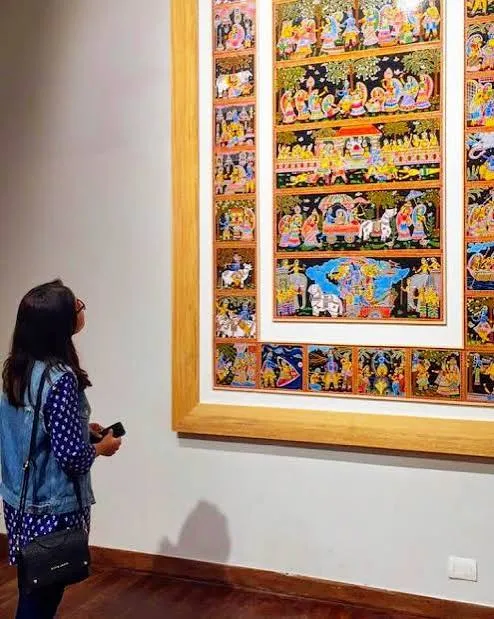
If you want to learn Tikuli art online, the best place to start is with a structured course taught by an artist who has grown up with this tradition. Rooftop is India's platform for authentic folk art education, offering online courses taught directly by master artists. Learning Tikuli art online means you can follow the process at your own pace, understand the layering technique, and practise the dotwork and colour methods that make this art form so distinctive.
Where to See and Buy Tikuli Art
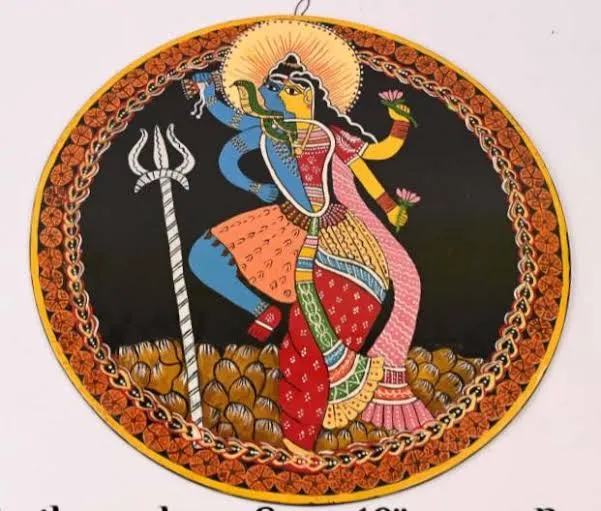
The best place to see Tikuli art being made is in the Digha, Danapur, and Gai Ghat mahallas of Patna, Bihar, where artisan families have practised the craft for generations. The Patna Museum and Bihar Museum also feature examples of traditional Tikuli works. For those outside Bihar, the art appears at major Indian craft fairs and folk art exhibitions. To buy authentic Tikuli painting India pieces, visit the Rooftop shop, where original artworks from Indian folk traditions are available, or explore the wider Art Wiki to discover related art forms from across India.
Learn Tikuli

Frequently Asked Questions
What is Tikuli art and where does it come from?
Tikuli art is a folk painting tradition from Patna, Bihar, named after the tikli or bindi, the ornamental dot traditionally worn on a woman's forehead. It is an 800-year-old art form that originated in Patna, on the site of ancient Patliputra. The paintings are made on hardboard coated with enamel, finished with gold leafing and semi-precious stones, and depict figures and scenes in vivid colours against a black background.
Which community in Bihar practises Tikuli art?
Tikuli art is practised primarily by artisan families living in the Digha, Danapur, and Gai Ghat mahallas of Patna town in Bihar. Historically, the production was divided between Muslim artisans who cut the glass sheets and Hindu artisans who applied the decorative tikuli foilwork. After the revival led by Upendra Maharathi, the art became particularly associated with women artisans, and today it supports an estimated 300 to 500 artisan families in the region.
What materials are used in Tikuli painting?
Modern Tikuli paintings are made on MDF or hardboard bases that are coated with four to five layers of enamel paint, smoothed with sandpaper between each coat. Artists then paint motifs using store-bought enamel paints and traditionally used squirrel or sable hair brushes, as well as sharpened bamboo offshoots for linework. The final artwork is decorated with gold leafing and semi-precious colourful stones called tikulis, fixed using gond, a natural adhesive.
Who are the most notable artists working in Tikuli art today?
Key artists associated with Tikuli art include Upendra Maharathi, who is credited with reviving the tradition by replacing the glass base with hardboard, and contemporary artists such as Ashok Kumar Biswas, Sumitra Devi, Sandhiya Singh, and Aarti Kumari, all based in Patna, Bihar. These artists have been central to expanding the commercial reach of Tikuli painting into the home decor market, both within India and internationally.
Can I learn Tikuli art online?
Yes, you can learn Tikuli art online through structured courses on platforms like Rooftop, which connects students with master folk artists from across India. Online learning lets you follow the layering, dotwork, and colour techniques at your own pace with guidance from experienced practitioners. This is a practical way to begin if you are not based in Bihar.
How has Tikuli art changed over time?
The most significant change in Tikuli art has been in its materials rather than its themes. The original glass base, made from molten glass blown into thin sheets, was replaced with hardboard and later MDF after the decline of traditional production following the Gold Act and the rise of cheaper machine-made bindis. Today, store-bought enamel paints are used in place of natural colour pigments, and the focus has shifted from religious and ceremonial use to home decor and commercial applications for both Indian and international buyers.
Tikuli art is a living example of how a folk tradition can adapt, survive, and find new meaning without losing its essential identity. From the mahallas of Patna to homes across India and beyond, it carries the spirit of Bihar's artisan communities and the symbolic depth of the bindi into a contemporary medium. Explore Indian folk art courses on Rooftop and begin your journey with one of Bihar's most glittering art traditions.
Bibliography
Sources
Sinha, A. (2018) Bihar ke Kaljai Shilpkar - Classical Artists of Bihar. Patna: Upendra Maharathi Shilp Anusandhan Sansthan.
Image Sources
"Ardhnarishvar Tikuli Art (Size 12"). Indian Folk Art, https://indianfolkart.org/product/ardhnarishvar-tikuli-art-size-12/. Accessed 21 July 2026.
"Mirror Tikuli Art (Size 18 × 14)." Indian Folk Art, https://indianfolkart.org/product/mirror-tikuli-art-size-18x14/. Accessed 21 July 2026.
"Radha Krishna Tikuli Art (Size 18 × 12)." Indian Folk Art, https://indianfolkart.org/product/radha-krishna-tikuli-art-size-18x12/. Accessed 21 July 2026.
"Tikuli Art: An 800-Year-Old Art Form from Bihar." That Patna Blogger, 6 Jan. 2018, https://thatpatnablogger.wordpress.com/2018/01/06/tikuli-art-an-800-year-old-art-form-from-bihar/. Accessed 21 July 2026.
"Tikuli Paintings." National Portal of India, https://www.india.gov.in/explore-india/odop/details/tikuli-paintings. Accessed 21 July 2026.