
Terah Taali - The Folk Dance Tradition of Rajasthan
Explore the Terah Taali, a devotional form performed in honor of Baba Ramdev, prominent folk dance of Rajasthan
Introduction
Introduction
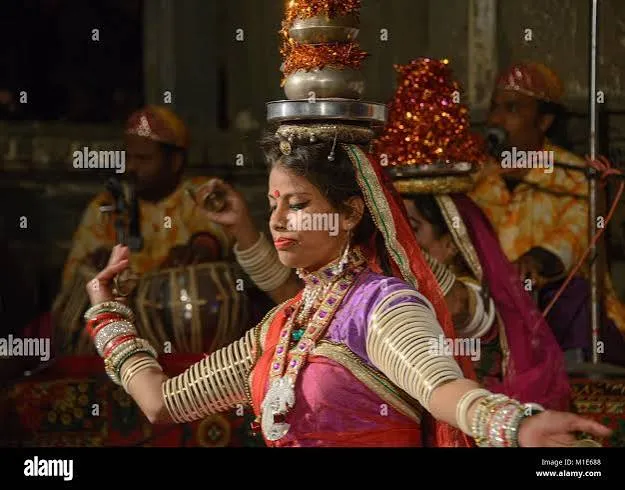
Terah Taali is a traditional folk dance of Rajasthan, India, performed primarily by women of the Kamad (also spelled Kamada or Kamar) community. The name translates directly from Hindi as thirteen (terah) beats (taali), referring to the thirteen small brass cymbals known as manjiras that performers attach to various parts of their bodies and strike in precise rhythmic sequences while dancing. The dance is performed in a seated or partially seated posture, with the performer's legs extended and the manjiras tied to different limbs, producing a polyphonic percussive sound. Terah Taali is documented as a devotional form performed in honor of Baba Ramdev, a folk deity revered in Rajasthan for his teachings of social equality and compassion, and is associated with the Baba Ramdev temple at Ramdevra (Runecha) in Jaisalmer district.
Etymology
The name Terah Taali derives from two Hindi words: terah, meaning thirteen, and taali, meaning clap or beat. The reference is to the thirteen manjiras tied to the performer's body, which produce thirteen distinct percussive beats when struck in specific sequences and combinations. The word taali here does not refer to hand clapping in the general sense but to the rhythmic beats produced by the cymbals. The dance is also referred to as Terah Taal or Tera Tali in variant spellings, but the meaning and reference remain consistent.
Origin
Terah Taali originates from the Kamad community of Rajasthan. The Kamad (also spelled Kamada) is a community historically associated with the devotional tradition of Baba Ramdev and with the performance arts traditions of Rajasthan, including Phad (scroll painting and narration) and theatrical performance. The dance is particularly associated with the regions of Pokhran (Jaisalmer district) and Deedwana (Nagaur district), where the Kamad community has maintained continuous performance traditions. While the Kamad are the primary custodians of Terah Taali, sources also document the performance of the dance by related performing communities including the Mirasi, Bhand, Dholi, Bhat, and Nat castes of Rajasthan, who share overlapping occupational identities as hereditary performers.
Location
Terah Taali is performed primarily in the areas of Pokhran (Jaisalmer district), Deedwana (Nagaur district), and in Pali district, where the Kamad community has a significant presence. The Baba Ramdev temple at Ramdevra (Runecha) in Jaisalmer district is the site most closely associated with the devotional performance of the dance, and annual performances are documented at the temple during the Ramdev fair held in the Hindu month of Bhadrapada. The dance is also performed at Bagore ki Haveli in Udaipur, where the daily Dharohar cultural show includes Terah Taali in its programme, bringing the form to a broad domestic and international tourist audience.
Community
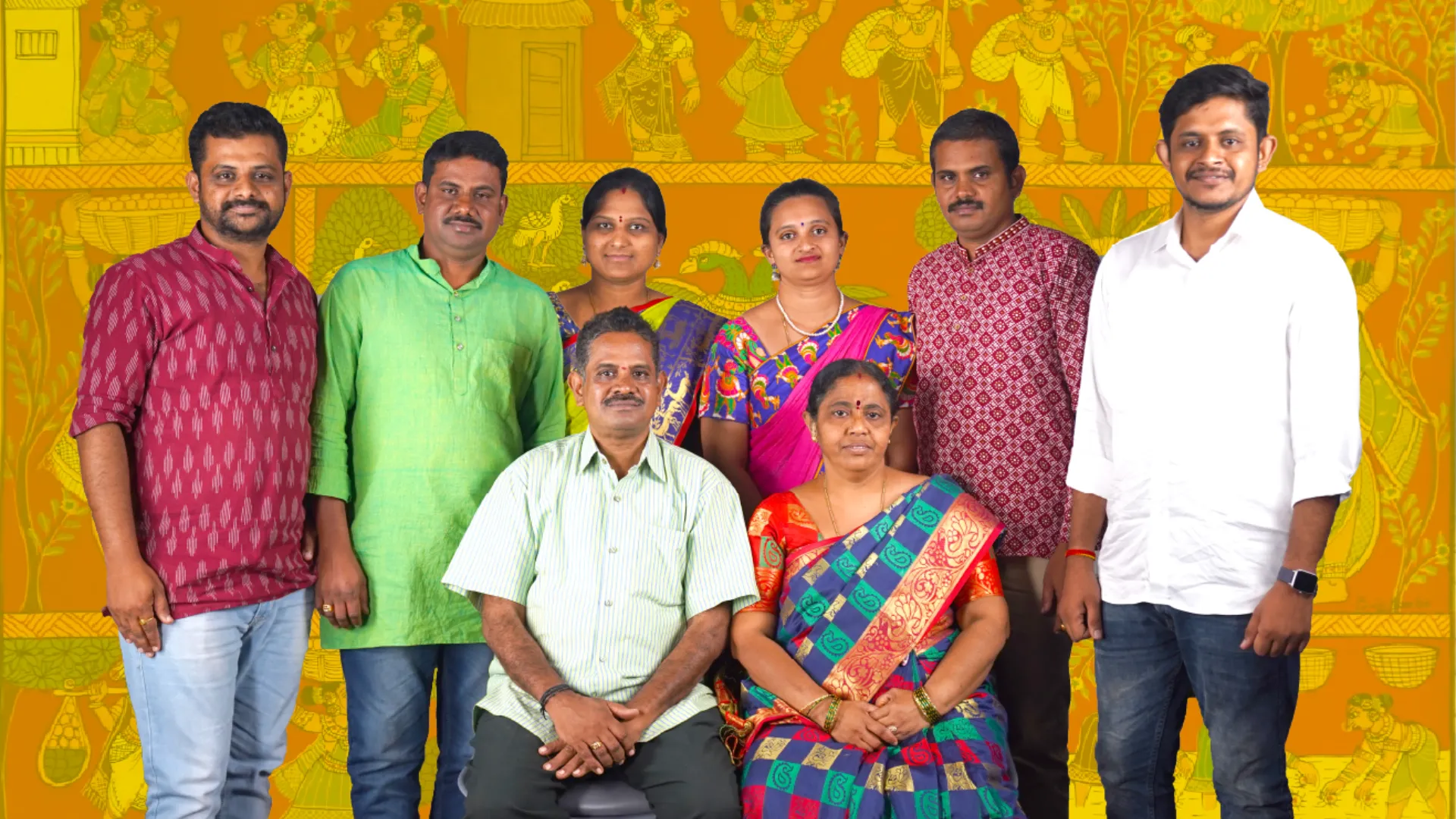
The Kamad community is listed as a Scheduled Caste in Rajasthan. The community is associated with the devotional tradition centered on Baba Ramdev and with a broader cluster of performance arts that includes Phad narration, Terah Taali, and musical accompaniment at religious events. The community performs the dance as an act of devotion to Baba Ramdev, whose worship emphasizes social equality and the rejection of caste-based discrimination, placing Terah Taali within a religious tradition with an explicit social justice dimension. Women are the primary dancers, while men play the four-stringed instrument called chautara (also spelled chau-tara) and sing devotional songs. The performance of Nirmala Devi and her family from Padarla village in Pali district has received documentation through People's Archive of Rural India (PARI), providing ground-level ethnographic detail about the dance's continued practice.
Relevance
Terah Taali is classified as a medium-relevance, vulnerable folk dance form in contemporary cultural surveys of Rajasthan, reflecting its continued practice within the Kamad community and at cultural venues while facing challenges from urbanization and the declining economic viability of hereditary performing arts. The dance is a regular feature of Rajasthan's cultural tourism circuit and is performed nightly at Bagore ki Haveli in Udaipur through the Dharohar Folk Dance programme. It has also been presented at national cultural events and festivals in India and abroad. Despite this visibility, the form's practitioners face economic precarity, as documented by PARI's reporting on Terah Taali artists in Udaipur.
History
Background
The Kamad community's practice of Terah Taali is embedded within a larger religious and cultural complex centered on Baba Ramdev (also known as Ramdev Pir or Ramdeo Ji), a 14th-15th century Rajput saint who is venerated across Rajasthan and in parts of Gujarat and Madhya Pradesh. Baba Ramdev is identified in Rajasthani tradition as one of the Panch Pir (five saint-protectors) of Rajasthan and is particularly venerated by lower-caste and marginalized communities. The Ramdevra fair at Jaisalmer, held annually during Bhadrapada, is one of the largest communal harmony fairs in Rajasthan, attracting both Hindu and Muslim devotees. Terah Taali performed at this fair represents the Kamad community's specific devotional contribution to the worship of their patron saint.
The sequence Nirmala Devi described to PARI traces the dance's evolution from bhajan and temple performance practices during Navratri, involving the tanpura, dholak, and manjira, which gradually developed into the formalized dance sequence using thirteen cymbals tied to the body.
Culture and Societies
Within the social structure of Rajasthani performing communities, the Kamad occupy a specific niche defined by their association with the Ramdev devotional tradition. The Phad scroll-painting tradition, which narrates the life of Pabuji and Devnarayan and is performed by Bhopa and Bhopi (male and female priest-singers) of the Nayak community, provides a parallel model of devotional performance art organized around a specific folk deity. The Kamad community's Terah Taali occupies a similar structural position in relation to Baba Ramdev. The dance is both a devotional act and a hereditary professional skill, transmitted within families from mother to daughter over generations.
Religious Significance
Terah Taali is explicitly a devotional performance offered to Baba Ramdev. The dance is performed with the women sitting in front of an image or representation of Baba Ramdev, physically oriented toward the deity in the manner of a ritual offering. This seated devotional orientation distinguishes Terah Taali structurally from Rajasthan's entertainment-focused folk dances. The deity Baba Ramdev is historically documented as a Rajput prince who became a saint and is venerated for his egalitarian social teachings and miracles. His worship crosses caste and community lines, and the Terah Taali dance performed in his honor carries the community's declaration of devotion and gratitude. The Ramdevra fair at which the dance is performed is explicitly identified by the Rajasthan government as a major fair of communal harmony.
Understanding the Art
Style
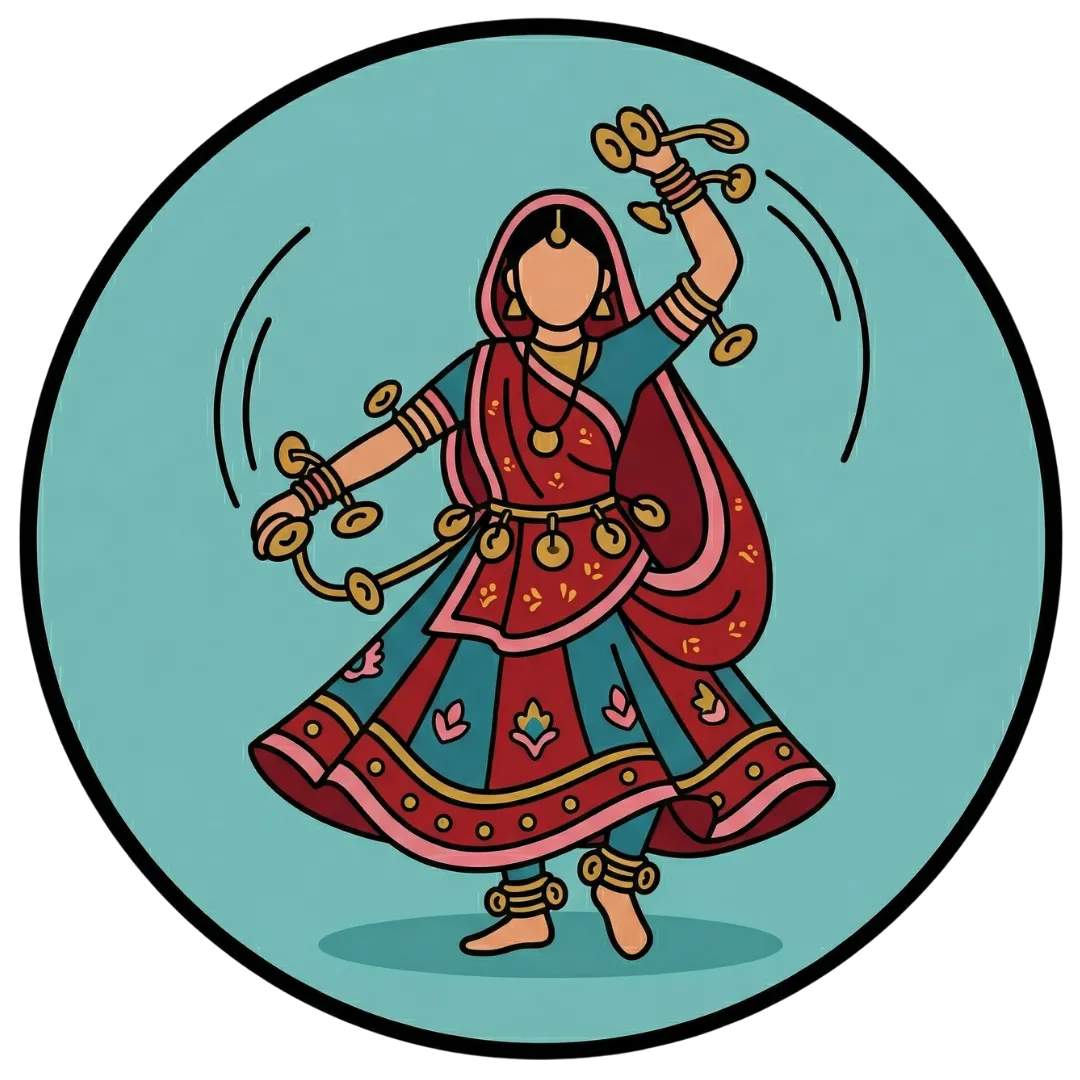
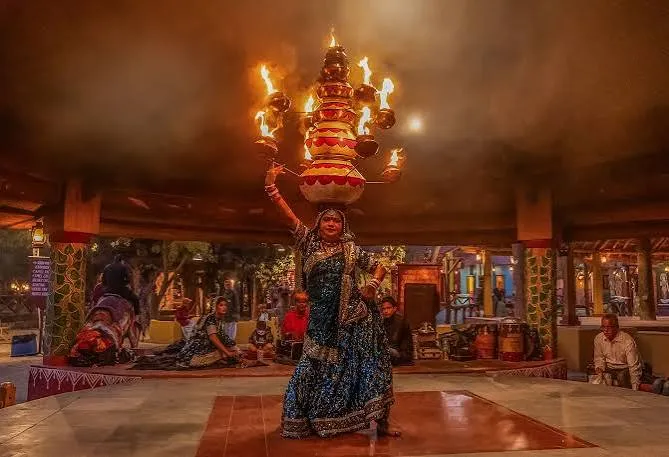
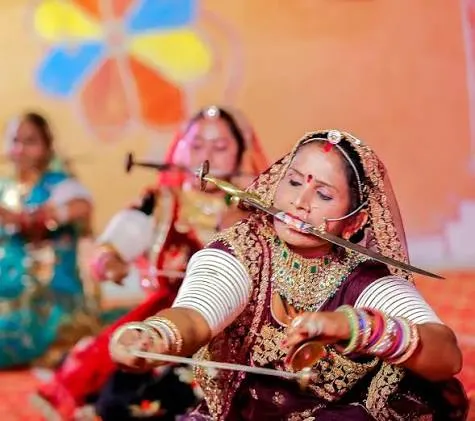
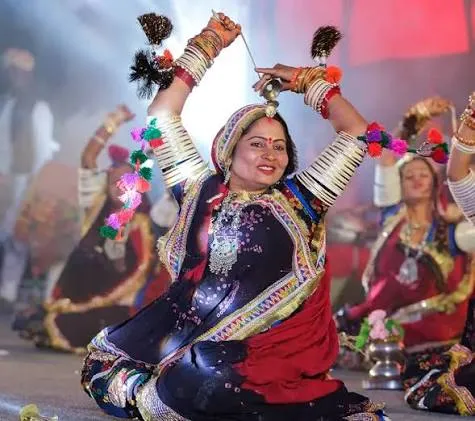
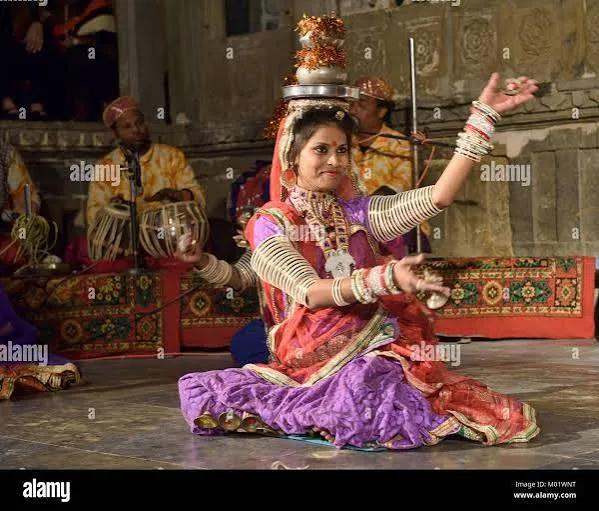
Terah Taali is distinctive in that the primary performers dance in a seated or cross-legged position, with movement concentrated in the upper body, arms, and hands. The female performers attach thirteen manjiras to their bodies: typically nine sets on the right leg (distributed from knee to ankle, with one on the instep and one on the toe), one on each wrist, and one held in each hand. The manjiras held in the hands are struck against the body-mounted cymbals in rapid rhythmic sequences, producing the characteristic Terah Taali sound. The movement of the arms, the angle and velocity of striking, and the synchronization among group performers create a complex percussive texture. During performances, dancers may also hold a sword between their teeth (a feat of balance and nerve) or balance a decorated pot or lit oil lamp on the head, adding acrobatic elements to the devotional display.
Central Motifs and Their Significance
The number thirteen has specific resonance within the performance context: thirteen is the count of manjiras, thirteen is the count of distinct percussive patterns or beats, and the configuration of cymbals on the body maps a specific spatial and rhythmic territory. The devotional orientation toward Baba Ramdev provides the thematic content: the male accompanists sing devotional songs (bhajans) about the saint while the women perform, creating a union of musical narration and rhythmic expression. The sword-balancing and pot-balancing elements, while acrobatic in effect, carry connotations of spiritual power and concentration characteristic of devotional performance traditions across Rajasthan.
Process
A Terah Taali performance begins with the male performers playing the chautara (four-stringed plucked instrument, sometimes also called tandoora) and singing devotional songs in praise of Baba Ramdev. The women sit before the deity's image and begin attaching the manjiras. The ektara (single-string instrument) may also provide melodic accompaniment. As the music establishes the rhythm, the dancers begin striking the body-mounted cymbals with the hand-held pair, gradually building the rhythmic complexity of the performance. The dance may incorporate the acrobatic elements (sword, pot, lamp) at designated points in the performance sequence. Group performances require precise synchronization among dancers.
Mediums Used
The thirteen manjiras are the defining material element of Terah Taali. Manjiras are small percussion discs made of brass or bronze, typically measuring three to six centimeters in diameter, connected in pairs by a string or rope. The attachment of thirteen of these to the body in the specific configuration described above requires ropes or fabric ties that hold them firmly in place during performance. The chautara is a four-stringed plucked instrument traditional to the Kamad community; the ektara is a simpler single-string folk instrument. The performer's costume typically consists of the ghagra (skirt) and choli (blouse) with traditional Rajasthani embroidery and mirrorwork, though in performance contexts the costume is less elaborate than in celebratory folk dances, reflecting the devotional rather than celebratory nature of the form.
New Outlook
Terah Taali faces the dual challenge of economic precarity among its practitioners and the risk of decontextualization as it enters the cultural tourism market. Its nightly performance at Bagore ki Haveli in Udaipur and its inclusion in Rajasthan cultural programming provides income and visibility to artists, but PARI's documentation of Nirmala Devi's family reveals the economic struggles of full-time folk performers in a market where performance fees have not kept pace with living costs. The Dharohar Folk Dance group that performs at Bagore ki Haveli has stated its commitment to performing Terah Taali as an effort to revive what it describes as an endangered tradition. Academic documentation of the dance remains limited relative to more prominent Rajasthani forms, and the Kamad community's specific religious and social context is incompletely represented in most tourist-facing presentations of the dance.
Learn Terah Taali

Bibliography
Sources
Kothari, Komal. Folk Musical Instruments of Rajasthan. Rupayan Sansthan, 1977.
Leavitt, John, editor. Musical Gestures: Sound, Movement, and Meaning. Routledge, 2008.
Mathur, U. B. Treasure-trove of Rajasthan. Folklorists, 2002.
Image Sources
“Terah Taali Dance.” Chokhi Dhani, https://chokhidhani.com/village-fair-restaurant-jaipur/slider/terah-taali-dance/. Accessed 4 July 2026.
“Terah Taali Dance.” Dancing Peacock, https://dancingpeacock.in/terah-taali-dance. Accessed 4 July 2026.
“Terah Taali Dance.” Dancing Peacock, https://dancingpeacock.in/terah-taali-dance. Accessed 4 July 2026.
“Woman Performing the Terah Taali (Terah Taal) Dance of the Kamada Tribe.” Alamy, https://www.alamy.com/stock-photo-woman-performing-the-terah-taali-terah-taal-dance-of-the-kamada-tribe-172145844.html. Accessed 4 July 2026.
“Woman Performing the Terah Taali (Terah Taal) Dance of the Kamada Tribe.” Alamy, https://www.alamy.com/stock-photo-woman-performing-the-terah-taali-terah-taal-dance-of-the-kamada-tribe-173030600.html. Accessed 4 July 2026.