
Sankirtana - The Music Tradition of Manipur
Discover Sankirtana or Sankirtan, a ritual and performance tradition of Manipur encompassing devotional singing, drumming, and dance associated with the Vaishnava communities of the Meitei people...
Introduction
Sankirtana, also written as Sankirtan, is a ritual and performance tradition of Manipur encompassing devotional singing, drumming, and dance associated with the Vaishnava communities of the Meitei people. It is practiced in temples, homes, and public spaces during religious and cultural events, and encompasses a range of performing arts including singing, drumming, and specific forms of dance. UNESCO inscribed Sankirtana on its Representative List of Intangible Cultural Heritage of Humanity in 2013, citing its significance as a living tradition that serves important social and religious functions within the Meitei community.
Sankirtana in Manipur is not a single performance genre but a family of related performance traditions, each with distinct stylistic characteristics, associated with different Vaishnava lineages and historical periods. Its role extends beyond entertainment and religious performance to encompass social functions at life-cycle ceremonies, community gatherings, and festivals.
Etymology
The term Sankirtana derives from Sanskrit: the prefix sam means together or fully, and kirtana derives from the root kirt meaning to praise, celebrate, or narrate. The compound therefore denotes communal singing in praise or collective narration of divine attributes. The term is used across multiple Vaishnava traditions in India in the broad sense of communal devotional singing, but in the Manipur context it refers specifically to the local tradition that developed through the integration of Vaishnava devotional practice with Meitei cultural forms from the 15th century onward.
Origin
The entry of kirtana into Manipur is historically associated with the reign of King Kiyamba (1467 to 1508), during which contact with Bengal facilitated the introduction of Vaishnava devotional practice including kirtana. However, the formalization of Sankirtana as a distinct Manipuri performance tradition is more specifically associated with the 18th century, during the reign of King Garibnawaz (also known as Pamheiba, 1709 to 1748), who converted to the Ramanandi sect of Vaishnavism and made it the state religion of Manipur. This conversion significantly restructured the religious and cultural life of the Meitei community and provided the institutional context for the development of Sankirtana.
The 19th century saw further systematization. During the reign of King Chandrakirti (1850 to 1886), Nata Sankirtana was developed by the religious figure Rajarshi Bhagyachandra (also known as Jai Singh, died 1819, whose legacy continued to influence practice), who is credited with systematizing the performance protocols of Sankirtana and integrating specific dance movements into the tradition. The association of Sankirtana with the 64 rasas over 32 performance days is a feature of the elaborated tradition as it developed in this period.
Location
Sankirtana is primarily practiced in the Imphal Valley of Manipur, the lowland region inhabited by the Meitei community. Temple complexes (mandaps) serve as primary performance venues, and the Govindaji temple in Imphal, which served as the royal temple of the Manipur king, is the most significant institutional center for the tradition. The tradition extends to village-level temples and to domestic settings for life-cycle ceremonies.
Community
Sankirtana is practiced by the Meitei community of the Imphal Valley, which is the dominant ethnic group of Manipur. Following the conversion to Vaishnavism in the 18th century, Sankirtana became a central cultural institution of the Meitei community. Specialized practitioners include trained singers (shanabas), drummers (pung players), and dancers (khubak ishei dancers). The performance is conducted primarily by men in public temple settings, while women participate in specific contexts. The tradition is transmitted through specialized institutions (mandaps) and through the guru-shishya system.
Relevance
Sankirtana was inscribed by UNESCO on the Representative List of Intangible Cultural Heritage of Humanity at the 8th session of the Intergovernmental Committee in Baku, Azerbaijan, in 2013. The UNESCO nomination was prepared by the Sangeet Natak Akademi of India. The inscription recognizes Sankirtana as a tradition with living social functions across the community, including its role in ceremonies related to the full life cycle from birth to death. The tradition is actively maintained and has not shown signs of significant decline, though the maintenance of specialized performing roles requires continuous training and institutional support.
History
Background
The pre-Vaishnava religious tradition of the Meitei community was the Sanamahism, an indigenous religious system centered on clan deities and nature spirits. The introduction of Vaishnavism through Bengal contact and the subsequent conversion of the royal family created a layered religious identity in which Vaishnava practice was superimposed on and eventually integrated with elements of the older tradition. The musical and performative forms of Sankirtana developed within this context, drawing on both Vaishnava textual and compositional traditions from Bengal and on existing Meitei performance conventions.
The Gita Govinda of Jayadeva (12th century), a Sanskrit composition describing the love of Radha and Krishna, has a central place in the Sankirtana repertoire. Manipuri Vaishnavism emphasizes the Radha-Krishna theology of the Gaudiya tradition, and the Gita Govinda is performed in Sankirtana contexts with specific Manipuri melodic and rhythmic adaptations.
Culture and Societies
Sankirtana serves multiple social functions within the Meitei community beyond its religious role. It is performed at the naming ceremony of a child, at the sacred thread ceremony, at marriages, and at death ceremonies where it accompanies the deceased to the cremation ground and is performed during the mourning period. The communal nature of the performance, with multiple musicians and vocalists performing together in a coordinated ensemble, reinforces social bonds and marks the participation of the community in the individual's life transitions.
The four main performance styles of Sankirtana in Manipur are the Ariba (Bangdesh) Pala, associated with the oldest layer of the tradition, the Manoharsai, the Dhop (Chaitanya Sampradaya), and the Dhrumei. Each style is associated with specific ragas, talas, and performance contexts, and carries the identity of the particular Vaishnava lineage from which it developed.
Religious Significance
Sankirtana is understood within the Manipuri Vaishnava tradition as a visible manifestation of God, a position that reflects the influence of the Gaudiya Vaishnava theology according to which the divine is immanent in the devotional performance itself. The communal singing of divine names and the narration of Krishna's activities through music and movement are regarded as acts of worship equivalent to temple ritual. The performance is conducted in sacred space facing east, in accordance with the directional orientation prescribed by Vaishnava ritual convention. The Goura-Chandrika, a prologue composition invoking the figure of Chaitanya Mahaprabhu, opens formal Sankirtana performances.
Understanding the Art
Style
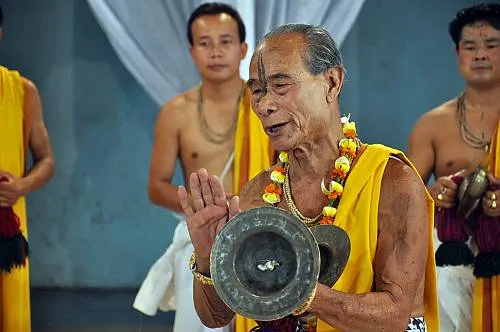
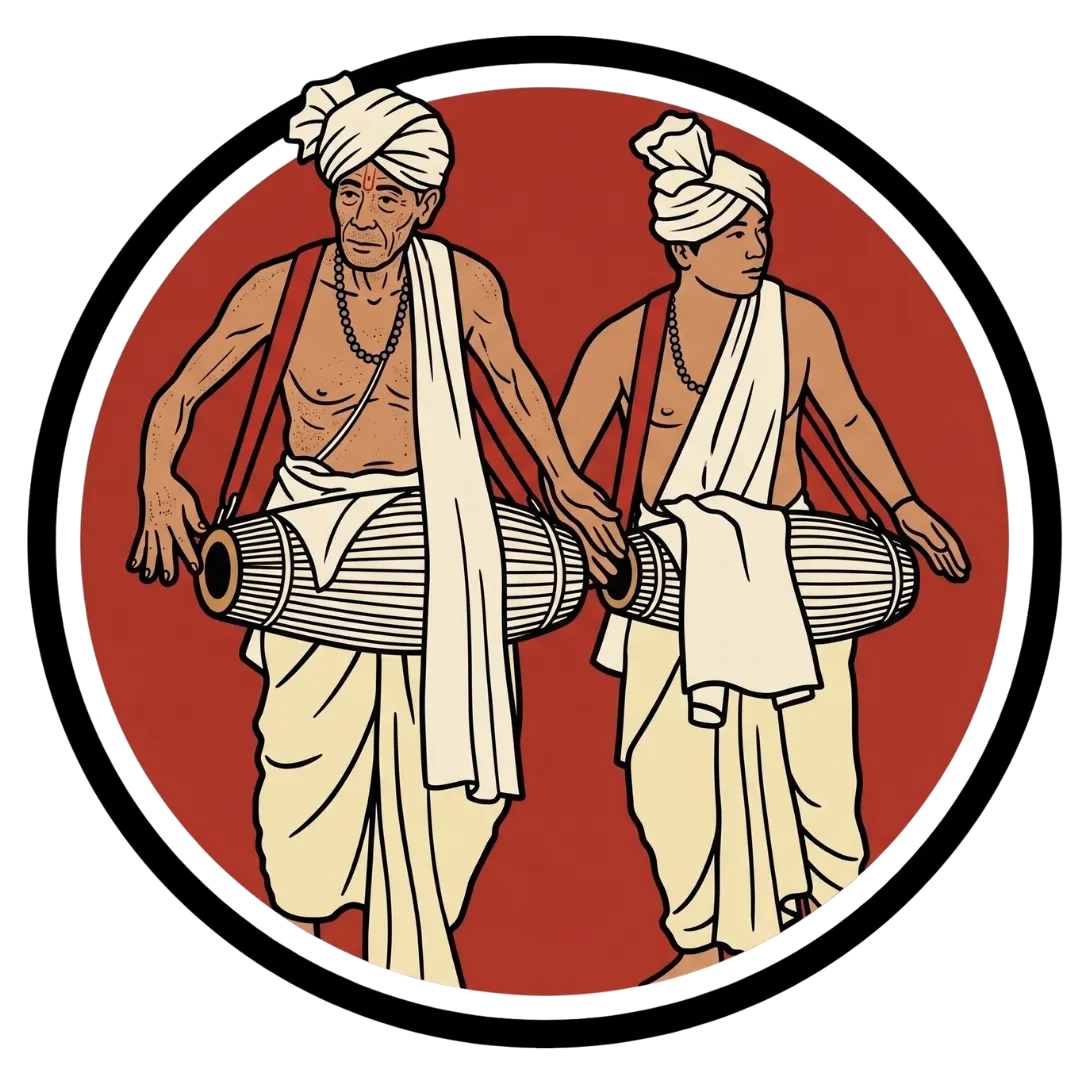
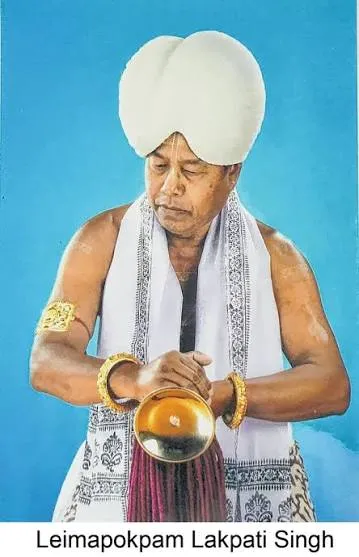
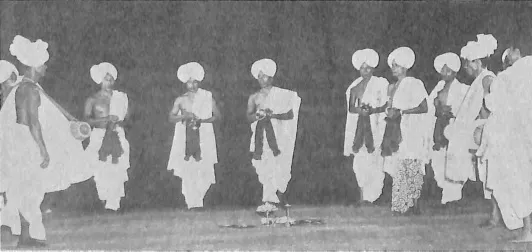
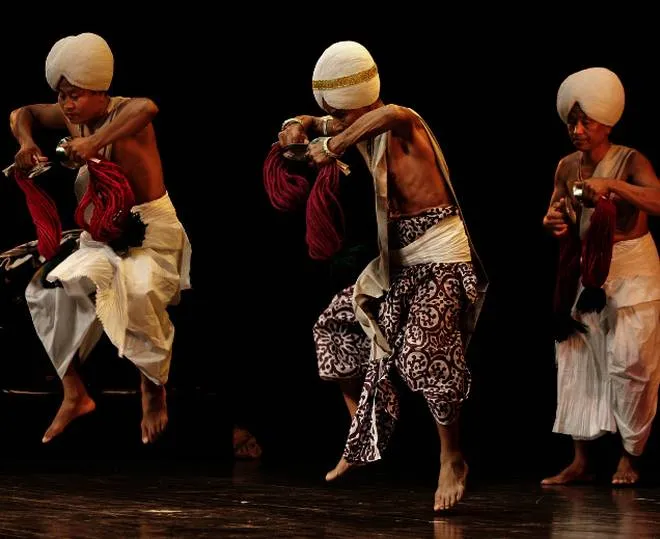
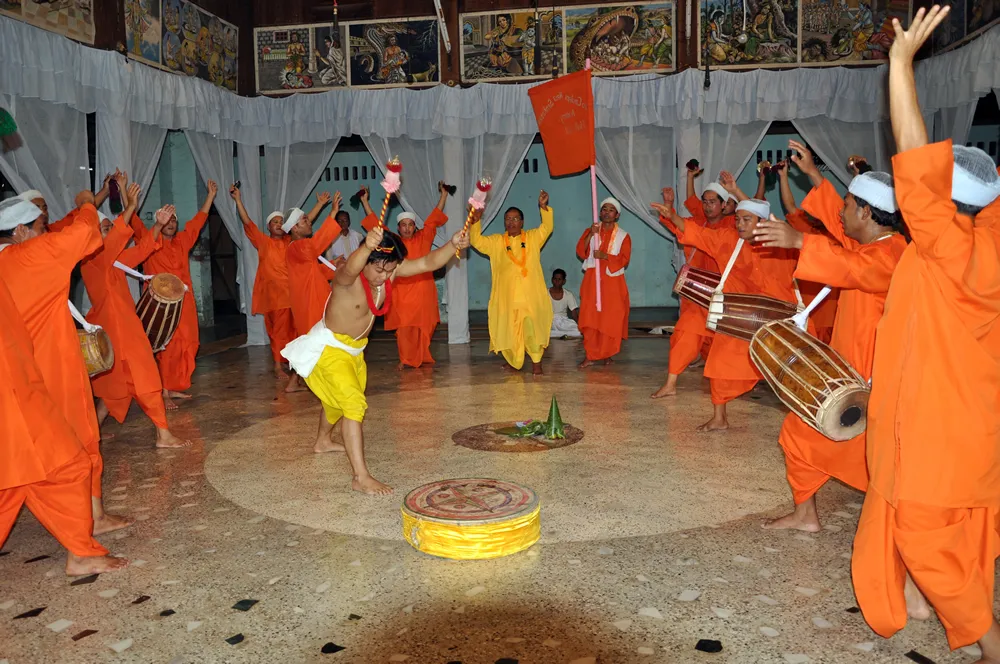
The ensemble for a standard Sankirtana performance consists of approximately 10 to 12 performer-singers supported by two drummers playing the pung. The performance is conducted in a square or circular space, often in front of a deity or in a mandap. The singers and dancers move in a circular pattern, and the choreography of the movement is integrated with the musical structure. The pung (a barrel drum similar to the mridangam) is the central percussion instrument and provides both rhythmic structure and melodic contour through its varied tonal range. Cymbals (kartal) provide additional rhythmic support.
The ragas used in Sankirtana are drawn from both the Indian classical tradition and from Manipuri regional melodic systems. The talas include tintala, duitala, rajmel, and ektal, among others. The textual repertoire is drawn from padavalis (Vaishnava devotional poetry) in Bengali, Maithili, Braj Bhasha, and Manipuri.
Central Motifs and Their Significance
The dominant thematic content of Sankirtana is the narrative of Radha and Krishna, drawn from the Gita Govinda, the Bhagavata Purana's tenth canto, and the padavali compositions of Bengali Vaishnava poets including Chandidas, Vidyapati, and Govindadas. The themes of the union and separation of Radha and Krishna, the eight phases of their love (ashta-nayika), and the cosmic dimensions of Krishna's activities are the primary narrative material. The Goura-Chandrika opening section invokes Chaitanya Mahaprabhu and connects the Manipuri tradition to its Gaudiya Vaishnava theological foundation.
Process
Sankirtana is transmitted through the guru-shishya system within institutional frameworks (mandaps) associated with specific temples. Training encompasses vocal music, drumming on the pung, and the specific movements associated with Sankirtana performance. The complexity of the pung playing in particular, which involves intricate hand and finger technique producing a wide range of tones, requires extensive training. The specialization of roles within the ensemble (lead singer, response singers, pung players, cymbal players) means that different practitioners specialize in different aspects of the tradition.
Mediums Used
The instruments of Sankirtana are the pung (barrel drum, the central instrument), kartal or manjira (cymbals), and in some contexts small idiophones. No melodic instruments other than the human voice are used in standard Sankirtana performance, reflecting the tradition's emphasis on the voice as the primary musical medium. The absence of melodic instruments focuses attention on the vocal quality and textual content of the performance.
New Outlook
New Outlook The UNESCO inscription of 2013 has contributed to increased institutional support and documentation efforts for Sankirtana. The Manipur government and national bodies including the Sangeet Natak Akademi have engaged with programs to ensure the continuation of training institutions and to document the repertoire. The tradition is maintained in a healthy state with active performance calendars in temple and community contexts. Challenges include the maintenance of specialized trained roles, particularly proficient pung playing, and the demographic pressures affecting participation in traditional institutions.
Learn Sankirtana (Manipur)
Bibliography
Sources
Ibotombi, Sorokhaibam. The Cultural History of Manipur. Manipur State Kala Akademi, 1985.
Nettl, Bruno, editor. The Garland Encyclopedia of World Music: South Asia. Routledge, 2000.
Singh, Khelchandra. Manipuri Culture, the Meiteis and Their Art, Literature and Philosophy. Manipur State Kala Akademi, 1975.
UNESCO. Nomination File No. 00343 for the Inscription of Sankirtana on the Representative List. UNESCO, 2013.
Image Sources
"To Be a Professionally Expert Person in Any Field of Our Life..." The Sangai Express, https://www.thesangaiexpress.com/Encyc/2021/9/7/Yumnam-Suren-WangkheiTo-be-a-professionally-expert-person-in-any-field-of-our-life-without-the-lea.html. Accessed 22 July 2026.
Singh, E. Nilakanta. "Manipuri Sankirtana." Sahapedia, http://www.sahapedia.org/manipuri-sankirtana-e-nilakanta-singh. Accessed 22 July 2026.
"Manipuri Sankirtana." Educate Yourself to Grow, https://educateyourselftogrow.blogspot.com/2017/11/manipuri-sankirtana-civil-services-2017.html. Accessed 22 July 2026.
"Sankirtana, Ritual Singing, Drumming and Dancing of Manipur." UNESCO Intangible Cultural Heritage, https://ich.unesco.org/en/RL/sankirtana-ritual-singing-drumming-and-dancing-of-manipur-00843. Accessed 22 July 2026.
"Sankirtana, Ritual Singing, Drumming and Dancing of Manipur." Intangible Cultural Heritage of India, Sangeet Natak Akademi, https://indiaich-sna.in/node/744. Accessed 22 July 2026.