
Raslila - The Folk Dance Tradition of Uttar Pradesh
Delve into Ras Lila, the devotional dance drama from braj, enacting Krishna's interaction with Radha and the gopis of Vrindavan.
Introduction
Raslila is a form of dance drama from the Braj region of Uttar Pradesh that enacts the devotional narrative of Krishna's interaction with Radha and the gopis, or cowherd women, of Vrindavan. It is rooted in the canonical texts of Vaishnava Hinduism, principally the Bhagavata Purana and the Gita Govinda of Jayadeva, and functions as both a performing art and an act of religious worship. The emphasis of a Raslila performance lies not on theatrical spectacle but on darshan, the devotional act of seeing and experiencing the divine through sound, movement, and narrative.
Etymology
The term is derived from two Sanskrit words: rasa, meaning nectar, emotion, or sweet taste, and lila, meaning act, play, or divine sport. Together the compound is commonly translated as the Dance of Divine Love or the Sweet Act of Krishna. In the Bhakti traditions of Vaishnavism, rasa denotes not merely aesthetic pleasure but a specific spiritual state of ecstatic devotional love.
Origin
The Braj region of Uttar Pradesh, specifically the sacred towns of Vrindavan and Mathura; institutionalised performance tradition credited to Swami Sri Uddhavaghamanda Devacharya in the early fifteenth century
Location
Mathura and Vrindavan in Uttar Pradesh; also performed in Nathdwara in Rajasthan, Manipur, and Bengal, with state festival status in Assam
Community
Practitioners belonging to Vaishnava religious communities, particularly those associated with the Nimbarka Sampradaya, the Pushtimarg of Vallabhacharya, and Gaudiya Vaishnavism; traditionally an all-male performance with male actors playing female roles
Relevance
Thriving; the form maintains strong ritual and devotional relevance, performed extensively at Janmashtami and Holi festivals and in temple contexts across Uttar Pradesh and beyond
History
Background
The narrative that forms the basis of Raslila is described in the Bhagavata Purana, composed between the sixth and tenth centuries CE. The text recounts a night in Vrindavan when the gopis, upon hearing Krishna's flute, abandoned their households and came to the forest, where Krishna danced with them through a supernaturally extended night. The Bhagavata Purana states that whoever faithfully hears or describes this event attains the pure devotion known as suddha-bhakti. The earliest institutionalisation of Raslila as a performance tradition is attributed to Swami Sri Uddhavaghamanda Devacharya, a prominent saint of the Nimbarka Sampradaya and disciple of Swami Harivyasa Devacharya, who initiated formal performances at Vamshivata in Vrindavan, Mathura, in the early fifteenth century CE. The songs used in these performances were drawn from the Vani literature of Vraja, devotional compositions describing the eternal realm of Radha and Krishna.The form gained further prominence in the sixteenth and seventeenth centuries under the influence of Mahaprabhu Vallabhacharya and his son Vitthalanatha, who systematised its use within the Pushtimarg, the devotional path of grace associated with Krishna worship in Nathdwara. During the Mughal period, the form absorbed some aesthetic influences from the prevailing cultural milieu, including refinements in costume and musical presentation, while remaining rooted in its devotional framework. The Kathak dance tradition of North India is documented to have evolved from the Raslila of the Braj region.
Culture and Societies
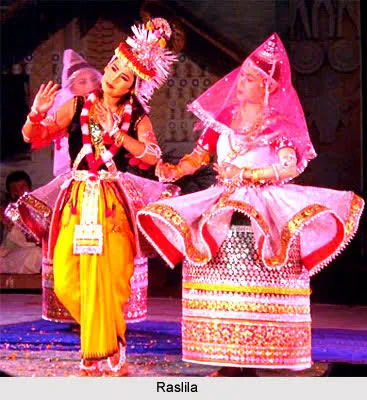
Raslila is closely associated with the Vaishnava communities of the Braj region, where it forms an integral component of religious life. Performances in Vrindavan, regarded as the spiritual centre of Krishna worship, draw pilgrims from across India and are considered experiences of the spiritual world in Vaishnava theological terms. The tradition also has a significant presence in Manipur, where it developed into Manipuri Raas Leela, a classical dance form incorporating distinct regional elements. In West Bengal, particularly in Nadia district associated with Gaudiya Vaishnavism, Raas Utsava is celebrated as a major festival. In Assam, Raas Mahotsava is recognised as a state festival, observed annually in November and December at major sites including Majuli and Nalbari. The performance tradition has influenced all of India's classical dance forms, including Bharatanatyam, Kathak, Odissi, Kuchipudi, and Manipuri.
Religious Significance
Raslila is a form with documented and substantive religious significance within the Vaishnava traditions of India. It is not merely a theatrical performance but an act of bhakti, devotional worship, in which performers are understood to embody divine figures. Traditionally, young boys or men play the role of Krishna while women play Radha and the gopis; the act of performance is itself conceived as spiritual participation in the divine lila, or play, of Krishna. The concept of rasa, or devotional aesthetic emotion, is central to the performance. The Bhagavata Purana provides the scriptural foundation, and the form is performed at religiously significant moments including Janmashtami, the festival marking Krishna's birth, and Holi, associated with Krishna's playful interactions with Radha.
Understanding the Art
Style
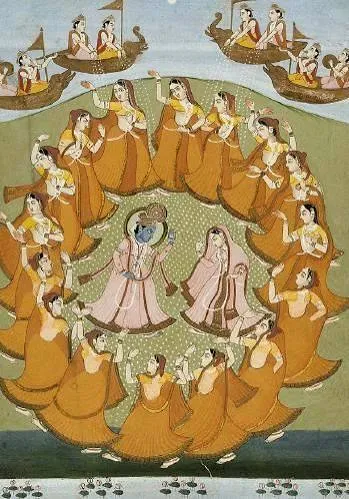
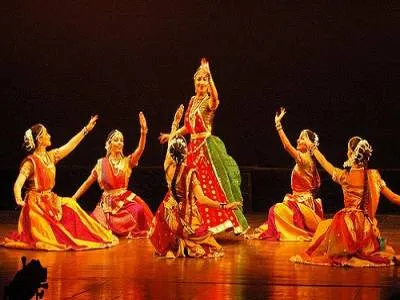
A traditional Raslila performance may last approximately three hours. It combines dance, dramatic narrative, and devotional music in a format that incorporates both scripted text and opportunities for extemporisation. Performances are traditionally held in circular formations, the circular movement symbolising the eternal and encompassing nature of divine love. The bhava, or specific devotional mood, is considered the most essential element of the performance, with music, song, and physical movement serving as instruments for producing this state in both performers and audience. The performance incorporates the nine rasas, or aesthetic emotions, of classical Indian theatrical theory, giving participants access to a range of devotional sentiments including parental love, friendship, conjugal love, awe, and pathos. The category of conjugal love, or shringara rasa, is elevated in the Raslila tradition to the highest spiritual sentiment, representing the soul's longing for union with the divine.
Central Motifs and Their Significance
The central narrative of Raslila depicts a single cosmic night in Vrindavan. Krishna plays his flute, drawing the gopis out of their homes into the forest. He multiplies himself so that each gopi experiences his presence individually, and all dance together throughout the night, which he supernaturally extends to the duration of a Brahma kalpa, approximately 4.32 billion years by Hindu reckoning. The motifs of the flute, the forest, the night, and the dance collectively represent spiritual themes of divine calling, the abandonment of worldly attachment, and ultimate union with the divine. The relationship between Radha and Krishna, which is the emotional centre of the performance, is interpreted theologically as a representation of the relationship between the devotee's soul and the divine. Secondary narratives drawn from the Bhagavata Purana and Gita Govinda may be incorporated.
Process
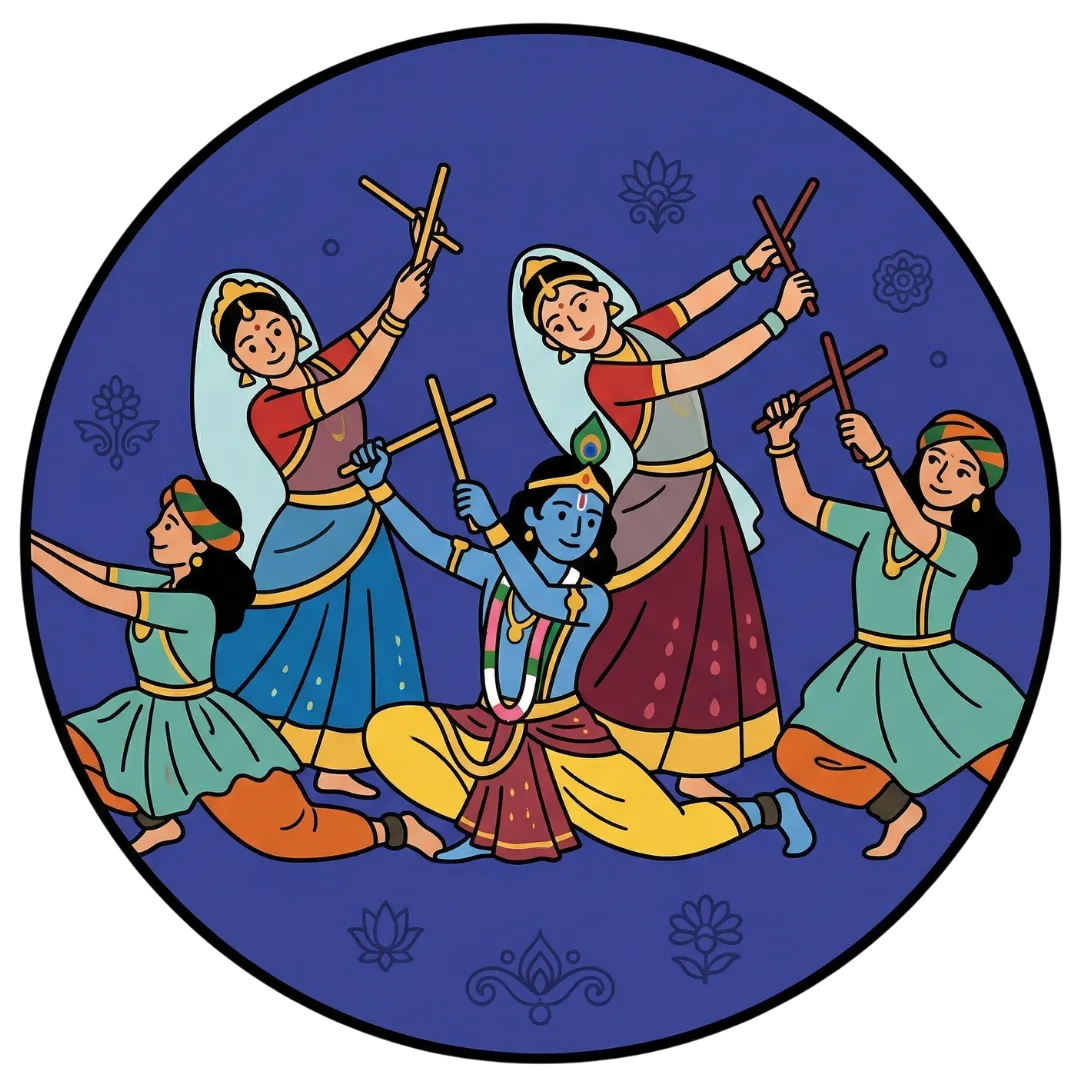
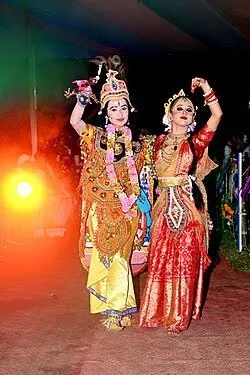
In the Vrindavan tradition, boys are trained by senior practitioners to portray Krishna and the gopis, with the expectation that their physical purity and youth render them suitable vehicles for divine embodiment. The training involves learning specific songs, dance movements, gestural vocabulary, and the Brajbhasha dialect associated with Krishna narrative. Performances involve the application of traditional costumes associated with the Braj region: men playing Krishna wear yellow dhotis, peacock feather turbans, and jewellery, while women wear ghagra-choli with dupatta. Performances are set to rasia, a form of devotional song wholly centred on the Krishna-Radha theme. Musical accompaniment uses the harmonium and dholak as primary instruments. Soft rhythmic and melodious songs with drums and cymbals are integral to the atmosphere.
Mediums Used
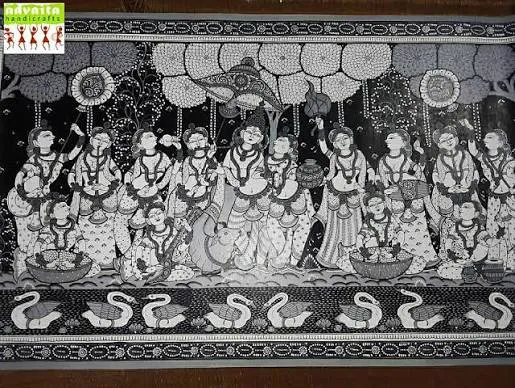
Raslila is performed in large gardens, open grounds, or decorated mandaps. The musical accompaniment consists principally of the harmonium and dholak, with drums and cymbals providing rhythmic structure. Songs used in performance belong to the rasia tradition and are devotional in character. Costumes are traditional Braj dress, associated iconographically with the visual representations of Krishna and Radha established over centuries in Vaishnavite painting and temple art. The scripts, where they exist in written form, draw from the Bhagavata Purana and Gita Govinda.
New Outlook
Raslila continues to be actively performed in its traditional context in Vrindavan and Mathura, attracting large numbers of pilgrims during Janmashtami and Holi. Cultural organisations and temple institutions support its continuation. The tradition has been the subject of academic study as a devotional and theatrical form. Its influence on classical Indian dance has ensured that its vocabulary of movement, costume, and narrative continues to be visible across multiple performance traditions. In Manipur and Assam, regional versions of the form have maintained independent vitality and official state recognition.
Learn Ras Lila
Bibliography
Sources
Hawley, John Stratton. At Play with Krishna: Pilgrimage Dramas from Brindavan. Princeton University Press, 1981.
Hein, Norvin. The Miracle Plays of Mathura. Yale University Press, 1972.
Kaur, Rani Balbir. Music in Traditional Indian Theatre: Special Reference to Raas Leela.
Kinsley, David. The Divine Player: A Study of Krsna Lila. Motilal Banarsidass, 1979.
Image Sources
“Raas Leela.” Advaita Handicrafts, https://advaitahandicrafts.com/products/black-white-raasleela-full-size?srsltid=AfmBOoo7D1MvvVCMX4n6cZaX25Fx9NozdZ_TMngvc8XYqAtyx0p3-eZo. Accessed 4 July 2026.
“Raas Leela Folk Dance.” GoSahin, https://www.gosahin.com/places-to-visit/raas-leela-folk-dance/. Accessed 4 July 2026.
“Raslila.” Indianetzone, https://www.indianetzone.com/raslila. Accessed 4 July 2026.
“Raslila.” Wikipedia, https://en.wikipedia.org/wiki/Raslila. Accessed 4 July 2026.
“Raslila.” Wikipedia, https://en.wikipedia.org/wiki/Raslila. Accessed 4 July 2026.