
Nati - The Folk Dance Tradition of Himachal Pradesh
Discover Nati, widely practiced folk dance associated with the Raas Lila tradition in Himachal Pradesh...
Introduction
Nati is the most widely practiced folk dance of Himachal Pradesh, performed across multiple districts including Kullu, Mandi, Shimla, Sirmaur, Chamba, and Kinnaur, with distinct regional variations in each area. In January 2016, Nati was officially listed in the Guinness Book of World Records as the largest folk dance in the world by number of participants, following a performance in which 9,892 women danced together at Kullu Dussehra. The dance is associated with the Raas Lila tradition and is understood as a performance in honor of Krishna and his gopis. It is performed at weddings, the Kullu Dussehra festival, Losar (the Tibetan and Kinnauri New Year), Lohri, and other community celebrations. Regional variants include Kulluvi Nati, Kinnauri Nati, Shimla Nati, Sirmauri Nati, Lahauli Nati, and Gaddi Nati.
Etymology
The word 'Nati' is a Pahari term used to describe the traditional folk songs and dances of the western and central Himalayan hill communities. It is the local designation for the dance form that is practiced across Himachal Pradesh's multiple cultural zones. Some sources note that the term is cognate with related forms in the Chandigarh region, where Himachali youth perform Nati at college and university cultural programs, and in parts of Uttarakhand.
Origin
The precise historical origins of Nati are not established in documentary sources. Regional tradition holds that the dance originated in the Sirmaur district of Himachal Pradesh, though other sources attribute different starting points to different regional variants. The form is understood in the folk tradition as related to the Raas Lila, the circular dance of Krishna with the gopis of Vrindavan, which has been absorbed into the devotional life of the hill communities. Wikipedia's article on traditional dances of Himachal Pradesh states that Nati is considered to have been developed in honor of Krishna and his Gopis, and also represents the entertaining plays of Chandravali. The form is an oral tradition without a single documented point of origin.
Location
Nati is practiced across Himachal Pradesh, with the highest concentration in the Kullu, Mandi, Shimla, Sirmaur, Chamba, and Kinnaur districts. Each district has a distinct regional variant with specific costume, musical accompaniment, and movement vocabulary. Kullu Nati is the most widely recognized variant nationally; it is the form performed at the Kullu Dussehra, one of the largest festivals in Himachal Pradesh, which draws international attention. Kinnauri Nati is performed in the high-altitude Kinnaur region and reflects the Tibetan cultural influences of that area.
Community
Nati is a broadly practiced form that transcends individual community boundaries within Himachal Pradesh. It is performed by men and women of all communities at weddings, festivals, and public celebrations. There are no caste, tribe, or gender restrictions on participation in the most widely practiced forms, though specific regional variants may be associated with particular communities. In the Kullu Dussehra context, women's Nati groups organize and compete in large public performances. The dance is passed from generation to generation within families and communities without formal training institutions.
Relevance
Nati is the primary cultural symbol of Himachal Pradesh and is recognized nationally and internationally as the representative folk form of the state. The Guinness World Record of 2016 brought significant international attention to the form. It is promoted by the Himachal Pradesh government through the state Tourism Department and cultural bodies, and is featured at the Kullu Dussehra, which attracts tourists from across India and abroad. The form is practiced by Himachali communities in Chandigarh and is performed at cultural events in cities beyond the state's borders.
History
Background
Nati is part of the ancient folk culture of the Pahari hill communities of the western Himalayas, which developed in relative geographic isolation from the plains cultural traditions of India. The form's association with the Raas Lila places it within the Vaishnava devotional tradition that spread through the Bhakti movement to the hill regions from the medieval period onward. The Kullu Dussehra, at which Nati is now a defining performance, has its own history dating to the reign of Raja Jagat Singh of Kullu in the seventeenth century, when the Raghunath idol was installed and the festival expanded. Nati has been performed at this festival throughout this period, though no precise historical documentation of the dance's form in earlier centuries exists.
Culture and Societies
At the Kullu Dussehra, thousands of participants perform Nati over seven days, with the presence of hundreds of devtas (local deities) carried in palanquins from across Kullu district. Nati performances at the Dussehra ground are organized by women's groups from different villages, and the competitive dimension of large group performance has been a consistent feature of the festival. At weddings, Nati is performed in the courtyards of houses and in open village spaces. In Kinnaur, Nati is performed during the Losar (New Year) festival and features the distinctive woolen attire and flower caps of the Kinnauri tradition. In Lahaul, the dance reflects the Tibetan Buddhist cultural context of that district.
Religious Significance
Nati is understood in the regional folk tradition as a performance in honor of Krishna and his gopis, and as a celebration of the Raas Lila. At the Kullu Dussehra, the performance takes place in the presence of the deity Raghunath (Rama), giving the dance a devotional context. In Kinnaur, Nati is performed at the Losar festival, which has both Buddhist and Hindu religious dimensions. The devtas whose processions are central to the Kullu Dussehra are greeted and honored with Nati performances, integrating the dance into the ritual life of the community in direct and sustained ways.
Understanding the Art
Style
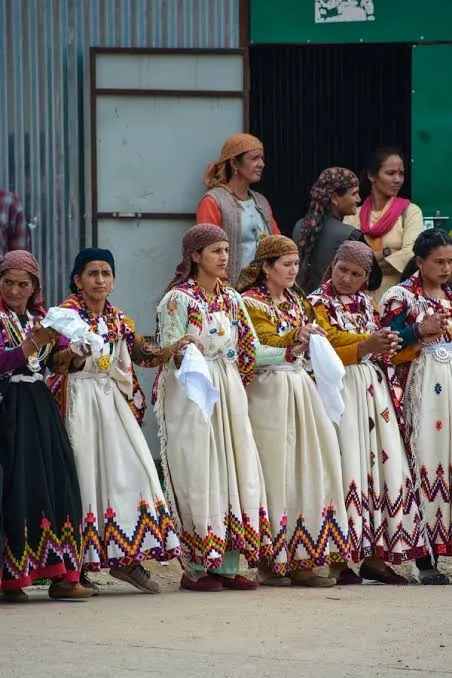
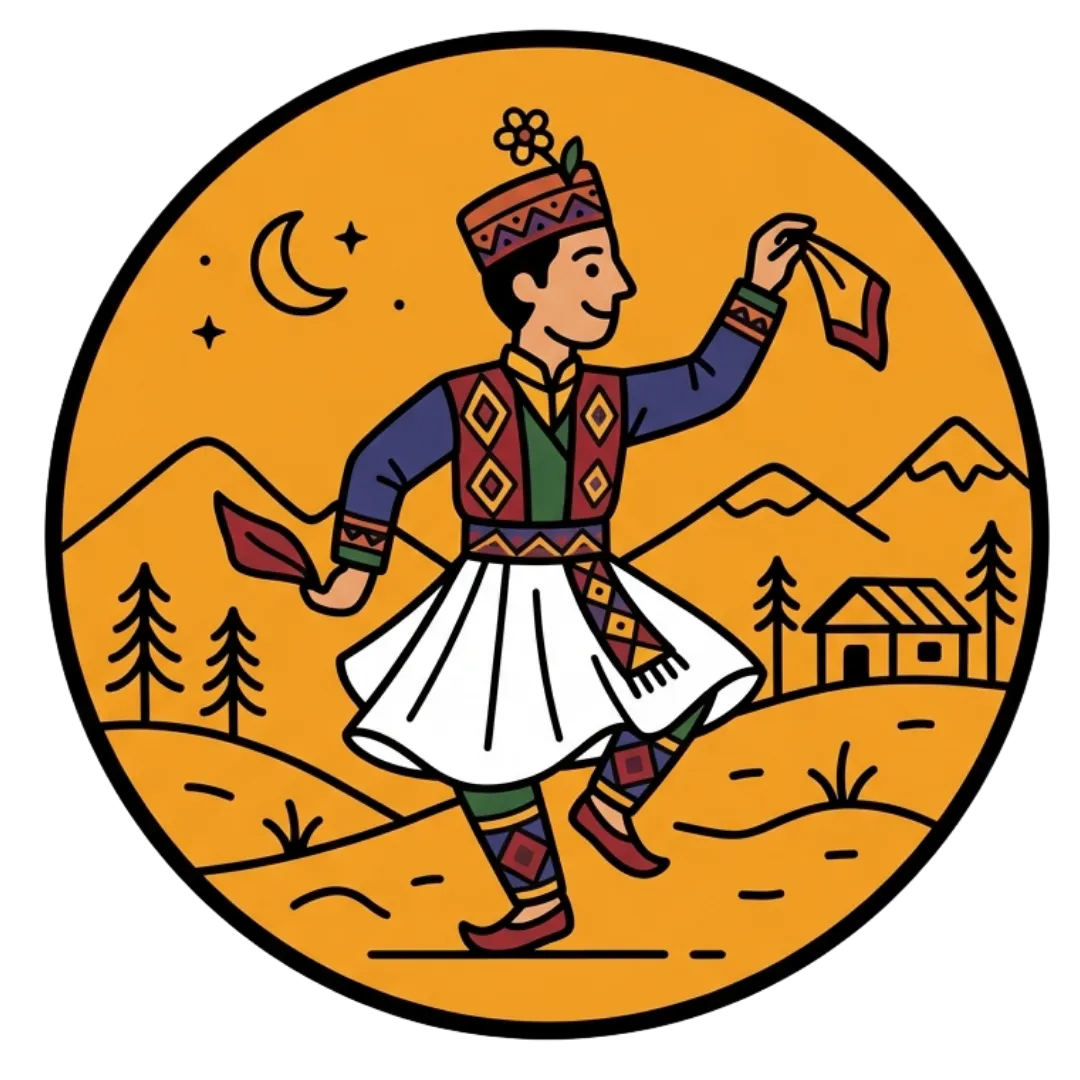
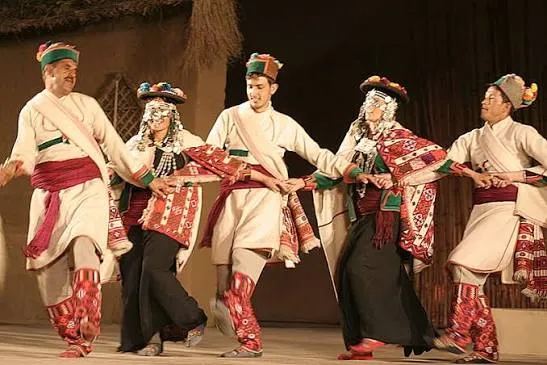
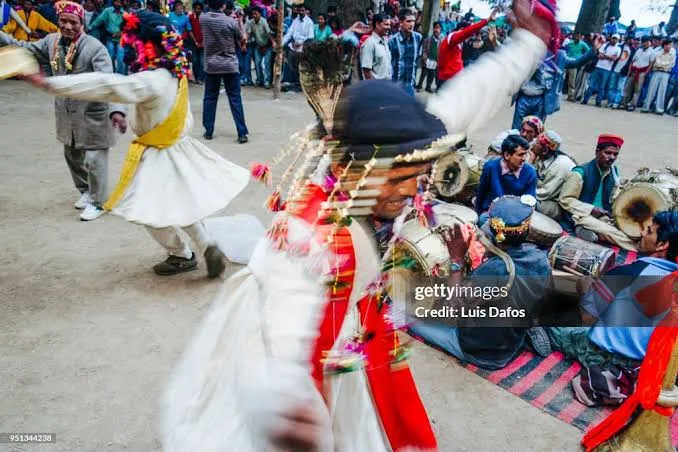
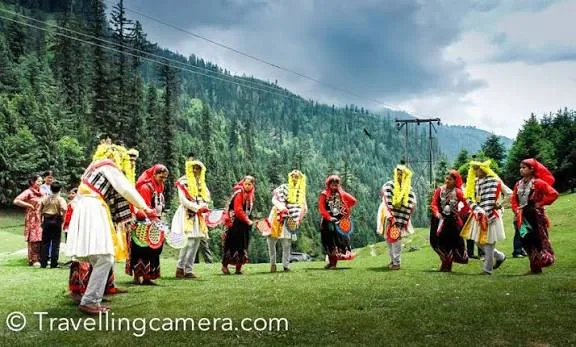
Nati is performed in circular or semi-circular formations, with participants holding each other at the waist or by the hands, moving counterclockwise. The dance begins at a slow pace, referred to in some sources as the 'loose pulse,' and gradually accelerates to a rapid tempo. Footwork involves synchronized stamping, stepping, and lateral movement. A handkerchief tied to the right index finger is a characteristic feature of the dance in many regional variants. Traditional footwear called pullas (pointed-toe leather shoes) are worn during formal Nati performances.
Central Motifs and Their Significance
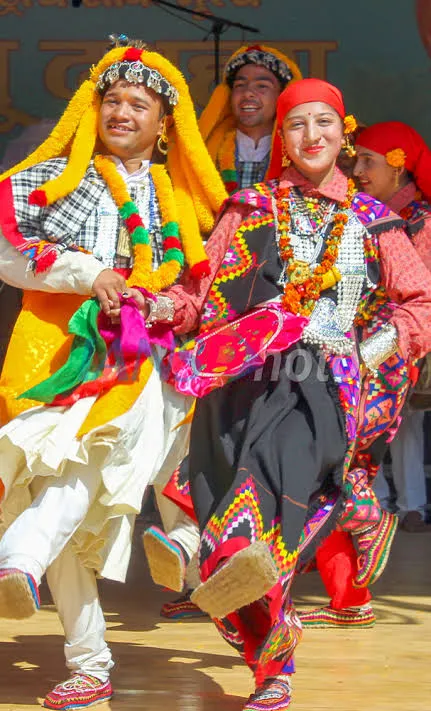
The circular formation around the devta or the performance space encodes the pradakshina (circumambulation) tradition and the Raas Lila circle of dancers around Krishna. The progressive acceleration of tempo represents increasing devotional fervor. The specific costumes of each regional variant of Nati, including the heavy silver jewelry of the Kullu tradition, the flower caps of Kinnaur, and the woolen ghaghra-chola of Shimla, are repositories of regional identity and aesthetic tradition. The handkerchief tied to the right index finger is understood in some traditions as a symbol of devotional offering.
Process
A Nati performance begins with the gathering of participants and the establishment of the musical accompaniment. Dhol and nagara players set the initial slow tempo. Participants arrange themselves in a circle or semi-circle, link arms, and begin the slow introductory movement. As the musicians increase the tempo, the dancing accelerates. The performance can last for several hours at festival contexts. At the Kullu Dussehra, organized groups of women rehearse their Nati performances in the weeks before the festival and present them in large coordinated displays.
Mediums Used
Musical instruments vary by regional variant: standard Nati accompaniment includes dhol, nagara, shehnai, karnal (a long brass horn), narsinghe (a curved brass horn), and flute. Kullu Nati costume for women includes a ghaghra (long flared skirt), chola (embroidered blouse), kalgi cap adorned with peacock feathers, boomani (a decorated waistband), and chandrahaar necklace. Shimla Nati costume includes rezta (a two-piece garment), sadri (a waistcoat), and dhattu (a headscarf). Kinnauri Nati performers wear woolen attire typical of the high-altitude community, with flower caps and heavy silver jewelry.
New Outlook
Nati is a thriving tradition with strong institutional support. The Himachal Pradesh government promotes it through tourism, cultural programs, and school curricula. The Guinness World Record of 2016 has been used as a promotional tool domestically and internationally. The Kullu Dussehra provides an annual high-profile performance occasion. Challenges include the risk of standardization: as Nati becomes an increasingly prominent state symbol, the specific regional variations of different districts may be subsumed into a single representative style. The formal training of Nati is still primarily through community-based oral transmission, though cultural academies and schools in Himachal Pradesh are beginning to incorporate it into curricula.
Learn Nati

Bibliography
Sources
Enriquez, C. M. The Realm of the Gods: Exploring the Hill States of Northern India. Simpkin Marshall, 1930.
Guinness World Records. "Largest Folk Dance: Nati." Guinness World Records, 2016.
Himachal Pradesh Tourism Development Corporation. Dussehra and Folk Traditions of Kullu. Himachal Pradesh Tourism Development Corporation, various editions.
Sangeet Natak Akademi. Documentation of Himachali Folk Dances. Sangeet Natak Akademi, various years.
Sharma, M. M., et al. Cultural Heritage of Himachal Pradesh. Himachal Pradesh Government Publications.
Image Sources
"Artists Perform Kullu Nati Dance." IANS Live, https://ianslive.in/webstories/artists-perform-kullu-nati-dance. Accessed 21 July 2026.
"Nati (Dance)." Wikipedia, https://en.wikipedia.org/wiki/Nati_(dance). Accessed 21 July 2026.
"Nati Dancers at the Hadimba Devi Festival in Manali." Getty Images, https://www.gettyimages.com/detail/photo/nati-dancers-at-the-hadimba-devi-festival-in-manali-royalty-free-image/951344238. Accessed 21 July 2026.
"Nati Dance." Dreamstime, https://www.dreamstime.com/photos-images/nati-dance.html. Accessed 21 July 2026.