
Mayilattam - The Folk Dance Tradition of Tamil Nadu
Get to know about Mayilattam, the peacock folk dance of Tamil Nadu, performed in the temples of Lord Murugan
Introduction
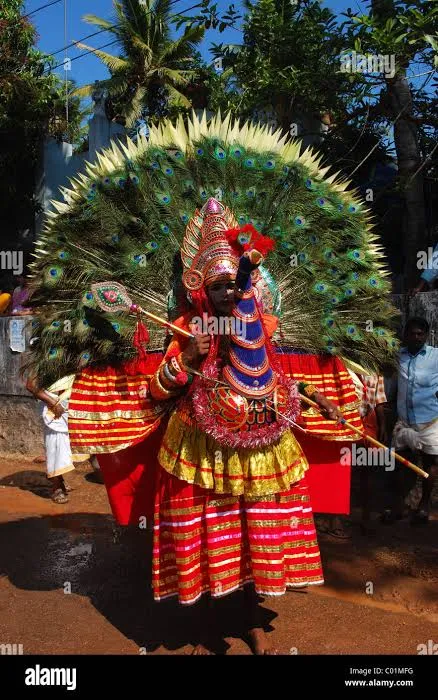
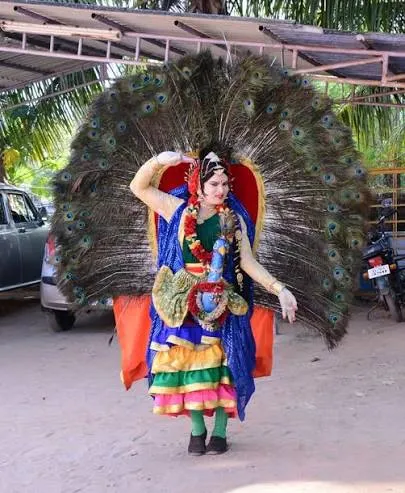
Mayilattam (also spelled Mayil Attam or Mayilnrityam) is a devotional folk dance of Tamil Nadu and Kerala, India, performed in the temples of Lord Murugan (also known as Subrahmanya or Kartikeya, son of Shiva and Parvati). The name translates directly from Tamil as peacock dance: mayil means peacock, and attam means dance. In the dance, performers wear an elaborate full-body costume representing a peacock, complete with a feathered tail, a peacock head-dress with a movable beak operated by a string held from inside the costume, and wooden stilts (kaal maram) attached to the feet. The dance imitates the behavioral patterns and movements of a peacock and is performed as a devotional offering in all Murugan temples during festivals. The dance is classified as a vulnerable form in contemporary surveys, reflecting a declining number of practitioners due to the physical difficulty of the performance and the low economic returns for artists.
Etymology
The name Mayilattam combines mayil (peacock in Tamil) with attam (dance), producing the literal meaning peacock dance. The alternate name Mayilnrityam uses the Sanskrit-derived nritya (expressive dance) in place of the Tamil attam, indicating the dance's use of abhinaya (expressive gesture) alongside the physical mimicry of the peacock's movements. The peacock is known in Tamil as Paravani when identified as the vahana (vehicle or mount) of Murugan, and the dance imitates this specific sacred bird.
Origin
Mayilattam is documented to have originated in Tamil Nadu as a devotional offering to Lord Subrahmanya. Wikipedia's entry on Mayilattam places its roots in the Sangam period, spanning the 3rd century BCE to the 4th century CE, during which Lord Subrahmanya was already a major deity of Tamil religious life. Kerala Tourism's official documentation of Mayilattam performed at the Thiruvambadi Sree Krishna Temple in Varkala provides institutional confirmation of the form's continued practice in the Kerala temple context. The peacock as Murugan's sacred vehicle is one of the most enduring iconographic elements of Tamil Murugan worship, and the dance's origin in this iconographic tradition gives it a continuous religious foundation extending across more than two millennia of Tamil cultural history.
Location
Mayilattam is performed across Tamil Nadu and Kerala, with performance concentrated in Murugan temples, which are particularly numerous in Tamil Nadu. The dance is performed at all six primary Murugan temples (the Arupadai Veedu) during their major festivals, including Thaipusam (Thai month, January-February), Panguni Uttaram (Panguni month, March-April), and Karthigaideepam (Karthikai month, November-December). Kerala's Murugan temples also stage Mayilattam performances. The dance's cultural influence extends beyond India: according to sources at the National School of Dance and Arts (NSDA), Mayilattam's symbolic use of the peacock has influenced similar peacock dance traditions in Myanmar, parts of Cambodia, West Java in Indonesia, Sri Lanka, and Bangladesh.
Community
Mayilattam is performed primarily by female performers, typically from families with hereditary connections to temple service arts in Tamil Nadu. The dance requires extensive physical training over years. The costume is heavy and the use of wooden stilts at the feet demands balance, flexibility, and sustained physical strength. Financial considerations have significantly reduced the number of practitioners: Wikipedia's entry notes that the number of Mayilattam performers is decreasing due to financial reasons. The low fees paid for temple performances relative to the physical demands and training requirements have made it difficult for families dependent on the art to maintain their practice.
Relevance
Mayilattam is classified as a medium-relevance, vulnerable folk dance form. It remains a required element of the performance programme at Murugan temples during festivals, but the declining number of trained performers represents a structural challenge to its continuation. The dance is recognized as an important part of Tamil religious and cultural heritage and is included in academic surveys of Tamil Nadu's dance forms. Its connection to one of Tamil Nadu's most widely venerated deities and its presence at major temple festivals provide a stable ritual context that other vulnerable folk forms may lack, but this does not resolve the economic challenges facing performers.
History
Background
The worship of Murugan as a distinct Tamil deity with a peacock mount is one of the oldest continuously documented religious traditions of the Tamil people. The Sangam literature, particularly the Akananuru and Purananuru poetry anthologies and the Tolkappiyam grammatical treatise, identifies Murugan (Seyon, the red god) as the deity of the kurinji (mountain) landscape in the ancient Tamil ecological-poetic system called Tinai. The peacock's association with Murugan in this literature establishes the symbolic foundation for Mayilattam within Tamil religious history. The Thaipusam festival, at which Mayilattam is prominently performed, involves an elaborate tradition of bodily devotion (kavadi carrying) that reflects the intensity of Murugan worship in Tamil communities. The dance's documented presence in the Sangam-period cultural context, combined with its continued performance across at least eighteen centuries, makes Mayilattam one of the longest-documented specific dance traditions of South India.
Culture and Societies
Mayilattam belongs to a family of similar costume-based dances in Tamil Nadu in which performers wear animal or nature-based costumes as devotional acts. Related forms include Kaalaiattam (bull dance, a form for another deity), Karadi Attam (bear dance), Aali Attam (demon dance), and Pampu Attam (snake dance). This cluster of animal-costume dances represents a distinctive category of Tamil temple folk performance organized around the iconographic world of Hindu deities and their animal associates. The peacock's prominence in this group reflects Murugan's position as one of the most widely worshipped Tamil deities and the deep cultural attachment to the peacock as a symbol of beauty, grace, and divine favor.
Religious Significance
Mayilattam is an explicitly devotional form with no significant secular function. The dance is performed as an offering to Lord Murugan, and every element of the performance, including the costume, the movements, and the performance context, is defined by its religious purpose. The dancer impersonates the peacock, the deity's sacred mount (vahana), and in doing so enacts the deity's divine presence within the performance. This type of devotional impersonation, in which the performer becomes the symbol or vehicle of the deity rather than merely depicting the deity, is a form of devotional expression found across South Indian temple performance traditions. The dancer is considered, within the performance context, to be a vehicle for the deity's presence and grace.
Understanding the Art
Style
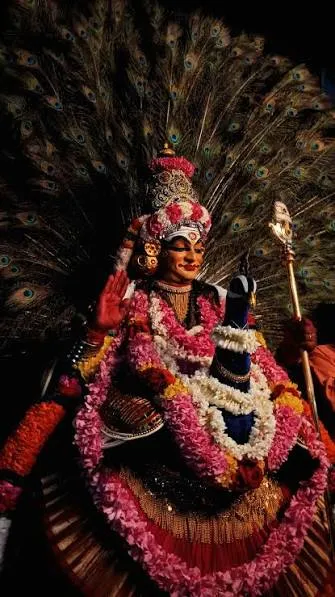
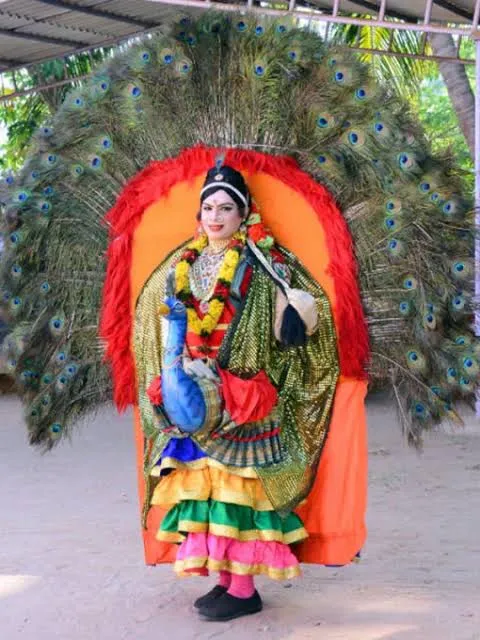
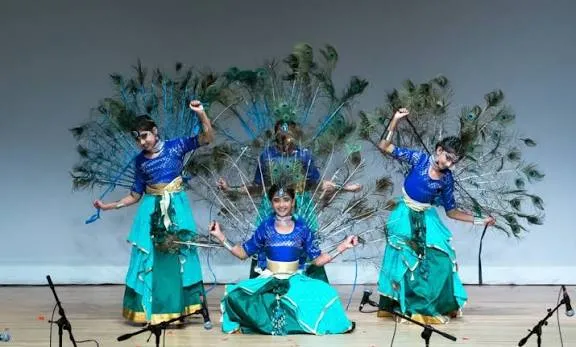
The Mayilattam performer wears a full peacock costume from head to foot. The headdress replicates the peacock's crest and includes a beak which is operated by a thread held inside the costume, allowing the performer to open and close the beak during the dance. The tail assembly carries actual peacock feathers or elaborate artificial feathers in shades of blue-green, and can be spread outward in imitation of the peacock's display. The dancer stands on wooden kaal maram (wooden leg extensions) that replicate the sound of bird feet and require balance skills to operate. The movement sequence begins with slow, deliberate steps imitating the peacock's walking gait, proceeds to the display of the tail (spreading feathers), and transitions to circular movement patterns as the rhythm intensifies. The dancer imitates the peacock cleaning its feathers with its beak, the bird's strutting posture, and the wheel display.
Central Motifs and Their Significance
The peacock is the central and exclusive symbolic motif of Mayilattam. In Tamil iconography, the peacock represents beauty, grace, divine protection, and the presence of Murugan. The blue-green iridescence of the peacock's plumage is associated in Tamil poetic tradition with the kurinji mountain landscape and the color of Murugan's complexion (Seyon, the red one, is sometimes identified by the contrast with the blue of the peacock). The display of the peacock's tail represents the divine's self-revelation to devotees, and the dance replicates this act of divine display as a devotional gesture. The complete identification between dancer and bird in Mayilattam, enacted through a total-body costume, represents an unusually complete form of devotional impersonation in the Tamil performing arts tradition.
Process
The performance takes place in temple precincts during festivals and occasionally during religious processions (utsavam). The dancer performs solo, accompanied by the nagaswaram (double-reed wind instrument) and parai or thavil (percussion instruments) that are standard in Tamil temple festivals. The rhythm of the accompanying music determines the pace of the performance: slow introductory sequences give way to accelerating middle sections, with the finale involving rapid circular movement and full tail display. The performance requires sustained physical strength given the weight of the costume and the demands of the wooden stilts.
Mediums Used
The costume is the primary and defining material element of Mayilattam. It consists of peacock feathers (or elaborate fabric imitations) forming the tail, a full-body garment in blue-green fabric replicating the bird's plumage, a peacock head-dress with a movable beak, and wooden stilts (kaal maram) attached at the feet. The preparation of the costume represents a significant material investment, and the maintenance of authentic peacock feathers (now typically replaced by fabricated alternatives due to wildlife protection laws) is a practical challenge. The instruments are those standard to the Naiyandi Melam or Karna Vilam ensemble used in Tamil temple festival contexts.
New Outlook
Mayilattam faces a critical challenge in practitioner numbers. The physical demands of the dance, combined with the low economic returns from temple performances and the multi-year training required to master the costume and movements, have reduced the pool of trained performers. Cultural organizations and state government cultural departments in Tamil Nadu have periodically undertaken documentation and promotion efforts, but systematic institutional support for training new performers has been limited. The dance's continued presence at major Murugan temple festivals provides an ongoing demand for performances, but this demand cannot alone sustain the form if the economic conditions for practitioners are not improved.
Learn Mayilattam
Bibliography
Sources
Devi, Ragini. Dance Dialects of India. Rev. ed., Motilal Banarsidass, 1990.
Hart, George L. The Poems of Ancient Tamil: Their Milieu and Their Sanskrit Counterparts. University of California Press, 1975.
Krishnadas, Priya. Folk Performing Arts: Tamilnadu. Madras Craft Foundation, 2008.
Zvelebil, Kamil V. The Smile of Murugan: On Tamil Literature of South India. E. J. Brill, 1973.
Image Sources
“Karagattam.” Alamy, https://www.alamy.com/stock-photo/karagattam.html. Accessed 4 July 2026.
“Karagattam Folk Dance.” Alamy, https://www.alamy.com/stock-photo/karagattam-folk-dance.html. Accessed 4 July 2026.
“Mayilattam.” Nruthya Shakti, https://www.nruthyashakti.com/folk/mayilattam.html. Accessed 4 July 2026.
“Mayilattam.” Palakkad Webs, https://palakkadwebs.com/mayilattam/index.html. Accessed 4 July 2026.
“Mayilattam.” Sree Sakthi Cultural Academy, http://www.sreesakthicultural.com/mayilattam.html. Accessed 4 July 2026.
“Mayilattam or Peacock Dance.” Wikimedia Commons, https://commons.wikimedia.org/wiki/File:Mayilattam_or_Peacock_Dance.jpg. Accessed 4 July 2026.