
Manganiyar Music - The Music Tradition of Rajasthan
Get to know about Manganiyar Music of the western Rajasthan, sangeet that encompasses compositions praising both Hindu deities and Sufi saints...
Introduction
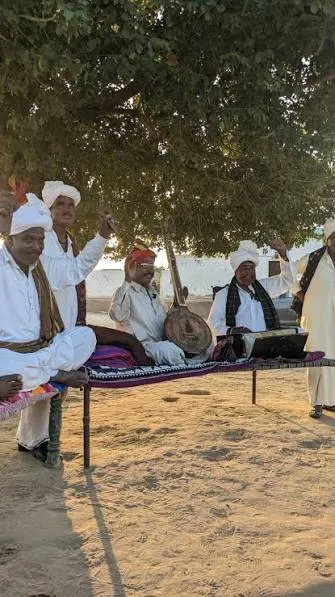
Manganiyar music is a hereditary tradition of professional musicians from the Barmer and Jaisalmer districts of western Rajasthan, practiced by the Manganiyar community, a Muslim group with a documented tradition of hereditary musicianship spanning multiple centuries. The Manganiyars are primarily known for their vocal music and for their mastery of the kamaicha, a bowed chordophone unique to the Thar Desert region. Like the neighboring Langa community, the Manganiyars historically operated within the jajmani system, providing musical services to patron families from predominantly Rajput, Brahmin, and Charan communities at births, weddings, and festivals.
The Manganiyar tradition is distinguished by a particularly wide repertoire that encompasses compositions praising both Hindu deities and Sufi saints, reflecting the syncretic religious environment of the Thar Desert. The tradition has received international recognition through theatrical productions, world music festivals, and documentary recordings, and several Manganiyar musicians have achieved national and international prominence.
Etymology
The term Manganiyar derives from the Hindi-Rajasthani root mangan, meaning to beg or to ask, combined with the agentive suffix har, which carries the nuance of bearer or garland-wearer. The community name therefore carries the historical implication of those who petition or request, a reference to the economic relationship with patrons in which musicians traditionally sought remuneration after performance. The term does not carry a pejorative connotation within the community, which uses it as a positive identity marker. Alternative folk etymologies within the community trace the name to a founding ancestor, but these accounts lack historical documentation.
Origin
The Manganiyar community is concentrated in Barmer and Jaisalmer districts of Rajasthan and also maintains a significant presence in the Tharparkar and Sanghar districts of Sindh province in Pakistan. This transnational distribution reflects the historical continuity of the Thar Desert cultural zone across the current India-Pakistan border. The community's presence in both countries predates the 1947 Partition, and musical exchanges between Manganiyar musicians on both sides of the border have been documented.
The Ain-i-Akbari of Abul Fazl, compiled in 1590 as part of the Akbarnama documenting the Mughal Empire under Emperor Akbar, contains references to musicians of the Thar Desert region who correspond to the Manganiyar community, providing documentary evidence of their established presence and patronage relationships with Mughal-era nobility. This places the tradition firmly within the 16th century, though community oral accounts suggest earlier origins.
Location
The primary geographic zone of Manganiyar music is the Thar Desert, specifically Barmer and Jaisalmer districts of Rajasthan and the adjacent Tharparkar and Sanghar districts of Sindh in Pakistan. Within India, Jaisalmer is the more prominent urban center associated with the tradition for international audiences, partly due to its role as a tourist destination and the staging of the Rajasthan International Folk Festival. The village clusters around Barmer town represent the denser concentration of Manganiyar population.
Community
The Manganiyar community is Muslim and practices hereditary musicianship. Their jajmani relationships have historically been maintained primarily with Rajput families, who constitute their principal patron community. Unlike the Langas, whose patrons are primarily cattle-breeding and farming communities, the Manganiyar patrons are generally landholding Rajput families of higher social standing in the traditional hierarchy of western Rajasthan. The Manganiyars also serve as genealogical record-keepers for their patron families, maintaining oral records of births, deaths, marriages, and military achievements in sung compositions called Shubhraj. This function as bardic genealogists places them within a broader category of hereditary performers that includes the Charans (epic poets) and Bhats (genealogists) of Rajasthan.
The community's musical practice is primarily male-dominated in public performance contexts. Women within the community sing within household settings and at women-specific ceremonies, but public performance has been predominantly a male occupation.
Relevance
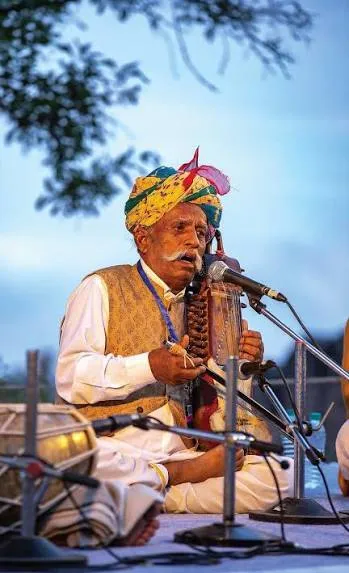
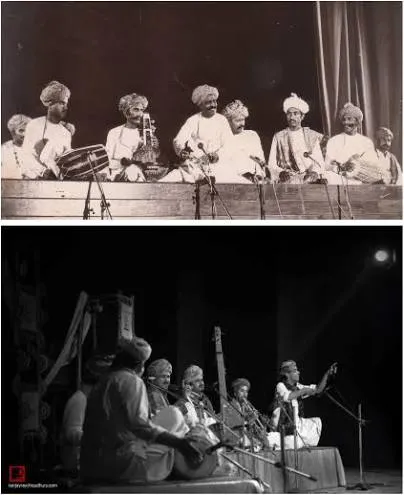
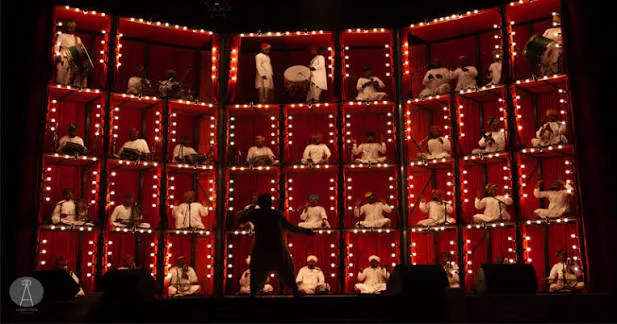
Manganiyar music has achieved significant national and international recognition. The theatrical production The Manganiyar Seduction, conceived and directed by theater artist Roysten Abel in 2006, brought approximately 45 Manganiyar musicians from Rajasthan onto a large stage installation and toured internationally, performing in venues in Europe, North America, and Asia. This production is among the most widely reviewed presentations of a Rajasthani folk music tradition in international contexts. Individual Manganiyar musicians have achieved significant public profiles. Sakar Khan Manganiyar (1938 to 2013) was the pre-eminent kamaicha player of the tradition, documented in recordings archived at the Smithsonian Folkways collection, and was the recipient of the Padma Shri award from the Government of India in 2012. Mame Khan, a vocalist and descendant of Sakar Khan, has performed on the Coke Studio television program and at major international music festivals. The Grammy-winning composer Yo-Yo Ma's Silk Road Ensemble has featured Manganiyar music in collaborative projects.
History
Background
The historical documentation of the Manganiyar tradition includes the Ain-i-Akbari reference noted above as among the earliest written records. Subsequent documentation comes from colonial-period ethnographic reports on the communities of Rajputana, compiled by the Rajputana Gazetteer series and individual administrative officers. Systematic ethnomusicological study of the tradition began in the mid-20th century, with Komal Kothari (1929 to 2004) of the Rupayan Sansthan in Jodhpur being the most significant scholar-documentarian. Kothari's fieldwork, conducted from the 1950s onward, produced the first detailed academic documentation of Manganiyar musical repertoire, instrumental construction, and community social organization.
Culture and Societies
The Manganiyar tradition functions as a living memory system for the patron communities of western Rajasthan. The Shubhraj, a genre of genealogical singing unique to the Manganiyars, documents the lineages of Rajput patron families across multiple generations. These oral genealogical records are maintained in memory by musicians who specialize in specific patron families and are passed down through generations of musicians serving the same families. The economic and social relationship between musicians and patrons, while significantly weakened in the contemporary context, historically constituted a mutual system of obligation.
The Manganiyar repertoire is notable for its inclusion of compositions praising Hindu deities including Krishna, Rama, Shiva, and Lakshmi alongside Islamic and Sufi devotional compositions. This is not regarded as syncretic compromise within the community but as a continuation of a cultural practice in which musicians serve patron communities of different religious backgrounds. Compositions for Hindu festivals including Diwali, Holi, and Gangaur are part of the active repertoire. The invocation of Krishna in concert settings is a documented practice among Manganiyar musicians, reflecting the integration of Hindu devotional content into their performance tradition.
Religious Significance
The Manganiyar tradition does not have a fixed liturgical function in the manner of temple music traditions. Its religious significance is expressed through the devotional content of compositions, through performance at religious festivals of patron communities, and through the presence of Sufi devotional material in the repertoire. The dargahs of Sufi saints in Rajasthan, including that of Hazrat Pir Shah Ghazi near Barmer, are performance contexts for Manganiyar musicians. The presence of Sufi poetry in the repertoire reflects the community's Islamic identity and their participation in regional Sufi networks.
Understanding the Art
Style
Manganiyar music is characterized by vocally dominant performance with instrumental support. The lead vocalist occupies a central position, and the kamaicha player provides melodic accompaniment. The performance aesthetic emphasizes emotional expressiveness, and the musicians are known for the ornamentation-heavy vocal style that characterizes the Thar Desert regional tradition. Raga frameworks provide the melodic context, though the ragas of the Manganiyar tradition include several melodic patterns specific to the desert region that are not precisely correspondent to classical Hindustani ragas of the same name. Performance settings include the jajmani context (ceremonies at patron families), the festival context (Rajasthan International Folk Festival and similar events), and the theatrical context. The distinction between these contexts influences performance length, repertoire selection, and the degree of audience interaction.
Central Motifs and Their Significance
The central thematic categories of the Manganiyar repertoire include: genealogical compositions praising patron lineages (Shubhraj); compositions in praise of Hindu deities, particularly Krishna in his aspect as Govinda; compositions referencing the historical rulers and battles of the Thar Desert region; romantic narrative poetry including material associated with the legends of Dhola-Maru; Sufi devotional poetry referencing themes of divine longing and union; compositions associated with specific festivals including Holi, Diwali, and Gangaur; and lullabies and wedding songs associated with life-cycle ceremonies. The sand, the camel, the desert well, and the monsoon cloud are recurring landscape elements in the poetic imagery of this repertoire.
Process
Transmission of the Manganiyar tradition is primarily through hereditary family lineage. Boys within the community begin musical learning from early childhood and are formally introduced to their patron families as young musicians before assuming full professional responsibilities. The kamaicha in particular requires years of dedicated practice to achieve proficiency, and mastery of the instrument is considered a significant accomplishment within the community. The community's practice of genealogical record-keeping through music requires musicians to memorize extensive oral histories specific to each patron family.
Mediums Used
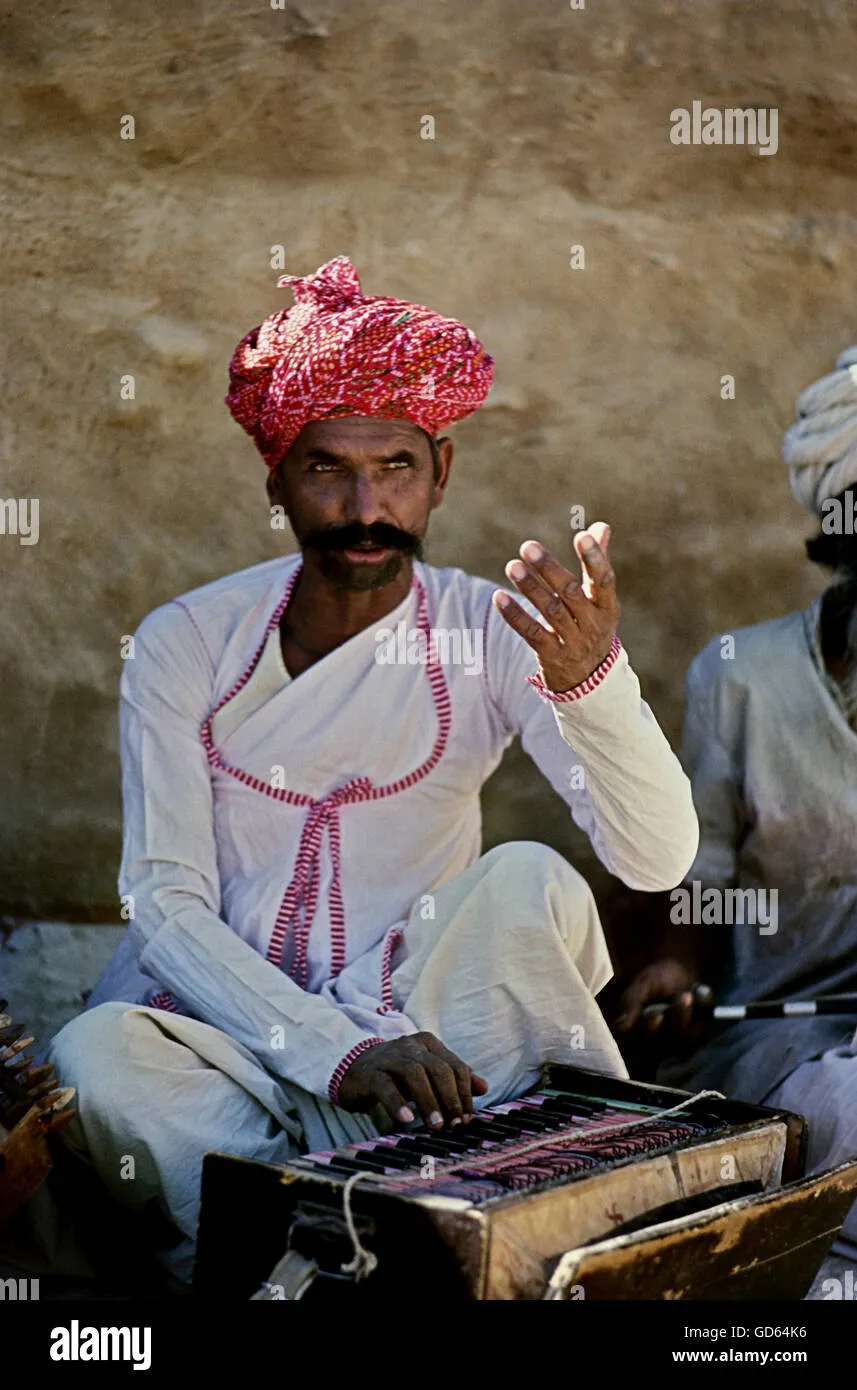
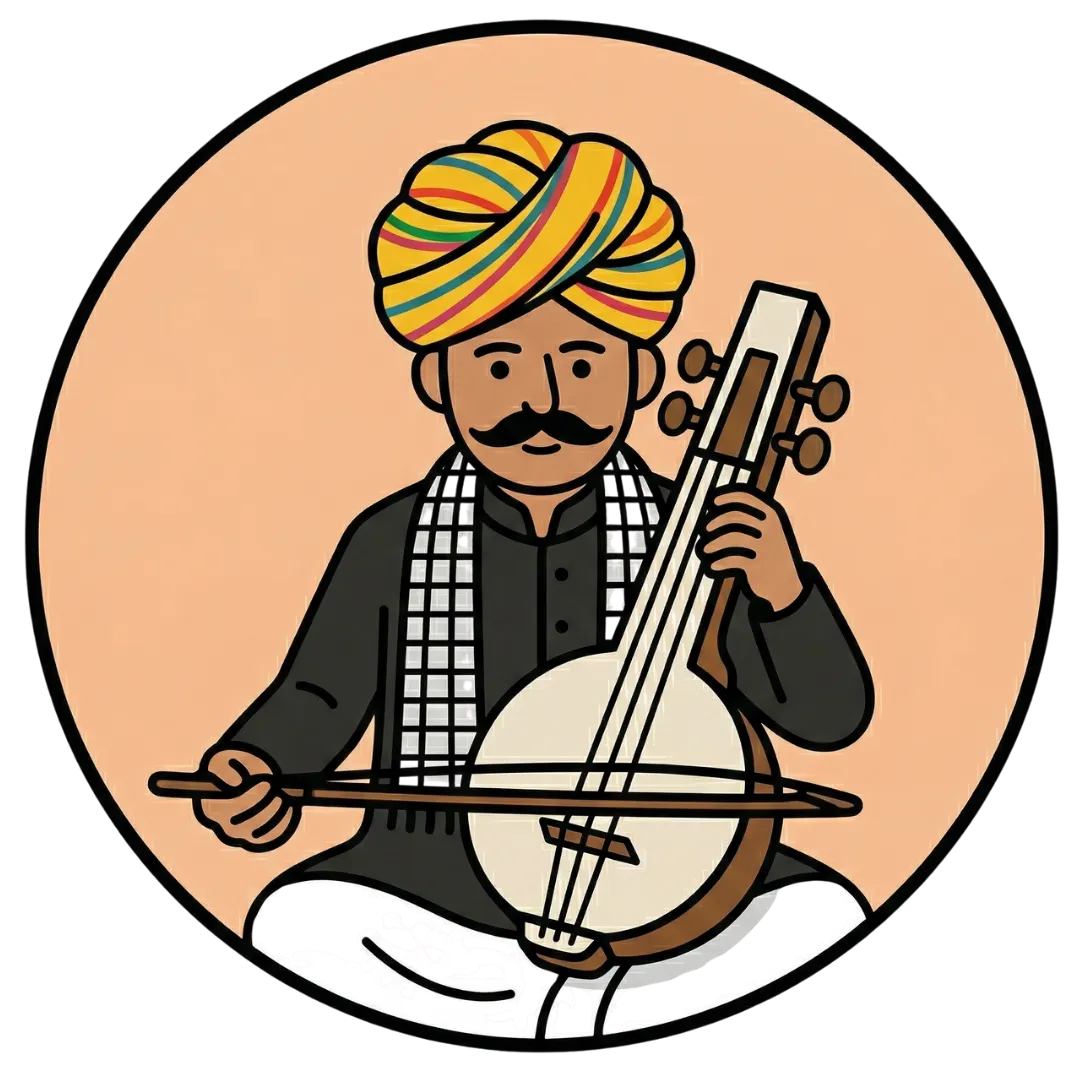
The kamaicha is the defining instrument of the Manganiyar tradition. It is a bowed chordophone with a body constructed from a single piece of mango wood to which a goat-skin membrane is attached. The instrument has approximately four main playing strings and thirteen or more sympathetic strings. The bow is strung with horsehair. The kamaicha's tonal quality is distinctive and not replicated by any other instrument in the region. Other instruments used in Manganiyar performance include the khadtal or kartaal (wooden castanets played in pairs), the dholak (double-headed cylindrical drum), the harmonium (adopted into performance practice in the 20th century), and the singi (metal horn). The kamaicha has undergone some modifications in recent decades, with certain performers experimenting with metal strings and adjusted tuning systems.
New Outlook
The Manganiyar tradition has experienced significant transformation in the 21st century due to the decline of the jajmani system and the emergence of a festival and international performance economy. The Rajasthan International Folk Festival at Mehrangarh Fort in Jodhpur has been a primary platform for Manganiyar musicians since its founding in 2007. The theatrical and concert economy has provided income for a generation of musicians who might otherwise have had to abandon the tradition for non-musical employment.
The kamaicha faces challenges similar to those documented for the Sindhi Sarangi in the Langa tradition: the instrument is technically demanding and economically less versatile than the harmonium or the dholak, and its practitioners are aging. The Rupayan Sansthan in Jodhpur, founded by Komal Kothari, maintains an archive of Manganiyar recordings and has conducted training programs. Government arts bodies including the Sangeet Natak Akademi have provided fellowships to Manganiyar musicians, and the Padma Shri awarded to Sakar Khan Manganiyar in 2012 represented official national recognition of the tradition.
Learn Manganiyar Music
Bibliography
Sources
Kothari, Komal. Folk Music and Musical Instruments of Rajasthan. Rupayan Sansthan, 1977.
Neuman, Daniel M. The Life of Music in North India. University of Chicago Press, 1990.
Erdman, Joan L. Patrons and Performers in Rajasthan. Chanakya Publications, 1985.
Bor, Joep, editor. The Raga Guide. Nimbus Records with Rotterdam Conservatory of Music, 1999.
Image Sources
"Songs from the Desert." Marwar India, https://www.marwar.com/songs-from-the-desert.php. Accessed 10 July 2026.
"The Manganiyar Musicians." Mame Khan, https://www.mamekhan.com/manganiyar-musicians.html. Accessed 10 July 2026.
"The Manganiyar Seduction." Jindal School of Liberal Arts and Humanities, https://jgu.edu.in/slce/the-manganiyar-seduciton.php. Accessed 10 July 2026.
"Muslim Manganiyar Community in Rajasthan, India." Wikimedia Commons, https://commons.wikimedia.org/wiki/File:Muslim_Manganiyar_Community_in_Rajasthan,_India.jpg. Accessed 10 July 2026.
"Manganiyar Rajasthan." Alamy, https://www.alamy.com/stock-photo/manganiyar-rajasthan.html. Accessed 10 July 2026.