

Mandana Painting: Rajasthan's Sacred Floor Art Tradition
Let's learn about Mandana, an art from Rajasthan and Madhya Pradesh.
Introduction and Origin
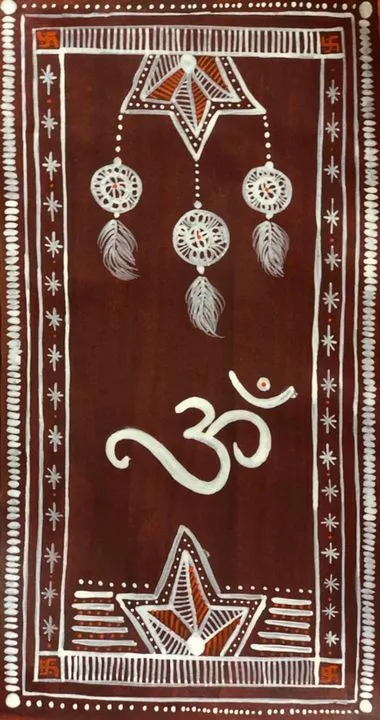
In the villages of Rajasthan and Madhya Pradesh, women of the Meena community have long painted the floors and walls of their homes with a striking two-colour art form known as Mandana painting. Derived from the word mandari, meaning decoration in their regional language, Mandana means to draw. These paintings are not decorative in a casual sense - they carry deep ritual meaning, protecting the home from evil forces and welcoming the presence of gods. Today, this form of Indian folk art stands at a quiet crossroads between living tradition and gradual disappearance.
What Is Mandana Painting?
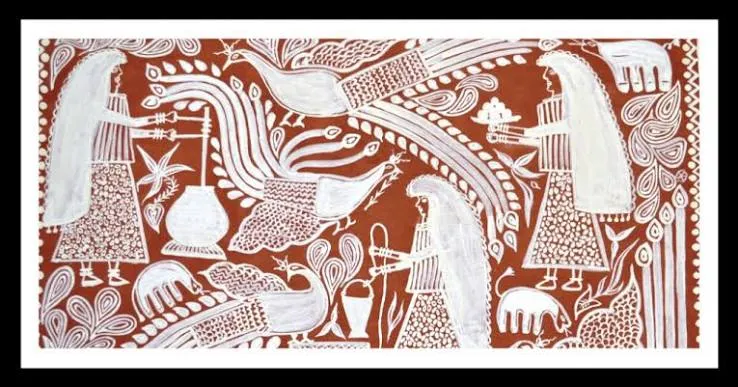
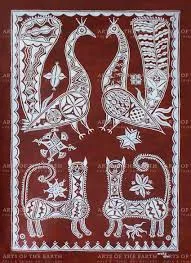
Mandana painting is a traditional floor and wall art practised by the Meena community of Rajasthan and Madhya Pradesh. The word Mandana comes from the regional term mandari, which means decoration. Visually, Mandana work is immediately recognisable by its white designs applied over a deep red or ochre base - a palette created entirely from natural materials. Artists use a base coat of geru (red soil) and clay called rati, then apply white patterns using a solution of limestone powder or chalk powder, painted with homemade brushes made from date sticks, small clusters of hair, or pieces of cotton fabric.
The Meena women of Rajasthan create both floor and wall paintings, while those in Madhya Pradesh focus solely on floor paintings. These works appear on the occasion of local festivals, religious ceremonies, births, and marriages. The Meena community believes Mandana paintings protect their homes from evil power, illnesses, and bad luck - making this art form as much a ritual act as it is a visual one.
History and Origin
Mandana painting is one of the oldest forms of tribal art in India. It is rooted in the domestic and spiritual life of the Meena community, who are the predominant settlers of Rajasthan, making up approximately 56.34 percent of the state's population. The Meena community is concentrated across the districts of Jaipur, Alwar, Bharatpur, Sawai Madhopur, Tonk, Hadoti, and Jhalawar.
Because caring for home and family has traditionally been a woman's responsibility in Meena society, this art form was developed and passed down entirely through women. It is not taught in a formal setting - it is an acquired skill, learned by watching and doing across generations. The paintings depict the main deity of whatever occasion is being celebrated, based on the belief that drawing the deity calls their presence into the home. Many Mandana patterns closely resemble Vastu purasha mandalas, old temple floor plans, and Vedic yagna altar designs, pointing to the art form's ancient architectural and religious roots. The drawings are deliberately made in a feminine, free-hand manner, without fixed rules of perspective or proportion.
Key Features and Famous Artists
Key Features and Visual Style
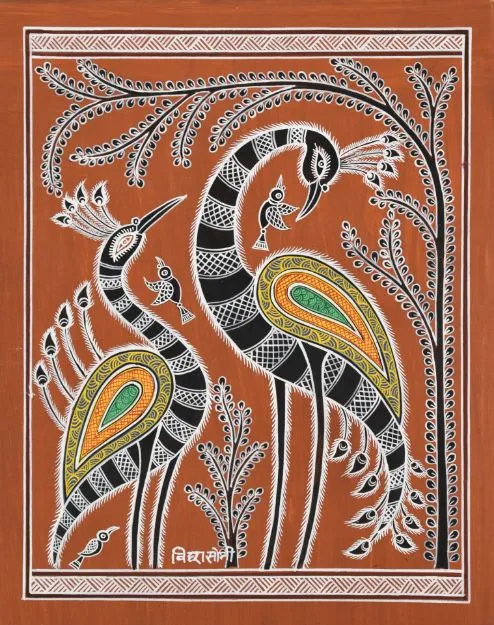
Mandana painting is one of the most visually distinctive forms of traditional Indian art. Its combination of ritual purpose and geometric precision sets it apart from other floor art traditions in India.
Colours are strictly natural: the base is made from geru (red soil) and rati clay, while the white pigment comes from limestone powder or chalk dissolved in water, and red pigment from mixing cow dung with yellow mud.
Motifs range from religious to natural: images of Lord Ganesha, women doing daily chores, birds, peacocks, tigers, and floral patterns sit alongside geometric, geomorphic, zoomorphic, and anthropomorphic designs.
Designs are perfectly symmetrical and well-centred, drawn freehand using plotting points: for example, three points are plotted first to create an equilateral triangle before filling begins.
Paintings have a decorative floral border that frames the composition and holds it together, a distinctive visual signature of the Mandana tradition.
Walls and floors are prepared in multiple layers: first coated with cow dung or yellow mud called peeli mitti, left to dry for a day or two, and then painted over with the white and red mixture.
The art is exclusively woman-centric: Mandana is painted only by Meena women, and is transmitted from mother to daughter across generations as a transgenerational craft.
Famous Artists of Mandana Painting
Because Mandana is a community practice rather than a studio art, the tradition has been sustained by generations of unnamed women artists. However, several practitioners and scholars have brought formal recognition to this art form.
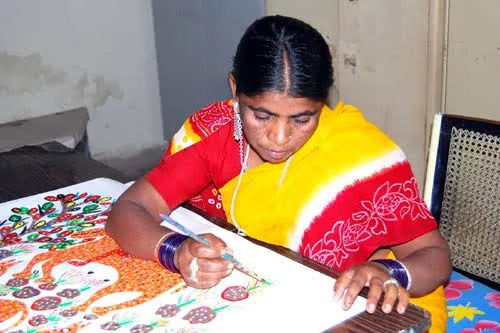
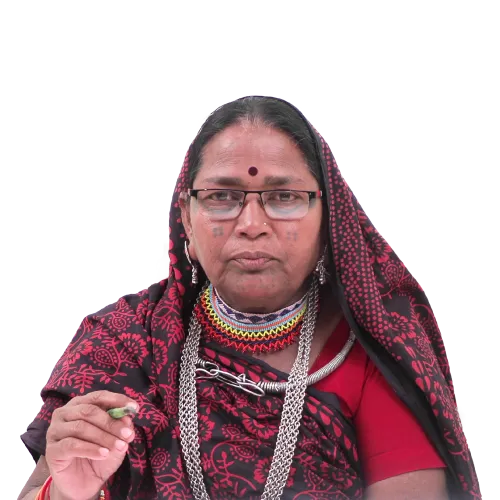
Lado Bai, from Rajasthan, is a respected practitioner of folk and tribal painting traditions who has contributed to the preservation of community-based art forms like Mandana. She is associated with Rooftop's folk art courses.
J. Saksena, a researcher and author, documented the Mandana tradition in the 1985 work Mandana: A Folk Art of Rajasthan, published by the Crafts Museum, New Delhi. This remains the primary scholarly record of the art form's techniques and cultural context.
Dr. Kusum Lata Sharma, based in Rajasthan, is a noted scholar and artist who has worked to document and revive traditional Rajasthani folk art forms, including Mandana, connecting them to contemporary audiences.
The Meena women of Jaipur, Tonk, and Sawai Madhopur remain the living custodians of this tradition, practising it at home during festivals, weddings, and community events.
How to Learn Mandana Painting
If you are wondering how to learn Mandana painting, the most direct path is to connect with teachers who come from within India's living folk art traditions. Rooftop offers online folk art courses taught by master artists from across India, covering techniques rooted in the same community practices that produced Mandana. These courses are accessible from anywhere in India and taught in a way that respects the original craft. Exploring related Rajasthani art forms on Rooftop is also a strong way to build context and skill before attempting Mandana's specific techniques.
Where to See and Buy Mandana Painting
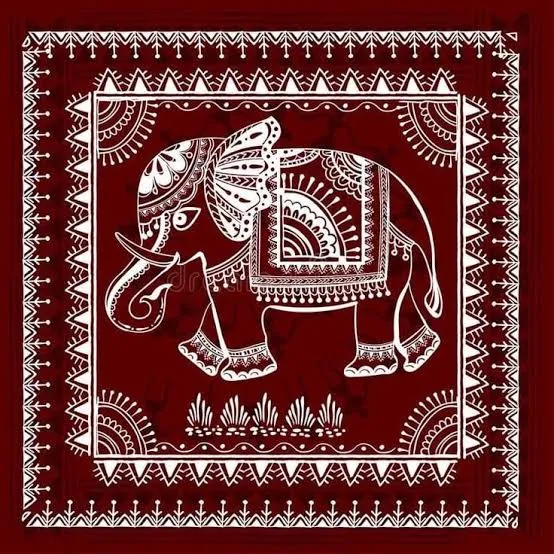
Mandana paintings in their traditional form are best seen in the villages of Jaipur, Alwar, Bharatpur, Sawai Madhopur, Tonk, Hadoti, and Jhalawar in Rajasthan, particularly during festivals and wedding seasons. The Crafts Museum in New Delhi holds documented examples and reference material. For those wanting to bring this art home, Rooftop's shop carries original works by traditional Indian artists. You can also explore the full range of folk and tribal Indian art forms on the Art Wiki to discover related traditions from the same region.
Learn Mandana
Frequently Asked Questions
What is Mandana painting and where does it come from?
Mandana painting is a traditional floor and wall art practised by the Meena community in Rajasthan and Madhya Pradesh. The name comes from the word mandari, which means decoration in the regional language. It is one of the oldest forms of tribal art in India, painted by women on the occasion of festivals, weddings, births, and religious ceremonies. The Meena community believes these paintings protect the home from evil forces and invite the presence of gods.
Which community in India practises Rajasthani Mandana art?
Mandana painting belongs to the Meena community, who make up approximately 56.34 percent of the population of Rajasthan. They are concentrated in the districts of Jaipur, Alwar, Bharatpur, Sawai Madhopur, Tonk, Hadoti, and Jhalawar. The Meena women of Rajasthan create both floor and wall paintings, while those in Madhya Pradesh practise only floor paintings. The art is exclusively made by women and passed down through generations as a family and community tradition.
What materials and colours are used in Mandana painting India?
Mandana paintings are created using entirely natural materials. The base is prepared with geru (red soil) and a clay called rati, which gives walls a reddish tone. White designs are painted over this using limestone powder or chalk powder dissolved in water. Homemade brushes made from date sticks, small clusters of hair, or cotton fabric are used to apply the patterns. In recent decades, some Meena women have begun using synthetic paints such as acrylics and oil paints in place of traditional natural mediums.
What are the main motifs and symbols found in Mandana paintings?
Mandana motifs are drawn from Hindu religious imagery and from the natural world. Common subjects include Lord Ganesha, women performing daily chores, birds, peacocks, tigers, and floral patterns. Alongside these, the art also features geometric, geomorphic, zoomorphic, and anthropomorphic designs. Many patterns closely resemble Vastu purasha mandalas, ancient temple floor plans, and Vedic yagna altar layouts, suggesting the art has deep architectural and spiritual roots.
Can I learn Mandana or related Indian folk art online?
Yes, you can learn traditional Indian folk art online through Rooftop's courses, which are taught by master artists from living folk art traditions across India. While a dedicated Mandana course may vary in availability, Rooftop offers courses in closely related Rajasthani and tribal art forms that share techniques and cultural context with Mandana. These are accessible from anywhere in India and are structured for learners at all levels.
Why is Mandana painting declining today?
Mandana painting faces significant challenges due to the shift from traditional to contemporary lifestyles. The art was originally made on mud houses using clay and natural pigments, but as most homes are now built with cement and clay is becoming harder to source, practising Mandana in its traditional form is increasingly difficult. The art is also an exclusively oral and visual tradition - it is not taught in schools or formally documented in most communities. Organisations like Rooftop are working to document and connect audiences with India's living folk art traditions before such forms are lost.
Mandana painting is more than a decorative tradition - it is a living record of the Meena community's spiritual beliefs, domestic rhythms, and artistic knowledge. Every floor painting drawn for a wedding or festival carries centuries of practice in its lines. Explore folk and tribal art courses on Rooftop and begin your journey into one of India's most quietly powerful art traditions.
Bibliography
Sources
- Saksena, J. (1985) Mandana a folk art of Rajasthan. New Delhi: Crafts Museum.
Image Sources
"Untitled (Mandana Painting)." Archer Art Gallery, https://www.archerindia.com/mandana-untitled-3. Accessed 14 July 2026.
"Lado Bai." Indira Gandhi National Centre for the Arts (IGNCA), https://ignca.gov.in/divisionss/janapada-sampada/tribal-art-culture/bhil-artists-of-madhya-pradesh-and-rajasthan/lado-bai/. Accessed 14 July 2026.
"Gajraaj Mandana Painting (12 × 18)." Indian Folk Art, https://indianfolkart.org/product/gajraaj-mandana-painting-12-x-18/. Accessed 14 July 2026.
"Mandana Painting: The Tribal Art That Has Taken Over the World." Rajasthan Studio, https://rajasthanstudio.com/mandana-painting-the-tribal-art-that-has-taken-over-the-world/. Accessed 14 July 2026.
"Mandana Meena Painting." Arts of the Earth India, https://www.artsoftheearthindia.in/painting/mandana-meena-painting-931302114. Accessed 14 July 2026.
"Mandana Painting." ArtPal, https://www.artpal.com/memaanad?i=136137-43. Accessed 14 July 2026.