

Kummi - The Folk Dance Tradition of Tamil Nadu
Let us learn about the dance of Kummi from Tamil Nadu!
Introduction
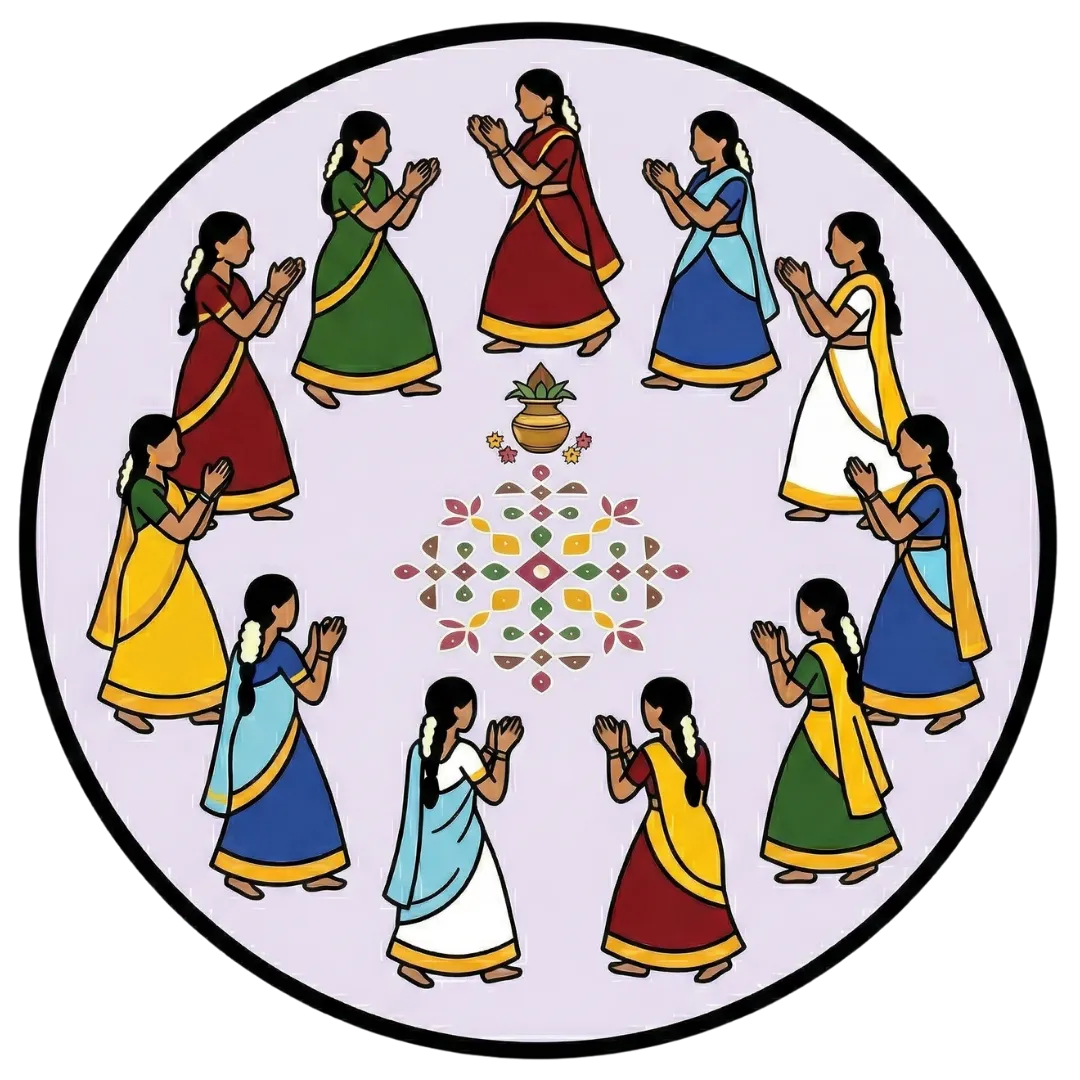
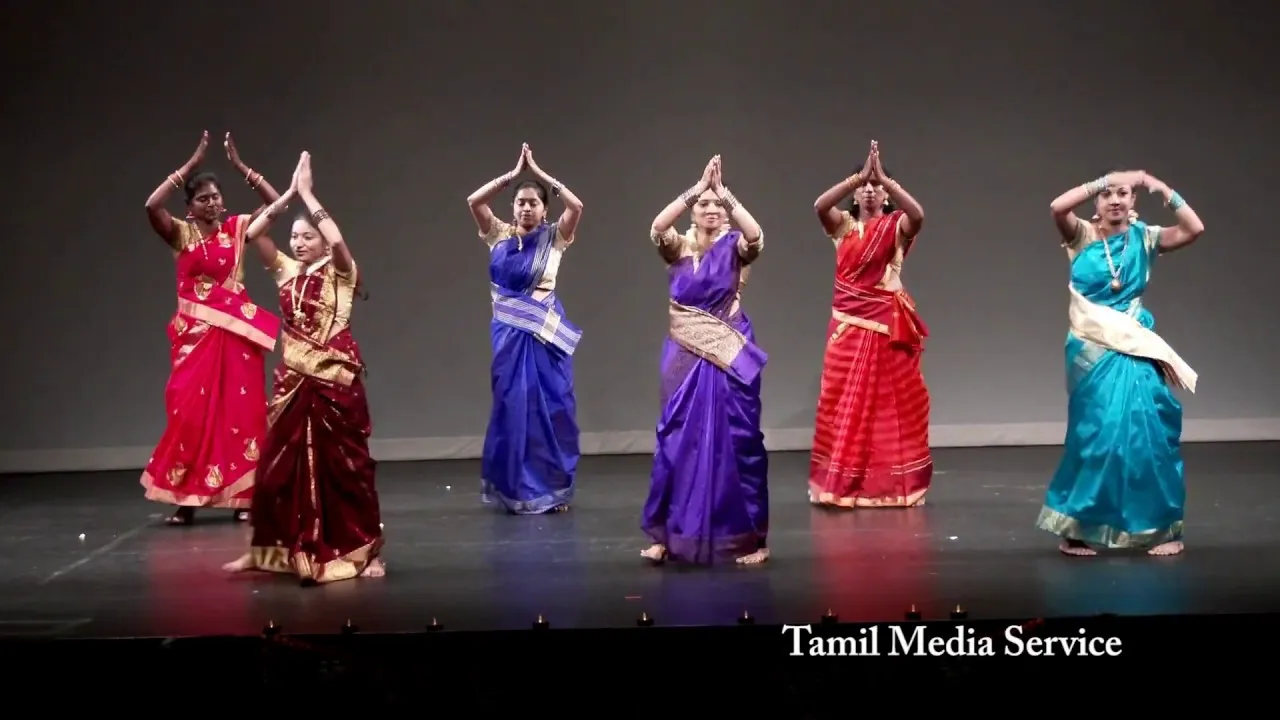
Kummi is one of the oldest and most widely practiced folk dances of Tamil Nadu, India, and is also performed in Kerala and among Tamil communities in Sri Lanka. It is an entirely communal and participatory form, performed primarily by women who stand in a circular formation and clap their hands rhythmically while singing folk songs. The dance's most distinctive feature is its lack of instrumental accompaniment: the rhythmic clapping of hands by the participants themselves creates the musical foundation, reflecting an origin in a period when musical instruments were either unavailable or not part of the performance tradition. Kummi is performed during harvest festivals, temple celebrations, marriage ceremonies, coming-of-age rituals, and other communal occasions. The form is referenced in the Sangam epics of Tamil literature, placing it among the oldest continuously documented performance traditions of South India.
Etymology
The word Kummi derives from the Tamil word kommai, which translates as dancing with the clapping of hands, or sometimes rendered as circle. Wikipedia's entry on Kummi notes that the term refers to a dance with hand-clapping originating at a time before instruments were invented. Some sources cite the etymological root as Kormai, with the same meaning of dancing and clapping. The dance is sometimes called Kummiattam (kummi dance) in formal references. A fusion form incorporating the Oyilattam (dance of beauty) tradition is called Oyil Kummi.
Origin
Kummi is referenced in the Sangam epics, the body of classical Tamil literature spanning approximately the 3rd century BCE to the 4th century CE, establishing a documented history of at least two thousand years. The Oaklores essay on Kummi (2025) specifically notes that Kummiattam is cited in the Sangam epics. Accounts of the dance's origin consistently identify it as emerging before the development of musical instruments, when rhythmic hand-clapping was the primary means of creating musical time. The form is understood as rooted in the agricultural and communal life of Tamil Nadu's villages, where women gathered during seasonal transitions and festivals to sing and dance together.
Location
Kummi is practiced throughout Tamil Nadu and Kerala, with wide distribution across both urban and rural settings. It is also performed by Tamil communities in Sri Lanka. Within Tamil Nadu, the dance appears across districts without strong regional concentration, as it is a pan-Tamil folk form rather than a geographically specific tradition. The dance has been observed in agricultural villages in the districts south of Mayiladuthurai (Mayuram), in the Kaveri delta, and across the southern districts of Tamil Nadu. Rural performances of the dance were documented in the early 1970s by observers working in the rice-farming regions of the state.
Community
Kummi is primarily performed by women across community and caste lines in Tamil Nadu. It is not specific to a single caste or occupational community. Girls begin participating in Kummi performances from a young age, learning the songs and movements within family and community settings. The dance serves as an important social space for women's collective expression and solidarity. The Oaklores essay (2025) documents instances of Kummi being used as a medium of social protest: in 2025, women in Madurai performed Kummi as part of a protest against tungsten mining, illustrating the dance's continuing function as a vehicle for community expression beyond its festival contexts. Tamil poets, most notably Subramania Bharathiyar (1882-1921), wrote Kummi Paatu (Kummi songs) as a means of communicating social reform messages, reflecting the form's documented use as a medium for cultural and political communication.
Relevance
Kummi is classified as a high-relevance, thriving folk tradition. It is performed at Pongal (the Tamil harvest festival), Navaratri, Karthigai Deepam, temple festivals, marriage ceremonies, and rites of passage including girls' coming-of-age celebrations and childbirths (Kulavai Kummi). The form is included in school cultural curricula in Tamil Nadu and is regularly performed at public events. Its accessibility, requiring no instruments or specialized costuming, has contributed to its broad survival across social and economic contexts. The form is also part of the kuthiyottam festival tradition in its contemporary context, where Kummi songs have been incorporated as a popular addition.
History
Background
The Sangam period (approximately 3rd century BCE to 4th century CE) represents the earliest documented cultural context for Kummi. This period of ancient Tamil civilization produced a substantial body of literature, including the eight anthologies of poetry (Ettuthokai) and the ten idylls (Pathupattu), which document the social, ecological, and cultural life of the Tamil people in considerable detail. Dance and music are identified in this literature as parts of the nine fine arts (nun kalaigal) of Tamil culture. The specific reference to Kummiattam (hand-clapping dance) in this body of literature places the form firmly within the artistic traditions of ancient Tamil society.
The use of Kummi as a vehicle for social and political messaging has a documented history extending at least to the 19th century. The Oaklores essay references a specific Kummi composed in response to the Madras cyclone of 1877, in which poets recorded community suffering through the medium of Kummi lyrics. This illustrates that the form functioned not only as entertainment and ritual but as oral history and social documentation.
Culture and Societies
Kummi reflects and reinforces the social structure of women's community life in Tamil Nadu. The collective singing and clapping format creates a participatory space in which leadership is distributed rather than hierarchical: one woman leads by singing the first line of a verse, and the others respond in chorus. This call-and-response structure ensures that the knowledge of Kummi songs circulates through the group rather than being concentrated in a single performer. The dance has served as a site for intergenerational transmission of cultural knowledge, moral values, and social commentary. The specific variant forms reflect distinct social contexts: Deepa Kummi (with lit lamps) for night festivals, Kadir Kummi for harvest celebrations, and Mulaipari Kummi for fertility rituals demonstrate the dance's adaptability to specific ceremonial functions.
Religious Significance
Kummi is performed at temple festivals dedicated to multiple deities, including Mariamman, Murugan, and others. It is a prominent feature of Pongal, the harvest festival offering gratitude to the sun (Surya) and rain for agricultural bounty. Navaratri, the nine-night festival dedicated to the goddess, is another major context for Kummi performance. In the ritual context of Mulaipari Kummi, the dance is performed as part of a fertility ritual involving the sprouting of seeds, connecting the form to agricultural religious practice. However, the dance also functions in entirely secular social contexts, and its religious significance varies by the specific variant and occasion.
Understanding the Art
Style
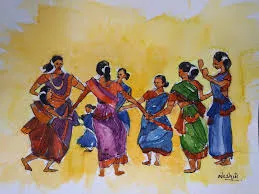
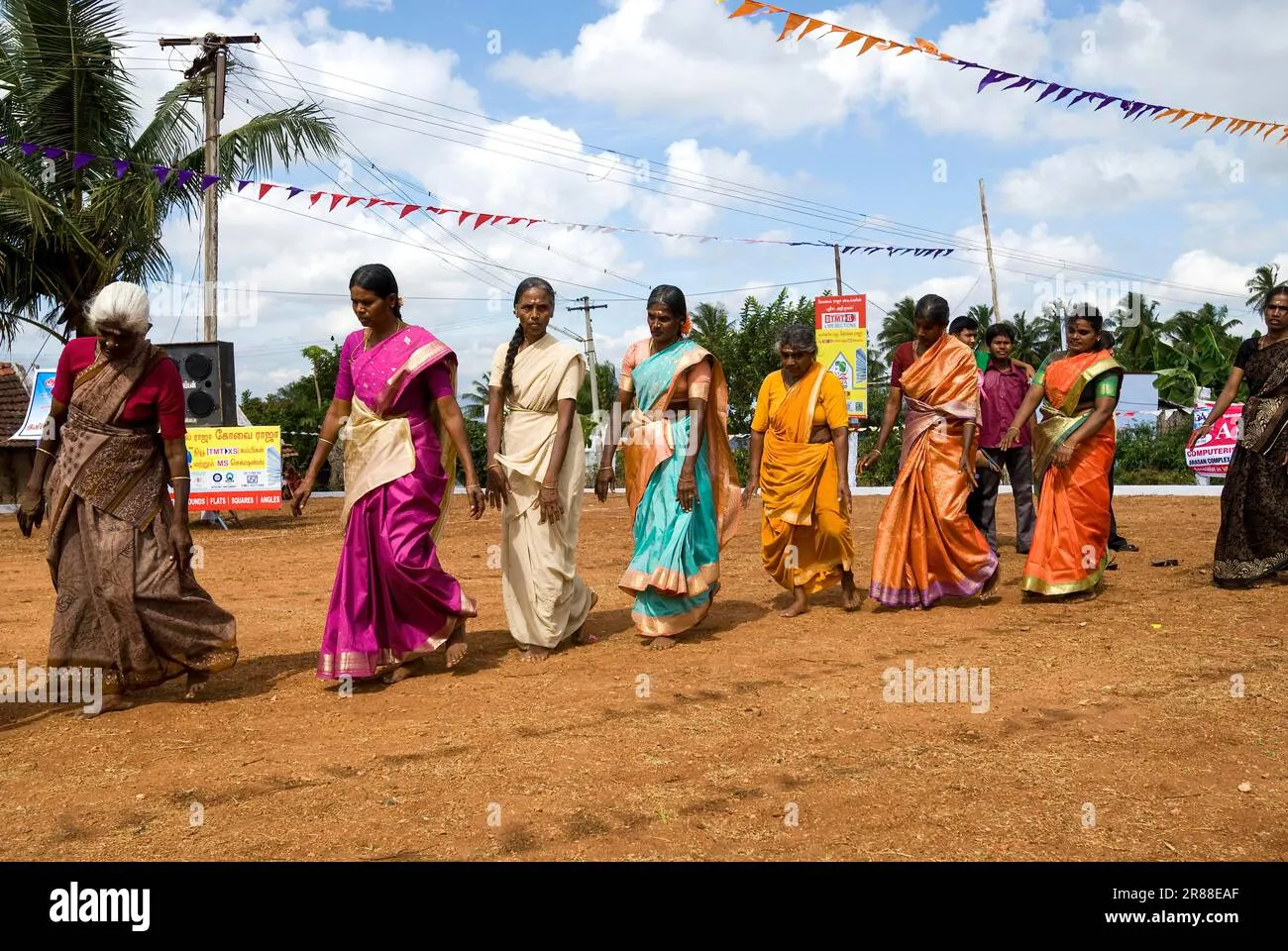
The basic form of Kummi involves women standing in a circle, clapping their hands in rhythmic patterns coordinated with the melody of the sung Kummi songs. The clapping pattern varies with the song and its tempo, and skilled performers execute complex simultaneous clapping patterns using both hands. Body movements include forward-and-backward steps, bending at the waist, raising and lowering the arms, and gentle swaying of the torso. The footwork is relatively simple, with the emphasis placed on the rhythmic precision of the clapping and the melodic quality of the singing. In some regional variations, women hold hands and move in coordinated formation; in others, they clap the hands of neighboring dancers rather than clapping their own hands together.
A mixed-gender variation is documented in which men form an outer circle holding sticks and beat the sticks rhythmically while women stand in an inner circle clapping, with the synchronization between the two circles creating the characteristic texture of this variant.
Central Motifs and Their Significance
Kummi songs draw on a wide repertoire of themes: devotional songs addressed to deities (Pongal praise songs, Murugan devotional lyrics), narrations of agricultural activities (sowing, harvesting, grinding), social commentary (as documented in Bharathiyar's compositions and protest Kummi), and celebrations of life events (marriage, childbirth, rites of passage). The circular formation is itself a structural motif connecting Kummi to the broader tradition of circle dances found across South and Southeast Asia, in which the circular arrangement symbolizes communal equality, continuity, and unity.
Process
A Kummi session begins when one woman starts a song from the repertoire of known Kummi paatu (Kummi songs). The others join in with the chorus, and the clapping rhythm begins. The lead singer provides a new line, which the group echoes, continuing until the song cycle is completed or participants tire. Songs may last from a few minutes to extended sessions. There is no formal beginning or ending ritual; participants join and leave the circle as the occasion permits. Specific variant forms have more structured ritual contexts (Mulaipari Kummi, for example, is tied to specific stages of a fertility ceremony).
Mediums Used
The principal medium of Kummi is the human voice (singing) and the human body (hand-clapping). No instruments or props are required in the basic form. Costume follows no specific dress code: young girls wear pavadai chattai (skirt and blouse), older girls wear pavadai dhavani (skirt with a decorative shawl), and adult women wear saris in regional styles. The absence of material requirements is cited in multiple sources as one reason for the dance's broad survival and democratic accessibility across economic strata.
New Outlook
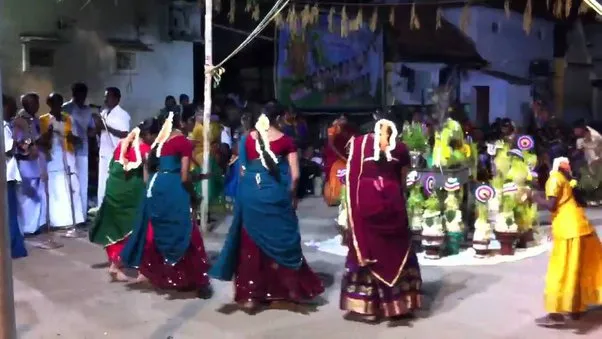
Kummi is actively practiced across Tamil Nadu in both traditional and reinvented forms. Its accessibility and lack of material requirements have protected it from some of the economic pressures affecting more resource-intensive folk forms. Contemporary adaptations include staged performances at cultural events and incorporation into school programmes. The social protest function documented in Madurai in 2025 illustrates the form's continued vitality as a medium for collective expression. Scholars in Tamil cultural studies continue to examine Kummi's role in women's social history and its significance as a documented Sangam-era tradition.
Learn Kummi
Bibliography
Sources
Ananthi Ramachandhiran. Nam Naattu Nadanangal. Paari Nilayam, 1962. ([Shanlax Publications][1])
Devi, Ragini. Dance Dialects of India. Rev. ed., Motilal Banarsidass, 1990.
Krishnadas, Priya. Folk Performing Arts: Tamilnadu. Madras Craft Foundation, 2008.
Image Sources
"Kummi: A Dance of Rhythm and Resistance." Oaklores, 15 Aug. 2025, https://oaklores.com/2025/08/15/kummi-a-dance-of-rhythm-and-resistance/. Accessed 22 July 2026.
"Women Clapping Hands Folk Dance Called Kummi during Pongal Celebration at Pollachi, Tamil Nadu, South India." Alamy, https://www.alamy.com/women-clapping-hands-folk-dance-called-kummi-during-pongal-celebration-at-pollachi-tamil-nadu-south-india-india-asia-image555835911.html. Accessed 22 July 2026.
"File: Kummi.jpg." Wikimedia Commons, https://commons.wikimedia.org/wiki/File:Kummi.jpg. Accessed 22 July 2026.
"Kummi." Forms of Dances in Tamilnadu, https://formsofdancesintamilnadu.wordpress.com/kummi/. Accessed 22 July 2026.
