
Kolattam - The Folk Dance Tradition of Andhra Pradesh
Get to know more about Kolattam, the traditional folk dance of Andhra Pradesh and Tamil Nadu...
Introduction
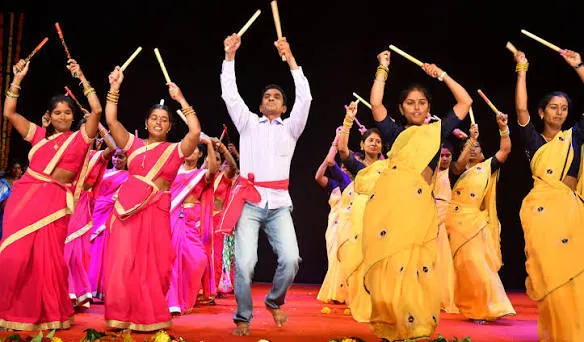
Kolattam is a traditional folk dance performed across Andhra Pradesh and Tamil Nadu in South India. It is a group performance in which participants strike short wooden sticks held in each hand against the sticks of adjacent dancers in rhythmic patterns while singing folk songs and moving in circular formations. The dance is primarily performed by women during village festivals, harvest celebrations, and religious occasions. It is one of the most widely practised folk dance forms of the Telugu-speaking region.
Etymology
The name Kolattam is derived from two Tamil or Telugu words: kol, meaning a small stick, and attam, meaning dance or play. The compound thus translates directly as stick dance. In Andhra Pradesh the dance is also known as Kolannalu or Kolkolannalu; in the Prakasam district it is locally called Kolanna. In classical Sanskrit literature, similar group and stick dance forms are referred to as Hallisaka (a circular formation dance) and Dandarasaka, names cited in texts including the Natya Shastra. An alternative name recorded in Sanskrit sources is Dandarasa.
Origin
Precise documentation of Kolattam's origin is limited to regional ethnographic and historical sources. Early references to Kolannalu appear in accounts of rural performances during the Vijayanagara Empire (14th to 17th centuries), where a stick dance associated with festivals honouring goddesses such as Gauri was observed in Telugu-speaking regions, as noted in historical accounts of the period's cultural practices. The colonial-era ethnographer Edgar Thurston included a description of Kolattam (as a synonymous term for Kolannalu) in his survey Castes and Tribes of Southern India (1909), describing it as part of South Indian rural folk practice. Some sources date the dance's emergence to approximately the 7th century CE, though this claim lacks detailed textual verification. Given its primarily oral and community-based transmission, formal academic documentation of Kolattam's origin is limited.
Location
Kolattam is performed across Andhra Pradesh, including coastal regions, Rayalaseema, and districts such as Macherla, Ongole (Prakasam district), and areas of Telangana. In Tamil Nadu, a variant practice under the same name (Kolattam) is common during the harvest festival of Pongal and during Navaratri celebrations. The dance is also noted in parts of Karnataka. Within Andhra Pradesh, the areas of Mahabalipuram, Tirupati (Taripatri), Macherla, Hampi, and Ramappa are cited as historically associated with the practice.
Community
Kolattam is practised primarily by women of rural agricultural communities across Andhra Pradesh and Tamil Nadu. Performances can include between 8 and 40 participants organised in pairs. A designated leader (referred to as Pennudi in Telugu) directs the group, calling out the tempo changes (Usi) and initiating each section. While historically a women's performance, male participation is not prohibited, and mixed performances occur. The dance is transmitted informally across generations through community practice rather than through formal institutional training.
Relevance
Kolattam is significant as one of the most widespread folk dance forms of the Telugu-speaking region and as a form that has maintained continuous community practice through agricultural festival traditions. Its association with major South Indian folk festivals including Ugadi (Telugu New Year), Pongal, Navaratri, and Diwali ensures regular annual performance contexts. The form has also been documented in Andhra diaspora communities internationally, particularly in the United States, where it is performed at cultural events to maintain community identity.
History
Background
The theoretical lineage of Kolattam is connected to the Hallisaka and Dandarasaka forms described in the Natya Shastra, which are defined as circular group dances and stick-play dances respectively, suggesting classical antecedents for the practice. During the Vijayanagara Empire, the dance was associated with devotional practices at temples dedicated to goddesses including Gauri, and documentation indicates it was performed over multiple days during specific festival cycles as a form of communal worship. The earliest systematic Western documentation appears in Edgar Thurston's Castes and Tribes of Southern India (1909), which describes the practice in the context of South Indian community life.
Culture and Societies
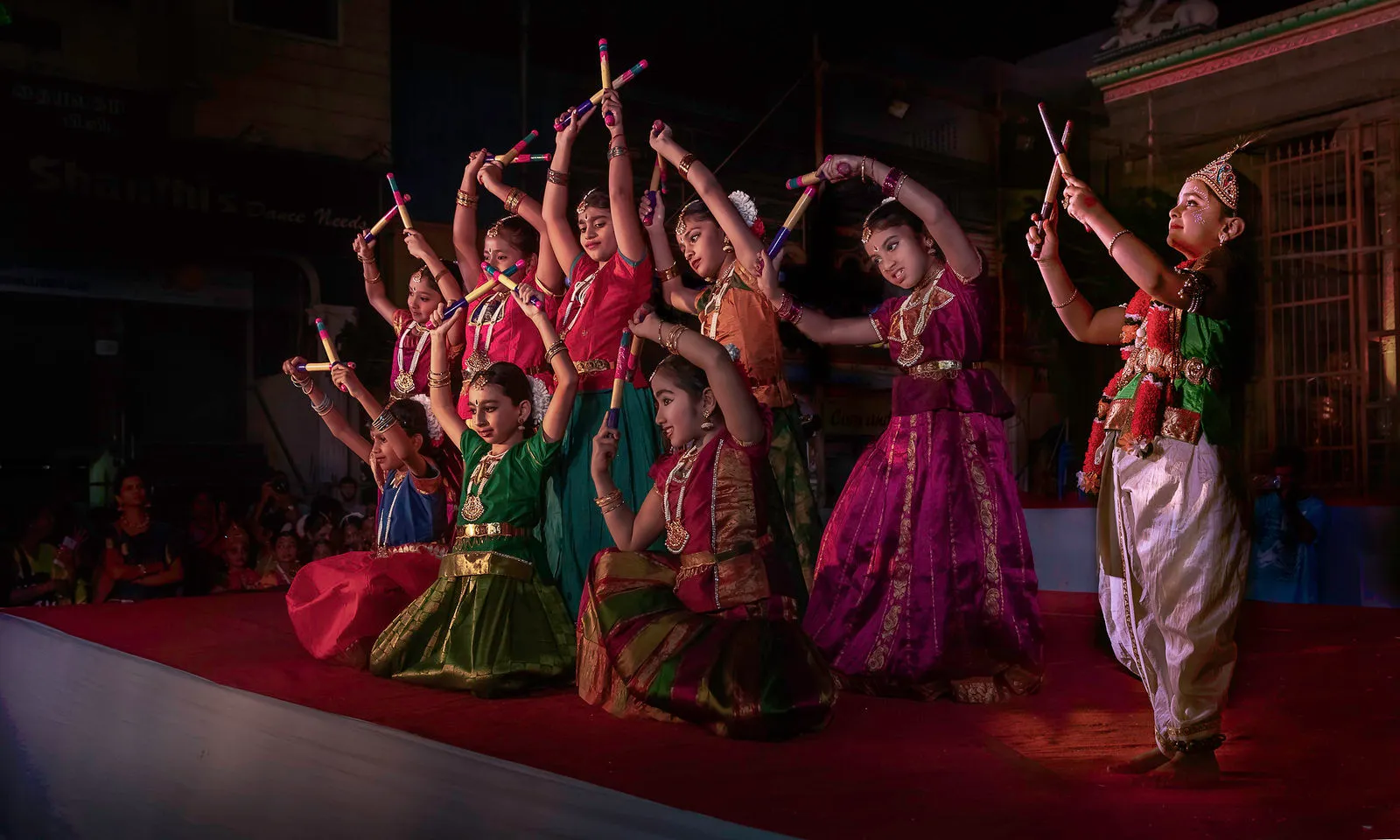
Kolattam is embedded in the agricultural and ritual calendar of rural Andhra Pradesh and Tamil Nadu. It is performed during Ugadi to celebrate renewal and the new year, during harvest festivals to mark agricultural abundance, and during religious festivals dedicated to village goddesses and to Shiva. The dance is also performed at social ceremonies including weddings and birth celebrations. In urban contexts, Kolattam troupes have been presented at cultural events in Hyderabad (at venues such as Ravindra Bharathi auditorium during the Teej Festival) and Chennai (during Navaratri celebrations in neighbourhoods such as Nanganallur). A variation called Pinnal Kolattam or Pinnal Kolannalu uses ribbons or ropes interwoven by the dancers to create braided patterns, adding visual complexity to the standard stick-strike format.
Religious Significance
Kolattam has documented associations with the worship of village deities and temple goddesses in Andhra Pradesh. In ancient practice, female dancers performed Kolattam in temple halls as an offering to Lord Ganesha and to local goddesses. A widely cited legend in the tradition connects the dance to Lord Shiva through the story of Basavasura (also called Kolannalu-related demon narratives), in which the performance of the dance caused the demon to renounce evil, tying the form to Shaivite devotion. The dance in its Tamil Nadu context is frequently associated with Parvati and Ganga mythology, with the theme of Ganga Gouri Samvadam (the dispute between Shiva's wives Ganga and Parvati) being a common narrative subject. Kolattam is therefore identified with both goddess worship and Shaivite tradition across its area of practice.
Understanding the Art
Style
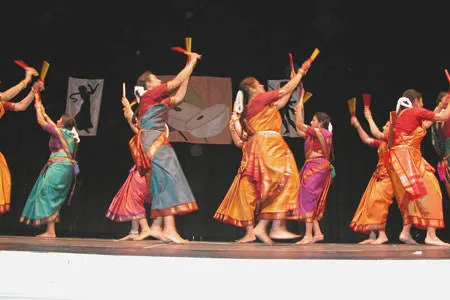
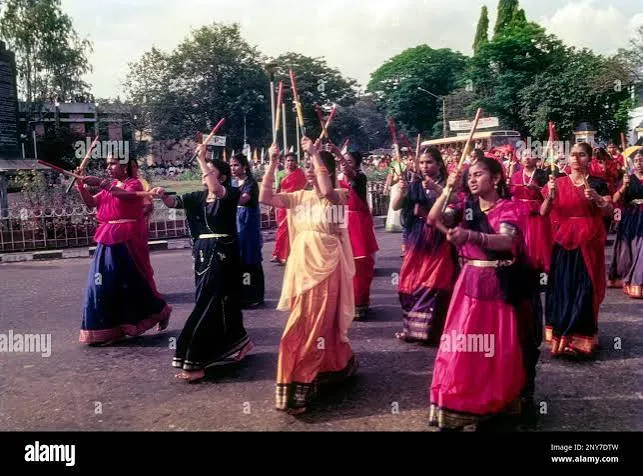
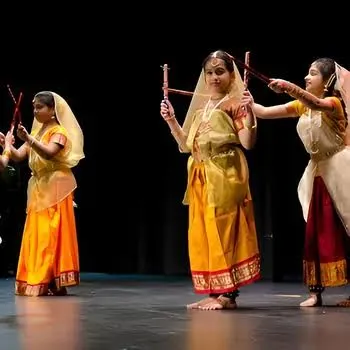
Kolattam performances begin with a large circle of all participants, which then divides into two concentric circles, one rotating within the other. Inner circle dancers strike the sticks of outer circle dancers in prescribed rhythmic patterns. The basic rhythm is typically expressed in the syllabic pattern itayyaku or kita kita tayyaku, which dancers vocalise to maintain synchrony. A performance is divided into sections: Ettugadu (commencement of the dance), Usi (speed transition), and Muktayimpu (conclusion). Body movements include tilting, footsteps, and coordinated upper body gestures timed to the stick strikes and vocal rhythms. The leader sings the opening line of each song, which the group completes in call-and-response format. Two performance formats exist: the standard Kolattam using short wooden sticks, and the Pinnal Kolattam or Pinnal Kolannalu variant in which 14 to 18 dancers weave ribbons or ponytails into a braid while performing. The latter requires sustained coordination as the plait must be completed before the song ends.
Central Motifs and Their Significance
The songs performed during Kolattam cover a range of thematic content: prayers and invocations to deities (Bhakti rasa), love themes (Shringara rasa), heroic narratives (Vira rasa), and expressions of sorrow (Karuna rasa). The dominant narrative theme involves the mythological story of Ganga Gouri Samvadam, the conflict and resolution between the two wives of Shiva, reflecting the dance's connection to Shaivite mythology. Agricultural and seasonal imagery connected to the harvest cycle is also prominent in many traditional songs.
Process
Kolattam is transmitted informally within communities through observation and participation in festival settings. There is no formal institutional system of training or certification. Groups assemble for performances during specific festival seasons, typically rehearsing for several weeks beforehand. The sticks used are generally made of wood, approximately 18 inches (approximately 45 cm) in length, sometimes lacquered and decorated with coloured strings or small bells at the ends.
Mediums Used
The primary instruments used are the performers' own sticks, which provide the main percussive rhythm through striking. Additional accompaniment includes mridangam, harmonium, cymbal, and occasionally clarinet or other melodic instruments. Costumes for women typically consist of bright-coloured silk sarees or skirts and blouses; men wear dhoti, shirt, and neck handkerchief. Both male and female performers may wear anklet bells (ghungroo) to augment the rhythmic sound.
New Outlook
Kolattam continues to be practised in rural Andhra Pradesh and Tamil Nadu as part of annual festival cycles. The form faces gradual erosion in younger generations due to urbanisation and changing festival practices, prompting concerns from regional cultural organisations about its continuity. Urban revivals of Kolattam have been organised in Hyderabad, Chennai, and by Andhra diaspora communities in the United States, often presenting condensed stage versions of the traditional community performance. Since the 2010s, digital documentation efforts have begun to record and archive traditional Kolattam performances as part of broader intangible heritage conservation initiatives.
Learn Kolattam
Bibliography
Sources
Kothari, Sunil. Folk Dances of India. Marg Publications, 1990.
Nāṭyaśāstra. Attributed to Bharata Muni. Compiled c. 200 BCE–200 CE.
Thurston, Edgar. Castes and Tribes of Southern India. Government Press, Madras, 1909.
Image Sources
"Kolatam Performance in Janapada Jathara (2019)." Wikimedia Commons, https://commons.wikimedia.org/wiki/File:Kolatam_performance_in_Janapada_Jathara_(2019)_02.jpg. Accessed 21 July 2026.
"Kolattam." Momscribe, 26 June 2011, https://www.momscribe.com/2011/06/kolattam.html. Accessed 21 July 2026.
"Kolattam." South Tourism, https://www.southtourism.in/tamilnadu/artforms/kolattam.php. Accessed 21 July 2026.
"Kolattam." Alamy, https://www.alamy.com/stock-photo/kolattam.html. Accessed 21 July 2026.
"Kolattam." Flickr, https://www.flickr.com/photos/mulspixel/39893074033. Accessed 21 July 2026.