
Khovar Painting - The Painting Tradition of Jharkhand
Get to know about Khovar Paintings of Jharkhand...
Introduction
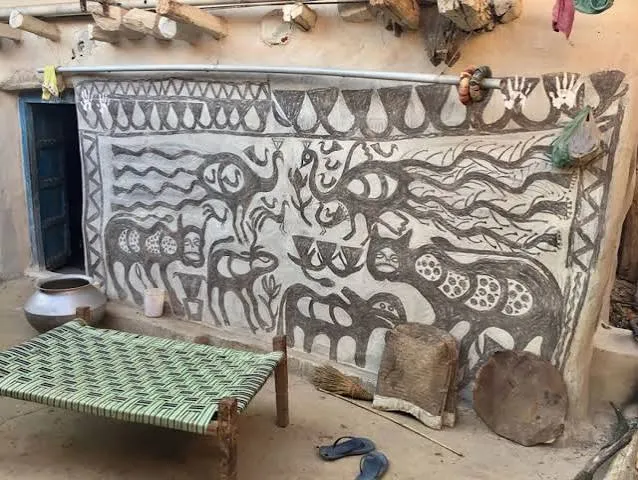
Khovar painting is a traditional mural art form practiced in Hazaribagh district and the upper Damodar valley region of Jharkhand. The tradition is associated primarily with Adivasi and other communities of the region and is applied to the interior walls of nuptial chambers (the bridal room) in the context of wedding preparations. The name 'Khovar' derives from the local words 'Kho' (chamber or cave) and 'Var' (bridegroom or married couple), collectively referring to the chamber prepared for the married couple. The painting is created by women, specifically by the mother and aunts of the bride, and is understood as a visual blessing for the couple's fertility and prosperity.
Khovar painting received a Geographical Indication tag jointly with Sohrai painting in 2019 to 2020, following an application submitted by the Sohrai Kala Mahila Vikas Sahyog Samiti. The tradition has been promoted significantly through the work of Bulu Imam, a Padma Shri awardee who established the Sanskriti Museum and Art Gallery in Hazaribagh in 1992 and the Tribal Women Artists' Cooperative (TWAC) in 1995. The tradition is classified as vulnerable, facing threats from the replacement of mud houses with cement construction and from coal mining displacement in the Damodar valley.
Etymology
'Khovar' is a compound of the local terms 'Kho' and 'Var.' 'Kho' refers to a chamber or inner room, with an etymology that some scholars connect to the Sanskrit concept of a cave or sheltered space associated with fertility and protection. 'Var' refers to the bridegroom and by extension to the married couple; the word shares its root with the Sanskrit 'vara' (bridegroom). The compound name therefore designates the painting as specifically belonging to the space of the married couple, distinguishing it from the Sohrai painting tradition which is applied to the exterior and interior walls during the harvest festival season. The practice is also spelled 'Kohbar' or 'Kohvar' in some documentation, particularly in sources that approach the tradition from the Bihar or Bengali perspective, where cognate traditions exist.
Origin
Historians of Khovar painting connect the tradition to the prehistoric rock art of the Isko rock shelters in Barkagaon, Hazaribagh district. The Isko site, declared a national monument by the Archaeological Survey of India in April 2023, contains rock art attributed to the Meso-Chalcolithic period (approximately 9,000 to 5,000 BCE). The visual vocabulary of Khovar painting, particularly its geometric motifs and certain animal depictions, is cited as evidence of continuity with this rock art tradition.
The argument for continuity between the Isko rock art and Khovar wall painting is a hypothesis supported by visual similarity rather than by demonstrable historical documentation of an unbroken chain of transmission. This distinction is noted in the scholarly literature, which treats the rock art connection as plausible but not definitively established. The Isko connection was developed most extensively by Bulu Imam, who discovered the Isko site in 1991 and documented it through his research at the Sanskriti Centre.
Location
Khovar painting is concentrated in Hazaribagh district, Jharkhand, particularly in villages along the upper Damodar valley. The Sanskriti Centre and Sanskriti Museum in Hazaribagh town serve as the primary institutional documentation center for the tradition. Bhelwara village in Hazaribagh district is specifically cited in documentation as a site of particularly well-preserved Khovar and Sohrai murals.
The tradition historically extended across a broader area of Jharkhand's Chota Nagpur Plateau, practiced in all communities where the nuptial chamber tradition was maintained. The contraction of the practice to Hazaribagh and adjacent districts reflects both the broader decline of mud-wall architecture and the concentration of revival activities in the district.
Community
Khovar painting is practiced by women within the communities of Hazaribagh, including Santhal, Munda, Oraon, Agaria, Kurmi, Ghatwal, and Ganju groups, as well as artisan communities including Rana, Teli, Kumbhar, and Prajapati. The practice is matrilineal in its transmission: the mother and aunts of the bride are the primary painters, and knowledge is passed from mother to daughter within households.
The Tribal Women Artists' Cooperative (TWAC), established by Bulu Imam and his son Gustav Imam in 1995, has formalized the community of women practitioners and facilitated their participation in national and international exhibitions. This institutional framework has provided economic sustainability to a practice that was previously maintained only within the domestic ritual context.
Relevance
Khovar painting is understood within the communities that practice it as a ritual preparation of the bridal chamber that activates the space for fertility, prosperity, and protection of the couple. The motifs painted on the walls of the nuptial chamber are not merely decorative; they are understood as visual prayers and as invocations of the fertility forces associated with the depicted symbols.
The tradition establishes a visual statement about the cultural aspirations and beliefs of the communities in which it operates, connecting the contemporary practice of marriage with a much deeper cultural history of fertility symbolism that the rock art parallel suggests extends into the prehistoric period.
History
Background
The documented modern history of Khovar painting begins with the colonial-era anthropological documentation of the Santhal Pargana and Chota Nagpur communities, in which the nuptial chamber painting tradition is mentioned as a component of wedding ritual. Systematic art historical attention to the tradition began with Bulu Imam's research and advocacy from the 1970s onward, culminating in the establishment of the Sanskriti Museum in 1992.
The joint GI tag application in 2019 to 2020 formalized Khovar's status as a protected craft tradition within the Indian intellectual property framework, alongside Sohrai painting. The April 2023 ASI designation of Isko as a national monument provided additional institutional recognition of the historical context within which Khovar is understood.
Culture and Societies
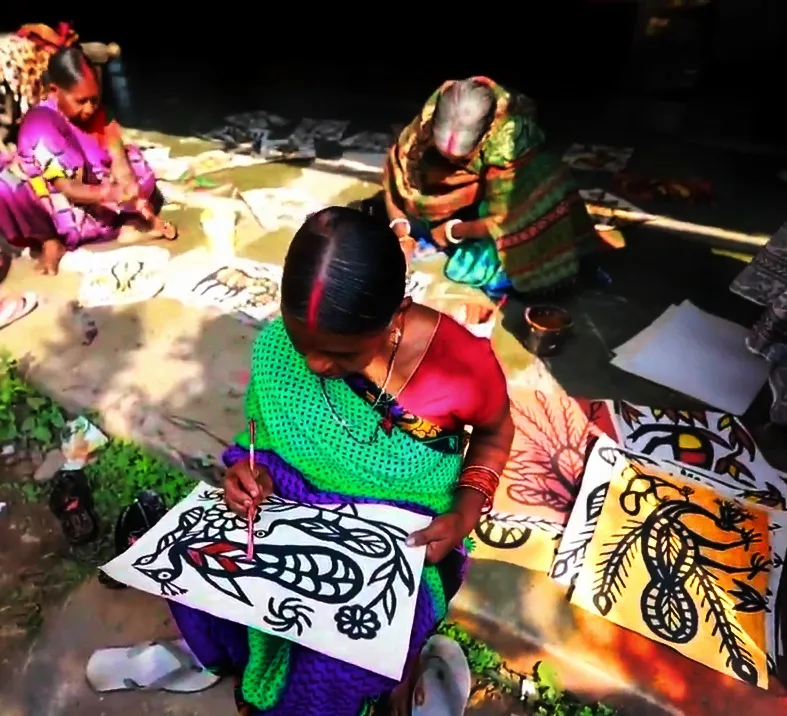
The production of Khovar painting is a collective female activity associated with wedding preparation. The mother, aunts, and other senior women of the bride's family work together over the days preceding the wedding to complete the nuptial chamber paintings. The practice thus creates a specific occasion for female artistic collaboration and for the transmission of knowledge from older to younger women.
The seasonal concentration of Khovar practice in the January-to-June wedding season reflects the agricultural calendar of the communities, in which the post-harvest period is the preferred time for weddings. Sohrai painting, practiced in the October-to-December post-harvest festival period, occupies a different seasonal slot and serves a different ritual function, though the two traditions share techniques, communities, and geographical space.
Religious Significance
Khovar painting is associated with the fertility symbolism of the nuptial chamber and with the invocation of protective forces for the married couple. The pregnant peacock, documented as the most auspicious motif in the Khovar repertoire, directly symbolizes fertility and the hope for offspring. Bamboo, also a central motif, is associated in local tradition with growth, resilience, and regenerative capacity.
The symbolism of the Khovar tradition is connected to Pashupati (Shiva as lord of animals), who appears in some documented panels in both zoomorphic and anthropomorphic form. The Kurmi community's specific practice of depicting female animals with young in the womb is documented as an explicit prayer for offspring. The black undercoat (manganese-rich black clay) used as the base layer of the sgraffito technique is described in community accounts as symbolizing the womb, establishing a connection between the painting technique itself and the fertility symbolism of the tradition.
Understanding the Art
Style
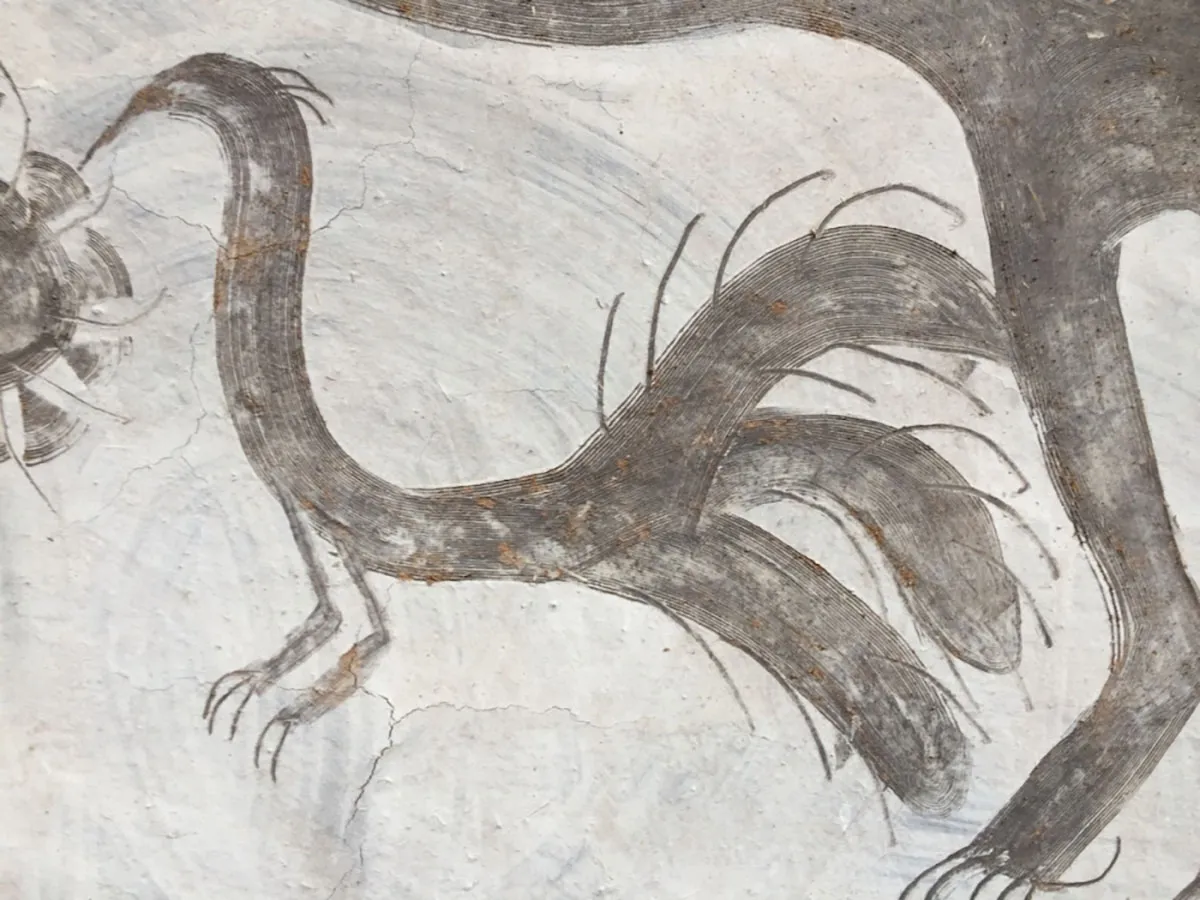
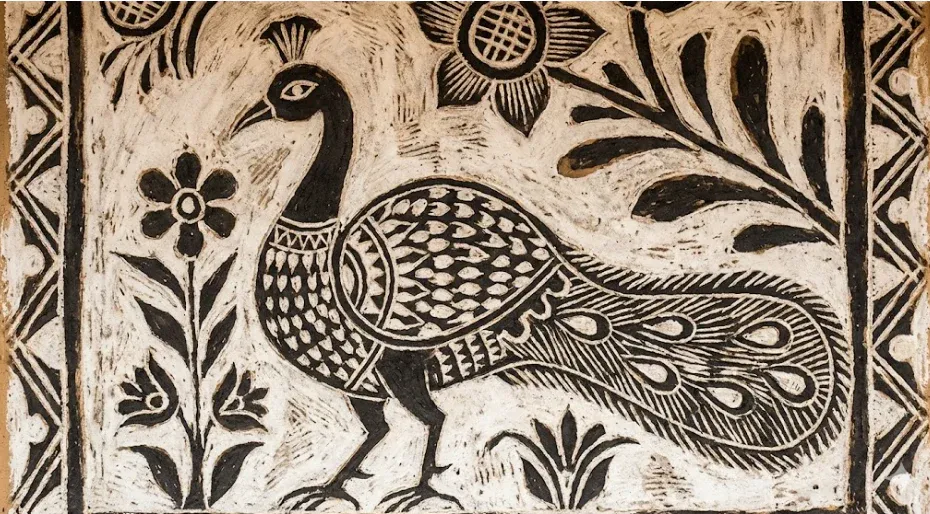
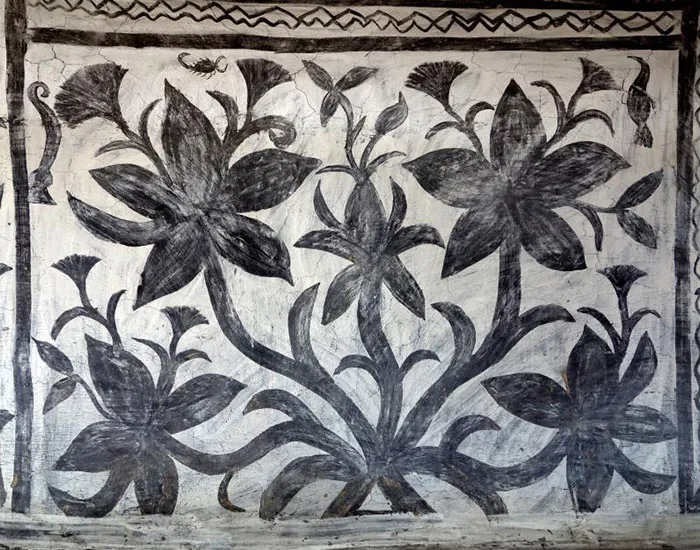
The defining technical feature of Khovar painting is the sgraffito (scratching) or comb-cutting technique. A layer of manganese-rich black clay is applied to the wall first. A white or cream layer of kaolin (charak maati or dhudhi maati) or yellow ochre (pila maati) is then applied over the black. While the upper layer is still wet, the artist uses comb pieces, sticks, or fingers to scratch through the white/cream layer, revealing the black undercoat in the scratched lines. This creates a design of black marks on a white or cream ground.
The visual character of Khovar is therefore essentially linear: the design is expressed through the revealed black lines rather than through applied pigment. This distinguishes Khovar from Sohrai, which is painted (applied) rather than scratched. The formal vocabulary consists predominantly of geometric forms, stylized plants, and animal figures rendered in outline.
Central Motifs and Their Significance
The pregnant peacock is the most documented and significant Khovar motif, representing fertility and the hope for children. The peacock is depicted with an enlarged, rounded abdomen suggesting pregnancy. Bamboo plants are standard compositional elements, associated with growth and resilience. Lotus flowers and other flowering plants represent beauty and auspicious natural abundance.
Elephants (associated with royal power and auspiciousness) and turtles (associated with longevity and stability) appear regularly. Lizards and geometric patterns including fish-net designs, triangles, and circular forms are documented as standard elements. Female animals with young in the womb (specific to Kurmi community Khovar) constitute an explicit fertility prayer.
Process
The wall surface is prepared by cleaning and smoothing the existing mud and cowdung plaster. A layer of manganese-rich black earth clay is applied and allowed to dry or set. A layer of white kaolin (charak maati or dhudhi maati) is then applied over the black. While the white layer is fresh and workable, the artist uses a comb made from a divided bamboo or palm frond piece, a stick, or the fingers to scratch designs through the white into the black layer.
The timing is critical: the white layer must be scraped when it is at the right stage of drying. If too wet, the lines smear; if too dry, the material flakes rather than scraping cleanly. The technique requires knowledge of the materials' behavior that is transmitted through practice.
Mediums Used
Manganese-rich black earth clay for the base layer. White kaolin (charak maati, dhudhi maati) or yellow ochre (pila maati) for the upper layer. Comb-cutting instruments made from split bamboo, palm frond sections, or similar local materials. Fingers for finer detailing. The entire medium is mineral-based and locally sourced from the Hazaribagh region's laterite and clay deposits.
New Outlook
The Tribal Women Artists' Cooperative has facilitated the expansion of Khovar from an exclusively domestic and seasonal practice to a year-round artistic activity with commercial and institutional markets. Khovar paintings on paper and canvas have been exhibited internationally and sold through craft channels. The TWAC-affiliated artists have participated in more than fifty international exhibitions facilitated by Bulu Imam's network. The Birsa Munda Airport in Ranchi features Khovar and Sohrai-inspired murals, and the tradition was represented at the G20 Ranchi 2023 cultural program. These institutional acknowledgments reflect the growing national recognition of Jharkhand's wall painting traditions.
The primary structural threat to the tradition remains the replacement of mud houses with cement construction, which eliminates the surface on which Khovar is produced. No technique for applying the sgraffito method to cement surfaces that replicates the aesthetic and material qualities of the original has been documented as successfully adopted.
Learn Khovar Paintings
Bibliography
Sources
Bhattacharya, Sukhomoy. Arts and Crafts of Central India. Sangeet Natak Akademi, 1984.
Elwin, Verrier. The Muria and Their Ghotul. Oxford University Press, 1947.
Haimendorf, Christoph von Fürer. The Gonds of Andhra Pradesh: Tradition and Change in an Indian Tribe. Allen and Unwin, 1979.
Imam, Bulu. Tribal Art Traditions of Hazaribagh. Sanskriti Centre, 1990.
Jain, Jyotindra, and Aarti Aggarwala. National Handicrafts and Handlooms Museum. Mapin Publishing, 1989.
Sohrai Kala Mahila Vikas Sahyog Samiti. GI Application Documentation for Sohrai and Khovar Painting. Geographical Indications Registry, 2019.
Image Sources
"Khovar Painting." Impart Encyclopedia of Art, 21 Apr. 2022, https://imp-art.org/articles/khovar-painting/. Accessed 22 July 2026.
"Khovar Painting." Impart Encyclopedia of Art, 21 Apr. 2022, https://imp-art.org/articles/khovar-painting/. Accessed 22 July 2026.
"Why Khovar Painting Is More Than an Art?" My Bluekart, 9 Dec. 2025, https://mybluekart.in/blogs/news/why-khovar-painting-is-more-than-art. Accessed 22 July 2026.
"File: Sohrai Painting, Jharkhand.jpg." Wikimedia Commons, https://commons.wikimedia.org/wiki/File:Sohrai_painting,_Jharkhand.jpg. Accessed 22 July 2026.
"Khovar Painting." Impart Encyclopedia of Art, 21 Apr. 2022, https://imp-art.org/articles/khovar-painting/. Accessed 22 July 2026.