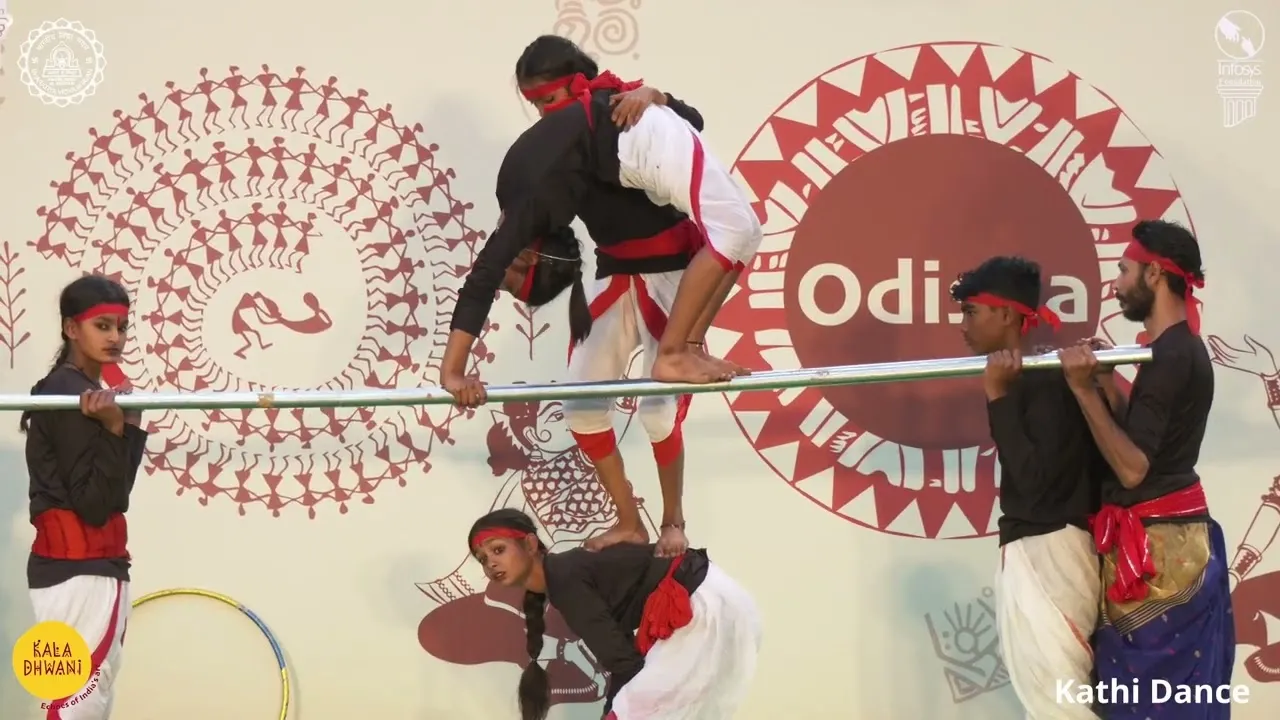

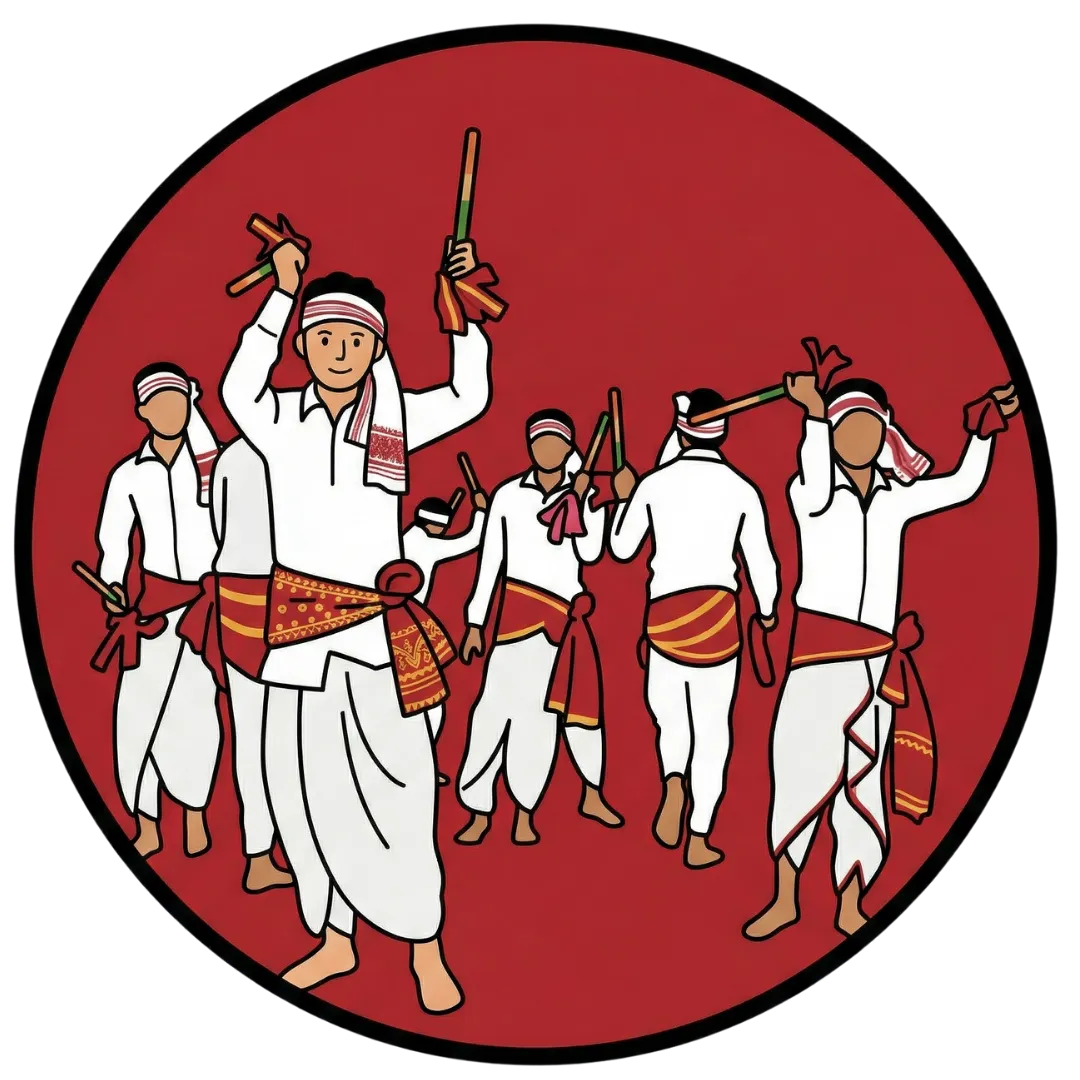
Kathi Dance - The Folk Dance Tradition of West Bengal
Let us learn about Kathi dance from West Bengal!
Introduction
Kathi dance is a stick dance tradition of West Bengal, characterised by rhythmic footwork and the coordinated striking of sticks by male performers. The form belongs to the martial folk dance traditions of the Rarh region of Bengal and reflects the physical training and ceremonial performance culture of communities historically associated with military service to local feudal lords. Kathi Nacher Gaan, the song tradition associated with the dance, draws themes from the Ramayana, Mahabharata, and stories of Radha and Krishna. The form has experienced significant decline in the twentieth and twenty-first centuries. History
Etymology
The word kathi means stick in Bengali, and the dance takes its name from the central prop and movement vocabulary of the performance: performers use sticks that are beaten rhythmically against each other during the dance. The form is also known as Kathi Nach, and the songs associated with it as Kathi Nacher Gaan.
Origin
Rarh Bengal, the historical region lying between the Chota Nagpur Plateau and the Ganges Delta in western West Bengal; the documented tradition in West Bengal is associated with the Purulia, Bankura, and Midnapore districts
Location
Districts of Purulia, Bankura, Midnapore, Birbhum, Bardhaman, Murshidabad, and Nadia in West Bengal; also Purulia district specifically for martial dance variants Community: Historically associated with the pike community, military retainers of feudal lords in the Rarh region; also associated with communities including Bagal, Bhuiya, Mahato, Bagdi, and related groups of the Rarh region
Relevance
Vulnerable; the Kathi dance tradition faces significant decline, with the Kathi Nacher Gaan song tradition described by researchers as nearly extinct in its original form
History
Background
The Kathi dance tradition is understood to be a product of the feudal culture of Rarh Bengal, the historical region west of the Ganges Delta. During the period of feudal lordship in this region, the pike community performed Kathi Nach as both physical training and ceremonial performance during pujas and other festive occasions. The song tradition, Kathi Nacher Gaan, is described by researcher Lokogandhar as a degenerated form of Rarh Bangla, the folk music tradition specific to the Rarh region. Some accounts date the tradition to the sixteenth century in West Bengal. The historical connection to the practice of Guru Saday Dutta, a scholar and cultural revivalist, is cited in documentation of the form's traditional method, contrasting with a newer method that has developed subsequently.
Culture and Societies
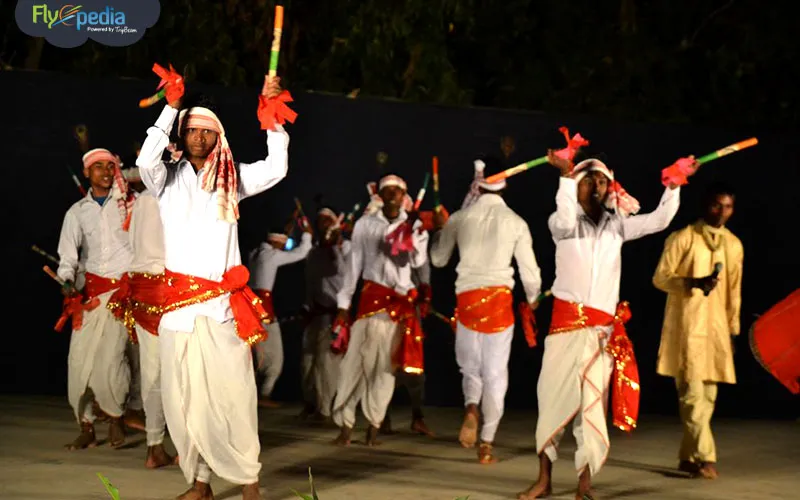
The Kathi dance is exclusively performed by men. It is popular during Durga Puja and is displayed in various parts of West Bengal during this festive period. The dance involves eighteen to twenty performers forming circles that move and reform around each other; the individual dancer who moves to the centre of the circle performs the role of a warrior, while those forming the outer circle function as his opponents or adversaries. The Birbhum, Bardhaman, Murshidabad, and Nadia districts are documented as areas where the dance is performed on the occasion of social and domestic festivals, involving vigorous movements of the body combined with acrobatics using a raibansh, a long bamboo stick.The Kathi dance is also identified as a variant within the tradition of Jhumur folk music: when performed with Jhumur songs, it is called Jhumur gaaner Kathi Nach. The Santhal community uses the madal drum as a principal instrument, reflecting the form's connection to tribal as well as agrarian communities.
Religious Significance
The Kathi dance is documented as performed on the occasion of pujas, and its historical association with festive and ritual occasions in the Rarh region indicates contextual religious framing. However, the dance is not understood as a devotional act in itself; its function is primarily martial-performative and entertainment-oriented. The song themes may draw from the Ramayana and Mahabharata as well as from Radha-Krishna narratives, reflecting the broader devotional folk repertoire of Bengal. No specific cult, temple, or ritual institution has been documented as the institutional locus of the Kathi dance tradition.
Understanding the Art
Style
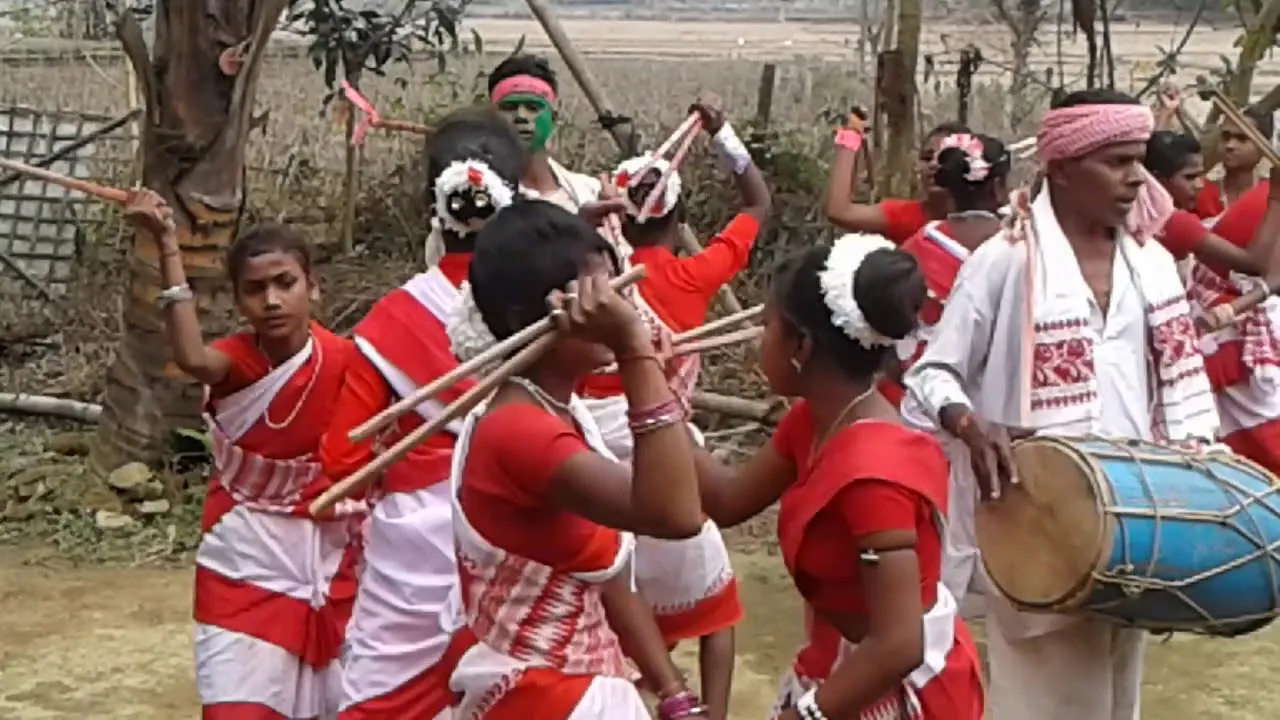
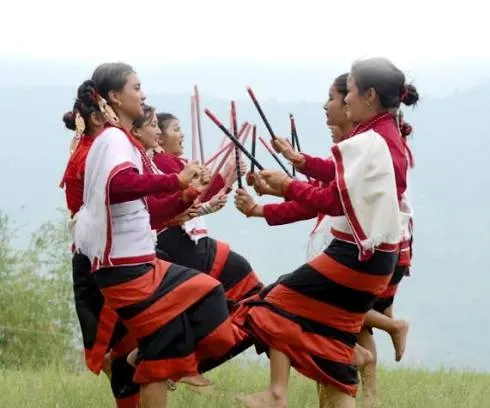
The Kathi dance is characterised by vigorous physical movement, the coordinated striking of sticks, rhythmic footwork, and the formation and reformation of circular patterns by the performing group. Performers move in two concentric circles, both circles moving in opposite directions simultaneously. An individual dancer periodically leaves the formation to stand at the centre, where he revolves in place while striking his sticks and beating his feet on the ground, performing a stylised depiction of combat. The performers shout during the dance, simulating the vocal encouragement of warriors in battle. The posture throughout is described as firm and military. The repetition of steps over extended periods is a structural feature of the form.
Central Motifs and Their Significance
The central motif of the Kathi dance is martial: the sticks represent weapons, the central performer represents a warrior, and the surrounding circle represents opposing forces. The choreographic vocabulary directly evokes military combat. At the same time, the social occasions on which Kathi is performed, including Durga Puja, link the martial content to the broader devotional culture of Bengal, where martial imagery and goddess worship intersect. Song themes from the Ramayana, Mahabharata, and Radha-Krishna narratives add a mythological dimension to what is primarily a martial performance.
Process
The Kathi dance is performed by a group of eighteen to twenty men dressed in dhoti and shirt with anklets; in some traditional versions, shirts were made to resemble leopard skin. Anklets produce rhythmic metallic sounds that complement the percussion. The primary instruments are the madal, a double-headed Santhal drum made from a carved wooden log with animal skin stretched over both faces, the nagara kettledrum, and the kartal. When associated with Jhumur music, additional instruments from the Jhumur ensemble are used.
Mediums Used
The primary medium is the stick itself, around which the dance's entire movement vocabulary is organised. Instruments include the madal, nagara, and kartal. Costumes are minimal, consisting of dhoti, shirt, and anklets. No written script or fixed musical notation is used; transmission occurs within performing communities through direct participation.
New Outlook
The Kathi Nacher Gaan song tradition, according to researchers from Lokogandhar, is at risk of extinction in its original form, with the original compositional and performance methods associated with Guru Saday Dutta's tradition surviving only marginally. The dance form itself continues to be performed in parts of West Bengal during Durga Puja but lacks formal institutional support or academic documentation commensurate with its historical significance. Limited formal scholarship on this specific tradition has been published. The Rural Crafts and Cultural Hub of West Bengal has documented the form as part of a broader survey of the state's martial folk dance heritage.
Learn Kathi
Bibliography
Sources
Bhattacharyya, Ashutosh. Banglar Lokosamskriti. Calcutta Book House, 1962.
Dutta, Guru Saday. The Bratachari Movement: A Nation-Building Program in India. Macmillan, 1937.
Sinha, Maitri. "The Extinct Culture of Rarh Bengal's Kathi Nacher Gaan." Lokogandhar, 1 Mar. 2024, https://lokogandhar.com/the-extinct-culture-of-rarh-bengals-kathi-nacher-gaan/.
Image Sources
"Kathi Dance." Indianetzone, https://www.indianetzone.com/kathi_dance. Accessed 22 July 2026.
"Traditional Folk Dances of West Bengal." Sam India Tour, https://www.samindiatour.com/blog/traditional-folk-dances-of-west-bengal/. Accessed 22 July 2026.
"Exploring the Top 7 Famous Folk Dances of West Bengal: From Baul to Gambhira." Flyopedia, https://flyopedia.ca/blog/exploring-the-top-7-famous-folk-dances-of-west-bengal-from-baul-to-gambhira. Accessed 22 July 2026.
"Folk Dance." RCC Heritage Bengal, https://rcchbengal.com/art/folk-dance. Accessed 22 July 2026.
"Kathi Dance." YouTube, https://www.youtube.com/watch?v=yCdtEhmr9pE. Accessed 22 July 2026.