
Kalbelia - The Folk Dance Tradition of Rajasthan
Get to know Kalbelia Dance, also known as Sapera Dance or Snake Charmer Dance, the pride of Rajasthan's iconic folk dance
Introduction
Introduction
Kalbelia is a folk dance of the Kalbelia community of Rajasthan, India, performed primarily by women of the tribe as an expression of their community's identity and traditional way of life. Also known as the Sapera Dance or Snake Charmer Dance, the form is characterized by fluid, serpentine body movements that evoke the motion of a cobra, performed to the accompaniment of traditional instruments including the poongi (been) and dholak. The Kalbelia community were historically nomadic snake charmers who derived their livelihood from snake handling, the trading of snake venom, and herbal medicine. Following the enactment of India's Wildlife Protection Act of 1972, which prohibited snake handling, the community transitioned increasingly toward cultural performance as a livelihood. In 2010, Kalbelia folk songs and dances were inscribed on UNESCO's Representative List of the Intangible Cultural Heritage of Humanity. A scholarly debate exists around the historical depth of the Kalbelia dance as a formalized stage performance. Academic research, including a study published through the University of Pennsylvania (Sarah Louise Diamond, 1999) and reviewed in ethnographic literature, argues that the formalized dance as currently performed on stage developed primarily in the early 1980s, with the first documented stage performance occurring in 1981. UNESCO's inscription in 2010 has itself been a subject of discussion in the context of heritage nomination processes.
Etymology
The term Kalbelia is derived from two words: Kal, meaning snake (and sometimes interpreted as black, in reference to the cobra), and Belia, meaning friend or companion. The name thus identifies the community as companions or followers of the snake, reflecting the defining occupational and symbolic relationship between the Kalbelia people and serpents. The dance is also called Sapera Dance (from sapera, meaning snake charmer) and Snake Charmer Dance in tourist and documentary contexts.
Origin
The Kalbelia community traces its identity to a founding legend involving Guru Gorakhnath and his disciple Kanifnath. According to this tradition, Kanifnath drank a bowl of poison as a test of devotion, and Guru Gorakhnath rewarded him with the power to control all venomous creatures, a power passed to his descendants. This origin narrative places the Kalbelia community within the Nath yogic tradition. Some sources trace the community's presence in Rajasthan to the 12th century, though documented historical records from this period are limited. The formalized dance performance associated with the community in its contemporary tourist and festival contexts developed significantly from the early 1980s onward, with research (including Diamond's 1999 dissertation and the academic.edu-accessible article by a subsequent researcher) arguing that this stage form was substantially shaped by specific dancers and by the demands of Rajasthan's developing cultural tourism industry. The Padma Shri recipient Gulabo Sapera, a Kalbelia dancer from Ajmer, is widely credited with bringing the dance to international stages. UNESCO's inscription acknowledges the dance as an expression of the community's traditional way of life while also recognizing the community's effort to adapt their heritage in response to changing economic conditions.
Location
The Kalbelia community is concentrated in the districts of Pali, Ajmer, Chittorgarh, Udaipur, and Jodhpur in Rajasthan. The largest cluster of Kalbelia settlements is in Pali district. The community historically lived in nomadic encampments called deras, moving in established routes through the Thar Desert. These deras were typically sited outside village boundaries, reflecting the community's marginal social position. In the post-Wildlife Act period, many families have settled more permanently in peri-urban areas. Performances occur at tourist venues, cultural festivals, and events across India and internationally.
Community
The Kalbelia are classified as a Scheduled Tribe in Rajasthan. The community is divided into two main groups: the Daliwal and the Mewara. Historically, Kalbelia men carried cobras in cane baskets from village to village, while women sang and danced to solicit alms. The community reveres the cobra and observes a prohibition on killing snakes. Women occupy a position of cultural prominence within the community, serving as the primary performers and bearers of artistic identity. Kalbelia women are also known for their knowledge of herbal medicine, which supplemented the community's income from snake handling and performance. The community has faced social marginalization and historically had limited access to formal education and institutional recognition.
Relevance
UNESCO's 2010 inscription on the Representative List of the Intangible Cultural Heritage of Humanity represents the most significant formal recognition of Kalbelia cultural practice. The inscription describes Kalbelia songs and dances as an expression of the community's traditional way of life and as a symbol of their identity at a time when their traditional livelihood and social role in rural Rajasthan are declining. The dance is a prominent feature of the Rajasthan International Folk Festival, the Pushkar Fair, and numerous state and national cultural events. Kalbelia performance has become one of the most internationally recognizable markers of Rajasthani folk culture, a process that UNESCO's inscription has accelerated.
History
Background
The Kalbelia community's documented history in Rajasthan's social landscape is one of structural marginalization. As a community associated with snake handling and nomadism, they occupied a position outside the village social order, living in peripheral encampments and operating within but not fully integrated into the agrarian economy. Their traditional occupation required movement through multiple villages and districts, and their cultural practices, including music and dance, evolved within this nomadic context as a means both of entertainment and of soliciting income from settled communities. The Wildlife Protection Act of 1972 effectively ended the legal basis for snake handling, precipitating a significant occupational shift toward performance as a primary livelihood. This transition, supported by the growth of cultural tourism in Rajasthan from the 1970s onward, created the conditions under which the formalized stage dance developed.
Culture and Societies
Kalbelia cultural life is organized around a strong oral tradition. Songs and dances are transmitted from generation to generation without written manuals or structured educational institutions. The community is noted for its improvisational capacity: Kalbelia singers compose lyrics spontaneously during performances, adapting to the audience and occasion. This capacity for improvisation is specifically acknowledged in UNESCO's inscription documentation. The songs convey mythological knowledge, ancestral histories, and social commentary. The community's self-representation through dance and music has been both a survival strategy and an assertion of cultural presence in the face of social marginalization.
Religious Significance
The Kalbelia community identifies as followers of Sage Kanifnath and operates within the broader Nath yogic tradition, which venerates Guru Gorakhnath. Their reverence for the cobra has both practical and religious dimensions: cobras are not killed by Kalbelia practitioners, and the snake is regarded as a sacred animal connected to their founding ancestor's divine gift of venom control. Special Kalbelia dances are performed during the festival of Holi. However, the dance as a formalized performance art is not a strictly liturgical or temple-based practice. Its religious associations are present at the level of community identity and mythological narrative rather than in organized ritual performance.
Understanding the Art
Style
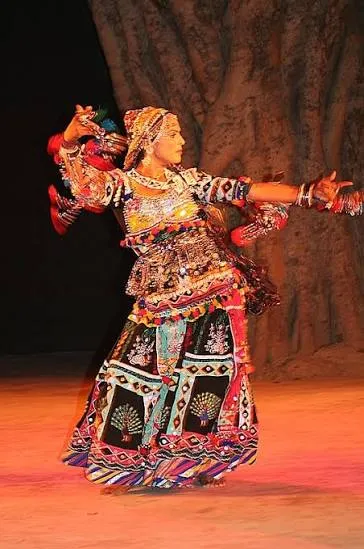
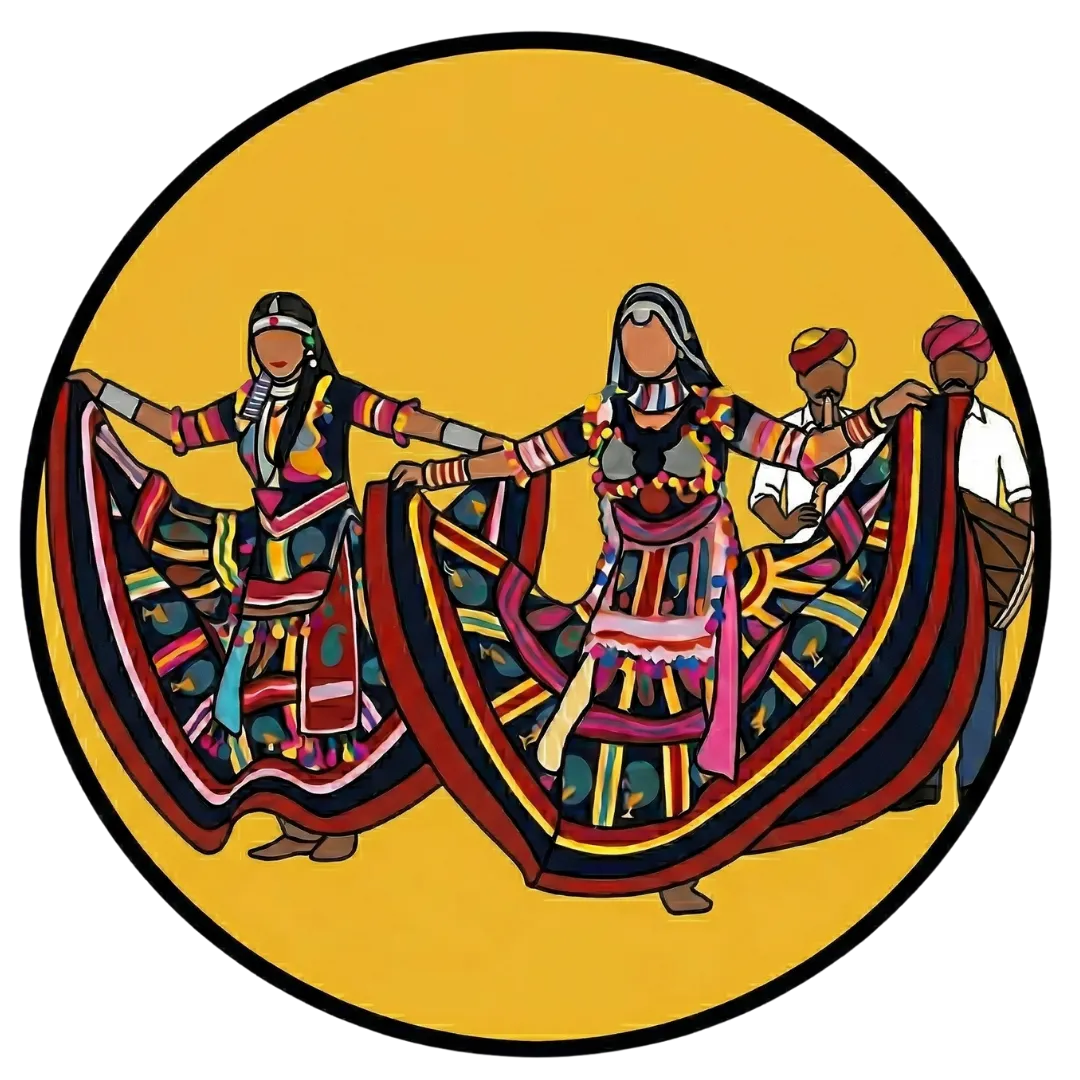
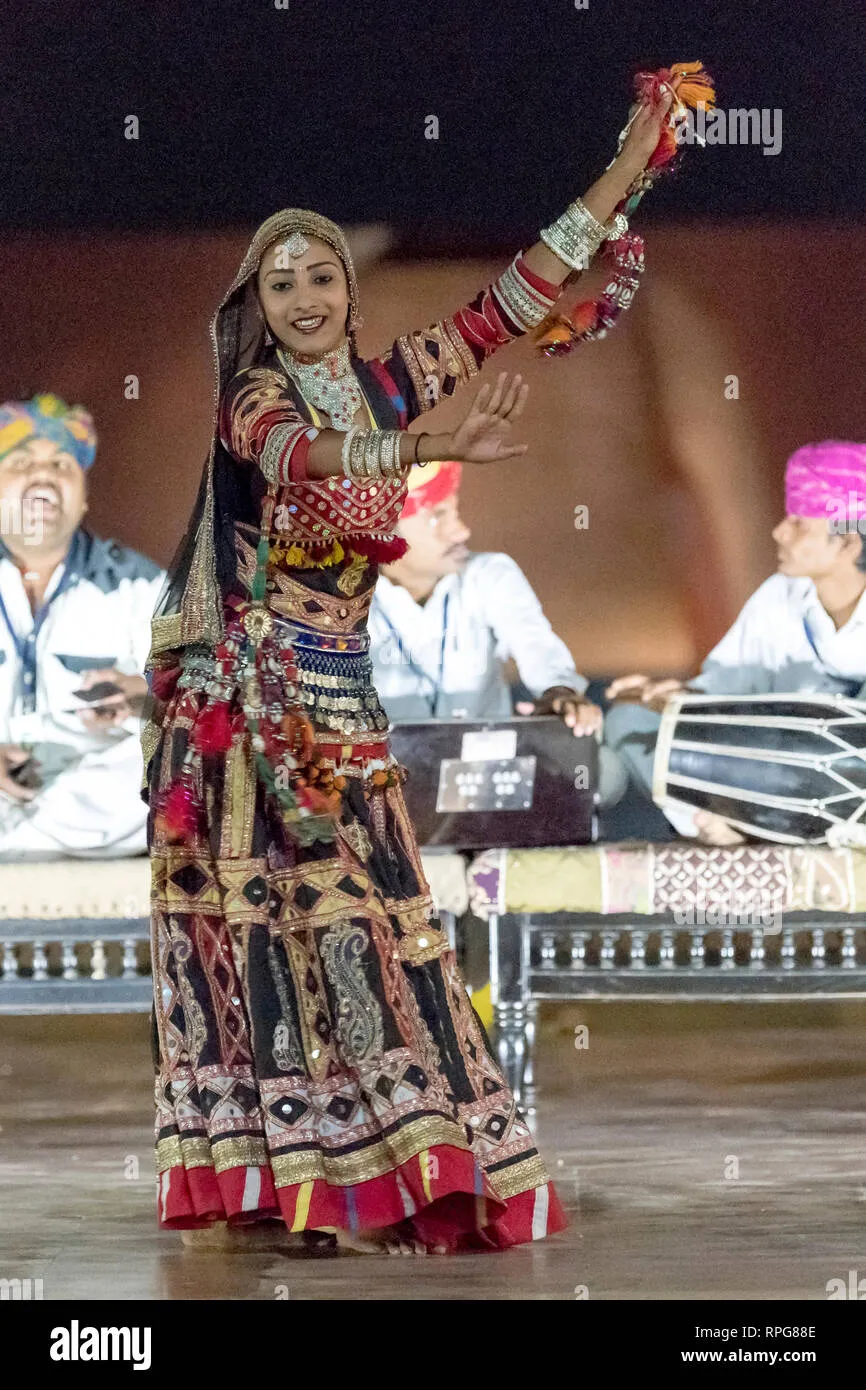
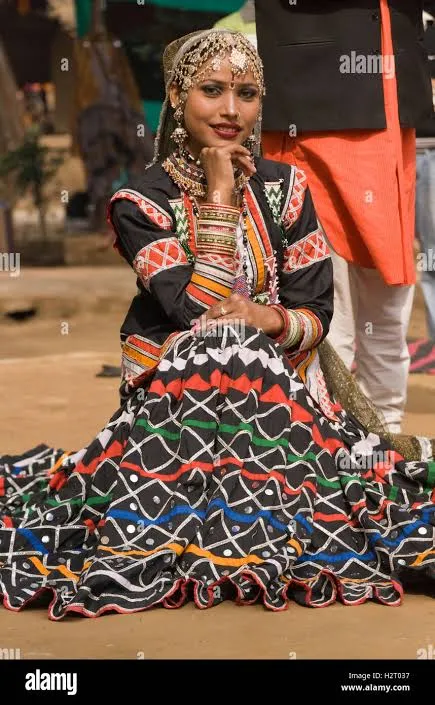
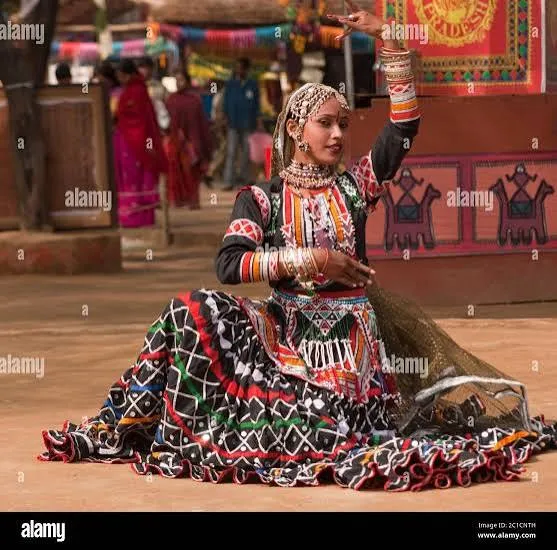
The central stylistic feature of Kalbelia dance is the simulation of serpentine movement through the dancer's body. Women perform in long, wide-skirted black lehengas (floor-length skirts) that swirl around their bodies as they spin and bend. The movements include fluid spins, bending low to the ground, undulating torso movements, and rapid changes of direction. These movements consciously evoke a cobra's patterns of movement: the spread of the hood, the swaying body, and the quick strike. As the performance progresses, the rhythm of accompanying instruments accelerates, and the dance becomes increasingly energetic. The dancers are typically barefoot. Men from the community provide instrumental accompaniment while women dance.
Central Motifs and Their Significance
The snake is the primary symbolic referent of Kalbelia dance at every level: the costume's black color represents the cobra, the sinuous movements represent the snake's locomotion, and the poongi (the wind instrument traditionally used to charm snakes) provides the central melodic line of the musical accompaniment. This symbolic unity between the dance, the costume, the music, and the community's historical occupation creates a coherent visual and sonic language specific to Kalbelia identity. The songs frequently address themes of the desert landscape, ancestral narratives, and the relationship between the community and the natural world of the Thar. Process
A Kalbelia performance typically involves female dancers accompanied by male instrumentalists. The poongi (also called been) is the signature instrument, a double-pipe wind instrument derived from the snake charmer's flute. Other instruments include the dufli, khanjari (tambourine-type percussion), morchang (mouth harp), khuralio, and dholak (double-headed drum). Kartal (wooden clappers) may also be used. The dance begins at a moderate pace and accelerates continuously. The musicians and dancers maintain close rhythmic communication throughout the performance. Songs are performed alongside the dance, with improvised lyrics addressing the occasion, the audience, or mythological narratives.
Mediums Used
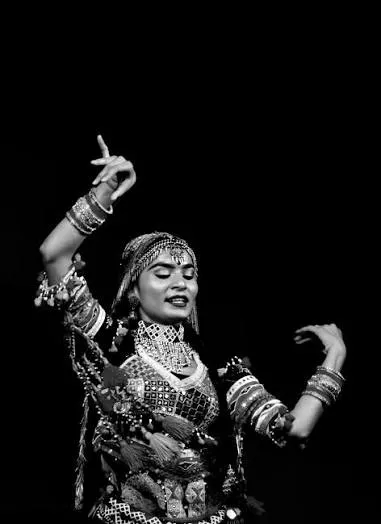
The female dancer's costume is the most visually distinctive element of Kalbelia performance. The lehenga (lower garment) is black, embroidered with silver thread in patterns that evoke a black cobra with white markings. Mirror (shisha) work is extensively used, producing a glittering effect consistent with the visual vocabulary of Rajasthani textiles. The upper garment (angrakhi or choli) and the odhni (headcloth) are also black or dark-colored with silver embroidery. The costume is entirely designed by Kalbelia women, who also make their own garments. Heavy silver jewelry, including necklaces, bangles, and anklets, accompanies the costume. Traditional tattoo designs are also documented among Kalbelia performers, as noted in UNESCO's inscription documentation.
New Outlook
Kalbelia dance is in a thriving state in terms of visibility and institutional recognition, a consequence primarily of its UNESCO inscription and its integration into the global folk festival circuit. Gulabo Sapera's international career and Padma Shri recognition have provided a high-profile model for younger Kalbelia dancers. The online platform Kalbeliya World, launched in 2020 by three international partners, connects Kalbelia artists in Rajasthan with students and audiences worldwide, representing a digital adaptation of the oral transmission tradition. However, the broader community continues to face socioeconomic challenges, including limited access to formal education, housing instability, and reduced income from performance during disruptions such as the COVID-19 pandemic. Scholars including those whose work appears in academic databases continue to examine the complex relationship between heritage inscription, commercial tourism, and community welfare in the Kalbelia context.
Learn Kalbelia
Bibliography
Sources
Diamond, Sarah Louise. Karagattam: Performance and the Politics of Desire in Tamil Nadu, India. PhD diss., University of Pennsylvania, 1999.
Kothari, Komal. Folk Musical Instruments of Rajasthan. Rupayan Sansthan, 1977.
Mathur, U. B. Treasure-trove of Rajasthan. Folklorists, 2002.
UNESCO. Convention for the Safeguarding of the Intangible Cultural Heritage: Nomination File No. 00340. UNESCO, 2010. Available at ich.unesco.org.
Image Sources
“Indian Kalbelia Dancer.” Alamy, https://www.alamy.com/indian-kalbelia-dancer-image362312961.html. Accessed 4 July 2026.
“Kalbeliya Dance 2.” Wikimedia Commons, https://commons.wikimedia.org/wiki/File:Kalbeliya_Dance_2.jpg. Accessed 4 July 2026.
“Kalbeliya Performer.” Wikimedia Commons, https://commons.wikimedia.org/wiki/File:Kalbeliya_Performer.jpg. Accessed 4 July 2026.
“Kalbelia Dance.” Alamy, https://www.alamy.com/stock-photo/kalbelia-dance.html?pseudoid=37E0C7E1-FFFB-4DB3-9906-CF257F698CC6. Accessed 4 July 2026.
“Woman Performing Traditional Kalbelia Dance, Jaisalmer, Rajasthan, India.” Alamy, https://www.alamy.com/woman-performing-traditional-kalbelia-dance-jaisalmer-rajasthan-india-image237614958.html. Accessed 4 July 2026.