
Kalamkari: Andhra Pradesh's Ancient Cloth Art Tradition
Let's explore the Kalamkari art form!
Introduction and Origin
Of all the cloth arts that India has produced, Kalamkari stands apart in the sheer intimacy of its making. Every line drawn with a bamboo pen, every colour extracted from bark and root, every scene depicting the Mahabharata or the Ramayana - these are acts of devotion as much as artistry. This ancient practice from Andhra Pradesh, rooted in both temple ritual and courtly patronage, belongs to the living tradition of Indian folk art that continues to inspire artists, designers, and collectors across the world today.
What Is Kalamkari?
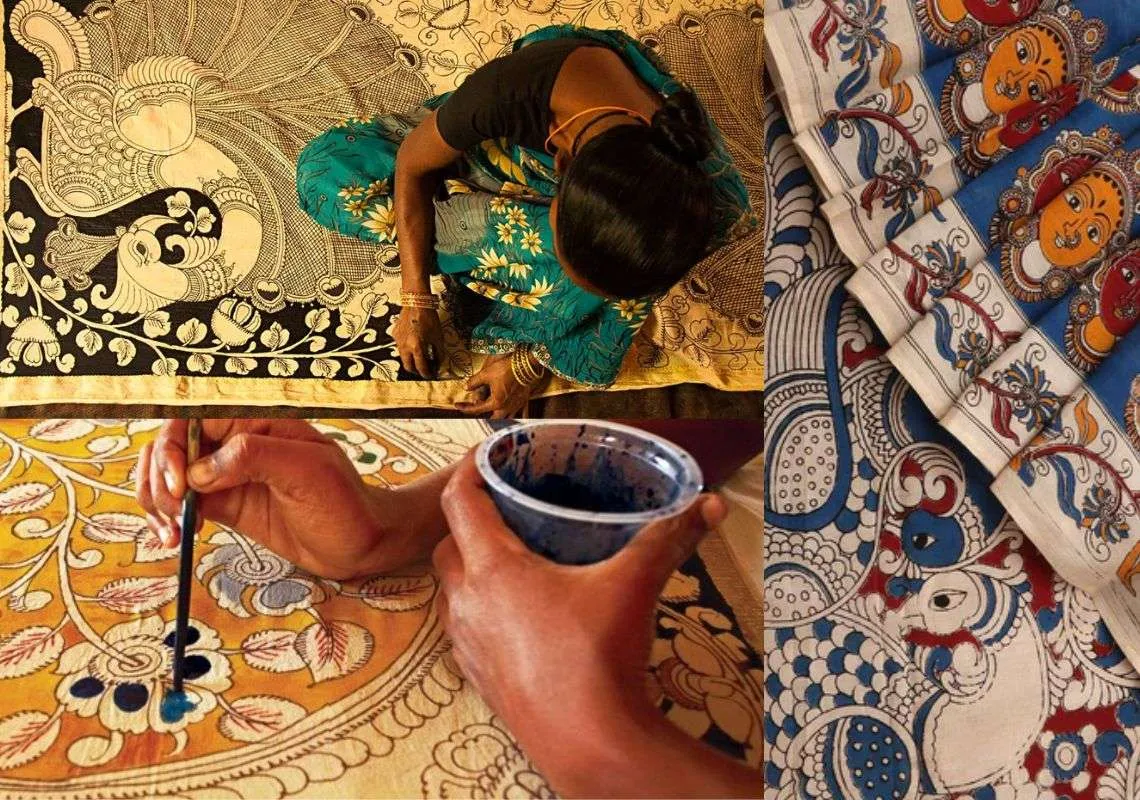
Kalamkari is a form of hand-drawn and block-printed cloth art from Andhra Pradesh, in which natural dyes are used to paint or print detailed scenes onto cotton fabric. The word comes from the Persian - 'kalam' means pen or qualam, and 'kari' means work - so it literally translates as pen-work. Some historians note that the art form earned its name because the artisans who made it were called Kalamkars, and the work they produced came to be known by their title. The British called these scrolls 'chintz', the Portuguese called them 'pintadoe', and the Mughals simply called them 'Kalamkari'. The art form served a specific religious and social purpose: Kalamkari textiles were a portable substitute for temple architecture and statues, carrying painted images of deities and epic narratives to devotees wherever the artists travelled.
History and Origin
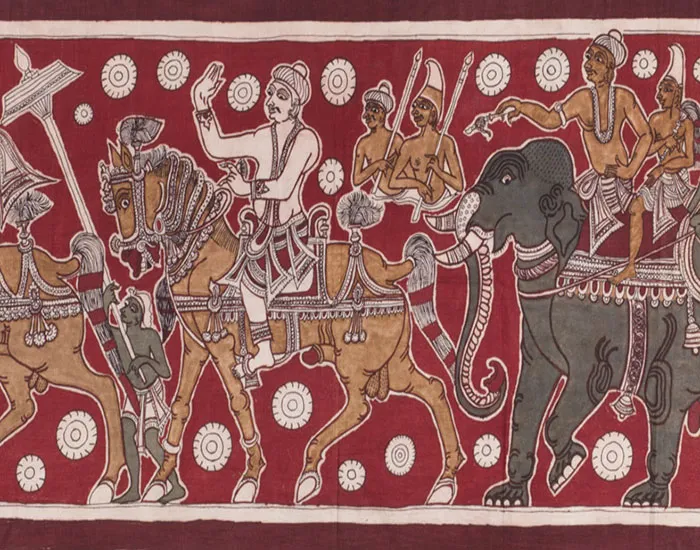
Kalamkari painting as a distinct tradition developed in the 17th century in the Golconda region of Masulipatnam, in what is now Andhra Pradesh. The region was under Nizam rule at the time, and strong Persian influence shaped the Machilipatnam style, which was produced by the Naqqash community of artisans who travelled with the Nizams and eventually settled there. A separate tradition took root in Srikalahasti, a temple town in the Chittoor district, practised by the Balojas community - traditionally bangle-makers - who focused exclusively on painting Hindu deities and scenes from epics like the Mahabharata and Ramayana. A third variant, the Karrupur style from the Thanjavur region, later incorporated gold brocade work into woven textiles. The Bhakti movement gave these scrolls a particular social function: wandering minstrels carried them while spreading devotional stories, making the illustrated cloth a teaching tool accessible to both learned and common audiences. Patrons across the social order - emperors, feudal kings, local chieftains, and merchants - supported the tradition over the centuries. This history makes Kalamkari Art India's remarkable meeting point of temple devotion, Persian court aesthetics, and travelling folk performance.
Key Features and Visual Style
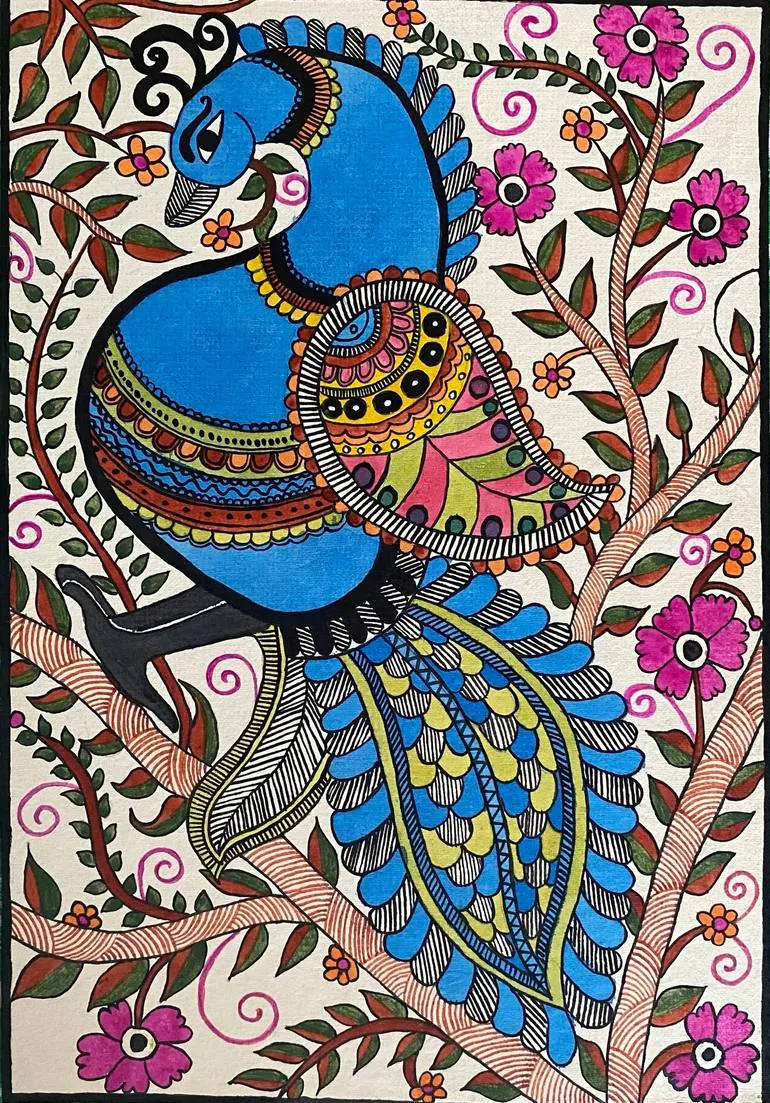
Kalamkari painting is visually distinctive because of its combination of hand-drawn linework, block-printing technique, and an earthy, natural palette that comes entirely from plant and mineral sources. The two principal schools - Srikalahasti and Machilipatnam - have distinct visual personalities, but share the same textile base and preparation process.
The Srikalahasti school uses a hand-held bamboo or palm pen (the 'kalam') to draw elaborate outlines, with lean confident linework and decorative floral borders around the central figure or scene.
The Machilipatnam school uses carved wooden blocks to stamp repeated Persian-inspired motifs such as trees, creepers, flowers, and leaves onto the cloth, with brighter primary colours.
Natural dyes are prepared from bark, flower, and roots - madder root gives red, pomegranate seed gives yellow, mango bark produces black pigments, and myrobalan fruit is used as a base treatment to fix colours.
The fabric preparation process begins with soaking cotton in cow dung and buffalo milk, then treating it with myrobalan fruit solution before drawing begins - ripened fruit is used in the Machilipatnam method and dried fruit in the Srikalahasti method.
Alum is used as a mordant before dyeing red areas; indigo solution fixes blue, and wax resist technique separates zones of colour during the dyeing stages.
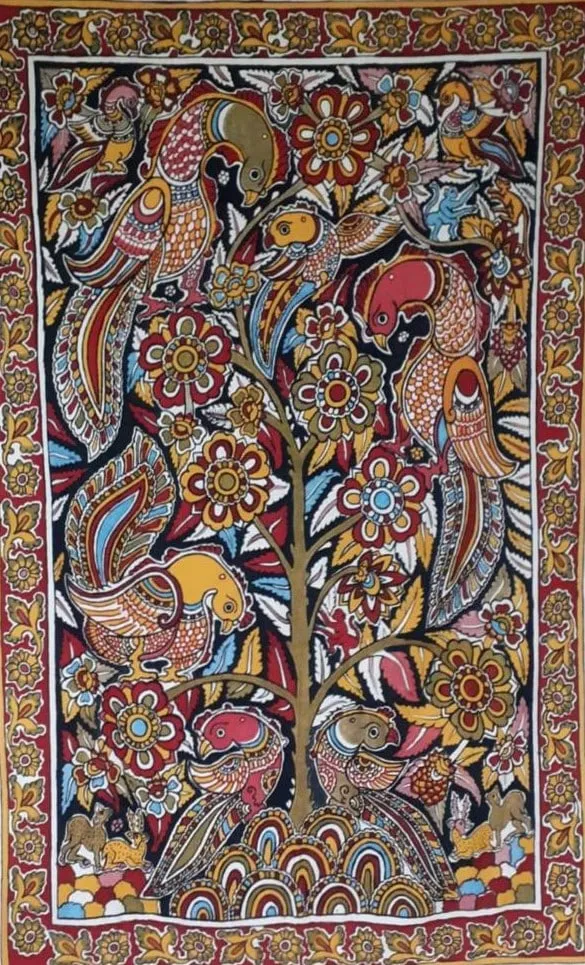
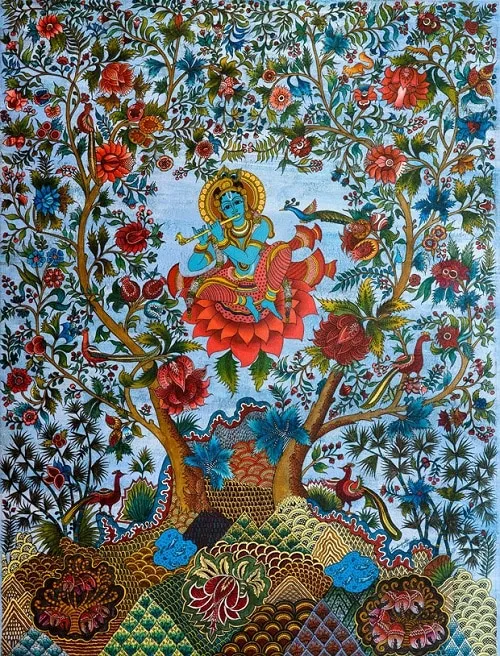
Srikalahasti themes are drawn from the Hindu Puranas - deities such as Krishna, Brahma, Ganesha, Durga, Lakshmi, Rama, Shiva, and Parvati appear regularly, and the tree of life is a recurring central motif.
Famous Artists of Kalamkari
Several artists have shaped the living tradition of Kalamkari and brought it to wider recognition in India and abroad.
J. Gurappa Chetty from Srikalahasti in Andhra Pradesh is one of the most celebrated names in temple-style Kalamkari. Working entirely in the hand-drawn tradition, he is known for large-format narrative panels depicting scenes from the Ramayana and Mahabharata, and has received national recognition for his contribution to this art form.
Surya Prakash is a Srikalahasti-based artist known for his refined kalam linework and his work in reviving the devotional scroll format. His pieces have been exhibited nationally and are held in private collections across India.
K. Niranjani is a Srikalahasti practitioner who has worked to bring Kalamkari techniques into contemporary textile design without compromising the hand-drawn quality or the natural dye palette that defines authentic Andhra Pradesh folk art. Shakeel Ahmed from Machilipatnam represents the Naqqash lineage of block-print Kalamkari, working with Persian-derived motifs and producing textiles for both domestic and export markets. His workshop has trained the next generation of Machilipatnam artisans.
Eluru Suresh is another Machilipatnam-based artist who has adapted the Naqqash block-print style into contemporary home textile products while maintaining traditional natural dye practices.
How to Learn Kalamkari
If you want to learn Kalamkari, the most direct way is to study with someone who actually practises it. Rooftop's courses are taught by master folk artists from across India and cover traditional art forms in structured, step-by-step online sessions. Courses include guidance on the fabric preparation process, natural dye preparation, and the kalam drawing technique, so you are learning the whole practice - not just the surface appearance. You can also explore related South Indian cloth art traditions on Rooftop, including Cheriyal scroll painting from Telangana.
Where to See and Buy Kalamkari
Original Kalamkari work can be seen at the Crafts Museum in New Delhi, the National Museum, and at the annual Surajkund Crafts Mela near Delhi. The weaving and painting villages around Srikalahasti and Machilipatnam in Andhra Pradesh are the best places to see the work being made. Authentic pieces can be purchased directly from artisan cooperatives in these towns. Online, Rooftop's shop carries original Indian folk art, and the Art Wiki covers related traditions including Pattachitra and Tanjore painting.
Learn Kalamkari
Frequently Asked Questions
What is Kalamkari and where does it come from?
Kalamkari is a hand-drawn and block-printed cloth art from Andhra Pradesh in South India. The name comes from the Persian words 'kalam' (pen) and 'kari' (work), and the tradition developed in the 17th century across two main centres - Srikalahasti in Chittoor district and Machilipatnam (also called Masulipatnam) on the Coromandel Coast. The art uses natural dyes on cotton cloth to depict mythological narratives, Persian floral motifs, and devotional imagery.
What are the two main styles of Kalamkari painting?
The Srikalahasti style is entirely hand-drawn using a bamboo or palm pen (kalam), and focuses on Hindu religious themes drawn from the Puranas and epics. The Machilipatnam (Masulipatnam) style uses carved wooden blocks to print Persian-inspired floral and geometric patterns, and was shaped by the Naqqash artisan community that worked under Nizam patronage. Both styles use natural dyes but differ in technique, motifs, and colour palette.
What natural materials and dyes are used in Kalamkari?
Kalamkari artists use only plant and mineral-based materials. The cotton fabric is first treated in a solution of cow dung and buffalo milk, then processed with myrobalan fruit to prepare the surface for dyeing. Red colour comes from madder root boiled with the cloth, yellow from pomegranate and mango seeds, and black from iron acetate. Indigo solution creates blue tones. Alum is used as a mordant to fix colours before dyeing, and wax resist separates colour zones during the process.
Which community in Andhra Pradesh practises Kalamkari?
Two distinct artisan communities carry this tradition. The Balojas community of Srikalahasti - traditionally a bangle-making community - have practised temple-style Kalamkari for generations and remain the only surviving community making these religious tapestries. The Naqqash community of Machilipatnam developed the block-print style under Mughal and Nizam influence, bringing Persian design vocabulary into Indian cloth art. Both communities are still active today.
Can I learn Kalamkari online in India?
Yes, Kalamkari can be learned online through structured courses taught by practising artists. Rooftop's courses cover traditional Indian art forms including South Indian folk art traditions. Online learning is particularly useful for understanding the preparation stages, colour theory behind natural dyes, and the drawing techniques before attempting the full process on fabric. Studying with a teacher who has learned the tradition from within a practising community gives you much more than technique alone.
Kalamkari connects us to a way of making art that is inseparable from story, devotion, and the material world - cotton and madder root and bamboo, the oldest of tools put to the most enduring of purposes. Explore the full Art Wiki on Rooftop and discover courses that bring you into direct contact with the artists who carry this tradition forward today.
Bibliography
Sources
Dallapiccola, Anna L. Kalamkari Temple Hangings. Mapin Publishing, 2015.
Ramani, S. Kalamkari and Traditional Design Heritage of India. Wisdom Tree, 2007.
Varadarajan, Lotika. South Indian Traditions of Kalamkari. National Institute of Design, 1982.
Image Sources
"Kalamkari." Impart Encyclopedia of Art, 21 Apr. 2022, https://imp-art.org/articles/kalamkari/. Accessed 16 July 2026.
Peacock Kalamkari. Saatchi Art, https://www.saatchiart.com/en-in/art/Painting-Peacock-Kalamkari/1723300/8177590/view. Accessed 16 July 2026.
"Tree of Life – Kalamkari Painting (5 ft × 3 ft)." International Indian Folk Art Gallery, https://indianfolkart.org/product/tree-of-life-kalamkari-painting-5ft-x-3ft/. Accessed 16 July 2026.
"Two Dancing Apsaras – Kalamkari Painting." Exotic India Art, https://www.exoticindiaart.com/product/paintings/two-dancing-apsaras-kalamkari-painting-dde291/. Accessed 16 July 2026.
"What Is Kalamkari?" DesignMango, https://designmango.in/blog/What-is-Kalamkari-292. Accessed 16 July 2026.
"Everything You Need to Know About Kalamkari Art." Rajni Dutta Art, 22 Jan. 2025, https://www.rajniduttaart.com/blog/kalamkari-art/. Accessed 16 July 2026.