
Jadopatia Scroll Painting/ Jadu Patua - Painting Tradition
Get to know about Jadopatia Scroll Paintings, a tradition of narrative scroll art practiced primarily in the Santhal Pargana region of Jharkhand...
Introduction
Jadopatia scroll painting, also known as Jadu Patua or Jadupatua painting, is a tradition of narrative scroll art practiced primarily in the Santhal Pargana region of Jharkhand, with historical distribution extending across the Maldah, Murshidabad, Birbhum, Bankura, Hooghly, Burdwan, and Midnapore districts of West Bengal, and certain districts of Bihar. The tradition is associated with the Santhal tribal community as patron and audience, and with the Hindu Chitrakar caste as practitioners. The term 'Jadopatia' derives from the Santhal word for the artist (Jadu or Jado, meaning the magic-maker or performer) and the Hindi/Bengali word for painted scroll (Patia or Patta).
The defining feature of Jadopatia scroll painting is its ritual function within the Santhal community: the Chakshudaan Pata (Eye-gifting scroll) is commissioned by a family following the death of a member. The artist paints the deceased's portrait without pupils; the family then pays the artist to paint in the pupils, completing the ritual of releasing the soul to the afterlife. This practice constitutes one of the most specifically documented ritual functions of any Indian folk art tradition. The tradition is classified as endangered, with documented reports of very few active practitioners and a significant decline in the scroll performance tradition.
Etymology
'Jadu' or 'Jado' is documented as a Santhal word for the itinerant artist-performer who practices scroll painting and narrative singing. The word carries the meaning of magic-performer or conjurer, reflecting the community's understanding of the artist as someone with access to the spiritual realm through their images. 'Patia' or 'Patta' (also spelled 'Pat' in Bengali contexts) refers to the scroll itself, derived from the Sanskrit 'patta' meaning cloth or board and by extension the surface on which an image is made. The compound 'Jadopatia' therefore means the scroll of the magic-performer or the conjurer's scroll. Practitioners are also referred to as 'Chitrakars' (picture-makers), using the Sanskrit-derived term common in the Bengali and Hindi tradition.
Origin
The precise historical origin of Jadopatia scroll painting is not documented in archival or archaeological sources. The tradition is assumed to be ancient on the basis of its embeddedness in Santhal social and religious practice, but no dated examples from before the modern period have been identified in the scholarly literature. The Chitrakar community's practice of narrative scroll painting and singing has been documented as continuous with the Bengal Patachitra tradition of scroll painting, suggesting a shared origin in the broader tradition of itinerant narrative painters in Bengal and Bihar. The Asia InCH (Asia International Cooperation for Heritage) encyclopedia includes a documentation entry on Jadopatia, and ethnographic documentation from the Santhal Pargana region has described the tradition in social anthropology literature from the colonial period onward. No singular founding event or historical moment of origin has been documented.
Location
The primary contemporary center of Jadopatia scroll painting is Dumka district, Jharkhand, which is part of the Santhal Pargana administrative division. Historically, the tradition was practiced across a much wider area encompassing the Santhal-inhabited districts of West Bengal (Murshidabad, Birbhum, Bankura, Hooghly, Burdwan, Midnapore) and Bihar. The contraction of the tradition's geographical range reflects both the general decline of the practice and the migration of some Chitrakar practitioners to urban centers.
Community
The Jadopatia tradition involves two distinct communities in a ritual relationship. The Santhal tribal community is the patron and ritual client: they commission scrolls, participate in the performance, and receive the ritual service of the Chakshudaan ceremony. The Hindu Chitrakar caste community is the practitioner: they paint the scrolls, perform the accompanying narrative singing, and provide the ritual service. The Chitrakar community is a hereditary occupational caste of painters and scroll-performers found across Bengal and Jharkhand. Within the Jadopatia context, the Chitrakar artists are specifically those who have maintained the Santhal-oriented ritual scroll tradition, as distinct from other branches of the Chitrakar community that serve different patron communities with different iconographic programs.
Relevance
The Jadopatia tradition's primary relevance is its ritual function within Santhal society. The Chakshudaan (gift of the eye) ceremony performed through the scroll is understood as necessary for the peace of the deceased's soul; a family that cannot afford to commission a Jadopatia risks leaving the soul restless and potentially harmful to the living. This belief creates a social obligation that has historically sustained the economic basis of the Chitrakar practitioners. Secondary functions of the scroll tradition include the commissioning of scrolls depicting the happiness of a daughter for her parents on the occasion of her marriage, which serves as both a gift and a narrative reassurance. The scrolls also function as vehicles for the transmission of Santhal cosmology, history, and festival traditions, performed in village settings before community audiences.
History
Background
The history of Jadopatia scroll painting within the Santhal Pargana is embedded in the broader history of the Santhal community's social and religious life. The Santhal Rebellion of 1855 to 1856 is a central event in Santhal historical consciousness, and some documentation indicates that contemporary Jadopatia artists have incorporated this historical episode into their scroll narratives, suggesting a responsive and adaptive dimension to the tradition's historical content. The twentieth century brought significant disruption to the traditional social structures that sustained Jadopatia practice. The weakening of Santhal ritual practices associated with death and the afterlife, through the influence of Christianity and mainstream Hindu practice, reduced the demand for Chakshudaan scrolls. The economic basis of the Chitrakar practitioners consequently eroded.
Culture and Societies
The performance of Jadopatia scroll painting is a social event within the Santhal community. The artist (Jadopatia or Chitrakar) arrives at the household, unrolls the scroll progressively while narrating the story depicted in each panel, and accompanies the narration with singing using the Ektara (a single-stringed instrument) and Dotara (a two-stringed instrument). The performance typically takes place in the evening and attracts a community audience. The scrolls themselves are physical objects of significant scale: documented dimensions range from five to twenty feet in length and eight to ten inches in width, constructed from paper sheets hand-stitched together with cloth panels at the ends and bamboo rods for rolling. The scale of the scroll reflects its function as a performance prop rather than a private devotional or decorative object.
Religious Significance
The Jadopatia tradition's religious significance is direct and documented. The Chakshudaan Pata (scroll depicting the deceased without eyes) is a ritual instrument for the release of the soul of a recently deceased person. According to Santhal belief, a person who dies with their eyes open or whose soul has not been properly addressed remains in a liminal state that is dangerous for the living family. The completion of the eye-gifting ritual by the Chitrakar painter, performed for payment, releases the soul to the realm of Jam Raja (the deity of the afterlife).
The afterlife (Jam) is a central theme of the Jadopatia scroll's iconographic program, depicting Jam Raja presiding over the assessment and distribution of souls, with rewards for the virtuous and punishments for the transgressive. This afterlife cosmology reflects Santhal religious belief in a structured realm of the dead governed by a divine judge, which has parallels with but is distinct from the Hindu Yamraj tradition.
Other religious subjects in the Jadopatia tradition include the Santhal creation myth (depicting the original ancestors of the Santhal people, the Harak and Ayo, and their relationship with the creator deity Thakur Jiu), the Baha Parab (spring flower festival), and various episodes from Santhal cosmological history.
Understanding the Art
Style
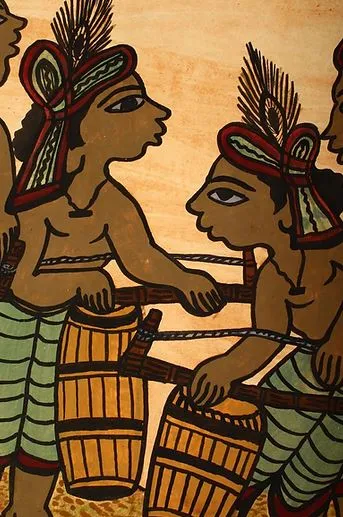
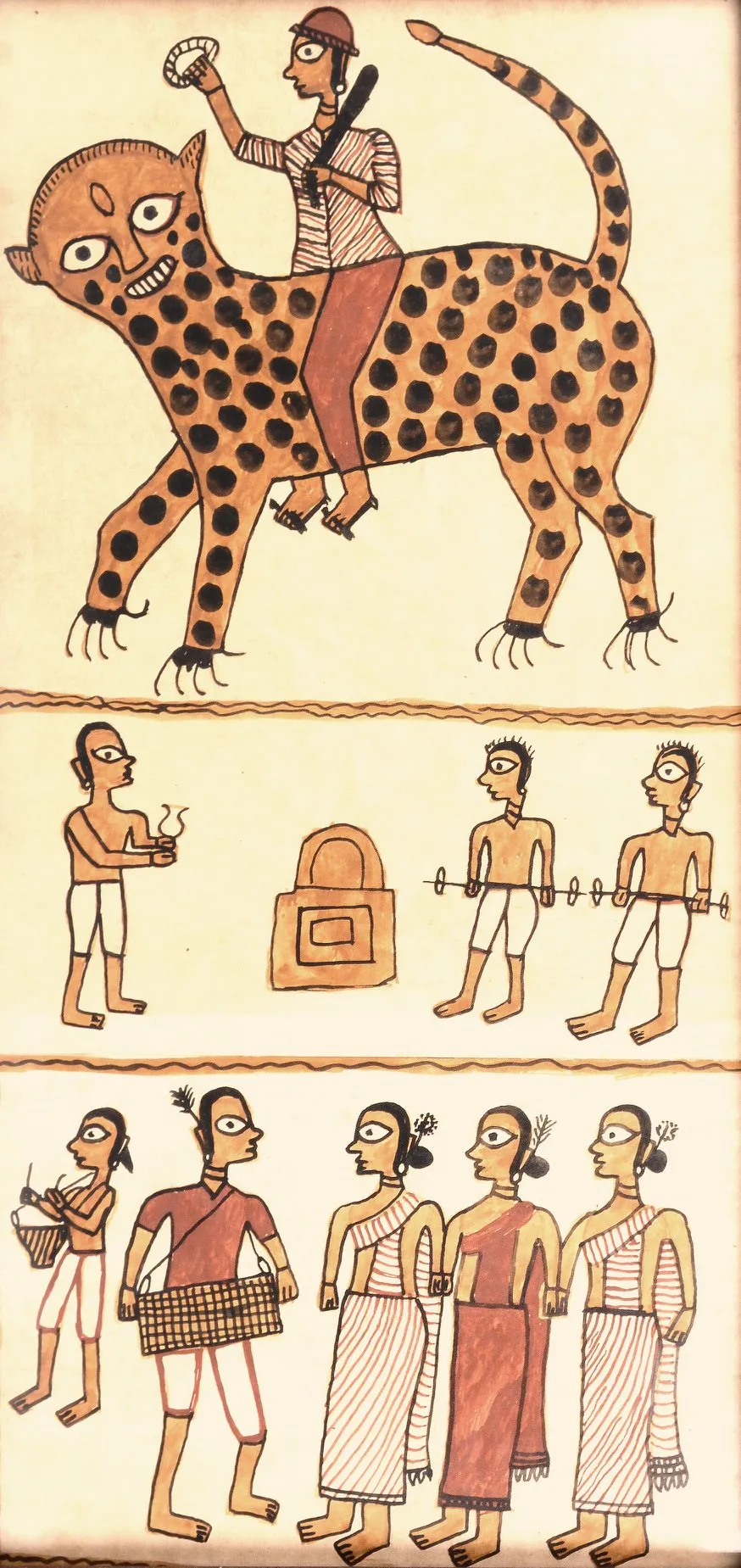
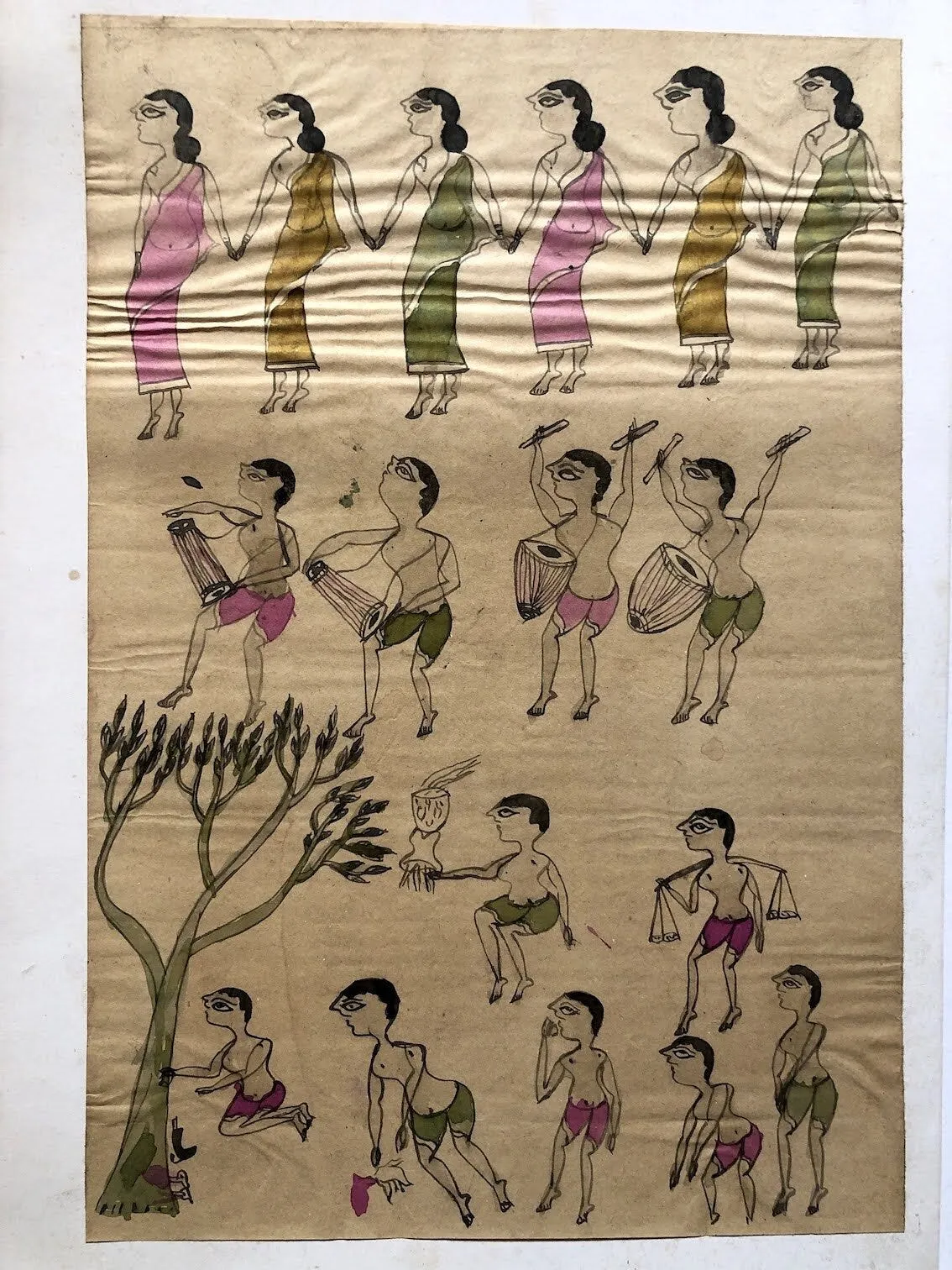
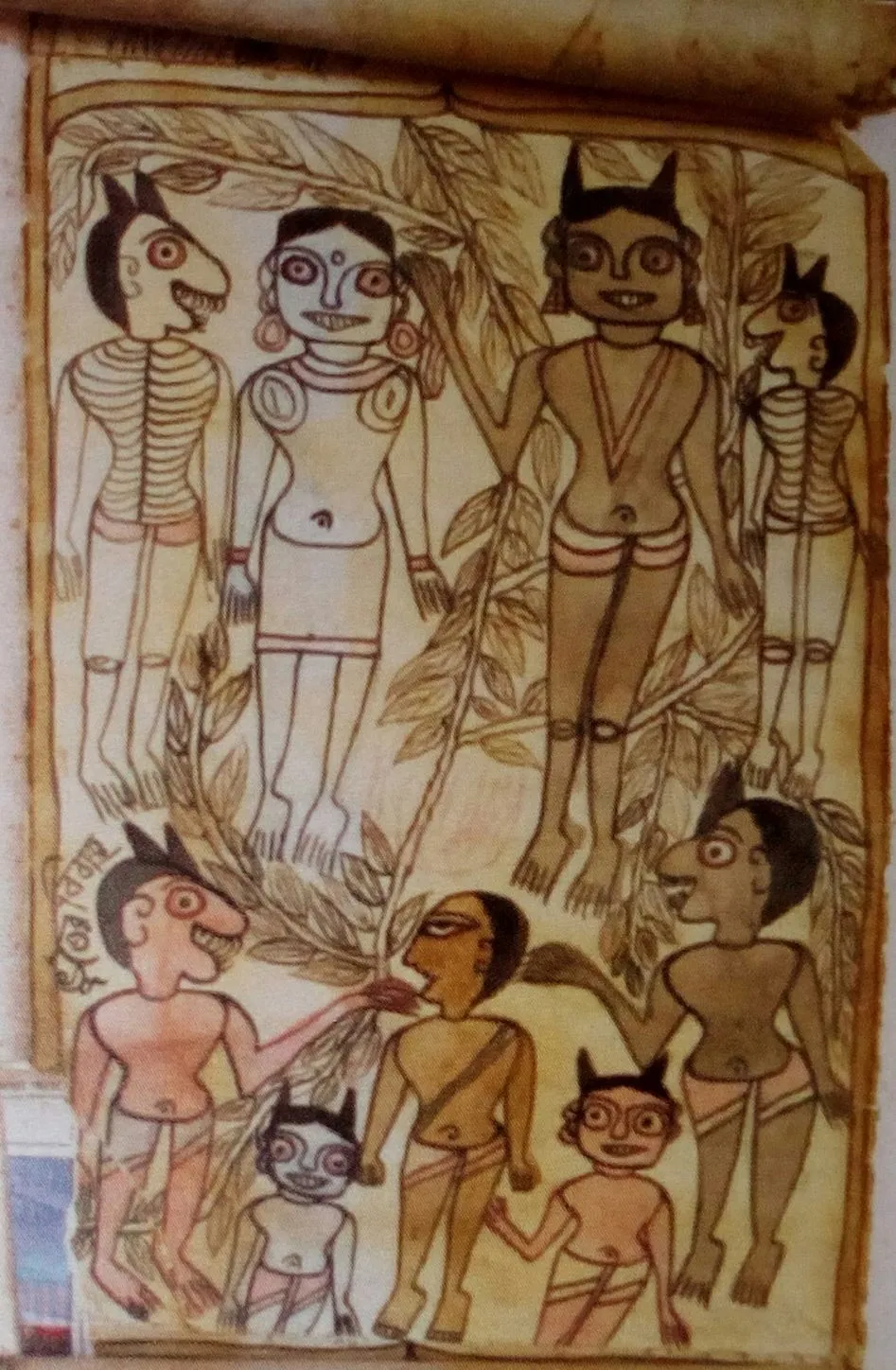
Jadopatia scroll painting is organized as a sequence of narrative panels arranged vertically within the scroll's horizontal frame. Individual panels are separated by horizontal bands, typically in a contrasting color. Figures are depicted in a flat, two-dimensional manner with minimal suggestion of depth or perspective; this formal approach prioritizes narrative legibility over spatial illusionism.
The human figures in Jadopatia painting are characterized by enlarged, prominent eyes (which carry particular significance in a tradition centered on the ritual gift of sight), bold black outlines, and a mild indifference to anatomical naturalism. Figures are typically depicted in frontal or three-quarter view. Animals are depicted in profile. The overall visual character is direct, bold, and narratively functional.
Central Motifs and Their Significance
The deceased figure without pupils is the most ritually significant motif in the Jadopatia tradition; its completion through the addition of pupils constitutes the central act of the Chakshudaan ceremony. Jam Raja (depicted with dark skin, presiding over the afterlife court) is a recurring iconographic figure. The Santhal creation ancestors and their relationship with the creator deity appear in cosmological scrolls. Humans riding tigers: this motif, which appears in several Jadopatia scrolls, does not have a universally documented interpretation but is associated in some accounts with shamanic or ritual authority. Festival scenes depicting the Baha Parab spring festival show Santhal social life and ritual practice. Ramayana and Mahabharata scenes appear in some Jadopatia scrolls, reflecting the Chitrakar community's broader iconographic repertoire which also serves Hindu patron communities.
Process
The scroll is constructed from sheets of locally available paper or plant-fiber material, hand-stitched together end-to-end to create the required length. Cloth panels are attached at each end, and thin bamboo rods are inserted for rolling. The surface may be sized with a prepared binding medium before painting.
Pigments are prepared from natural sources documented in the tradition: munga plant stem or vermilion for red; turmeric for yellow; indigo for blue; kohl or lamp soot for black; chalk or white clay for white. These are mixed with water and sometimes a binding agent. Brushes are made from goat hair (kuchi).
The narrative sequence of the painting follows an established compositional logic determined by the text being illustrated and the community's iconographic conventions. Artists do not work from external models in the contemporary period; the compositions are drawn from memory and transmitted within practitioner families.
Mediums Used
Scroll surface: Hand-stitched paper sheets with cloth panels. Pigments: Natural water-based pigments from plant and mineral sources. Brushes: Goat hair kuchi brushes. In contemporary practice, commercial paper and commercial pigments are used by some artists, particularly for single-frame tourist paintings which represent a survival strategy for the tradition.
New Outlook
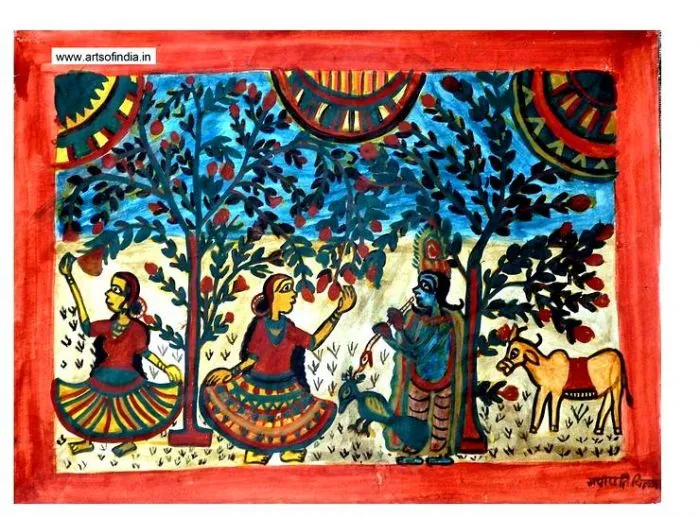
The contemporary state of Jadopatia scroll painting is documented as critically strained. Very few artists maintain the full scroll and performance tradition; most active Chitrakar artists in the Santhal Pargana area have transitioned to producing single-frame paintings on commercial paper for tourist and craft market audiences rather than the traditional long-scroll narrative format.
This transition to single-frame paintings preserves some of the visual vocabulary of the tradition but loses the performative, narrative, and ritual dimensions that define Jadopatia in its full form. The Chakshudaan ritual commission is the most likely continuing source of traditional scroll production, but documentation suggests that even this demand has declined as Santhal communities increasingly incorporate alternative death rituals.
Learn Jadopatia Scroll Painting
Bibliography
Sources
Asia InCH (Asia International Cooperation for Heritage). "Jadopatia Scroll Painting." Encyclopedia entry.
Sen, Asit Kumar. Patachitra of Bengal: An Illustrated Account. Crafts Council of West Bengal, 1980.
Korom, Frank J., editor. South Asian Folklore: A Handbook. Greenwood Press, 2006.
Image Sources
"The Magic Painters of Jharkhand: Jadopatia." Svasa Life, https://svasalife.com/the-magic-painters-of-jharkhand-jadopatia/. Accessed 10 July 2026.
"Jadopatia: The Dying Art of India's Scroll Painters." Brown History, https://brownhistory.substack.com/p/jadopatia-the-dying-art-of-indias. Accessed 10 July 2026.
"Jadopatia: The Dying Art of India's Scroll Painters." Brown History, https://brownhistory.substack.com/p/jadopatia-the-dying-art-of-indias. Accessed 10 July 2026.
"Jadupatua Tribal Folk Paintings of Jharkhand." The Cultural Heritage of India, https://cultureandheritage.org/2025/01/jadupatua-tribal-folk-paintings-of-jharkhand.html. Accessed 10 July 2026.
"The Miracle Workers: Story of Jadu Patuas of Jharkhand." Abirpothi, https://www.abirpothi.com/the-miracle-workers-story-of-jadu-patuas-of-jharkhand/. Accessed 10 July 2026.