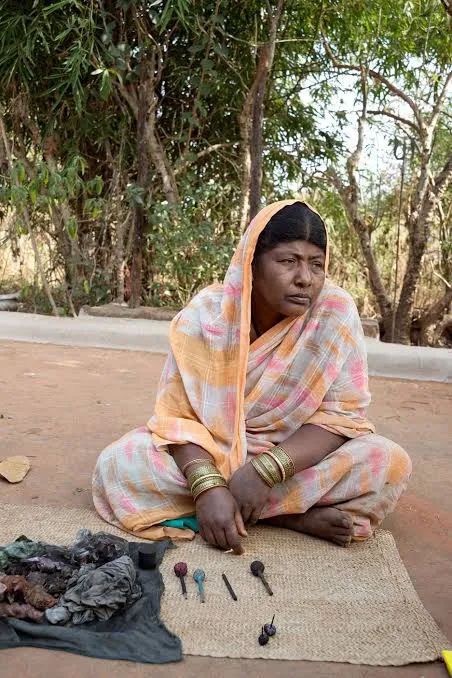


Godna (tribal tattoo art) - The Painting Tradition of Chhattisgarh
Familiarize yourself with **Godna**, a non-homogeneous traditional tribal form of body art practiced by tribal communities of Chhattisgarh and the adjoining states of Jharkhand, Odisha, Bihar, and Madhya Pradesh...
Introduction
Godna is a traditional form of body art practiced primarily among tribal and Scheduled Tribe communities of Chhattisgarh and the adjoining states of Jharkhand, Odisha, Bihar, and Madhya Pradesh. The practice involves the permanent marking of skin using natural pigments and sharp instruments, with each tattoo carrying documented social, ritual, and cosmological significance. In recent decades, godna has undergone a documented transition from the body to portable surfaces such as paper, cloth, and canvas, a shift that has allowed the tradition to survive commercial and institutional forms of cultural transmission while the original practice of body tattooing has sharply declined. Godna is listed as an endangered art form and has received documentation attention from the Directorate of Culture and Archaeology, Government of Chhattisgarh, as well as from Sahapedia and the MAP Academy.
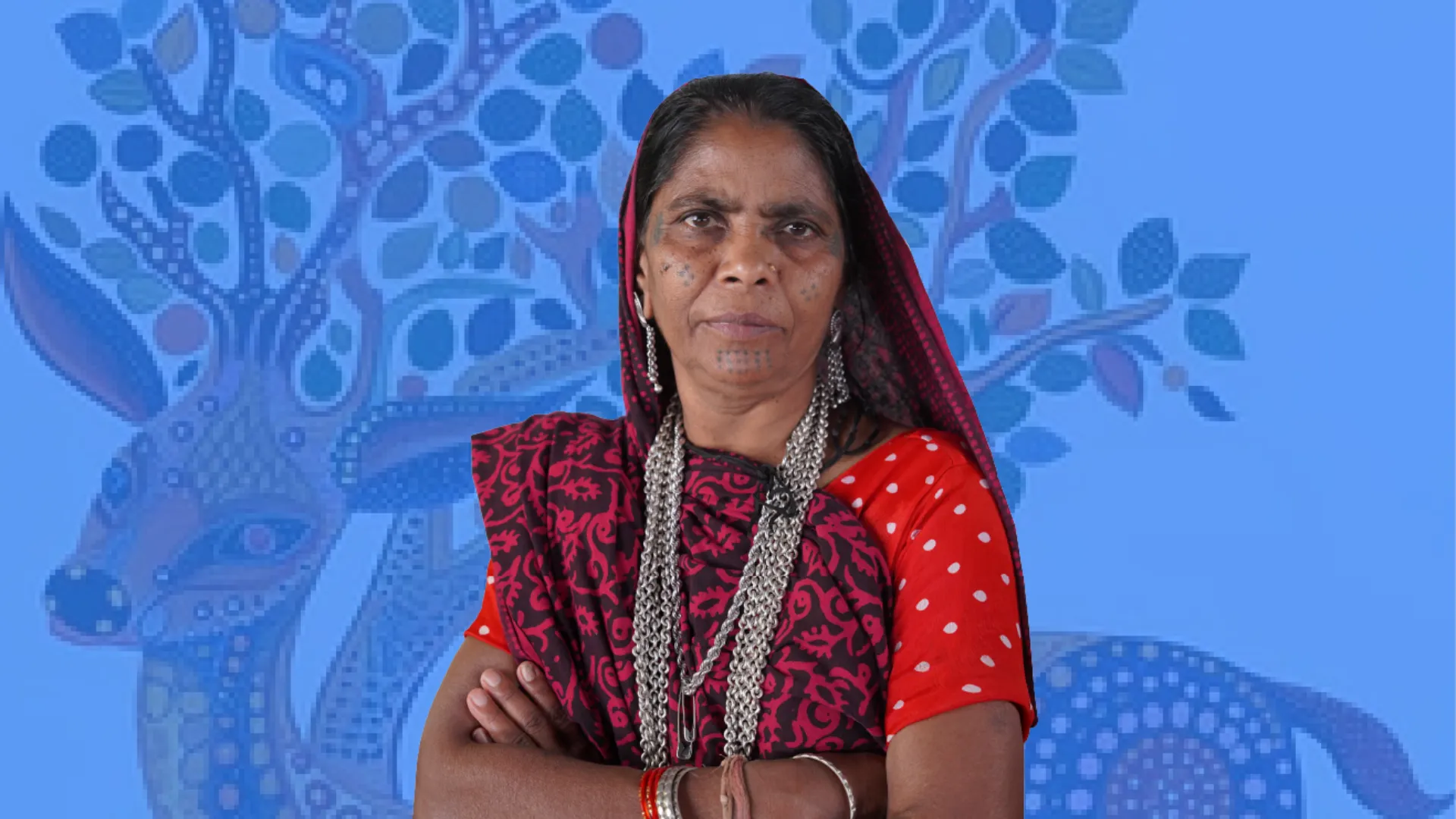
The art form is not homogeneous. Regional variants exist across districts and communities in Chhattisgarh, with distinct practices recorded in Rajanandgaon (Devar Godna), Surguja (Godi Godna), and Dindori, Madhya Pradesh (badi Godna). Each variant possesses its own visual vocabulary, social context, and application ritual, though they share a common structural logic of using the body as a surface for identity, belief, and lifecycle marking.
Etymology
The word 'Godna' derives from the Devanagari root meaning 'to scribble' or 'to draw,' and is sometimes rendered in regional sources as 'Khoda,' which carries the additional sense of engraving or incising. Both terms describe the physical act of puncturing or cutting the skin rather than the visual outcome. The practitioner community is referred to in documented sources as the Godhanhari, a sub-community within the broader social structure of the tribal groups in Chhattisgarh. In Bihar and Jharkhand contexts, the practitioner is sometimes called a Nai or a specialist tattooist from within the community.
Origin
The precise origins of Godna as a practice cannot be dated with certainty. Archaeological evidence cited by art historian Himanshu Prabha Singh (2015) points to female figurines at the Bharhut stupa (Madhya Pradesh, dated to approximately the second century BCE) that bear markings consistent with tattoo patterns, suggesting that skin marking was practiced in this region during the early historic period. However, a direct genealogical line between those figurines and the specific communities practicing Godna in Chhattisgarh has not been established in peer-reviewed literature.
Documented evidence from colonial-era ethnographies in the late nineteenth and early twentieth centuries confirms Godna as an established practice among the Gond, Baiga, Oraon, Munda, Birhor, Saharia, Bhunjia, and Santhal communities. The transition of Godna from a body practice to a painting tradition is historically traceable to approximately the 1970s. German anthropologist Erika Moser is documented as having suggested to members of the Dusadh Dalit community in Jitwarpur, Bihar, that they transfer their godna tattooing vocabulary to paper surfaces, a recommendation that gave rise to what is now commercially classified as Godna painting.
Location
The primary geographical concentration of Godna practice in Chhattisgarh is found in Rajanandgaon, Dindori, Surguja, Bilaspur, and Bastar districts. In Bihar, the tradition is documented most significantly in the Mithila region, with Jitwarpur and Ranti villages (Madhubani district) having developed the painted variant. Madhya Pradesh, particularly the Dindori district, hosts the badi Godna tradition practiced among Baiga communities. The Nari Shakti Self-Help Group, formed by Gond women in Jamgala village, Chhattisgarh, has been documented as a significant institutional locus for the transfer of Godna vocabulary from body to textile and paper surfaces. The Jamgala cluster is recognized in government cultural documentation as a production center for Godi Godna painting.
Community
Godna is documented among a wide range of Scheduled Tribe communities in central India, including the Gond, Baiga, Oraon, Birhor, Saharia, Bhunjia, Munda, and Santhal. Within these communities, the application of tattoos was traditionally performed by women on women. The Godhanhari sub-community served as professional tattoo practitioners in several Chhattisgarh communities. Among the Dusadh in Bihar, the tradition has been carried by women who transitioned into painters following the Jitwarpur shift of the 1970s.
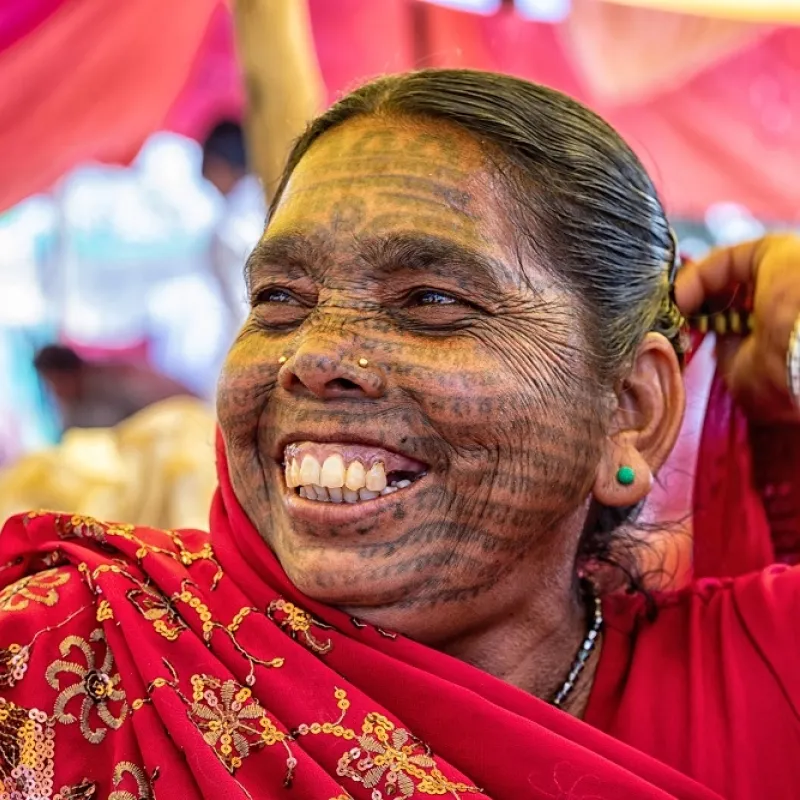
The Ramnami Samaj, a devotional community that emerged in nineteenth-century Chhattisgarh as a form of caste-based resistance, is documented as having used full-body tattooing of the name 'Ram' as a deliberate act of assertion against dominant-caste exclusion from temples and scripture. This community's tattoo practice, while sharing the term 'Godna,' operated on distinct social and theological logic from the tribal lifecycle tattooing traditions. Among the Dhaunk community in Bihar, documented ethnographic accounts record that women used Godna specifically to reduce the perceived attractiveness of daughters to upper-caste landlords, a protective function that reflects the social conditions of the late colonial and post-Independence period.
Relevance
Godna carries deep lifecycle and cosmological significance in the communities that practice it. Among Gond women, tattoos are applied at three documented stages: puberty (karelachani motif on forehead, neckline, and arms), marriage (machhimudi motif on ankles), and motherhood (chhati Godna). Each stage marks a social and biological transition, and the tattoos function as permanent records of these transitions.
A widely documented belief among Gond communities holds that Godna tattoos are the only possession that accompanies a person after death. The god of death, Yamraj, is described in oral tradition as using tattoo patterns to identify and differentiate souls in the afterlife. This belief lends the practice a dimension of preparation for death that is not purely aesthetic or social.
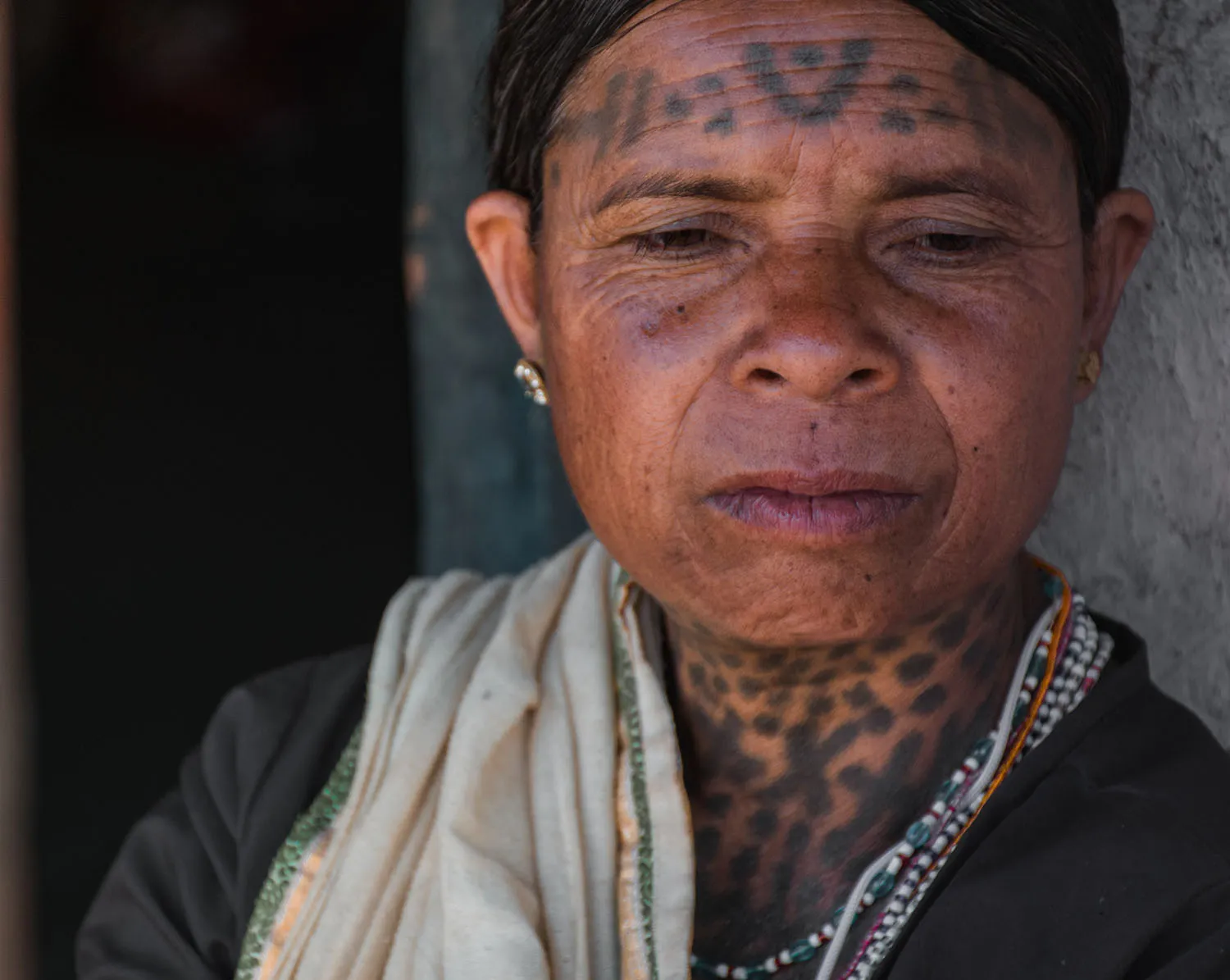
Among the Munda, three vertical lines tattooed on the forehead are documented as commemorating three defeats of Mughal forces by Munda warriors. This political and historical dimension of Godna, though not universal across all communities, illustrates the breadth of meaning the practice has carried.
History
Background
The recorded history of Godna as a community practice spans at least the early British colonial period, when ethnographers and administrators began documenting the customs of Scheduled Tribe communities in the Central Provinces. The practice was already well established when colonial documentation began, suggesting a considerably older origin, though pre-colonial written records are sparse.
The most significant historical turning point in the documented trajectory of Godna is the 1970s transition to surface painting. The initiative attributed to Erika Moser at Jitwarpur, Bihar, created a precedent that was subsequently replicated in Chhattisgarh, where organizations including the Nari Shakti Self-Help Group facilitated the transfer of Godna patterns to textiles. This transition was not purely a commercial strategy; it also functioned as a preservation mechanism during a period when the social conditions that had supported body tattooing were rapidly eroding.
The Directorate of Culture and Archaeology of Chhattisgarh commissioned a documentation project through Sahapedia that recorded Godna as practiced across multiple districts, with attention to practitioner communities, motif vocabularies, and social contexts. This documentation, completed in the early 2010s, represents the most systematic institutional record of Godna currently available.
Culture and Societies
Godna is embedded in the social organization of the communities that practice it. The Godhanhari practitioners operated as a distinct service sub-community with a specialized social role comparable to that of other artisan castes in the broader Indian social structure. Their access to the bodies of women from other communities was governed by social protocols regarding gender, lifecycle events, and payment.
The transition of godna from body art to painting on textiles has created a new economic and social role for women artisans within SHG structures. The Jamgala-based Nari Shakti group, for example, has moved from producing body tattoos to producing godna-pattern saris, tablecloths, and wall hangings that circulate within institutional craft markets. This transition has created documented tensions between preservation of the original practice and the commercial viability of the painted derivative.
Religious Significance
Godna among the Gond communities carries a documented cosmological function. The belief that tattoos serve as identification markers in the afterlife connects the practice to ancestor veneration and the Gond cosmological system, in which the relationship between the living and the dead is maintained through ritual acts. The tattooing of protective symbols at marriage and motherhood reflects a belief in the capacity of permanent marks to ward off harm and attract protective forces. The Ramnami Samaj's use of Ram-name tattooing, documented by scholars including Ramdas Lamb in his work on this community, represents a distinct form of devotional practice in which the body itself becomes a site of scripture. This practice explicitly rejected the mediation of Brahminical institutions in accessing the sacred, using the permanent mark on the body as a substitute for the written or chanted text.
Among communities where Godna marks lifecycle transitions, the practice intersects with ritual structures surrounding puberty, marriage, and childbirth, which are themselves occasions for propitiation of deities and ancestors. However, no documentary evidence exists for Godna as a component of formal temple or shrine-based religious practice.
Understanding the Art
Style
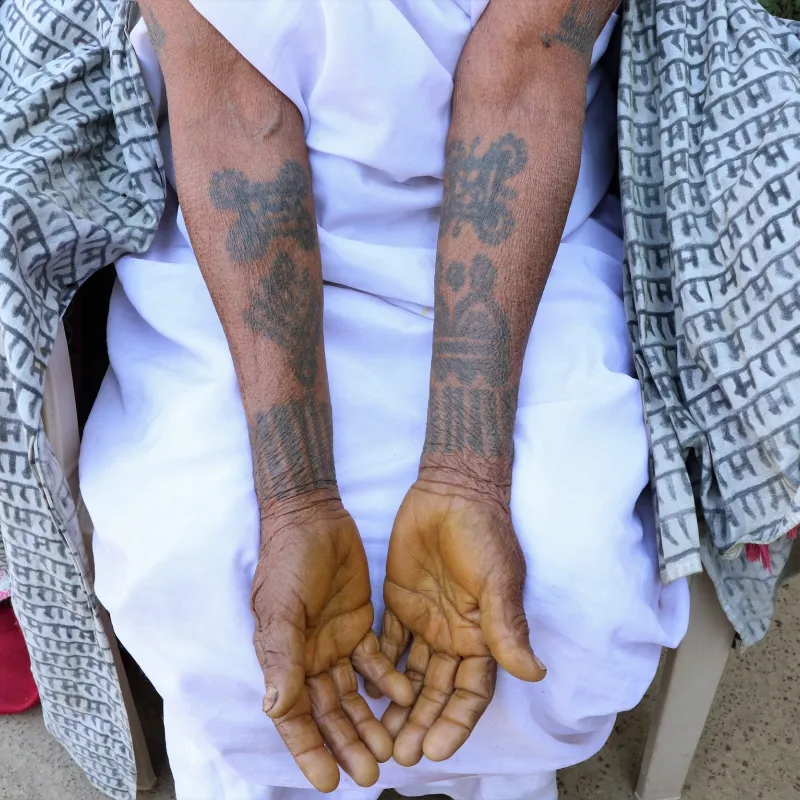
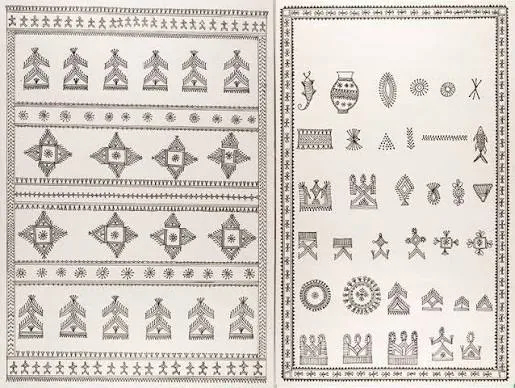
Godna patterns are predominantly geometric, organized around repeating units of dots, lines, triangles, and curved forms. Among Gond communities, the visual vocabulary includes representations of animals (horses, elephants, scorpions, peacocks) rendered in a stylized manner that prioritizes symbolic legibility over naturalistic representation. The scale of individual motifs is calibrated to the body surface on which they are applied, with smaller geometric patterns used on the face and wrists and larger animal or narrative designs used on the chest and back.
The regional variants display distinct stylistic characteristics. Devar Godna of Rajanandgaon is documented as featuring finer linework and denser geometric patterning. Godi Godna of Surguja employs bolder outlines and larger compositional units. The Madhubani Godna painting tradition, which developed from the Bihar transition, has incorporated influences from Madhubani painting's existing motif vocabulary while retaining the dot-based compositional logic of traditional body godna.
Central Motifs and Their Significance
The Tipka Godna (dots arranged in triangular formations) is documented as a symbol of beauty and grace, applied primarily to the face and neck. The Karelachani motif, applied at puberty, is associated with fertility and the marking of sexual maturity. The Machhimudi motif, applied at marriage on the ankles, is associated with marital protection and fidelity. The Chhati Godna applied at motherhood is associated with the protection of the child and the mother.
Animal motifs carry distinct associations: horses are linked to power and mobility; elephants to prosperity and auspicious occasions; peacocks to beauty and divine favor; scorpions to protection against evil. These associations are not uniform across all communities, and some variation exists in the documented literature.
Process
Traditional Godna application involves piercing the skin repeatedly with thorns, sharpened bamboo, or needles to create small puncture wounds. Pigment is then pressed into the wounds to create a permanent mark. The pigments used in documented practice include a mixture of cow bile, lamp soot, plant extracts (including crushed grape seeds), pig fat, and vegetable juice combined with oil. The resulting color is typically blue-black or dark green, though regional variation exists. The process is accompanied by social ritual, including the presence of the Godhanhari practitioner and women from the recipient's social circle. Pain management was achieved through distraction, social support, and in some documented cases, herbal preparations. The completed tattoo required several days of healing, during which the recipient observed certain social restrictions.
In the painted variant developed since the 1970s, natural pigments are mixed with acrylic media for longevity on textile and paper surfaces. The visual logic of the pattern vocabulary is retained, but the application method differs entirely from the body tattooing process.
Mediums Used
Traditional Godna: Skin surface; pigments derived from cow bile, lamp soot, plant materials, vegetable juice, and oil; instruments including thorns, sharpened bamboo slivers, and steel needles. Contemporary Godna Painting: Cotton and silk textiles (saris, shawls, tablecloths); handmade and machine paper; canvas; natural pigments supplemented with acrylic or mineral-based colors; brushes made from natural fibers. Products include saris, wall hangings, home furnishings, and framed works on paper.
New Outlook
The contemporary practice of Godna painting, as distinct from Godna tattooing, has been integrated into the institutional craft economy of Chhattisgarh through SHG structures, state government promotion, and craft fair participation. Artists including Umadevi (Rajanandgaon), Santhi Batti (Dindori), and Safiano Bai, Ramkeli, and Budh Kunwar (Jamgala) have been documented as active practitioners who have transitioned to the painted form.
The MAP Academy includes a documentation entry on Godna that situates it within the broader category of Indian folk and tribal art forms. The Economic and Political Weekly published a 2023 article titled 'Godna and the Gonds: From Tradition to Innovation' that examines the social dynamics of this transition.
The body tattooing practice itself faces significant threat from the abandonment of the social contexts that sustained it. Younger generations in tribal communities have largely discontinued the practice, partly as a consequence of urbanization, changing social norms, and the decreased authority of the lifecycle ritual structures in which Godna was embedded. The question of whether the painted derivative constitutes continuity or substitution of the original practice is a documented area of debate in the scholarly literature on Indian tribal arts.
Learn Godna (Tribal Tattoo Art)
Bibliography
Sources
Economic and Political Weekly. "Godna and the Gonds: From Tradition to Innovation." 2023.
Lamb, Ramdas. Rapt in the Name: The Ramnamis, Ramnam, and Untouchable Religion. State University of New York Press, 2002.
MAP Academy. "Godna." MAP Academy, https://mapacademy.io/.
Sahapedia. Documentation of Godna. Commissioned by the Directorate of Culture and Archaeology, Government of Chhattisgarh, https://www.sahapedia.org/.
Singh, Himanshu Prabha. Tribal Art of India. Publications Division, Ministry of Information and Broadcasting, Government of India, 2015.
Image Sources
"Godna: The Practice of Tattooing in Chhattisgarh." Sahapedia, http://www.sahapedia.org/godna-practice-tattooing-chhattisgarhchatataisagadha-kai-gaodanaa-paranparaa. Accessed 22 July 2026.
"Godna." Impart Encyclopedia of Art, 21 Apr. 2022, https://imp-art.org/articles/godna/. Accessed 22 July 2026.
Khan, Mushtaq. "Godna: Tattooing as Cultural and Social Practice." Sahapedia, http://www.sahapedia.org/gaodanaa-saamaajaika-evan-saansakartaika-sanadarabhagodna-tattooing-cultural-and-social-practice. Accessed 22 July 2026.
"Godna Typeface Made from Tribal Tattoos." Ishan Khosla Design, https://www.ishankhosla.com/work/godna-typeface-made-tribal-tattoos. Accessed 22 July 2026.
"Godna Tattoo Art by Women of the Baiga Tribe of Madhya Pradesh." INTACH Intangible Cultural Heritage, http://intangibleheritage.intach.org/godna-tattoo-art-by-women-of-the-baiga-tribe-of-madhya-pradesh/. Accessed 22 July 2026.