
Dumhal - The Folk Dance Tradition of Jammu & Kashmir
Learn about Dumhal, the ceremonial folk dance of the Wattal tribe to initially honor the Sufi saint Baba Nasim-U-Din-Gazi in the Kashmir Valley...
Introduction
Dumhal is a ceremonial folk dance performed exclusively by men of the Wattal tribe of the Kashmir Valley. It is performed on specific occasions, including weddings, festivals, and the Urs (death anniversary) pilgrimages to the shrines of Sufi saints. The dance involves a procession in which performers carry a tall decorated banner, plant it in the ground, and dance in circles around it. The Wattal community created the Dumhal tradition to honor the Sufi saint Baba Nasim-U-Din-Gazi, and the dance is most closely associated with the shrine and village of Charar-e-Sharief in Kashmir's Badgam district. The form was documented in 1895 by Walter R. Lawrence, a British official, in his work The Valley of Kashmir, where it is recorded under the spelling 'Dumali.'
Etymology
The name 'Dumhal' does not have an established Etymology in the available academic literature. The alternate spelling 'Dumali,' used by Walter R. Lawrence in 1895, suggests a possible variant form of the name in nineteenth-century usage. The name is specific to this dance tradition of the Wattal tribe and does not appear to be shared with other dance forms in the broader Kashmiri folk tradition.
Origin
Dumhal was created by the Wattal tribe to honor the Sufi saint Baba Nasim-U-Din-Gazi. The specific individual attributed with the dance's creation is Shah Sukar Saloni, who is documented in folk tradition as having instituted the Dumhal performance. The Wattal community's connection to the Sufi shrine tradition of Kashmir provides the devotional context for the dance's origin. The Walter R. Lawrence documentation of 1895 provides the earliest available written record of the form, placing its documented history within the late nineteenth century, though the oral tradition of the dance likely predates this documentation.
Location
Dumhal is performed by the Wattal community of the Kashmir Valley, with the most significant performances taking place at Charar-e-Sharief village in Badgam district, the location of the shrine of Baba Nasim-U-Din-Gazi. The Wattal community is spread across the Valley, and Dumhal performances occur in their communities at weddings and festivals, but the Urs pilgrimages to the saint's shrine remain the primary performance context for the dance in its most elaborate form.
Community
Dumhal is the specific cultural property of the Wattal tribe, a community of the Kashmir Valley whose social and cultural identity is closely tied to the Sufi devotional tradition of the region. The Wattal are a recognized community within the Valley's social structure and have maintained the Dumhal tradition as a marker of their distinct cultural identity. The dance is traditionally male-only; available sources note that women have performed Dumhal on a few recent occasions, suggesting limited contemporary change in the gender restriction.
Relevance
Dumhal is one of the most culturally specific folk dances of the Kashmir Valley, associated with a particular community (Wattal), a particular saint (Baba Nasim-U-Din-Gazi), and a particular shrine (Charar-e-Sharief). This specificity gives it a distinctive place in Kashmir's intangible cultural heritage, but also limits its practice to a defined community context. It is classified as a low-visibility, vulnerable tradition.
History
Background
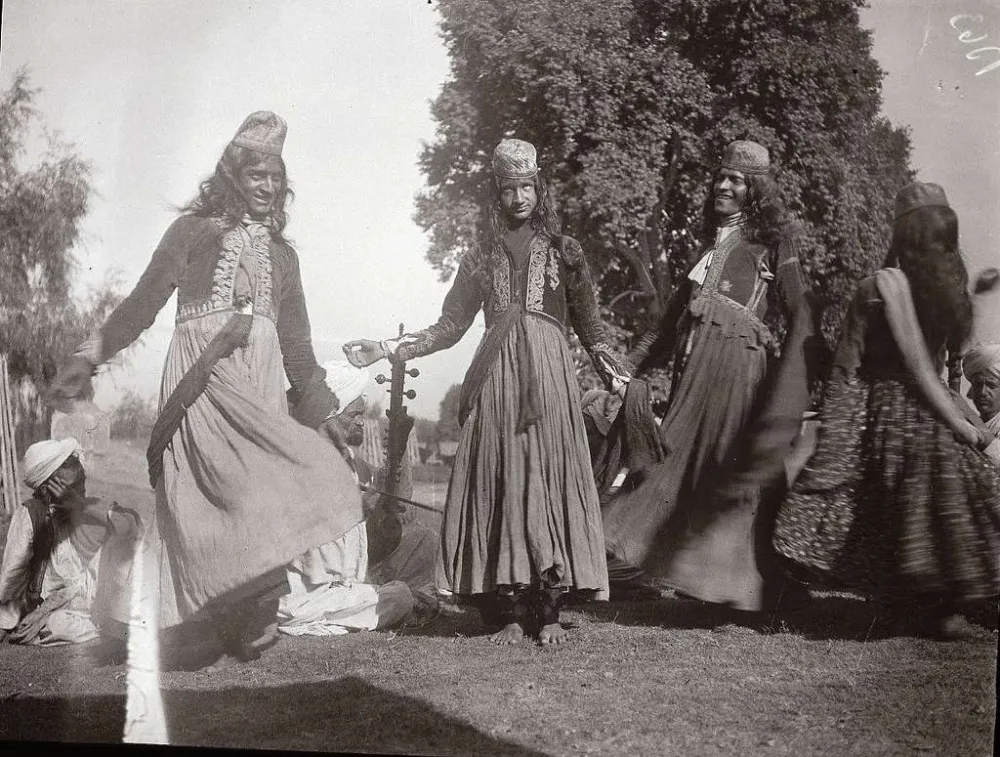
The earliest written documentation of Dumhal is Walter R. Lawrence's 1895 account in The Valley of Kashmir, one of the most detailed British surveys of Kashmiri society and culture. Lawrence's account, which uses the spelling 'Dumali,' places the tradition within the social and religious life of the Kashmiri community at the end of the nineteenth century. The dance's association with the Sufi shrine tradition places it within the broader context of Kashmir's Rishi-Sufi devotional culture, which developed from the thirteenth century onward and profoundly shaped the religious and cultural life of the Valley.
Culture and Societies
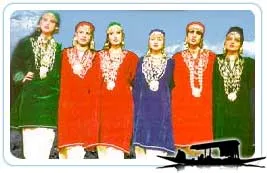
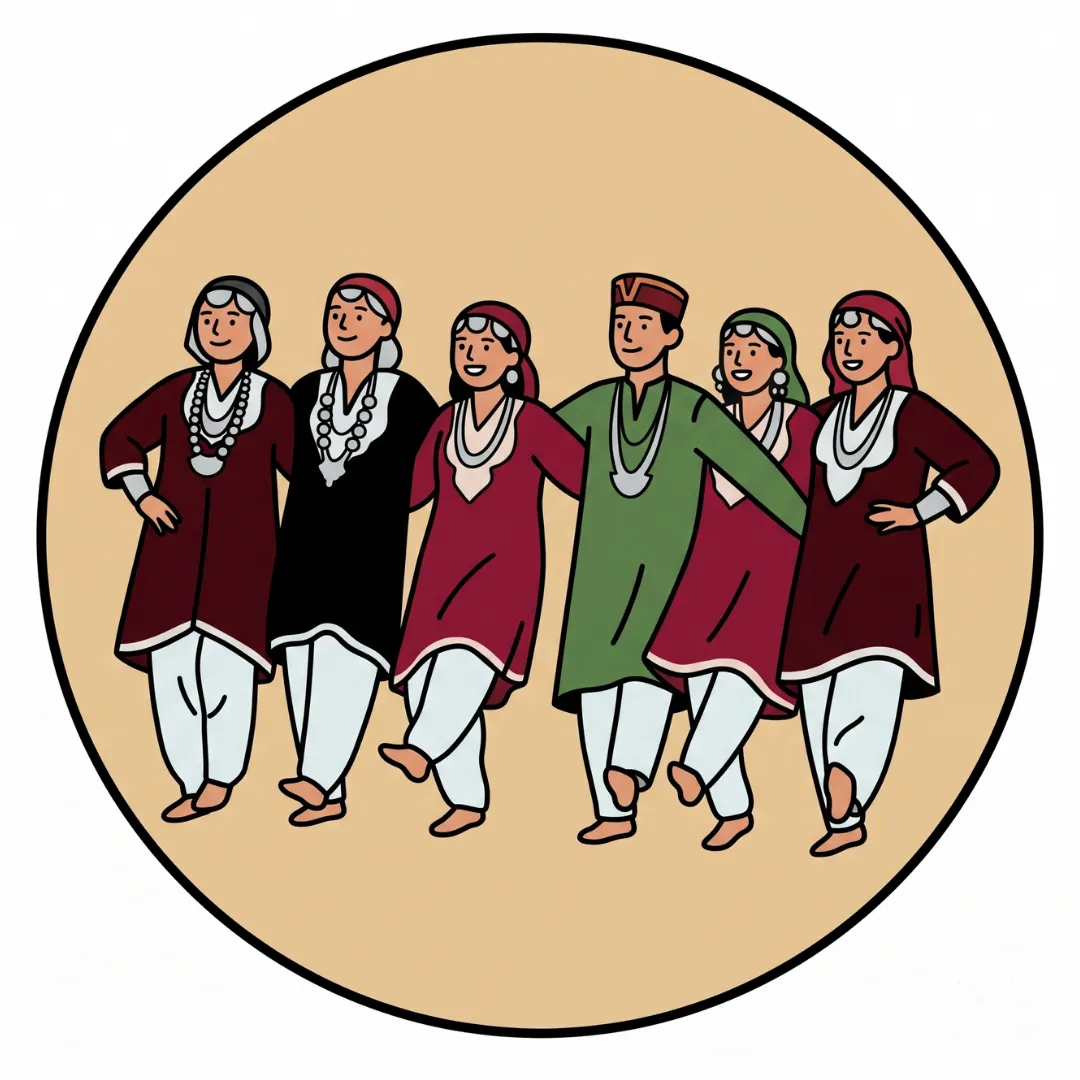
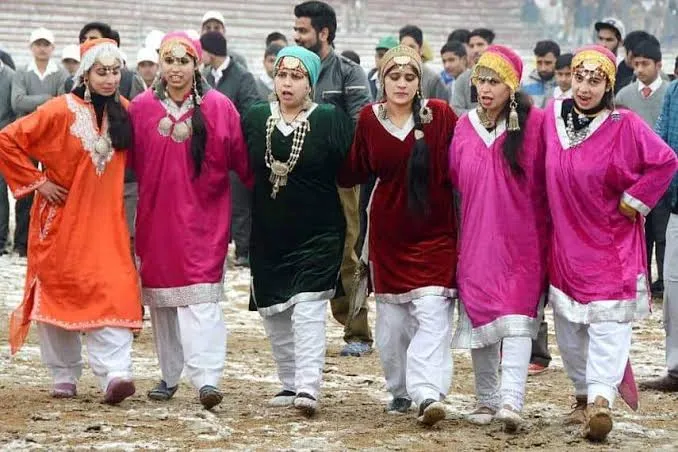
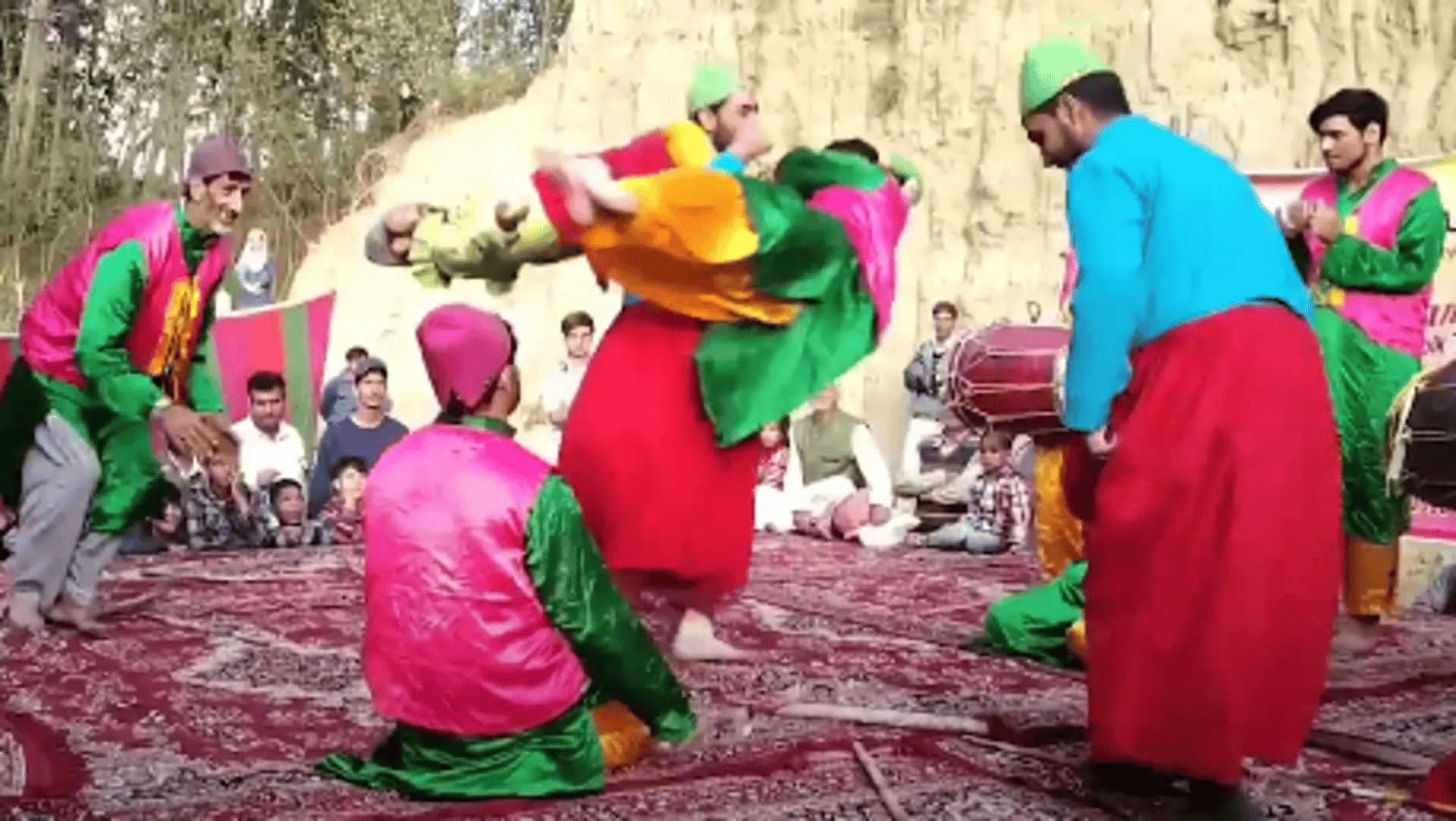
Dumhal is performed as part of the Urs ceremonies at Sufi shrines, particularly at Charar-e-Sharief. The Urs is the annual commemoration of a saint's death, understood in the Sufi tradition as the saint's wedding with the divine. Performances at the Urs are acts of devotional homage to the saint. At weddings and community festivals, Dumhal serves as a celebration of community identity. The dance involves a procession to the performance site, the ceremonial planting of a tall decorated banner in the ground, and the circular dance of the performers around the banner. The performers' costumes, consisting of long colorful robes with bead embellishments and tall conical caps studded with beads and shells, are elaborate and distinctive.
Religious Significance
Dumhal has explicit and primary religious significance. It was created to honor a Sufi saint and is performed at Sufi shrine Urs ceremonies. The banner planted at the center of the dance circle represents the saint's presence. The performance is an act of collective devotion by the Wattal community in the tradition of shrine veneration (ziyarat) that is central to Kashmiri Muslim devotional culture. The dance is not merely entertainment but a formal act of religious remembrance and devotion.
Understanding the Art
Style
The performance of Dumhal begins with a procession in which the performers carry the tall banner (a long pole with decorative attachments at the top) to the performance site. The banner is ceremonially planted in the ground. Performers then arrange themselves in a circle around the banner and begin the dance, moving in circular patterns to the beat of drums and the singing of folk songs by the chorus. The costumes of the Wattal performers in Dumhal are among the most elaborate in Kashmiri folk tradition: long robes with multicolored embellishments and tall conical caps decorated with beads and shells create a visual display that distinguishes this dance from all other Kashmiri folk forms.
Central Motifs and Their Significance
The central motif of Dumhal is the banner, which represents the saint being honored. The circular dance around the banner enacts the pradakshina (circumambulation) tradition common to both Hindu and Islamic shrine veneration. The elaborateness of the costumes reflects the devotional honor given to the saint: the performers' visual splendor is an offering to the saint's memory. The drums and songs that accompany the dance are traditional to the Wattal community and are specific to this performance context.
Process
Dumhal begins with the assembly of the Wattal performers in traditional dress. The banner is carried in procession to the performance site, typically the open space in front of the saint's shrine. The banner is ceremonially planted in the ground with specific ritual gestures. The performers form a circle, and the dhol player begins the drumbeat. The chorus begins the folk songs. Performers dance in circles around the banner, with the intensity and speed building through the performance. The performance concludes with specific closing rituals.
Mediums Used
The primary instrument of Dumhal is the dhol (drum). Chorus singing of traditional Wattal folk songs is an integral component. The banner, a tall decorated pole central to the performance, is the defining material object. Costumes are elaborate: long colorful robes with bead embellishments, and tall conical caps studded with beads and shells. These costumes are specific to Dumhal and are not worn in other Wattal community contexts.
New Outlook
Dumhal is a vulnerable tradition. The Wattal community is small, and the tradition has limited external institutional support. The form's association with Sufi shrine veneration practices, which have been subject to social pressure in certain periods of Kashmiri history, adds a dimension of vulnerability beyond the standard challenges of folk art preservation. The Walter R. Lawrence documentation of 1895 remains the most specific historical account of the form. Contemporary documentation has been undertaken by cultural organizations including the Sangeet Natak Akademi and by researchers of Kashmiri folk culture, but comprehensive preservation programs are not in evidence.
Learn Dumhal






Bibliography
Sources
Kalla, Krishan Lal. The Literary Heritage of Kashmir. Mittal Publications, 1985.
Khan, M. I. History of Srinagar. Aamir Publications, 1978.
Lawrence, Walter R. The Valley of Kashmir. Henry Frowde, 1895.
Sangeet Natak Akademi. Documentation of Kashmiri Folk Forms. Sangeet Natak Akademi, various years.
Image Sources
"Dumhal Dance – Jammu and Kashmir." DanceAsk, https://danceask.net/dumhal-dance-jammu-and-kashmir/. Accessed 21 July 2026.
"Echoes of the Valley." Sahapedia, http://www.sahapedia.org/echoes-valley. Accessed 21 July 2026.
"Dumhal Dance in Jammu and Kashmir: Origin, History, Costumes, Style, Technique, and Music." DanceUs.org, https://www.danceus.org/style/dumhal-dance-in-jammu-and-kashmir/. Accessed 21 July 2026.
"Dances of Kashmir." Jammu and Kashmir Tourism Development Corporation, https://www.jktdc.co.in/dances-of-kashmir.aspx. Accessed 21 July 2026.
"'Dhumhal,' the Traditional Dance, Star Attraction at Srinagar R-Day Rehearsal." TopNews, 25 Jan. 2008, https://topnews.in/dhumhal-traditional-dance-star-attraction-srinagar-r-day-rehearsal-216566. Accessed 21 July 2026.