
Dollu Kunitha - The Folk Dance Tradition of Karnataka
Find out more about Dollu Kunitha, the drum dance of North Karnataka to worship Beeralingeshwara, a form of Lord Shiva...
Introduction
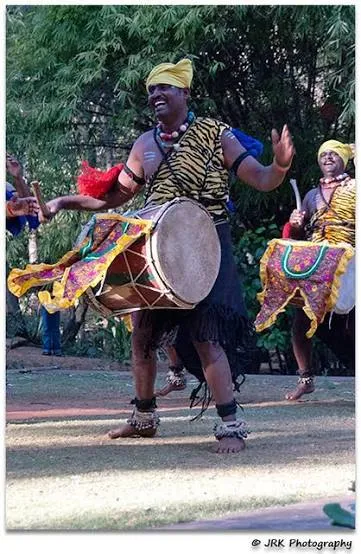
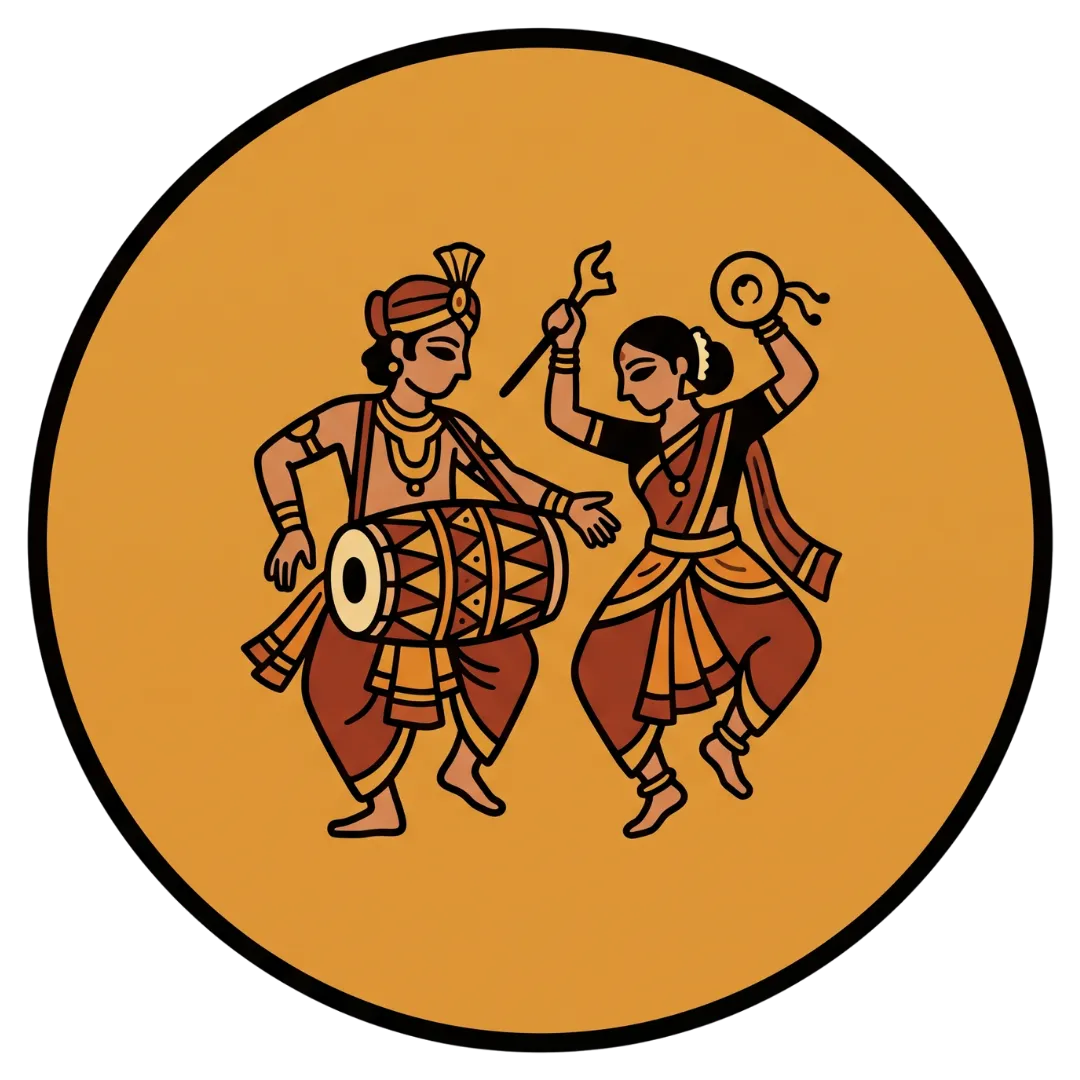
Dollu Kunitha is a drum dance of the Kuruba Gowda community of North Karnataka, performed in worship of Beereshwara (also called Beeralingeshwara), a form of Lord Shiva. The central instrument of the form is the dollu, a large double-headed barrel drum made from mango or jackfruit wood with cow or buffalo hide membranes, worn around the performer's waist. Dancers play the drums with bare hands or short sticks while executing choreographed movements in circular or semi-circular formations. Dollu Kunitha is performed at temple festivals, the Mysuru Dasara, and the Karaga procession. The form is included in the Halumatha Purana and the Kuruba Purana, which record the mythological origin of the dollu drum in the story of Shiva's destruction of the demon Dolla-asura.
Etymology
The name 'Dollu Kunitha' combines two Kannada terms: 'dollu,' referring to the large barrel drum that is the defining instrument of the form, and 'kunitha,' the Kannada word for dance or dancing. The compound thus means 'drum dance' or 'dance with the dollu.' The name 'dollu' is also the source of the mythological Etymology in the oral tradition: the demon Dolla-asura is said to have given his skin for the first dollu drum after being destroyed by Shiva.
Origin
Dollu Kunitha is indigenous to the Kuruba Gowda community of Karnataka. The oral traditions of the community, preserved in the Halumatha Purana and the Kuruba Purana, trace the origin of the dollu drum to a mythological narrative in which Shiva, trapped inside the body of the demon Dolla-asura, tears out of the demon's skin and fashions the first dollu drum from that skin. This myth legitimizes the drum as a sacred object and gives the dance its devotional character as an act of Shaivite worship. The specific geographic origin of Dollu Kunitha within Karnataka is North Karnataka, particularly the districts of Dharwad, Haveri, Gadag, and Belagavi, where the Kuruba Gowda community has historically been most concentrated.
Location
Dollu Kunitha is practiced primarily in the Kuruba Gowda-inhabited districts of North Karnataka, including Dharwad, Haveri, Gadag, Belagavi, and Koppal. It is also performed at state-level events in Mysuru (Mysore) and Bengaluru. The Mysuru Dasara provides the most prominent annual performance occasion, with Dollu Kunitha troupes participating in the Dasara procession and associated cultural events.
Community
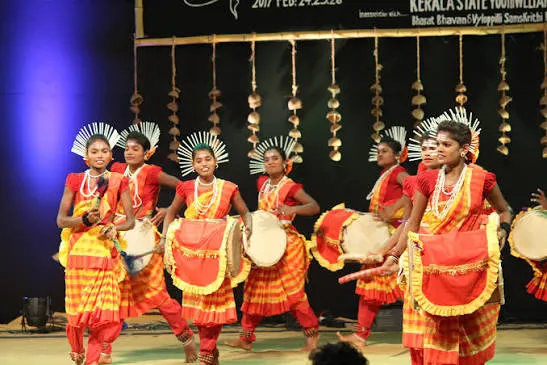
Dollu Kunitha is the specific cultural property of the Kuruba Gowda community, who are a significant Scheduled Caste community in Karnataka with a traditional occupation in weaving and herding. The dance is performed by men, traditionally drawn from the physically strong members of the community, as the dollu drum is heavy and the performance demands significant endurance. In the 1980s, Sri Choodamani Ramachandra established the first all-female Dollu Kunitha troupe, Snehasagara Mahila Mandala, breaking the male exclusivity of the tradition.
Relevance
Dollu Kunitha is a medium-visibility tradition that is actively practiced and thriving. Its inclusion in the Mysuru Dasara procession gives it a high-profile annual performance context that sustains both practice and recognition at the state level. It is one of the most energetically performed folk dances of Karnataka and represents the Kuruba Gowda community's cultural and religious identity within the broader Karnataka folk tradition.
History
Background
The Halumatha Purana and the Kuruba Purana, which are the oral literary traditions of the Kuruba community, provide the mythological background for Dollu Kunitha. These texts, transmitted in the community, place the origin of the dollu drum in cosmological time. The form's documented history in the more recent past includes the participation of Dollu Kunitha troupes in the Mysuru Dasara procession, which was reorganized in its modern form by the Mysore royal house in the early twentieth century. The establishment of the first female troupe by Choodamani Ramachandra in the 1980s represents a documented point of social change within the tradition.
Culture and Societies
Dollu Kunitha performances are organized by community troupes for temple festivals, life-cycle events, and state cultural occasions. The physical demands of the performance, which requires carrying and playing a large drum while executing choreographed movements, mean that performers typically undergo significant physical training. Troupes of ten to thirty performers are standard. The Mysuru Dasara procession context places Dollu Kunitha performers before audiences of hundreds of thousands. The form is also performed at the Karaga procession in Bengaluru, which is one of the oldest and most significant festivals of the city.
Religious Significance
Dollu Kunitha has direct and primary religious significance as an act of worship of Beereshwara, a form of Lord Shiva. The origin myth of the dollu drum, in which Shiva creates the drum from the skin of the destroyed demon, gives the instrument a sacred character: to play the dollu is to re-enact Shiva's victory and to honor the deity through sound. Performance of Dollu Kunitha at temple festivals is understood as devotional offering rather than secular entertainment. The Kuruba Gowda community's identity as devotees of Beereshwara is encoded in their primary folk performance tradition.
Understanding the Art
Style
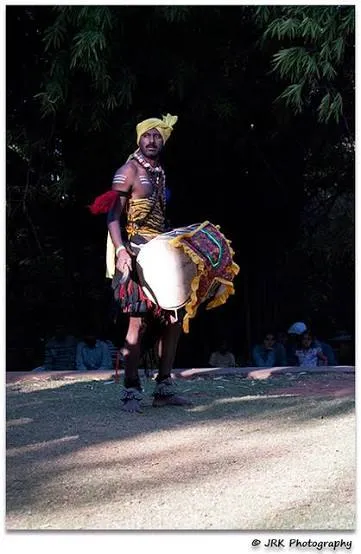
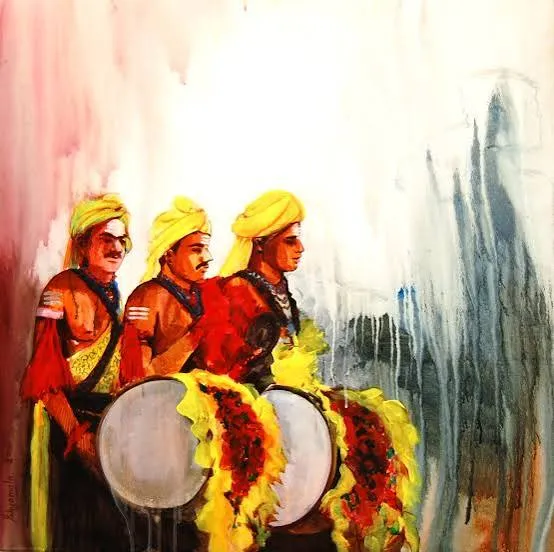
Dollu Kunitha performers wear the large dollu drum around the waist using a cloth harness and play it with both hands simultaneously, using either bare hands or short sticks depending on the section of the performance. The choreography involves circular and semi-circular formations in which all performers move together while playing. The performance includes acrobatic elements, synchronized strikes, and the physical choreography of moving the drum to different playing positions while maintaining the formation. The sound produced by a full troupe of Dollu Kunitha performers is described as powerful and percussive, creating an overwhelming sonic environment at temple festivals.
Central Motifs and Their Significance
The central motif is the dollu drum itself, which embodies the sacred narrative of Shiva's destruction of Dolla-asura. Each performance re-enacts this narrative through sound: the beating of the drum is the sonic equivalent of Shiva's victorious action. The circular formation of the dancers enacts the community's collective circumambulation of the deity. The inclusion of women's troupes since the 1980s has introduced a new dimension to the form, expanding the community of practice without altering the core devotional and musical framework.
Process
Dollu Kunitha performers strap the dollu drum around the waist using the traditional cloth harness, ensuring the drum is centered and balanced for playing while moving. The troupe arranges in circular or semi-circular formation. A lead performer sets the tempo and signals transitions between different playing patterns. The performance begins at a moderate pace and increases in speed and intensity, culminating in the most demanding sections which require high-speed drum playing while executing synchronized choreographic movements.
Mediums Used
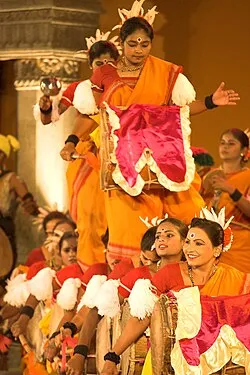
The dollu drum is made from mango or jackfruit wood for the body and cow or buffalo hide for the membranes, with traditional rope tensioning. Musical instruments used in addition to the dollu include tala (cymbals), tappadi (a smaller frame drum), trumpets, gong, and flute. Male performers wear a bare upper body (following a tradition of worshipping Shiva without covering) with a black sheet worn over the dhoti as the lower garment. Women wear traditional sarees in the performances organized by female troupes.
New Outlook
Dollu Kunitha is a thriving tradition with strong community support and significant institutional recognition. Its place in the Mysuru Dasara procession provides an annual high-profile performance occasion, and the Karnataka government's cultural bodies actively support the form through folk festival programming and documentation. The establishment of female troupes has expanded the community of practice. The form faces some challenges from the increasing physical demands placed on performers as performance contexts multiply and the need to present the tradition in new venues grows, but these are manageable within a functioning community of practice. Academic documentation of the form is available in Kannada-language scholarship and is increasingly represented in English-language studies of Karnataka folk traditions.
Learn Dollu Kunitha
Bibliography
Sources
Halumatha Purana and Kuruba Purana. Oral literary traditions of the Kuruba Gowda community. Oral tradition.
Karnataka Janapada Akademi. Documentation of Karnataka Folk Dances. Karnataka Janapada Akademi, various years.
Karnataka Tourism. Mysuru Dasara: Cultural Documentation. Government of Karnataka, various editions.
Kothari, Sunil. Folk Dances of India. Marg Publications, 1994.
Sangeet Natak Akademi. Karnataka Folk Traditions. Sangeet Natak Akademi, various years.
Image Sources
"Dollu Kunitha." Wikipedia, https://en.wikipedia.org/wiki/Dollu_Kunitha. Accessed 21 July 2026.
"Dollu Kunitha." Flickr, https://www.flickr.com/photos/55825367@N04/albums/72157628700507749/. Accessed 21 July 2026.
"Dollu Kunitha." Akanksha Art, https://akanksha-art.com/product/dollu-kunitha/. Accessed 21 July 2026.
"File:Dollu Kunitha 03.jpg." Wikimedia Commons, https://commons.wikimedia.org/wiki/File:Dollu_Kunitha_03.jpg. Accessed 21 July 2026.
"Dollu Kunitha." Flickr, https://www.flickr.com/photos/55825367@N04/6628726445. Accessed 21 July 2026.