
Charkula - The Folk Dance Tradition of Uttar Pradesh
Let us learn about Charkula dance from Uttar Pradesh!
Introduction
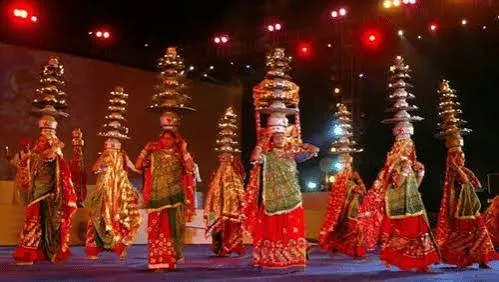
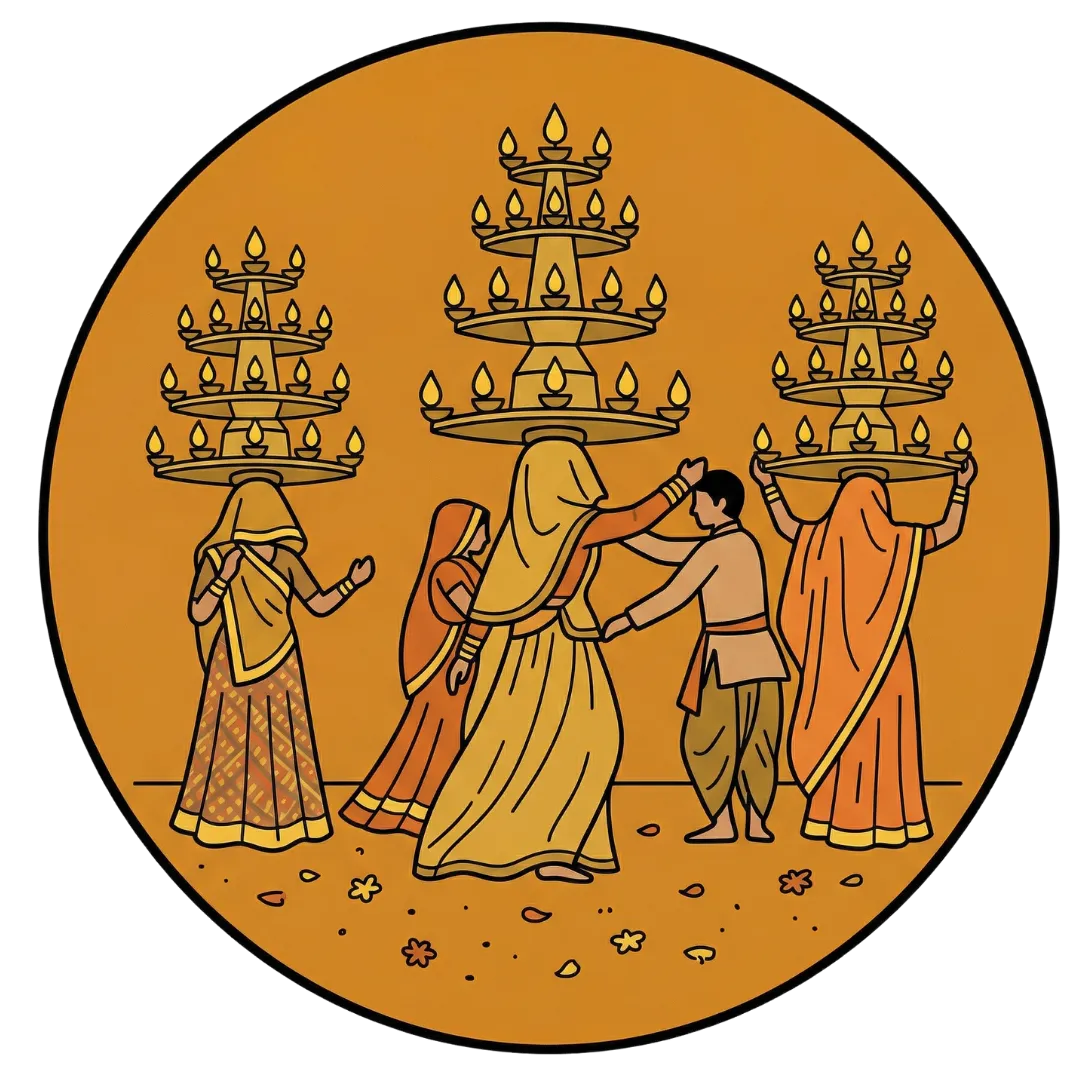
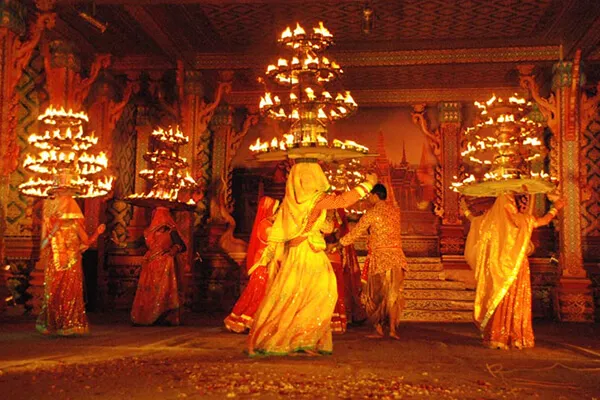
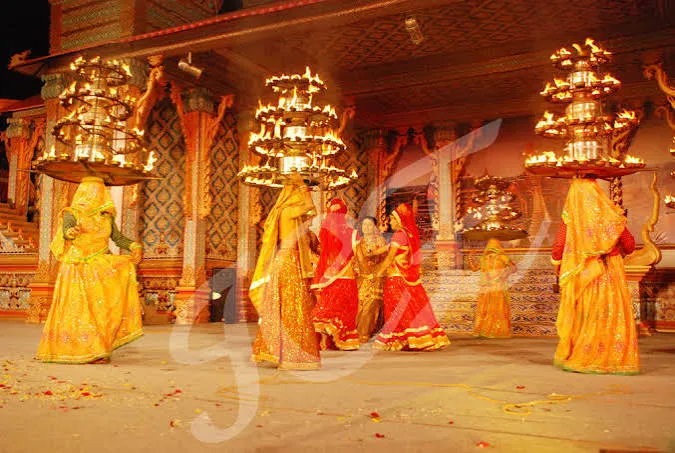
Charkula is a traditional folk dance of the Braj region of Uttar Pradesh, India, primarily associated with the cultural traditions of Mathura district and particularly with the village of Mukhrai. The dance is performed by women who balance a large multi-tiered circular wooden pyramid (the charkula) on their heads while dancing to Rasiya songs, which are folk songs of the Braj tradition devoted to the divine couple Radha and Krishna. The charkula structure, from which the dance takes its name, is a tapered wooden column with four to five circular tiers, on which earthen oil lamps are placed, typically numbering between 51 and 108. A fully loaded charkula may weigh up to 50 kilograms, and its balancing on the dancer's head while maintaining movement is considered the central feat of the performance. Charkula is especially performed on Dooj, the third day after Holi, which is believed to be the day of Radha's birth.
Etymology
The name Charkula refers to the multi-tiered wooden structure balanced on the dancer's head during the performance. The word combines char (four, in some interpretations referencing the tiered structure) or chakra (circle or wheel) with kula (group or clan), though the most direct interpretation relates the name to the circular (chakra) structure of the tiered platform. The structure is described in sources as a tapered wooden column of four to five circular tiers, suggesting both the chakra (wheel/circle) and the kula (tier/row) meanings in the compound. The Charkula Arts Academy's documentation identifies the wheel-like structure as the definitional visual element from which the name derives.
Origin
Two primary origin narratives are associated with Charkula, both rooted in the mythology of Krishna. The first and most frequently cited connects the dance to the birth of Radha: according to this legend, when Radha was born, her grandmother ran out of the house with a lighted charkula on her head to announce the joyful news to the community, and this act of celebratory balance became the founding gesture of the dance. The dance is thus specifically linked to the third day after Holi, which is identified in Braj tradition as the day of Radha's birth. The second origin narrative connects the dance to Krishna's Govardhan Leela: in this account, the dance celebrates Krishna's victory over the rain god Indra, when Krishna lifted the Govardhan hill on his finger to protect the Braj community from Indra's floods. The raising of the heavy charkula above the head re-enacts this gesture of protective elevation.
Location
Charkula is concentrated in the Braj region of Uttar Pradesh, centered on Mathura district. The dance is particularly associated with the village of Mukhrai in Mathura. The cities of Mathura and Vrindavan, the twin centers of Krishna-related pilgrimage in Braj, provide the primary geographic and cultural context for Charkula. Performances are concentrated in the areas where the Brahmin community of the Braj region maintains the dance tradition. The dance has been presented nationally through the Republic Day parade of India (Charkula represented Uttar Pradesh in the 1986 Republic Parade) and through the activities of the Charkula Arts Academy, which has performed for national cultural institutions including the National Centre of the Performing Arts (Mumbai) and the Nehru Centre.
Community
Charkula is primarily associated with the Brahmin community of the Braj region, particularly in Mathura district. This community identification reflects the broader pattern of Braj's cultural traditions, in which priestly and high-caste communities have historically served as custodians of Krishna-related performing arts, including Raslila (the theatrical enactment of Krishna's divine play). The dance is performed by women, with men providing musical accompaniment through Rasiya songs sung to the accompaniment of the nagara (drum) and other instruments. The Charkula Arts Academy, based in Singapore with activities in India, was established to promote and preserve the dance and represents one of the few institutionalized preservation efforts for the form.
Relevance
Charkula is classified as a low-relevance, vulnerable folk dance form in contemporary surveys. While it is recognized as the second most popular folk dance of Uttar Pradesh after Kathak, its geographic concentration in the Braj region and its dependence on a specific community for its practice limit its broader reach. The dance has received national visibility through the Republic Day parade and through institutional performances, but the number of active practitioners is limited. The form has received academic attention in the context of Braj cultural studies and Krishna devotional traditions, but comprehensive documentation remains incomplete.
History
Background
The Braj region of Uttar Pradesh is one of the most symbolically dense landscapes in the Hindu religious tradition. As the birthplace and childhood home of Krishna, and as the location of Radha and Krishna's divine love (as documented in the Bhagavata Purana and the later Vaishnava devotional literature of the Gaudiya tradition), Braj has attracted continuous pilgrimage, artistic production, and religious observance for at least a millennium. The cultural landscape of Braj is organized around the sites, seasons, and events of Krishna's mythology: every festival, every geographic feature, and every performing art in the region is interpreted through the lens of Krishna's divine biography. Charkula, as a dance associated specifically with Radha's birth anniversary and with the Govardhan Leela, participates fully in this mythologically saturated cultural geography.
The Rasiya song tradition that accompanies Charkula is a major folk literary form of the Braj region. Rasiya songs describe the love between Radha and Krishna in the Braj dialect (Braj Bhasha), a literary language with an extensive poetic tradition. The Bumb, the large drums that accompany the Rasiya during Holi celebrations, provide the rhythmic foundation for Charkula performance. This musical tradition connects Charkula to the broader festival culture of Holi in Braj, which is among the most elaborate and documented Holi celebrations in India.
Culture and Societies
Charkula belongs to a cluster of Braj performing arts traditions centered on Krishna devotion. Raslila (theatrical enactment of Krishna's childhood and youth), Ramlila (enactment of Rama's story), and various festival performance traditions of the Braj calendar form the broader context. The monsoon season (when Braj is associated in mythology with Krishna's rainfall dances with the gopis) and Holi (associated with Krishna's playful celebration of the festival) are the two performance seasons in which Braj's performing arts are most active. Charkula occupies a specific niche within this festival calendar as the Dooj performance marking Radha's birth.
Religious Significance
Charkula is deeply embedded in the religious life of Krishna devotion in Braj. Both origin narratives connect the dance directly to events in Krishna and Radha's mythology. The use of 108 oil lamps on the charkula is a number of specific religious significance in Hindu tradition: 108 is associated with the 108 names of the deity, the 108 beads on a devotional rosary (mala), and multiple other sacred numerical patterns. The Rasiya songs that accompany the dance are devotional compositions addressed to Radha and Krishna. The performance context on the Radha Dooj anniversary gives the dance an explicitly liturgical function in the calendar of Braj Vaishnavism, the regional form of Krishna devotion that centers on the divine couple Radha-Krishna as the supreme manifestation of the divine.
Understanding the Art
Style
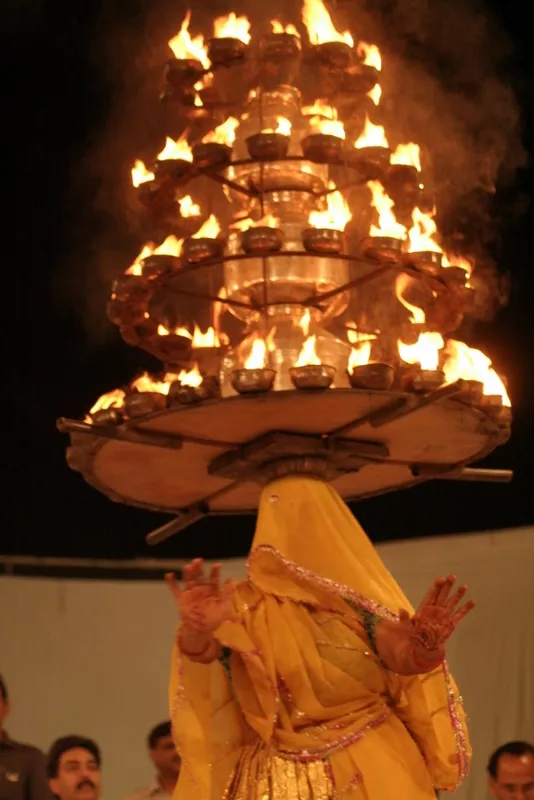
The central stylistic challenge of Charkula is the balancing of the 50-kilogram lit pyramid on the dancer's head while maintaining graceful, coordinated movement. The weight of the structure limits the range of footwork, so the steps are described as relatively limited in scope: gliding, bending, and whirling are the primary documented movements. Despite these physical constraints, performers must synchronize their movements with the drumbeats and the Rasiya melodies, maintaining aesthetic coherence throughout the performance. The lighting of 51 to 108 oil lamps on the charkula tiers creates a dramatic visual effect, particularly in evening and nighttime performances. Performers are veiled women, and the combination of veiled faces, ornate costume, and the blazing tiered structure creates the distinctive visual identity of the form.
Central Motifs and Their Significance
The charkula structure itself is the primary symbolic motif: it simultaneously represents the hill (the Govardhan Parvat raised by Krishna on his finger), the tower of lamps celebrating Radha's birth, and the cyclical nature of Braj festival life. The 108 lamps are simultaneously votive offerings and visual spectacle. The Rasiya songs performed during the dance provide narrative content, describing the love of Radha and Krishna, the beauty of Braj, and the joys of Holi. The integration of devotional song with a physically demanding feat of balance creates a performance that is simultaneously musical, devotional, and acrobatic.
Process
A Charkula performance involves a group of five to fifty women. At the climax of the performance, male singers and dancers may also join. The musical accompaniment consists of the nagara (large kettledrum), algoza (twin flute), thali (brass plate used as a percussion instrument), bansuri (flute), majira and khartal (hand cymbals), and harmonium. The performance is anchored by the Bumb (large drum) that provides the rhythmic foundation for Rasiya songs. The performance begins with the women lighting the lamps on the charkula tiers, lifting the structure to the head, and beginning the dance movement to the music.
Mediums Used
The charkula is a tapered wooden structure of four to five circular tiers, with earthen lamp holders (deepikas) on the rim of each tier. A fully prepared charkula may weigh up to 50 kilograms when loaded with lit lamps. The structure is reported in detailed descriptions as a custom-built wooden artifact specific to the tradition. The dancer's costume consists of an ankle-length long skirt with a long embroidered blouse, in the tradition of Braj women's festival dress. Silver or gold ornaments and embroidered work on the costume provide the visual complement to the blazing charkula.
New Outlook
Charkula faces challenges associated with the physical demands of the performance, the limited geographic base of practitioners, and reduced intergenerational transmission. Contemporary educational institutions in Braj have begun incorporating the dance into cultural programming, which provides some exposure to younger generations. The Charkula Arts Academy's international activities in Singapore and its performances at national cultural venues represent preservation efforts that extend the form beyond its native Braj community. However, the dance's classification as low-relevance and vulnerable reflects genuine concerns about its continued practice at the community level. Greater institutional documentation and economic support for Braj-based practitioners would be necessary to stabilize the form.
Learn Charkula
Bibliography
Sources
Devi, Ragini. Dance Dialects of India. Rev. ed., Motilal Banarsidass, 1990.
Entwistle, A. W. Braj: Centre of Krishna Pilgrimage. Egbert Forsten, 1987.
Hawley, John Stratton. At Play with Krishna: Pilgrimage Dramas from Brindavan. Princeton University Press, 1981.
Image Sources
"Charkula." Wikipedia, Wikimedia Foundation, https://en.wikipedia.org/wiki/Charkula. Accessed 22 July 2026.
"Charkula Dance." Indianetzone, https://www.indianetzone.com/charkula_dance_uttar_pradesh. Accessed 22 July 2026.
"Language & Culture." Mathura Hub, https://mathurahub.com/language-culture/. Accessed 22 July 2026.
"Charkula." Charkula, https://www.charkula.com/charkula/. Accessed 22 July 2026.
"Charkula Dance." Shri Radha Brij Vasundhara, https://www.shriradhabrijvasundhara.co/experiences/charkula-dance.html. Accessed 22 July 2026.