
Bihu Geet - The Music Tradition of Assam
Discover about Bihu Geet,mfolk songs associated with the Bihu festivals of Assam, performed alongside the Bihu dance...
Introduction
Bihu Geet is the genre of folk songs associated with the Bihu festivals of Assam, which are the most significant cultural celebrations of the state. There are three Bihus: Rongali or Bohag Bihu, celebrated in April to mark the Assamese New Year and the sowing season; Kongali or Kati Bihu, observed in October or November during a period of agricultural scarcity; and Bhogali or Magh Bihu, celebrated in January as a harvest festival. The songs associated with Bohag Bihu are the most extensive and culturally prominent, expressing themes of love, nature, youth, and the renewal of the agricultural cycle. These songs are performed alongside the Bihu dance, played on traditional Assamese instruments, and represent a central expression of Assamese cultural identity.
Etymology
The word Bihu is without a direct English translation. It is believed to have originated from the Deori word bisu, meaning to ask for prosperity and abundance, reflecting the agricultural and propitious origins of the festival with which the songs are associated. The word geet means song in Assamese. The earliest category of Bihu song is known as bonoriya geet, where bonoriya means of the wilderness, referring to the open, unconstrained spirit of the songs. Another common designation is bihu geet or bihu gan.
Origin
Assam; the tradition is described by Sahapedia as ancient, linked to the beginning of settled cultivation in the Brahmaputra Valley; the Ahom dynasty patronised the dance and its songs for six hundred years of consolidated rule
Location
Throughout Assam; strongest in the Brahmaputra Valley; also among the Assamese diaspora in India and internationally
Community
All communities of Assam irrespective of religion, caste, or ethnicity; traditionally associated with youth and courtship; the dance and songs are performed by both men and women
Relevance
triving; Bihu Geet and the associated Bihu dance are among the most actively performed and institutionally supported folk traditions of India, with a large following among the Assamese diaspora globally
History
Background
The Bihu festivals present an admixture of Tibeto-Burman, Austroasiatic, and Indo-Aryan traditions, reflecting the diverse ethnic and cultural composition of Assam. Their origins in the agricultural life of the Brahmaputra Valley are described in popular tradition as coeval with the beginning of cultivation in the valley; formal historical documentation does not establish a precise founding date. The Ahom dynasty, which ruled Assam for approximately six hundred years, patronised the Bihu celebrations and integrated them into the state's cultural life. Ahom kings enjoyed Bihu performances in the courtyard of the Rangghar, the house of joy, and commissioned songs that replaced the unrefined bonoriya geet with compositions praising the king, the Swargadeu.The earliest category of Bihu songs, bonoriya geet, are described as replete with references to love, desire, and sadness, and as expressing a young heart's longing for his lover. The Sahapedia documentation by cultural scholar notes that some upper-caste communities historically discouraged Bihu dance performances at their residences because of the songs' associations with courtship. The three Bihu festivals are linked to three phases of the agricultural cycle: Bohag Bihu is a sowing festival, Kati Bihu is associated with crop protection and animistic ritual, and Magh Bihu is a harvest festival.
Culture and Societies
The urban staging of Bihu was first undertaken at Lataxil field in Guwahati in 1962, organised by the Guwahati Bihu Sanmilani and promoted by Radha Govinda Baruah and others. This transition from rural field celebrations to urban stage performances created the bihutoli format, which has since proliferated across the state. Khagen Mahanta is identified as the Bihu Samrat, or king of Bihu, for his role in popularising the tradition. Contemporary Bihu celebrations extend across the full month of Bohag and include standup comedy, concerts, and theatrical performances alongside traditional song and dance. The gamosa, a handwoven cotton cloth with red borders traditionally given as a mark of respect to elders during Bihu, is a significant cultural symbol associated with the festival. Bihu Geet is celebrated by the Assamese diaspora across India, in Dubai, the United Kingdom, and the United States, through cultural organisations conducting Bihu Sammelans and festivals.
Religious Significance
The three Bihu festivals have documented connections to agricultural ritual, animistic practice, and communal celebration that extend across religious communities. Kati Bihu involves lighting lamps near tulsi plants and in paddy fields and has been described as an animistic form of festival associated with prayers for good harvests. Magh Bihu involves the lighting of a bonfire called the meji as a ritual element. Goru Bihu, the first day of Bohag Bihu, involves the ceremonial bathing, decoration, and worship of cattle, a practice with clear ritual significance in the agricultural community. The third day of Bohag Bihu, Gosain Bihu, involves the cleaning and worship of household deity figures. However, the Bihu traditions as a whole are not institutionally associated with any single religious sect, temple, or doctrinal system, and are celebrated across religious communities including Hindus and Muslims in Assam.
Understanding the Art
Style
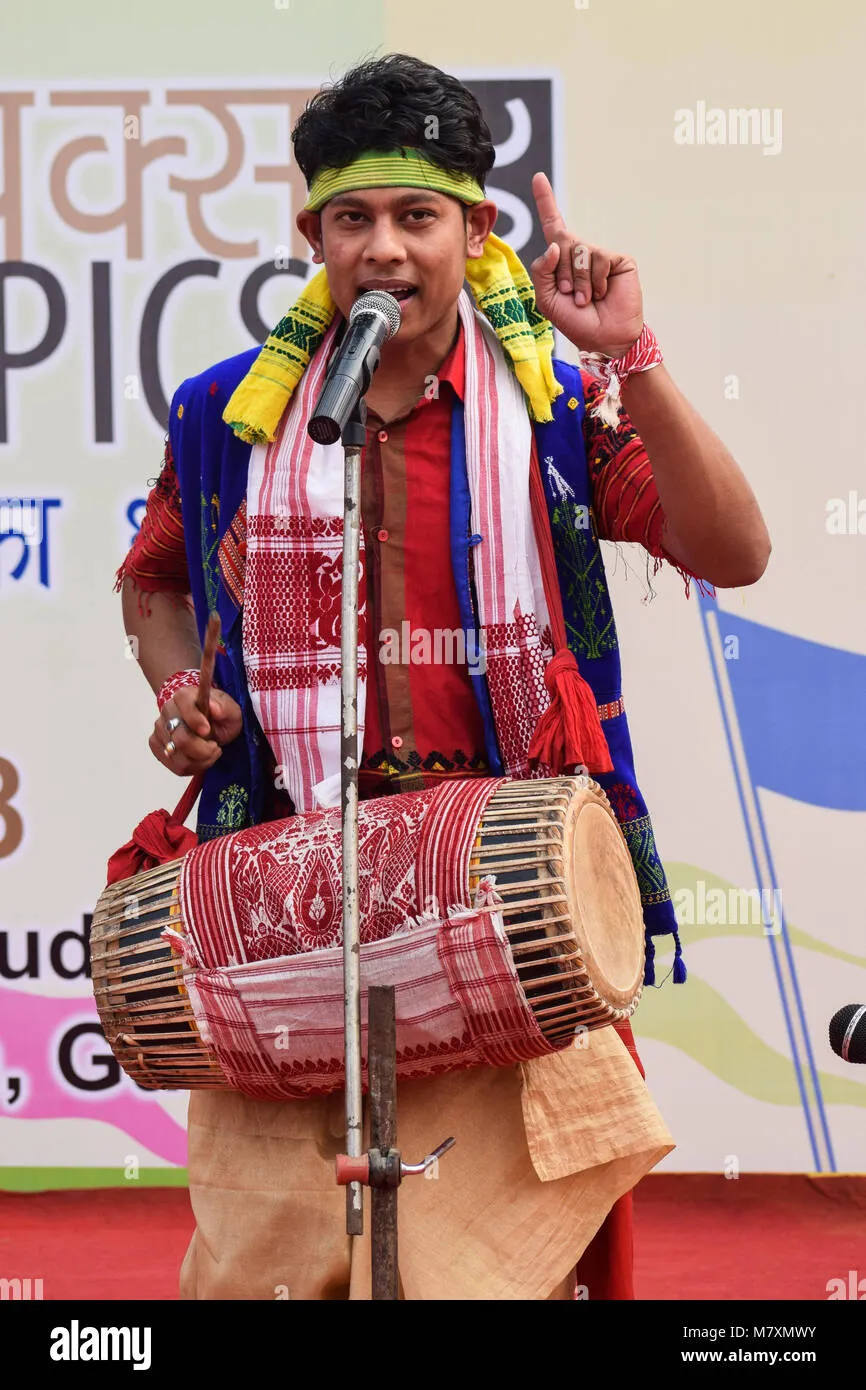
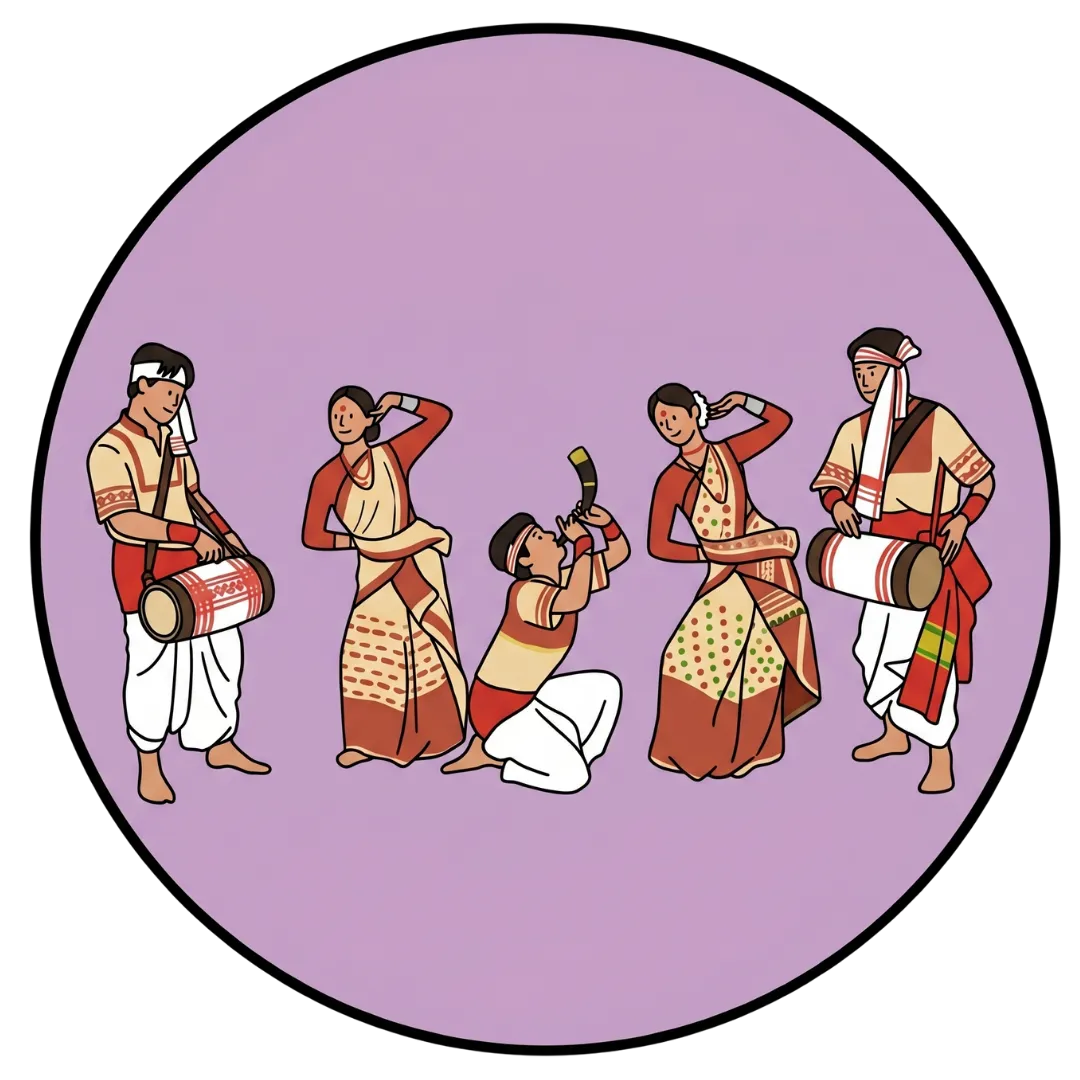
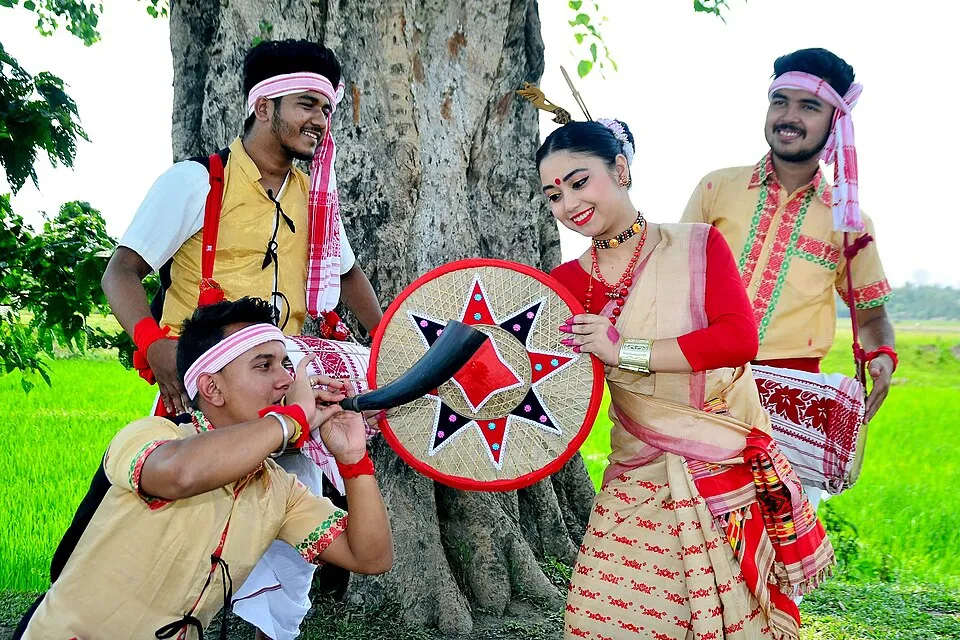
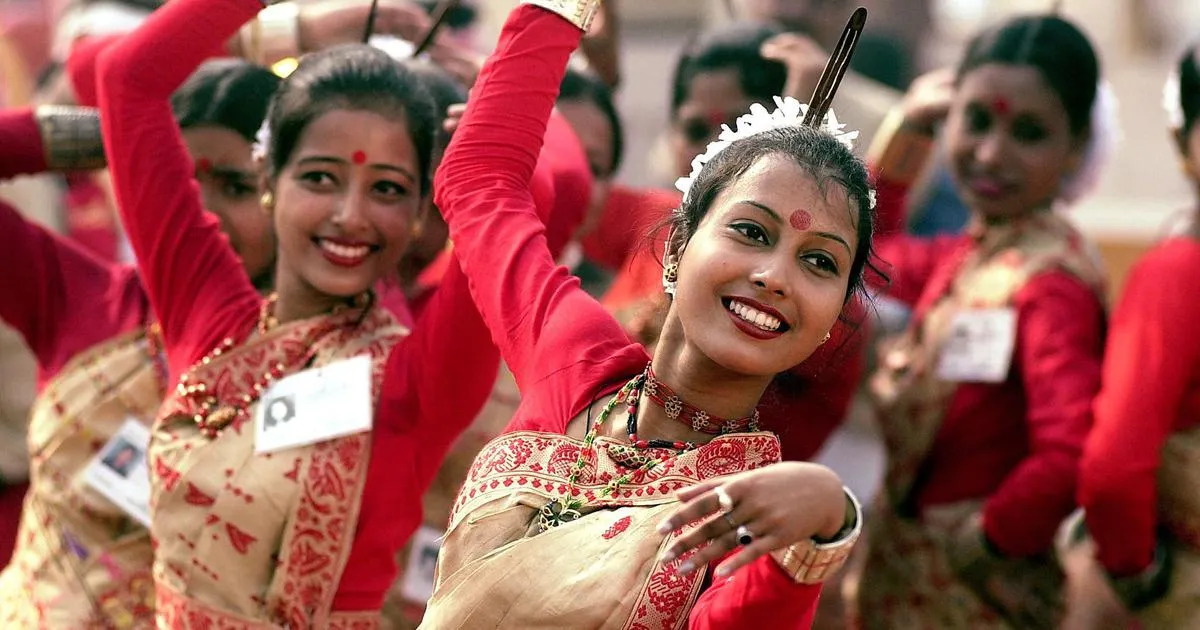
Bihu Geet are characterised by lyrical content centred on love, nature, agricultural life, and youthful sentiment. The bonoriya geet tradition represents the earliest layer of these songs, with an open and emotionally direct quality. The Bihu dance, Bihu Naas, is traditionally described as a courtship dance, beginning slowly and building in tempo, performed by groups of young men and women in open fields or purpose-built bihutoli stages. The songs are accompanied by the dhol, a double-headed drum; the pepa, a buffalo hornpipe; and the gogona, a bamboo jaw harp. Additional instruments include the bahi, or bamboo flute, and the taal, cymbals. The Bihu dance is known for its rapid hip and wrist movements, quick steps, and expressive use of the body.
Central Motifs and Their Significance
The central themes of Bihu Geet are the arrival of spring, agricultural renewal, love and courtship, and the natural world. Specific natural imagery associated with Bohag Bihu includes the kopou phul or foxtail orchid, worn in the hair of dancers, and the call of the cuckoo, which signals the season's arrival. The gamosa, given as a gift of respect, is both a practical object and a cultural symbol of Assamese identity. Bihu Geet often address the sorrow of separation alongside joy, as the farewell aspect of the festival, bohagi bidai, marks the end of the celebration month.
Process
Bihu Geet are sung in groups, typically by young men and women who learn the songs through participation in community life, family transmission, and increasingly through cultural programmes and workshops organised by government bodies and cultural organisations. The songs are not composed according to classical rules of raga or tala but follow the folk conventions of the Assamese oral tradition. Contemporary artists blend traditional Bihu Geet with contemporary musical arrangements, creating hybrid forms that maintain the lyrical themes while reaching younger audiences.
Mediums Used
The primary instruments of Bihu Geet are the dhol, pepa, and gogona. The bahi, taal, and dotara are also used. Costumes associated with the dance include the mekhela chador for women, woven in muga silk, pat silk, or cotton with red borders, and dhoti-kurta for men. Contemporary Bihu stages use sound amplification and lighting technology.
New Outlook
Bihu Geet and the associated dance are among the most robustly practised folk traditions in India. Cultural bodies, government programmes, and local organisations actively support training and performance. The tradition has been carried internationally by the Assamese diaspora, with organisations in multiple countries staging annual Bihu Sammelans. Contemporary artists experiment with fusion forms combining Bihu melodies with electronic and popular music arrangements. The increased urbanisation of the tradition through bihutoli stages has broadened participation while shifting the context of performance from the open fields of the agricultural community to organised public events.
Learn Bihu Geet




Bibliography
Sources
Phukan, Prabin. Assamese Folk Songs. Guwahati.
"Bihu: The Festival of Assam." Sahapedia, https://www.sahapedia.org/. Accessed 09 July 2026.
Barua, Birinchi Kumar. History of Assamese Literature. Sahitya Akademi, 1964.
Goswami, Prafulla Dutta. Bihu Songs of Assam. Lawyer's Book Stall, 1957.
Image Sources
"Bihu Geet (Assamese)." Amazon Music, https://music.amazon.in/playlists/B07TLWCFD1. Accessed 09 July 2026.
"Bihu Dance." Wikimedia Commons, https://commons.wikimedia.org/wiki/File:Bihu_dance.jpg. Accessed 09 July 2026.
"Old Melody." SoundCloud, https://soundcloud.com/assamese-songs/sets/old-melody. Accessed 09 July 2026.
"Listen: These Bihu Songs Reveal the Rhythms and Routines of Rural Assam." Scroll.in, https://scroll.in/article/992966/listen-these-bihu-songs-reveal-the-rhythms-and-routines-of-rural-assam. Accessed 09 July 2026.
"Artists Performing Assamese Folk Song Bihu during 8th Theatre Olympics." Alamy, https://www.alamy.com/stock-photo-artists-performing-assamese-folk-song-bihu-during-8th-theatre-olympics-176993431.html. Accessed 09 July 2026.