

Bhand Pather - The Folk Dance Tradition of Jammu & Kashmir
Get to know about Bhand Pather, the traditional folk court jester theater performance by the all-male troupes of the Kashmir Valley...
Introduction
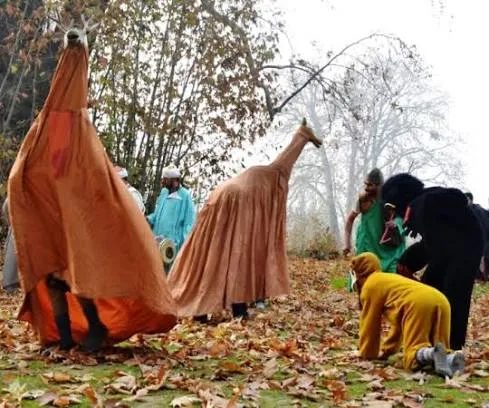
Bhand Pather is the traditional folk theatre of the Kashmir Valley, combining dance, dramatic narrative, music, social satire, and comedy in performances that have historically been staged in open-air village settings under chinar trees and in village courtyards. The name is a compound of 'Bhand,' referring to the traditional court jester or comic performer, and 'Pather,' meaning dramatic performance or scenario. The form is performed by all-male troupes of performers who specialize in the Bhand tradition, with men taking female roles in a convention consistent with many subcontinental folk theatre traditions. Bhand Pather is transmitted through the guru-shishya (master-disciple) system, has no predetermined script, and draws on Kashmiri, Gojri, Punjabi, Dogri, Persian, and English in its multilingual performances. The form is regarded as one of the oldest theatre traditions of the Kashmir Valley and is documented as having been referenced by the fifteenth-century Kashmiri Sufi saint Sheikh Noor-ud-Din Noorani.
Etymology
The word 'Bhand' derives from the Sanskrit 'Bhanda,' meaning comic, jester, or buffoon, and specifically refers to the caste and occupational group of hereditary performers who practice this tradition in Kashmir. 'Pather' is a Kashmiri-Urdu word meaning a dramatic scenario or performance. Together, the compound 'Bhand Pather' specifically designates the dramatic genre performed by the Bhand community, distinguishing it from other performance traditions. The Bhand community itself is a recognized occupational community whose social identity is defined by their role as hereditary performers of this theatrical form.
Origin
The historical origins of Bhand Pather are traced to the migration of Bhand performers from Persia, where the tradition of court jesters and comedic performers is well-documented in medieval Islamic court culture. This migration into the Kashmir Valley is placed in the late medieval period, approximately in the fourteenth century CE, when Kashmir was under the rule of the Shah Mir dynasty. The form's development in Kashmir involved the integration of the Bhand's Persian comedic tradition with local Kashmiri theatrical, musical, and linguistic culture. The mention of the Bhand tradition by Sheikh Noor-ud-Din Noorani, the founder of the Rishi Sufi order in Kashmir who lived from 1377 to 1438 CE, provides one of the earliest documentary references to the form's presence in the Valley.
Location
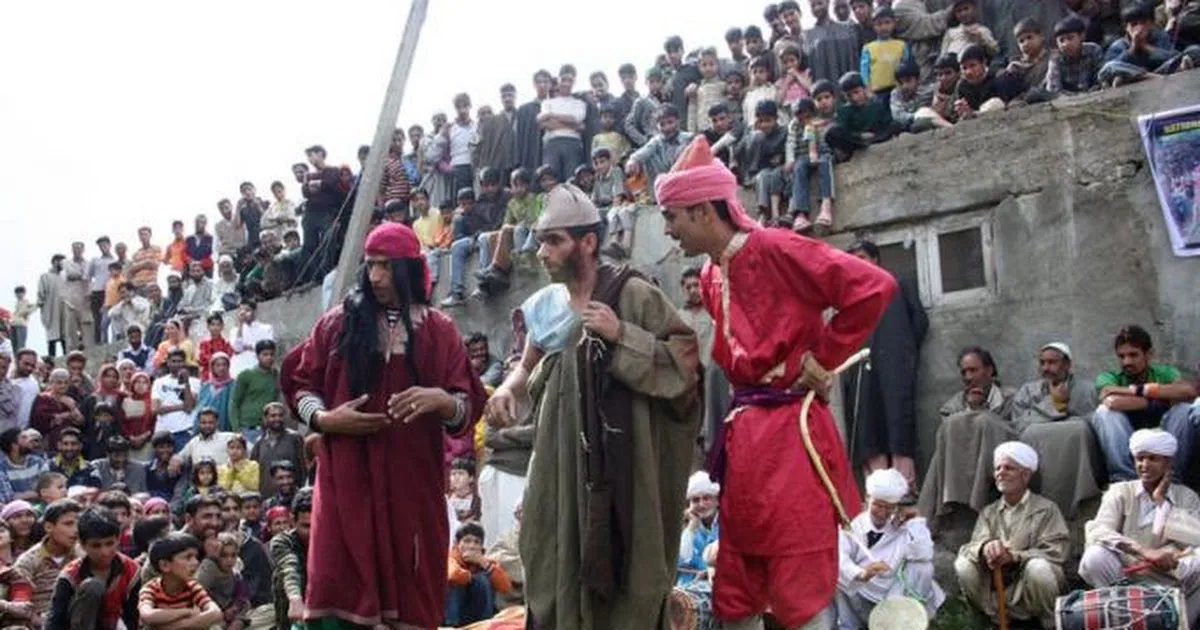
Bhand Pather is performed in the Kashmir Valley, primarily in the districts of Srinagar, Baramulla, Budgam, Pulwama, and Anantnag. Traditional performance venues include village greens and courtyards, open areas under chinar trees, and the spaces adjacent to shrines and mosques during festivals. Historically, approximately eighty troupes were active in the Valley; as of available documentation, approximately fifteen functional troupes remain.
Community
Bhand Pather is the hereditary art of the Bhand community of Kashmir, who are recognized as a distinct occupational community within the Valley's social structure. The form is transmitted from father to son and from master to disciple within the community. Female roles are played by men. Notable institutional expressions of the tradition include the National Bhand Theatre and the Karam Bulund Folk Theatre. M.K. Raina, a graduate of the National School of Drama, has worked on documentation and revival of the tradition from outside the community.
Relevance
Bhand Pather is one of the most historically significant folk theatre traditions of the Indian subcontinent, representing a living link to the medieval Kashmiri performance culture and to the Persian theatrical tradition that influenced it. It has been the subject of attention from academics, theatre practitioners, and cultural institutions who recognize its unique combination of oral improvisation, satirical content, musical performance, and multilingual expression. The form's endangered status makes its documentation and study a matter of urgency in the cultural heritage community.
History
Background
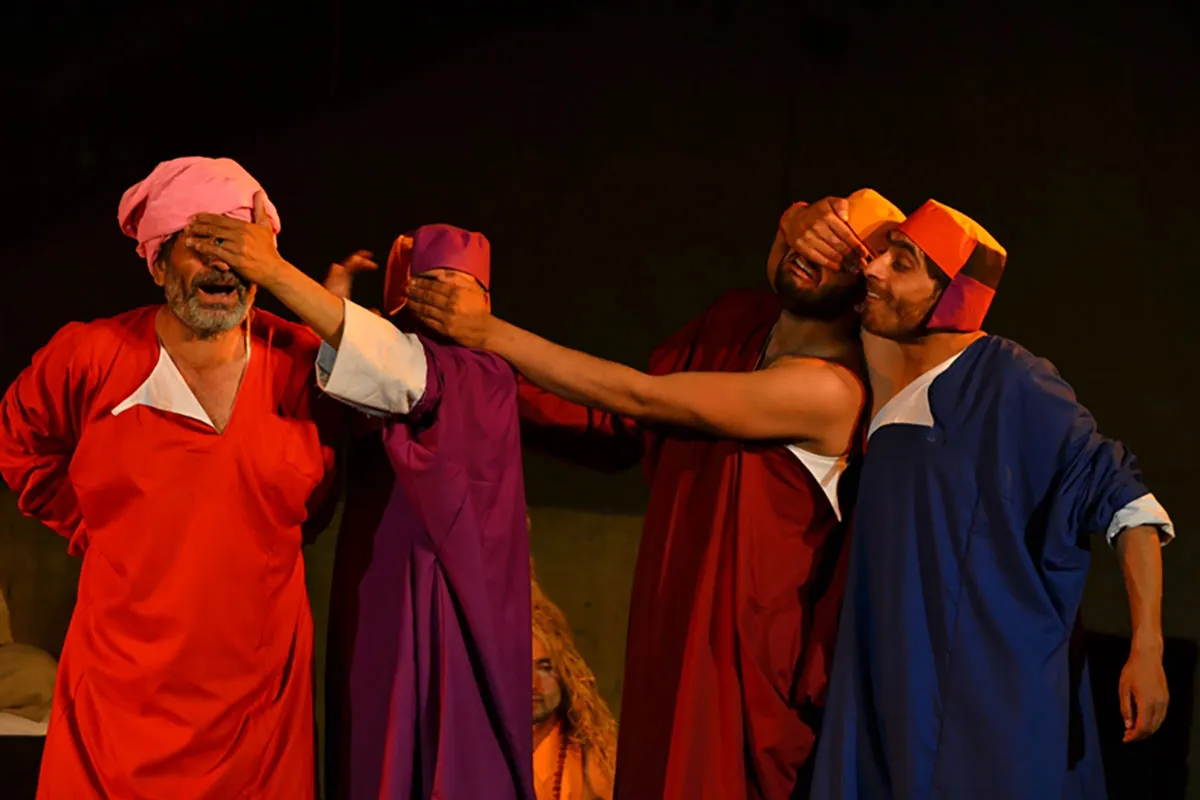
The historical record of Bhand Pather in Kashmir includes its mention in the poetry of Sheikh Noor-ud-Din Noorani in the fourteenth to fifteenth century and references in subsequent Kashmiri literature. The Valley's varied political history, including rule by the Shah Mir dynasty, the Mughals, the Afghans, the Sikhs, and the Dogras before accession to India, provided Bhand Pather with multiple layers of social and linguistic content for satire. The form's satirical tradition, which targets landlords, corrupt officials, religious hypocrisy, and social injustice, reflects the social conditions of each historical period. The genre's repertoire includes plays from different periods: Wattal Pather is documented as the oldest, and Angrez Pather (the English Pather), which satirizes British colonial administration, was added during the colonial period.
Culture and Societies
Bhand Pather troupes typically consist of ten to twenty performers, with the naqqal (lead actor and director) playing the central role. Performances are organized around a series of comic and dramatic episodes (pathers) that are selected and sequenced according to the occasion and audience. The multilingual character of performances, drawing on Kashmiri, Gojri, Punjabi, Dogri, Persian, and occasionally English, reflects the linguistic diversity of the Kashmir Valley and the Bhands' historical role as performers across different community and linguistic groups. The absence of a written script and the reliance on improvisation within traditional frameworks is a defining characteristic. The guru-shishya system of transmission ensures that the repertoire and the improvisatory skills of performance are passed from experienced performers to novices through direct observation and participation.
Religious Significance
Bhand Pather is primarily a social and artistic form rather than a devotional one. Its dominant register is satirical commentary and comedic entertainment. However, the form has been performed at festivals associated with Sufi shrines and Islamic religious occasions in the Valley, and the mention of the Bhand tradition by Sheikh Noor-ud-Din Noorani suggests a historically acknowledged relationship between the form and the Sufi cultural milieu of medieval Kashmir. Some specific pathers address religious themes, including Gosain Pather, which deals with the figure of the wandering Hindu ascetic (gosain), but the treatment is typically satirical rather than devotional.
Understanding the Art
Style
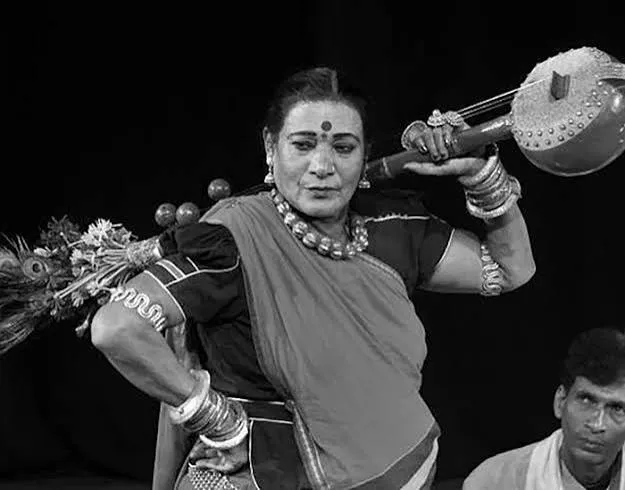
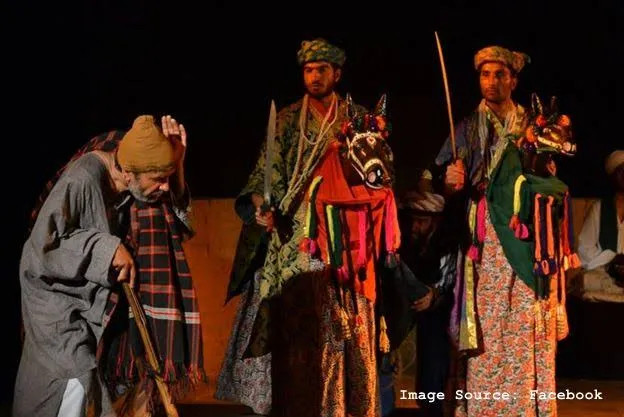
Bhand Pather is performed in an open space with no fixed stage infrastructure. The naqqal and ensemble move freely through the performance space, engaging the audience directly. Comic timing, improvised dialogue, and physical comedy (including slapstick) are central to the performance style. The music is performed throughout the drama, with the surnai (wooden flute with bell-shaped outlet) and dhol and nagara providing continuous accompaniment. Dance sequences are integrated into the dramatic episodes, and the female characters played by male performers adopt stylized feminine movement vocabularies. The form is responsive to the specific audience and occasion, with topical references and local humor incorporated into each performance.
Central Motifs and Their Significance
The central motifs of Bhand Pather are social satire and the comic exposure of hypocrisy and injustice. The landlord-peasant relationship, the corrupt qazi or official, the religious hypocrite, and the colonizer are recurring targets of satirical treatment across the repertoire. The figure of the Bhand jester, who speaks truth to power under the cover of comedy, is itself a significant motif: the traditional license of the court jester to criticize the powerful is encoded in the social contract between the Bhand community and the broader society. The multilingual range of the performances encodes the Valley's cultural complexity and the Bhands' historically mediating role between different communities.
Process
A Bhand Pather performance begins with musical invocation and the assembly of the performing troupe in the open performance space. The naqqal establishes the fictional frame of the pather being performed, and the ensemble enacts the scenes in improvised sequence within the traditional framework of each pather's narrative arc. The performance integrates music continuously, with the surnai and percussion providing rhythmic and melodic accompaniment to both the danced and spoken sections. The repertoire includes Wattal Pather, Gosain Pather, Shikargah Pather, Bakarwal Pather, Raza Pather, and Angrez Pather, among others.
Mediums Used
Instruments used in Bhand Pather include dhol, nagara, and surnai (a distinctive wooden flute specific to Kashmiri folk music, with a bell-shaped outlet that creates its characteristic sound). Costumes are specific to the characters being portrayed: landlords, religious figures, colonial officials, and other social types are represented through recognizable costume conventions. No elaborate stage infrastructure is used; the performance takes place in open-air venues with minimal material support.
New Outlook
Bhand Pather is classified as an endangered tradition. The decline from approximately eighty active troupes to approximately fifteen reflects the cumulative effects of political instability in the Kashmir Valley, economic pressures on hereditary performance communities, the disruption of the guru-shishya transmission system, and the absence of institutional support for the form. M.K. Raina and the National School of Drama have undertaken documentation and training initiatives, and the Sangeet Natak Akademi has recognized the form, but a sustained and adequately resourced preservation program was not established as of the available documentation. The form's survival depends on the continued activity of the remaining troupes and on renewed institutional commitment to documentation and training.
Learn Bhand Pather


Bibliography
Sources
Kalla, Krishan Lal. The Literary Heritage of Kashmir. Mittal Publications, 1985.
Khan, M. I. History of Srinagar. Aamir Publications, 1978.
Raina, M. K. Bhand Pather: The Folk Theatre of Kashmir. National School of Drama, various editions.
Richmond, Farley, Darius L. Swann, and Phillip B. Zarrilli, editors. Indian Theatre: Traditions of Performance. University of Hawaii Press, 1990.
Sangeet Natak Akademi. Documentation of Bhand Pather. Sangeet Natak Akademi, various years.
Image Sources
"Bhand Pather." MAP Academy Encyclopedia of Art, https://imp-art.org/articles/bhand-pather/. Accessed 21 July 2026.
"Bhand Pather: Echoes of Tradition." Kashmir Reader, 25 Apr. 2024, https://kashmirreader.com/2024/04/25/bhand-pather-echoes-of-tradition/. Accessed 21 July 2026.
"Bhand Pather Artists Visualize a Bleak Future." Kashmir Vision, https://kashmirvision.in/2023/01/24/bhand-pather-artists-visualize-a-bleak-future/. Accessed 21 July 2026.
Jeelani, Mehboob. "The Other Kashmir Problem." The Caravan, 1 Sept. 2011, https://caravanmagazine.in/reviews-and-essays/other-kashmir-problem. Accessed 21 July 2026.