
Bastar Tribal Painting - The Painting Tradition of Chhattisgarh
Read about Bastar Tribal Painting of Chattisgarh...
Introduction
Bastar tribal painting encompasses the wall painting and ritual visual art traditions of the indigenous tribal communities inhabiting the Bastar region of southern Chhattisgarh, a geographically and culturally distinct zone centered on the Indravati River basin. The region is home to a concentration of tribal communities including the Gond, Maria (also written Muria), Halba, Bhatra, and Ghasiya peoples, who collectively constitute approximately 70 percent of Bastar's population. The wall painting traditions of these communities are produced during festivals, weddings, and harvest celebrations, using natural earth and plant-based materials on the walls of domestic structures and communal spaces.
Bastar is also associated with a range of other visual art traditions including Dhokra metal casting, wood carving, terracotta, bamboo craft, and the bell metal bell tradition, all of which are produced within the tribal communities of the region. This article focuses primarily on the wall painting tradition, with reference to the broader visual culture of the region where relevant. The painting tradition is classified as vulnerable due to the declining use of traditional media and subject matter as synthetic paints and non-traditional design elements enter the production context.
Etymology
The term Bastar refers to the principal administrative and historical region of southern Chhattisgarh, named after the Bastar zamindari (landholding area) that was historically under the rule of the Bastar Raj (Bastar royal family), who patronized the tribal communities' cultural practices and maintained the institutional context for the Bastar Dussehra festival, the largest tribal festival in India by participation estimates. The tribal communities of the region do not use a single term for their wall painting tradition; each community has its own terminology in their respective languages for the ritual decoration practices.
Origin
The visual art traditions of the Bastar tribal communities are not associated with a single founding event or period. The Dhokra metal casting tradition, with which the Bastar region is strongly associated, has been connected by archaeological scholarship to the ancient lost-wax casting traditions of the Indian subcontinent, with the Dhokra technique estimated to have been in continuous use for 4,000 or more years based on archaeological finds. The Mohenjodaro dancing girl bronze, dated to approximately 2500 BCE, is cited in popular and some academic literature as an example of the technique's antiquity, though the direct connection between ancient archaeological finds and contemporary Bastar Dhokra production is a matter of continuity of technique rather than of documented unbroken lineage.
The wall painting traditions of the Bastar communities are more recent in their documented history, as wall paintings are ephemeral and are not preserved in archaeological or institutional collections with the same facility as metal objects. The academic documentation of Bastar wall painting traditions began in the second half of the 20th century with ethnographic fieldwork by researchers from Indira Kala Sangit University (Khairagarh) and other institutions.
Location
The Bastar region encompasses the districts of Bastar, Kondagaon, Narayanpur, Kanker, Dantewada, Sukma, and Bijapur in southern Chhattisgarh. The Indravati River is the principal geographic feature of the region, and the dense forest cover of the area has historically provided both the natural materials used in the arts and the degree of geographic isolation that has contributed to the preservation of indigenous cultural practices. The town of Jagdalpur serves as the administrative center of Bastar district and as the site of the Bastar Dussehra festival.
Community
The tribal communities of Bastar do not constitute a single ethnographic unit. The Gond are the largest tribal group in central India and are present in Bastar in several sub-groups including the Maria (Hill Maria, Bison Horn Maria, and Muria). The Halba are both a tribal and a scheduled caste community depending on specific sub-group designation under government classification systems. The Bhatra are a distinct community from the Gond and maintain separate cultural practices. The Ghasiya are traditionally associated with specific occupational roles within the Bastar tribal economy. The Dhruwa and Dorla communities are also documented as part of the Bastar tribal landscape. Each community maintains its own ritual and festival calendar and associated visual art practices.
Relevance
Bastar tribal art has received significant national and international attention primarily through the Dhokra metal casting tradition and through the Bastar Dussehra festival. The Dussehra of Bastar is a 75-day festival unique in its scale and ritual complexity, recognized by the Chhattisgarh government as a major cultural event. The tribal visual and material arts of Bastar have been collected by national and international museums and have been included in national-level craft exhibitions organized by the Crafts Council of India and government handicraft bodies. The vulnerability designation for the painting tradition reflects specific concerns about the declining use of traditional materials and the erosion of the specific ritual contexts that produce the paintings.
History
Background
The pre-colonial political and cultural context of Bastar was shaped by the Bastar Raj, a royal lineage that administered the region for several centuries under various forms of imperial suzerainty (Maratha, then British) while maintaining significant local autonomy. The Bastar royal family patronized the tribal festivals, particularly the Bastar Dussehra, and maintained the institutional framework within which tribal artistic practices were sustained. The incorporation of Bastar into the British colonial administrative system in the 19th century and the subsequent impact of forest policies, land settlements, and colonial economic transformations had significant effects on tribal communities and their material cultures.
Culture and Societies
Wall painting in the Bastar tribal context is associated with specific festival and life-cycle occasions. During the harvest festivals, including the Hareli festival (first agricultural festival of the Chhattisgarhi calendar), Diwali, and weddings, the walls of domestic structures are decorated with images of tribal deities, animals, and geometric patterns using white lime, black charcoal, and red ochre, sometimes supplemented with other natural pigments. These paintings are not permanent decorations but are produced fresh for each occasion and then allowed to decay or be overwritten. The Ghotul, the communal dormitory institution of the Muria Gond community, is a significant social institution associated with specific material culture including decorated posts, murals, and ritual objects. The Ghotul serves as both the sleeping place of unmarried young people and as the educational and social institution through which Muria cultural knowledge is transmitted. Its walls and supporting structures are decorated with imagery relevant to Muria cosmology and social practice.
Religious Significance
The wall paintings and other visual art of the Bastar tribal communities are deeply embedded in tribal religious practice. The primary deities of the Bastar tribal communities include Danteshwari (the principal deity of the Bastar royal family, a form of the Goddess), village deities (Gram Devata), forest deities, and ancestral spirits. The visual imagery produced in ritual contexts references these deities and the mythological narratives associated with them. The bell metal bell tradition of the Bastar region is specifically associated with ritual and temple practice, with bells produced for temples and for use in village deity worship.
The Bastar Dussehra, while structurally similar in timing to the pan-Indian Dussehra festival, has a completely distinct ritual content focused on the Danteshwari goddess and the processional ritual of the chariot (rath) through the streets of Jagdalpur over the 75-day festival period. Tribal artisans produce specific ritual objects including the chariot, deity decorations, and processional objects for this festival, constituting a significant concentrated production of tribal visual arts.
Understanding the Art
Style
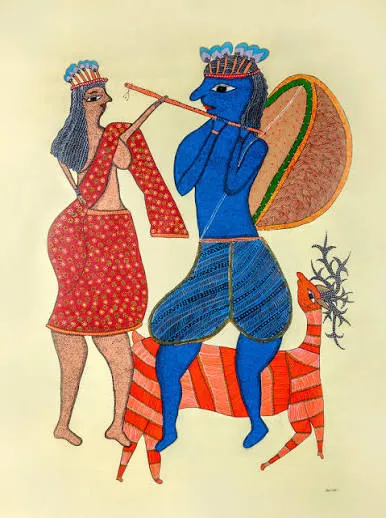
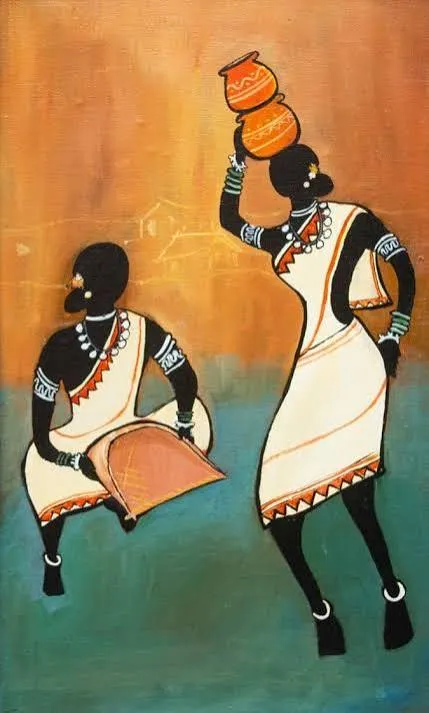
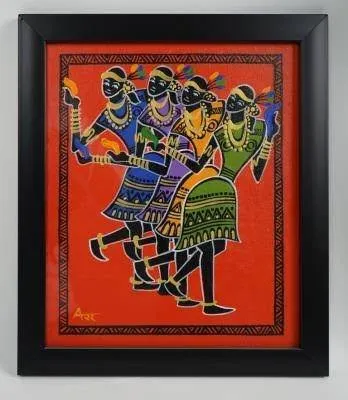
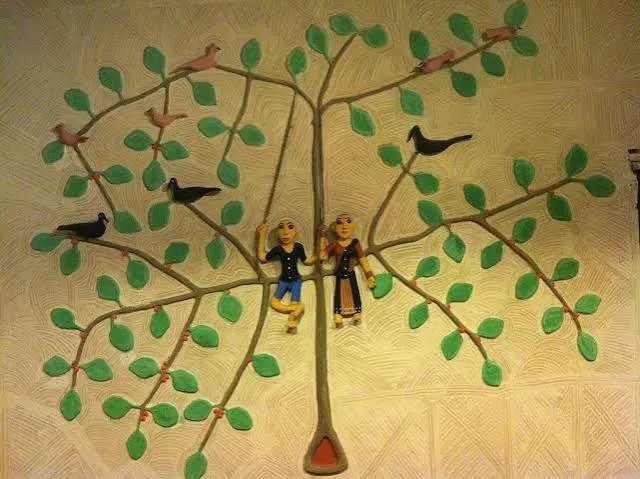
Bastar wall painting is characterized by schematic, strongly outlined figuration using a limited color palette determined by the available natural materials. White lime wash on a cow dung and mud wall surface provides the ground, with red ochre and black charcoal as the primary drawing and fill materials. The figures are generally frontal or profile presentations without spatial depth. Animal depictions (particularly the bison, which has specific significance in Maria Gond ritual life as the totemic animal associated with the Bison Horn Maria) and deity depictions are among the most frequently documented subjects.
Central Motifs and Their Significance
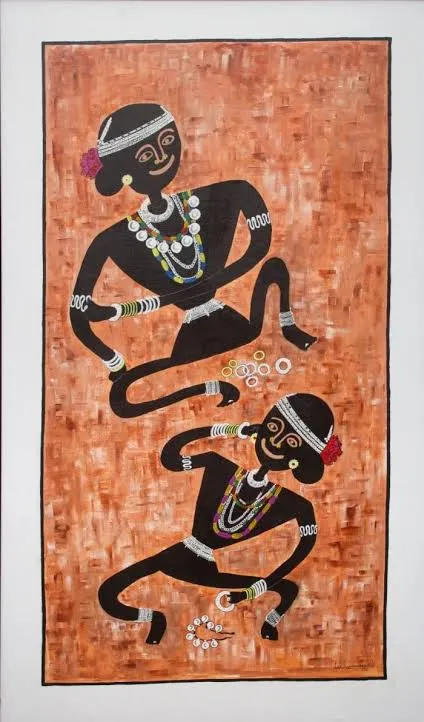
The primary motifs of Bastar tribal painting include representations of tribal deities in their characteristic iconic forms (Danteshwari, Bhimadeo, and village deities), bison and other animals of significance to tribal cosmology, hunting scenes that reference both practical activities and ritual hunts, dance scenes associated with tribal festivals, stylized plants and natural elements, and geometric border patterns derived from the weaving and tattooing traditions of the communities. The Champa flower, found in the environment of the Bastar forests, appears as a decorative motif in some contexts. Human figures associated with the tribal community's social roles, including the village headman, the village priest (pujari), and musicians, are depicted in narrative contexts.
Process
The traditional process of Bastar wall painting begins with the preparation of the wall surface using a coating of cow dung mixed with mud (ghar lipa), which provides a clean, semi-absorbent painting surface. White lime is prepared from locally burned limestone and applied as the ground for decoration. Drawing is done with charcoal or with sticks dipped in natural pigments. Red earth (ochre), black charcoal, white lime, and yellow clay are the standard natural pigments. In some contemporary contexts, synthetic paints have replaced natural pigments, which is one of the factors noted in the vulnerability assessment for the tradition.
Mediums Used
Traditional mediums include: cow dung and mud wall surface preparation; white lime as ground and white pigment; red ochre as red pigment; black charcoal as drawing and fill medium; yellow clay for yellow; locally gathered plant extracts for occasional color additions. Contemporary production may use synthetic enamel or acrylic paints on traditional surfaces, reflecting the reduced availability of time and traditional materials in an increasingly cash-economy context.
New Outlook
The Chhattisgarh government, through the state's handicrafts and cultural departments, has undertaken programs to promote the visual arts of Bastar through craft cooperatives, exhibition participation, and government craft emporium networks. The Bastar Dussehra festival serves as a significant platform for the display and commercial sale of tribal arts and crafts to visitors. National craft exhibitions organized by the Crafts Council of India and government bodies have included Bastar Dhokra and other crafts alongside wall painting demonstrations.
NGO-supported initiatives have attempted to create market access for tribal artisans and to provide fair-trade frameworks that reduce dependence on middlemen who have historically captured a disproportionate share of the economic value of tribal craft production. The documentation of Bastar tribal arts by ethnographic and art historical researchers has increased significantly in the 21st century, providing a growing literature base that can support future preservation and promotion programs.
Learn Bastar Tribal Painting
Bibliography
Sources
Bhattacharya, Sukhomoy. Arts and Crafts of Central India. Sangeet Natak Akademi, 1984.
Elwin, Verrier. The Muria and Their Ghotul. Oxford University Press, 1947.
Haimendorf, Christoph von Fürer. The Gonds of Andhra Pradesh: Tradition and Change in an Indian Tribe. Allen and Unwin, 1979.
Komal, Vats, and Srivastava. Tribal Art of Central India. Indira Gandhi Rashtriya Manav Sangrahalaya, 1998.
Image Sources
"Adornment – Bastar Folk Art (3ft × 5ft)." International Indian Folk Art Gallery, https://indianfolkart.org/product/adornment-bastar-folk-art-3ft-x-5ft/. Accessed 22 July 2026.
"Women in Bastar – Bastar Folk Art (2ft × 2ft)." International Indian Folk Art Gallery, https://indianfolkart.org/product/women-in-bastar-bastar-folk-art-2ft-x-2ft/. Accessed 22 July 2026.
"Bastar Art Canvas Painting." Artline Creation, https://artlinecreation.in/product/bastar-art-canvas-panting/. Accessed 22 July 2026.
"Tribal Art of Bastar." Savaari Blog, https://www.savaari.com/blog/tribal-art-bastar/. Accessed 22 July 2026.
"Decoratives for Your Wall." Bastar Arts, https://bastararts.com/collections/decoratives-for-your-wall?page=4. Accessed 22 July 2026.