

Alkap - The Folk Dance Tradition of West Bengal
Read about Bengali folk performance Alkap, known for its music, dance, theatrical dialogue, and satirical commentary...
Introduction
Alkap is a Bengali folk performance tradition encompassing music, dance, theatrical dialogue, and satirical commentary, historically practised in the rural districts of Murshidabad, Malda, and Birbhum in West Bengal and in adjacent areas of Bangladesh. The form is associated with the Gajan festival of Lord Shiva, typically celebrated around mid-April, and was traditionally performed at night in open village spaces. Alkap combines elements shared with the jatra tradition of Bengali folk theatre but distinguishes itself through its emphasis on improvisation, satire, cross-dressing, and social commentary. Prominent folklorist Ashutosh Bhattacharya characterised Alkap as a form of folk theatre prominent in Murshidabad and Malda, describing it not as formal theatre but as a portrayal of village life.
Etymology
Scholars have proposed several derivations for the term Alkap. The Banglapedia identifies kap as meaning kavya, or verse, and al as meaning part of the verse, making Alkap literally a portion of verse. An alternative interpretation holds that al means sharp, and kap carries the meaning of sam, a distorted or humorous gestural form. All documented scholarly opinions place the emergence of the term in the late nineteenth century. Origin: Rural districts of Bengal, primarily Murshidabad, Malda, and Birbhum in present-day West Bengal, and the Rajshahi region of present-day Bangladesh; late nineteenth century
Location
Murshidabad, Malda, and Birbhum districts of West Bengal; Chapai Nawabganj and Rajshahi districts of Bangladesh; Dumka in Jharkhand and parts of Bihar
Community
Rural agrarian communities of Bengal, both Hindu and Muslim, with performers drawn from village populations; associated with the Gajan festival dedicated to the worship of Shiva
Relevance
Endangered; the form has experienced severe decline due to competition from film and electronic media and lack of urban or institutional patronage
History
Background
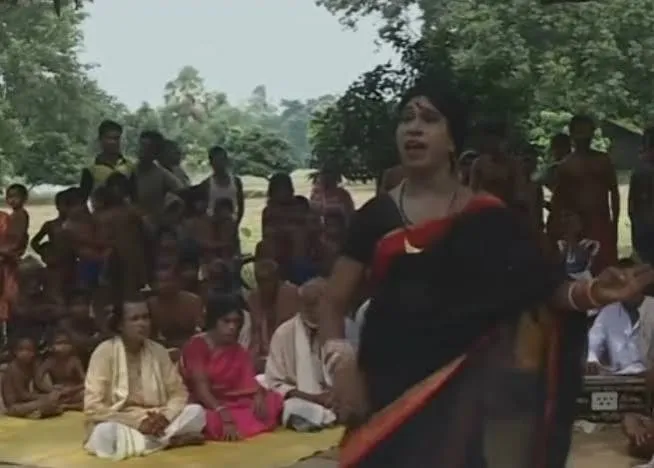
Alkap emerged as a performance tradition in the late nineteenth century in the rural districts of Bengal. It shares roots with the broader jatra tradition of Bengali folk performance but represents a specific regional and stylistic variant. The form developed as a performative response to seasonal agricultural cycles and community social life, traditionally staged in the post-harvest winter months. It is associated with a repertoire known as Bolbahi or Bolbhai, consisting of songs and satirical sketches enacting local events, characters, and scandals, which is identified as an earlier tradition that contributed to Alkap's development. The form gained limited literary recognition when the novelist Syed Mustafa Siraj, himself an Alkap artist from Murshidabad, incorporated Alkap narratives and performance culture into his fiction. His novel Mayamrdanga is centred on an Alkap troupe.
Culture and Societies
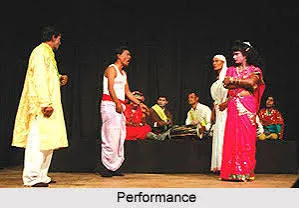
Alkap was historically performed by itinerant troupes comprising ten to twelve performers, led by a sarkar or guru. The troupe included two or three young male performers called chhokras, who were cross-dressed to play female roles, one or two gayens or lead singers, dohar or choristers, and musicians. A defining characteristic of the form was the use of young males as female impersonators, a practice that generated both theatrical interest and, in combination with the form's use of sexual humour and social transgression, restricted Alkap performances to night-time settings and to the physical periphery of villages. The form was associated with both Hindu and Muslim communities, reflecting the mixed population of its home districts. Haridas Palit and others documented the tradition within the cultural history of the Malda region; its connections to Vedic and medieval periods were claimed but remain difficult to verify with certainty. The performances were open to audience participation and were structured to allow real-time adaptation to audience response.
Religious Significance
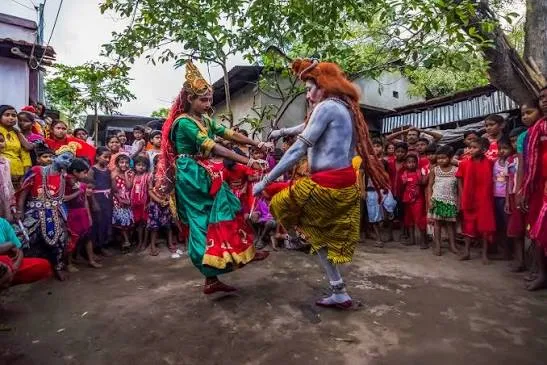
Alkap is associated with the Gajan festival dedicated to Lord Shiva, which takes place around mid-April. Some sources describe it as connected to the Gajan and Bahurupi impersonation traditions. However, the content of Alkap performances was predominantly social and satirical rather than devotional. The mythological content that appears in the song sections of performances, particularly stories of Radha and Krishna, served narrative and entertaining functions. The secular and transgressive character of the form's satirical skits and sexual comedy distinguishes it from ritual performance; the connection to Gajan is contextual rather than indicating a devotional primary function.
Understanding the Art
Style
Alkap is presented in five documented structural parts: Asar Vandana, an opening invocation; Chhora, a type of song; Kaap, the satirical skit sections from which the form takes its name; Baithaki Gaan, seated songs; and Khemta Pala, a closing section. The sarkar enters first, singing a vandana or hymn, and recites introductory verses. Singers then begin the alkap sections while choristers reinforce the burden of the song. The actors have a general notion of the storyline and improvise within it in a manner the Banglapedia article by scholar Wakil Ahmed compares to the Italian commedia dell'arte tradition. Two themes co-exist: mythological songs, particularly those centred on Radha and Krishna, and satirical dialogues addressing contemporary social events. The satirical sections, the kap, are the performative core of the form and involve vigorous bodily comedy, social mockery, and humour of a kind considered inappropriate for domestic or daylight contexts.
Central Motifs and Their Significance
Alkap historically served as a mechanism for social commentary and critique directed at those in authority. In the feudal context of rural Bengal, the mimicry of kings, landlords, and social superiors was a central feature. The transgression of gender norms through male cross-dressing and the use of sexual innuendo functioned as carnivalesque inversions of the social order. Mythological narratives, particularly those of Radha and Krishna, provided a poetic and culturally familiar substrate that the satirical sections could both draw upon and subvert. The form has been analysed by scholars including Mafijul Hoque and Mehtab Shaikh as an instance of folk carnivalesque, in the theoretical sense developed from Mikhail Bakhtin's analysis of folk humour as a mode of social resistance.
Process
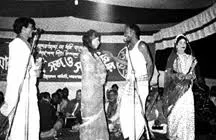
Alkap performances take place at night on an open stage lit by lanterns known as hyajak bati. Musicians sit below the stage while performers occupy the stage proper. The stage is surrounded by the audience on all sides, with a narrow passage left open for performer movement. There is no written script; the performances are entirely improvised around known narrative outlines. Instruments include the drum, harmonium, tabla, tambourine, and flute. The cross-dressed chhokras perform dances called nachari or lachari. The performance has no fixed duration and can continue for multiple days in its traditional form, though this practice has become rare.
Mediums Used
Alkap uses an open-air night-time stage, minimal costumes adapted to the roles being performed, and a small ensemble of traditional instruments. There is no written script. The form is entirely dependent on oral transmission and improvisational skill. The instruments used are the drum, harmonium, tabla, tambourine, and flute.
New Outlook
Alkap has experienced a severe decline in the late twentieth and early twenty-first centuries. Practitioners including the writer and performer Karunakanta Hazra have documented the difficulty of sustaining the tradition without urban audiences or institutional support. The form's sexual and transgressive content, which was historically central to its performative identity, has created friction with government-sponsored preservation programmes that tend to favour sanitised representations. The Information and Cultural Affairs Department of West Bengal recognised the form in a 2001 publication. Limited efforts have been made to bring Alkap into urban performance contexts, but scholars and performers note that such decontextualisation alters the form's character fundamentally.
Learn Alkap

Bibliography
Sources
Ahmed, Wakil. “Alkap Gan.” Banglapedia. Asiatic Society of Bangladesh.
Bhattacharyya, Ashutosh. Banglar Lokosamskriti (Folk Culture of Bengal). Calcutta Book House, 1962.
Hoque, Mafijul, and Mehtab Shaikh. “The Folk Carnivalesque: Resistance and Subversive Wit in Bengal's Alkap Tradition.” ShodhKosh: Journal of Visual and Performing Arts, 2024.
Islam, Md. N. Alkap. Information and Cultural Affairs Department of West Bengal, 2001.
Siraj, Syed Mustafa. Mayamrdanga.
Image Sources
“Alkap.” Banglapedia, https://en.banglapedia.org/index.php/Alkap_Gan. Accessed 4 July 2026.
“Alkap.” Indianetzone, https://www.indianetzone.com/alkap_indian_art_form. Accessed 4 July 2026.
“Alkap Dance of West Bengal.” Auchitya, https://www.auchitya.com/alkap-dance-of-west-bengal/. Accessed 4 July 2026.
“Bengal Cultural Folk Dance.” Wikimedia Commons, https://commons.wikimedia.org/wiki/File:BENGAL_CULTURAL_FOLK_DANCE.jpg. Accessed 4 July 2026.
