

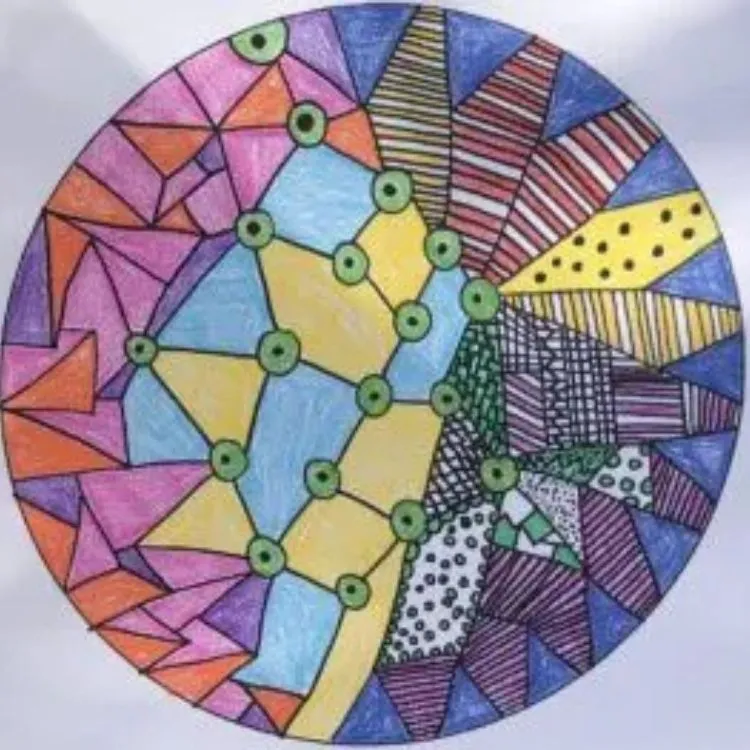

Mandala art therapy uses one simple constraint: you draw or colour inside a circle. Mandala is Sanskrit for circle. In Hindu and Buddhist practice it is a diagram of the cosmos used for meditation. In therapy it is borrowed for a plainer reason, which is that a bounded, repetitive task gives an anxious mind something to hold onto. Below is what the research supports, why the circle seems to help, and a practice you can do tonight.
Where mandala therapy comes from
Carl Jung brought the mandala into Western psychology. While commanding a camp for interned soldiers in Switzerland in 1918 and 1919, he drew a small circular sketch in his notebook most mornings. He later read the drawings as a record of his inner state that day. Art therapists picked up the idea from there, and Joan Kellogg built a whole assessment method around patients' mandalas.
What the research actually shows
The evidence is real but modest:
- Curry and Kasser, 2005. In a small study in the journal Art Therapy, students colouring a mandala template lost more anxiety than those who coloured freely.
- Van der Vennet and Serice, 2012. A replication found the same pattern.
- Henderson, Rosen and Mascaro, 2007. People who drew mandalas about a trauma showed fewer PTSD symptoms a month later. They did not show less depression or anxiety.
Nobody has shown that mandalas lower blood pressure or boost immunity, and this page no longer says so.
Means to an end
Three features do the work:
- The boundary limits choices, so you stop deciding and start doing.
- Repetition around a centre sets a rhythm, like counting breaths.
- Symmetry gives a visible sign of order building up, which is satisfying when the rest of the day feels out of control.
A 20-minute guided practice
- Draw a circle the size of a dinner plate. Mark the centre with a dot.
- Breathe out slowly once before every new ring.
- Draw a small shape at the centre. Repeat one shape around it four or eight times.
- Add rings outward. Let each ring echo the last with one change.
- Colour from the centre out. Do not plan the colours in advance.
- When you finish, write one line about how you feel. Date it.
When to see an art therapist
Colouring a mandala is a self-care tool, not treatment. If you are dealing with depression, trauma or anxiety that gets in the way of daily life, a qualified art therapist or mental health professional can guide the work properly. In India, Tele MANAS (14416) is a free government mental health helpline.
Learn mandala with Rooftop
Our mandala workshop with Manali Pardeshi walks beginners through their first grid. For the philosophy behind the circle, read Mandala: the art of living. For how other Indian traditions approach healing through art, see Art and Ayurveda.