

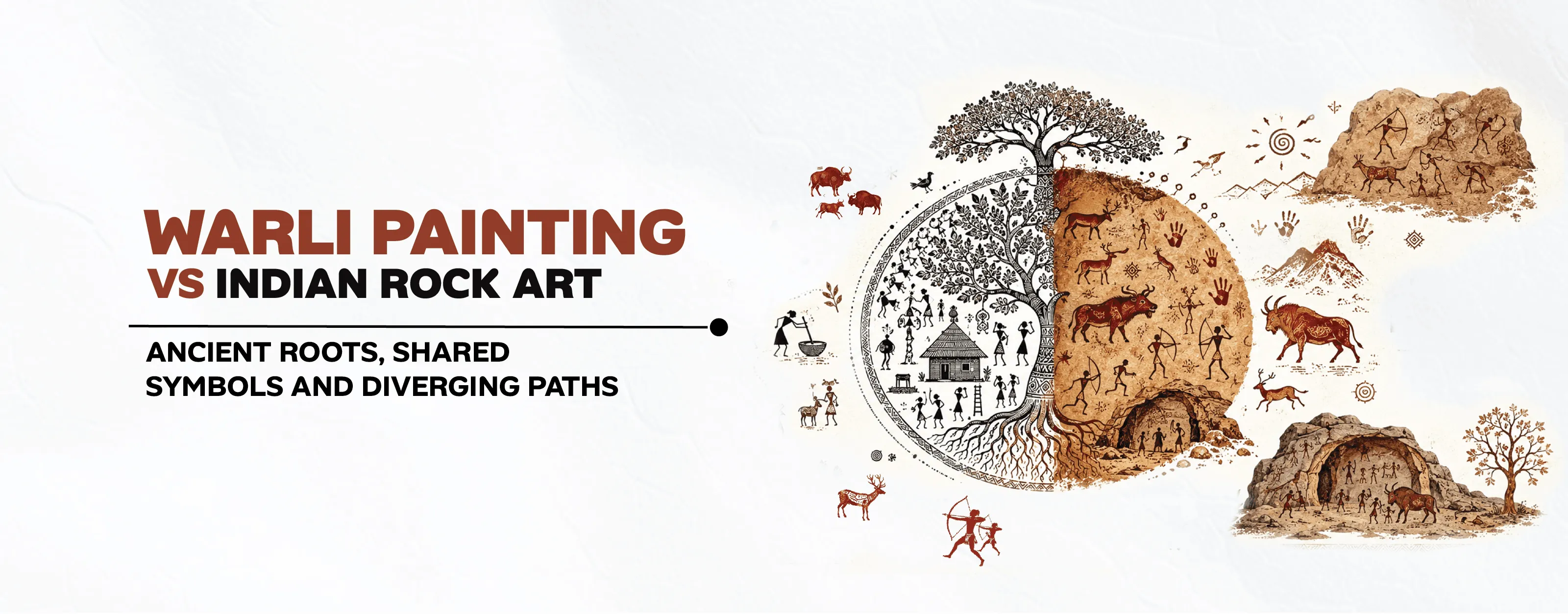
Warli Painting vs Indian Rock Art: Ancient Roots, Shared Symbols and Diverging Paths
Warli painting and India's prehistoric rock art share the same circles, triangles and figures. Here is what that long history of Indian art reveals, and where it ends.

Rooftop
Author
Put a Warli wall painting next to a photograph from a prehistoric rock shelter, and something strange happens. The two images rhyme. Both are worked in white on a dark ground. Both shrink the human body down to two triangles joined at a point. Both crowd the surface with small figures who dance, hunt, and walk in lines. One was painted a few decades ago on the mud wall of a home in Maharashtra. The other was painted on stone many thousands of years before writing existed.
That echo is easy to admire and much harder to explain. It is tempting to say that Warli painting simply is rock art, carried forward without a break. The truth is more interesting than that, and more honest. Warli painting sits at one end of a very long history of Indian art. The painted rock shelters sit at the other. What runs between them is not a single thread but a question worth taking seriously. Why do communities separated by ten thousand years reach for the same handful of shapes when they want to picture themselves?
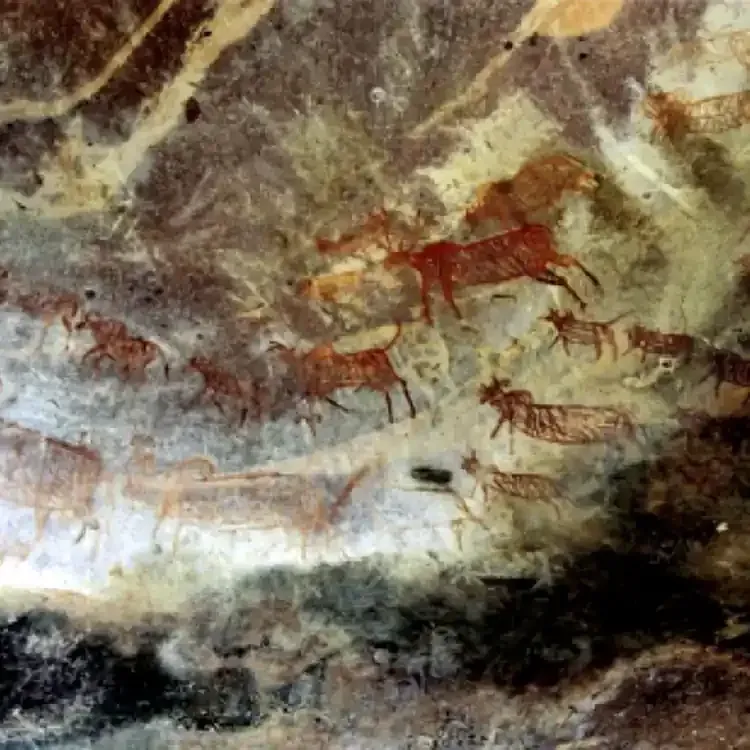
Prehistoric paintings at the Rock Shelters of Bhimbetka, Madhya Pradesh. Source: UNESCO World Heritage Centre
India's Rock Art Tradition: What the Painted Shelters Tell Us
India holds one of the richest concentrations of rock art on earth, and it is spread very widely. The most studied site is Bhimbetka in the Raisen district of Madhya Pradesh, about forty five kilometres south of Bhopal. Painted shelters also survive in the Jogimara caves of Chhattisgarh and across the Kumaon hills of the lower Himalaya. These sites were never part of one school or movement. They were made by different people, in different places, often centuries apart.
Bhimbetka shows just how deep this history runs. The site spreads across roughly ten kilometres of sandstone outcrops in the Vindhyan foothills. More than seven hundred and fifty shelters have been recorded, and around four hundred of them carry paintings. The oldest images are dated to about ten thousand years ago, and the shelters themselves show signs of human use stretching back far longer. The scale of the place was only fully reported in the 1970s, which is a date worth remembering for later.
750+ shelters, paintings from c.10,000 BCE
Bhimbetka spreads across about 10 km of the Vindhyan foothills. Around 400 of its 750-plus rock shelters carry paintings, and the oldest are dated to roughly 10,000 BCE. The site was inscribed by UNESCO in 2003.
What the painters chose to show is remarkably consistent. Across widely separated shelters and across thousands of years, the same subjects keep appearing. There are hunters with bows. There are large animals, bison and deer and elephants, often shown in motion. There are rows of figures dancing or moving together in groups. There are simple geometric forms that are harder to read. The vocabulary is small, but it is used again and again, by people who could not possibly have known each other. That repetition is the first clue that we are looking at something deeper than copying.
Warli Painting: A Living Tradition with Ancient Characteristics
Several hundred kilometres to the south west, in the Palghar district of Maharashtra, the Warli community has kept a painting tradition alive on the inside walls of its homes. You can read a fuller account of its roots in this overview of the Warli painting tradition. The Warli are among the older and larger tribal communities of the North Sahyadri hills, and their painting was, until recently, almost entirely private.
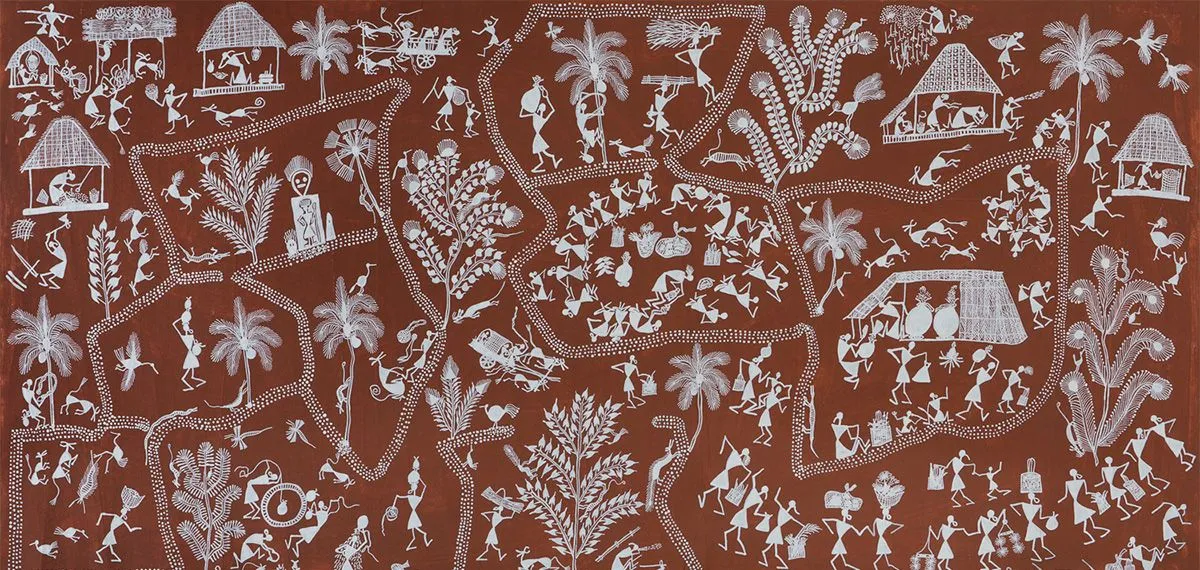
Warli painting was never made for galleries. It was made for ritual. The most important paintings mark life events such as weddings, where a square design called the chauk holds the marriage goddess at its centre. Other paintings mark the harvest and seasonal ceremonies. The work was traditionally done by married women, who painted with a paste of ground rice on walls coated in cow dung and earth. The result is the look that makes Warli instantly recognisable. Thin white figures glow against a warm dark ground, with no shading and no fixed viewpoint, just clear lines that anyone in the home could read.
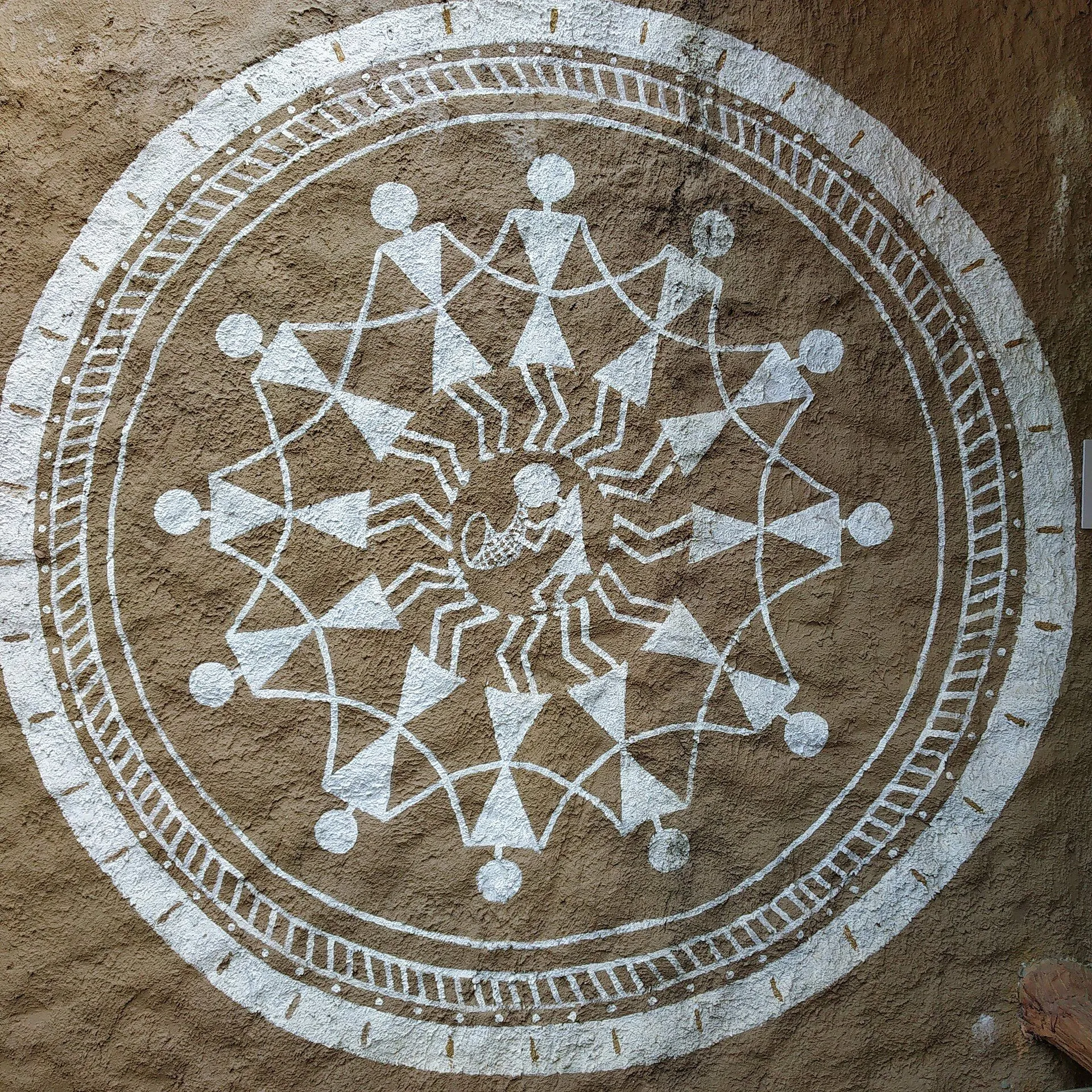
Traditional Warli wall painting in white rice paste on an earth ground. Source: Wikimedia Commons (Warli painting)

This is what people mean when they call Warli a living tradition with ancient characteristics. The style is plain and old, but the practice is current. The figures are not relics. They are made by people who can tell you what the wedding square means, why the goddess sits where she sits, and which song goes with which dance. That knowledge has never been written down in a manual. It travels from one generation to the next inside the community itself.
The Shared Visual Grammar: Circles, Triangles, and the Human Figure
Now we can look closely at the resemblance. Both Warli painting and Indian rock art build the human body the same way. The torso becomes two triangles meeting at the waist. The head becomes a circle. Arms and legs become single lines. This is not a style choice in any modern sense. It is a solution to a hard problem, which is how to show a living, moving person using the fewest possible marks.
The shared grammar goes beyond the single figure. Both traditions love the group in motion. In Warli painting the clearest example is the tarpa dance, where figures spiral outward in a long curving chain around a musician playing a wind instrument. In the rock shelters you find the same instinct, with rows and circles of dancers moving together. Both also return to the hunt and the procession, scenes where many bodies act as one.
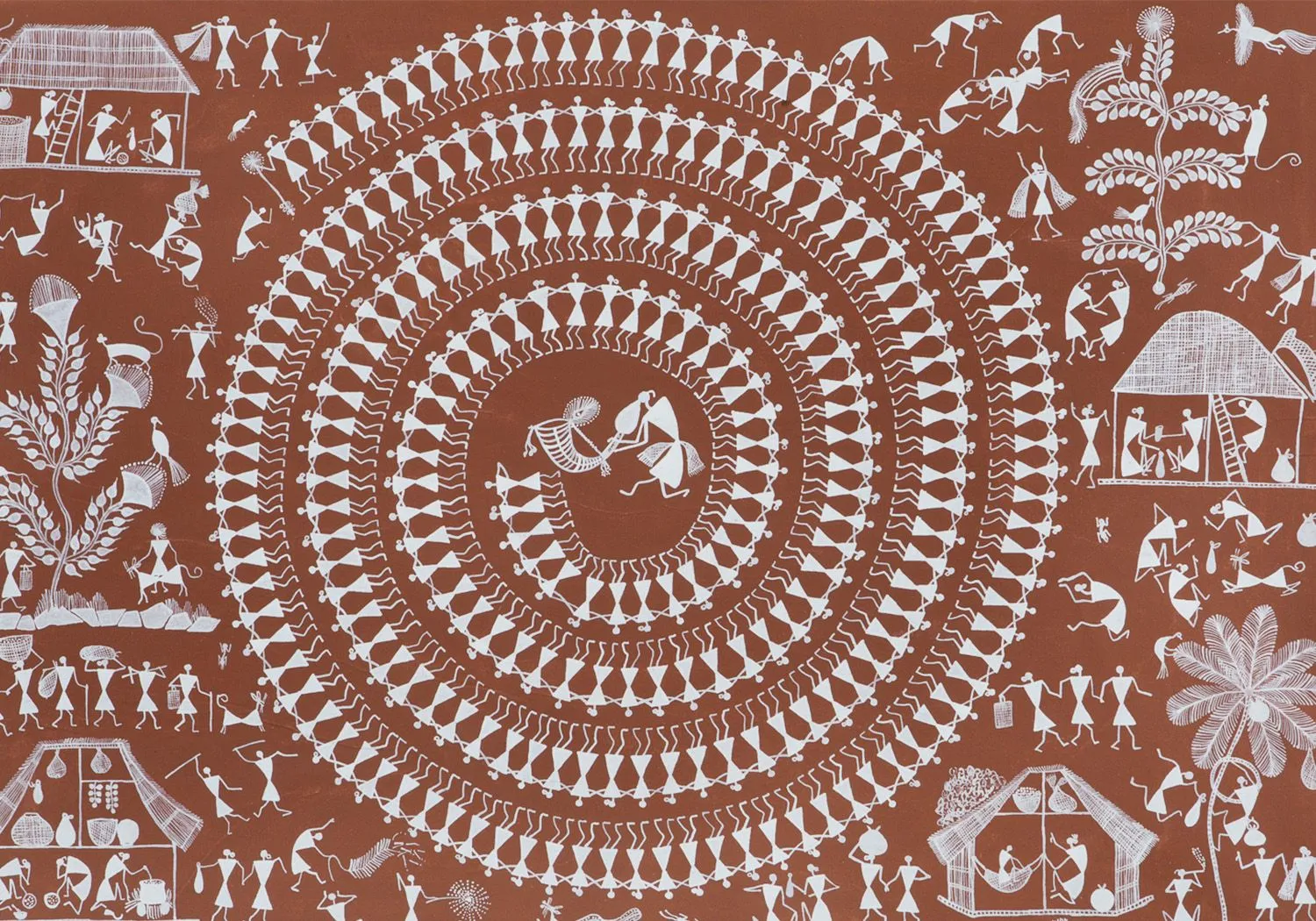
The tarpa dance, a spiralling chain of figures around a single musician. Source: https://imp-art.org/articles/warli-painting/
If you set the two side by side, the overlap is easy to list:
- The body reduced to triangles, circles and single lines, with no attempt at realistic anatomy.
- Group scenes of dancing, hunting and walking together, rather than single heroic figures.
- A flat surface with no horizon and no fixed viewpoint, where figures sit wherever the story needs them.
- White or pale pigment chosen to stand out against a dark wall or dark rock.
21 villages still echo the painted rock
UNESCO notes that the cultural traditions of the twenty one villages beside Bhimbetka still resemble the scenes painted on the shelter walls. The link between the painted past and present-day life is not a theory there. It is visible in how people still live.
The quickest way to feel why these shapes survived is to try drawing them. A few triangles and a steady line, and a figure appears. Anyone who wants to learn the strokes properly can start with a Warli art kit that comes with a practice canvas, bookmarks and an activity book built around the basic forms.
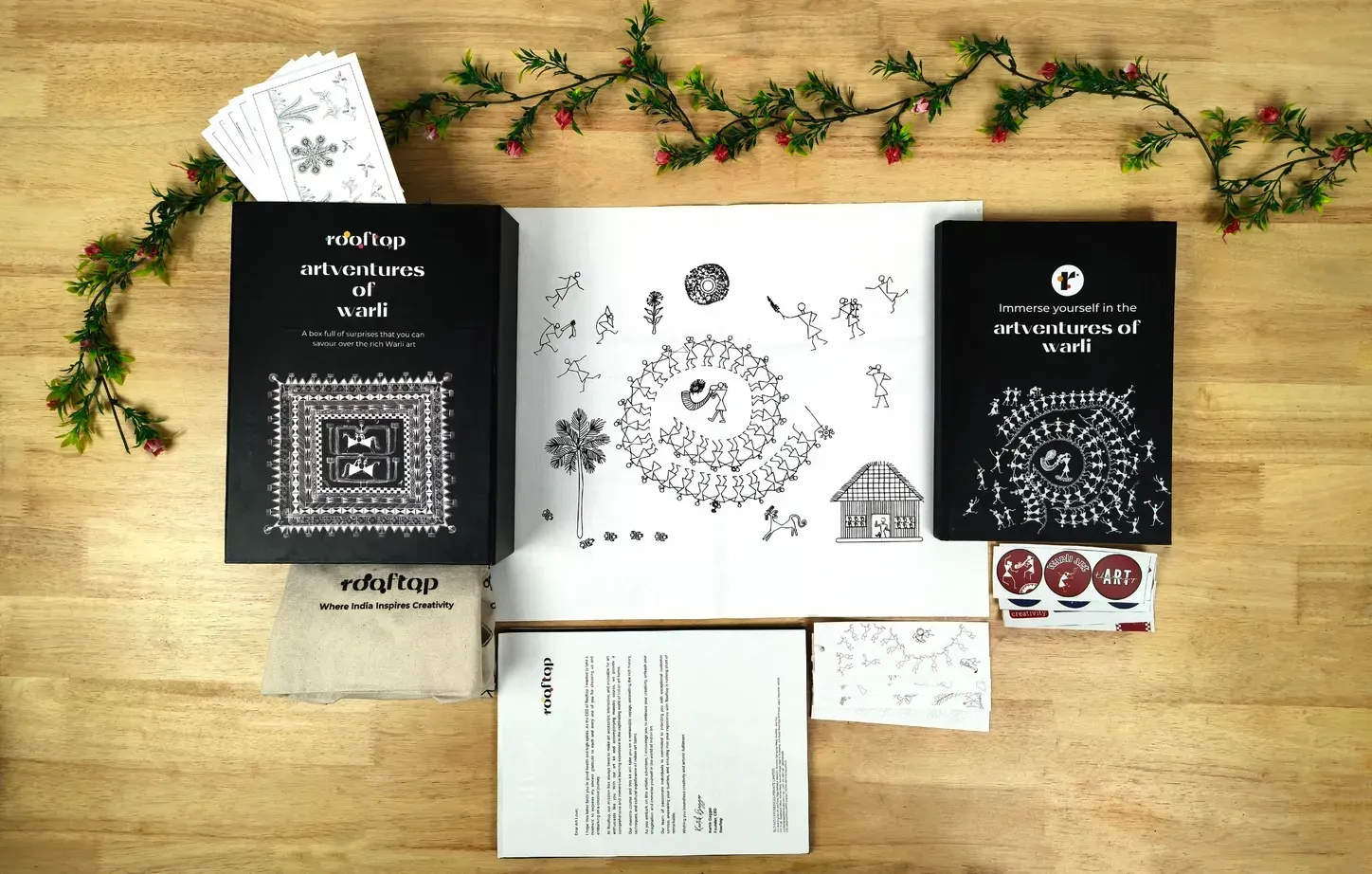
Warli Art Kit, a starter set built around the core Warli shapes. View on Rooftop
Where the Comparison Holds and Where It Breaks Down
It would be easy to stop here and declare that Warli painting is rock art that never died. That story is tidy, and it is wrong. The honest position is to hold two things at once, which is exactly where careful comparison earns its keep.
Where they meet. Both traditions reduce the body to its simplest geometry. Both gather figures into scenes of dancing, hunting and moving together. Both came from whole communities rather than from single named artists working for a market. At the level of pure visual habit, the kinship is real and worth taking seriously.
Where they part. Rock art is an archaeological record. We do not know for certain who made it, or why, or what the figures meant to the people who painted them. Warli painting is a living practice, and its meaning is known because the community that makes it is still here to explain it. Treating the two as one unbroken line flattens that difference and quietly erases the people who keep Warli alive today.
Responsible comparison means naming both the continuity and the rupture, and it means resisting the urge to collapse every tribal pictograph into one family. The Warli figure looks a great deal like the Saura figure of Odisha, for example, yet the two are distinct traditions with their own rules, as this look at Warli and Saura side by side shows. Resemblance is a starting point for a question, not the end of one.
What the Comparison Reveals About Visual Memory and Cultural Continuity
So what does it actually mean that the same shapes recur across such enormous stretches of time on the Indian subcontinent? The most likely answer is not a secret lineage. It is that certain visual solutions are simply very good. The triangle body, the group dance, the animal in motion are efficient and clear. Different people in different ages arrived at them independently because they work.
There is a second answer that matters just as much. Visual knowledge can survive for a very long time without any school, museum or written manual to carry it. In Warli painting it survives through ritual repetition, through the songs and ceremonies the paintings belong to, and through the simple fact of children watching adults paint. This is cultural memory held by practice rather than by text. It is fragile in some ways and astonishingly durable in others.
A timeline across the millennia
- c.10,000 BCE The oldest surviving paintings at Bhimbetka are made, with white and red figures of hunters, animals and dancers on sandstone.
- Stone Age onward Similar figures appear at rock shelters far apart, from the Vindhyan hills to the Kumaon foothills, sharing a visual habit without any shared school.
- Recent centuries Warli families in the North Sahyadri hills paint white rice-paste figures on the mud walls of their homes to mark weddings and harvests.
- 1970s The wider world meets both at once. Bhimbetka's true scale is finally reported, and Warli painting steps off the wall and onto paper.
- 2011 Jivya Soma Mashe receives the Padma Shri, recognition for a tribal art that galleries had ignored only a generation earlier.
- Today Warli figures travel on canvas, fabric and screens, while a smaller group of artists keeps painting them inside the ritual life that made them.
Seen this way, Warli painting becomes one of the most compelling examples anywhere of visual culture surviving into the present. Whatever its precise relationship to the rock shelters, it proves that a community can carry a way of seeing across centuries using nothing but memory, ritual and a wall. The same triangular vocabulary runs through Gond painting as well, which is why one of Rooftop's pairings, the Tribal Arts of India book combo, places Warli and Gond together so the shared logic of tribal line and form is easy to compare on the page.
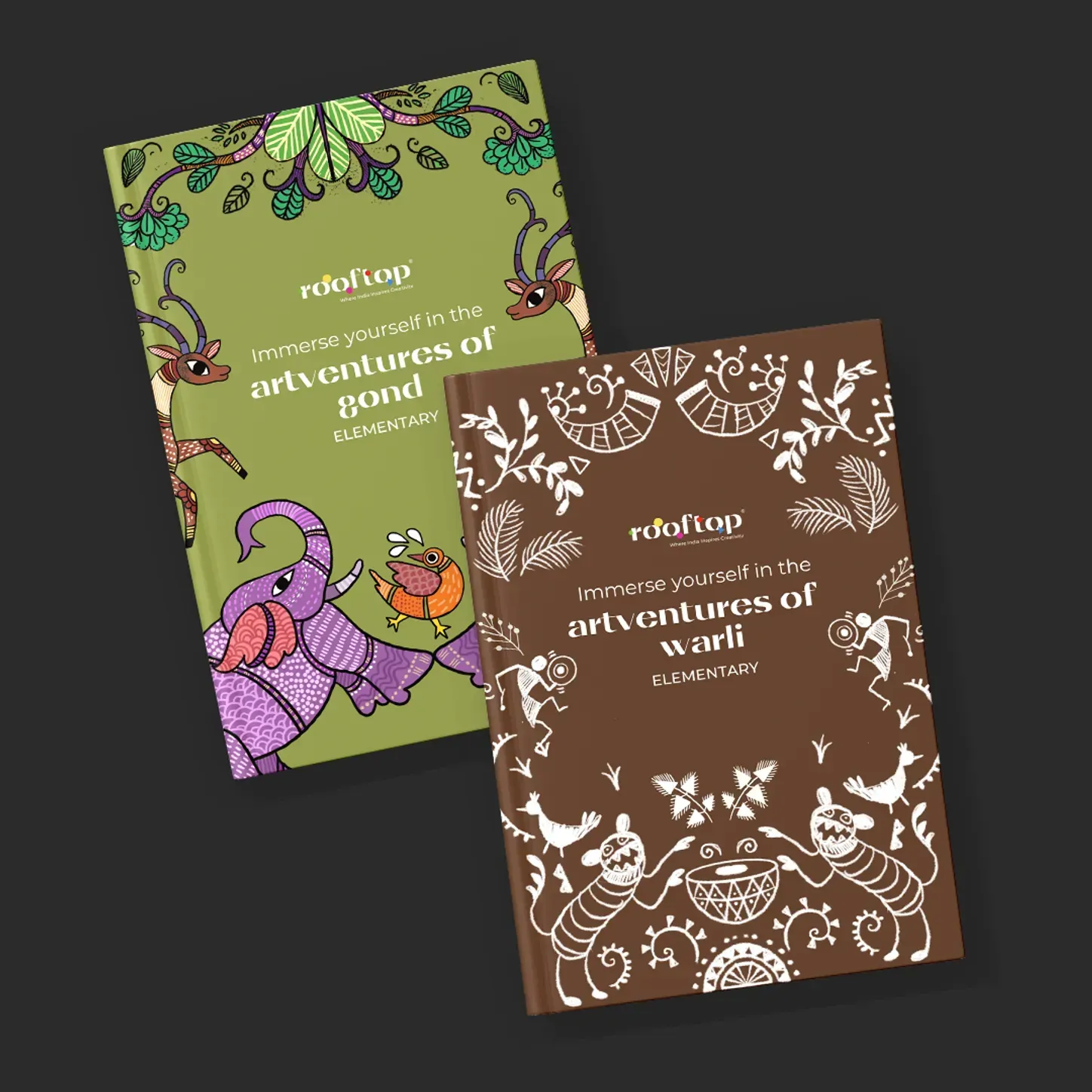
Tribal Arts of India combo, pairing Warli and Gond books. View on Rooftop
Warli Painting Today: Between Living Tradition and Art Market
The modern story of Warli painting turns on one person more than any other. Jivya Soma Mashe, born in 1934 in what is now the Palghar district, was the first Warli artist to move the figures off the wall and onto paper and canvas. In the 1970s he began painting every day rather than only for rituals, and that small shift changed everything. His work travelled from a Mumbai gallery to international shows, including the landmark exhibition Magiciens de la Terre at the Centre Pompidou in Paris in 1989.
Padma Shri 2011, Pompidou 1989
Jivya Soma Mashe received the National Award for Tribal Art in 1976, the Prince Claus Award in 2009 and the Padma Shri in 2011. His inclusion in Magiciens de la Terre at the Centre Pompidou in 1989 helped move Warli painting from village ritual into the global art conversation.
Everything moves, day and night. Life is movement.
Jivya Soma Mashe, on the Warli view of the world.
That success came with a cost, and it is worth naming plainly. As Warli became a recognisable graphic look, it was lifted onto sarees, mugs, packaging and logos, often with no connection to the community or the meaning behind the figures. A wedding square becomes a pattern. A sacred dance becomes a border print. The risk is not that Warli spreads. The risk is that it spreads as decoration while the living practice behind it thins out, with fewer women painting the ritual walls each year.
This is the line Rooftop tries to hold. The aim is to support Warli artists who still paint from inside the tradition, who learned it the way it has always been learned, rather than treating the style as a free template to be copied. Buying from a practising community artist is not the same as buying a Warli-style print, and the difference is the whole point.
##A Living Thread, Not a Style
The next time you see those white triangle figures, try not to read them as a trend. Read them as the latest visible point on one of the longest unbroken lines in the history of human image making, a line that runs from a painted shelter in the Vindhyan hills to a mud wall in a Maharashtra village to a canvas in a gallery. The shapes have barely changed. What has changed is who paints them, and why. You can meet that living end of the thread directly through Rooftop's collection of Warli paintings by practising community artists, where the figures still carry the world that made them.