

Jivya Soma Mashe and the Mashe Family: The Dynasty That Brought Warli Art to the World
Discover how Jivya Soma Mashe transformed Warli painting from ritual wall art into a globally recognised art form, and how the Mashe family continues that legacy today.

Rooftop
Author
We have all come across Warli art in some form or another. Warli art is now as recognised as an independent art form in India as it is abroad. This recognition that Warli art has received is credited to Jivya Soma Mashe (1934-2018), a Warli master artist who took this art form to the world stage and put it on the global art map.
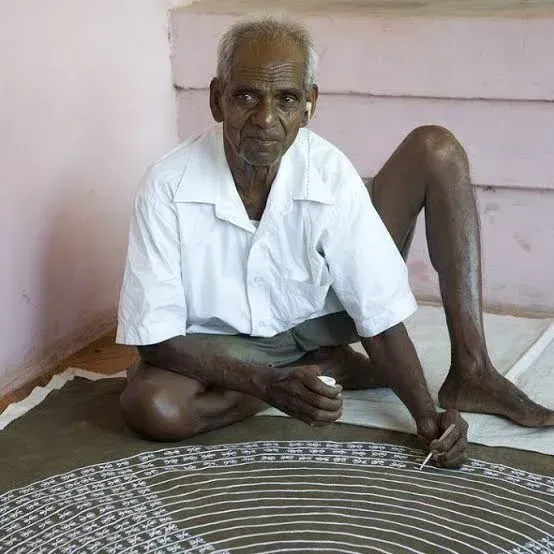
Jivya Soma Mashe (1934-2018)
As we all know, Warli art is associated with the people belonging to the Warli tribe. The Warli tribe is indigenous to the coastal borders of Northern Maharashtra and Southern Gujarat, as also Daman, Diu and Dadra and Nagar Haveli. Traditional Warli art is the form of cultural expression of the Warli people and is said to originate as far back as 2,500 BCE. In fact, one of the enduring characteristics that makes Warli art important to the community is it’s easily visible resemblance to prehistoric rock art found in India and around the world. As such, this continued practice is an important source of ethnographical study of not only the Warli tribe in particular but also of the development of art and human civilisation.
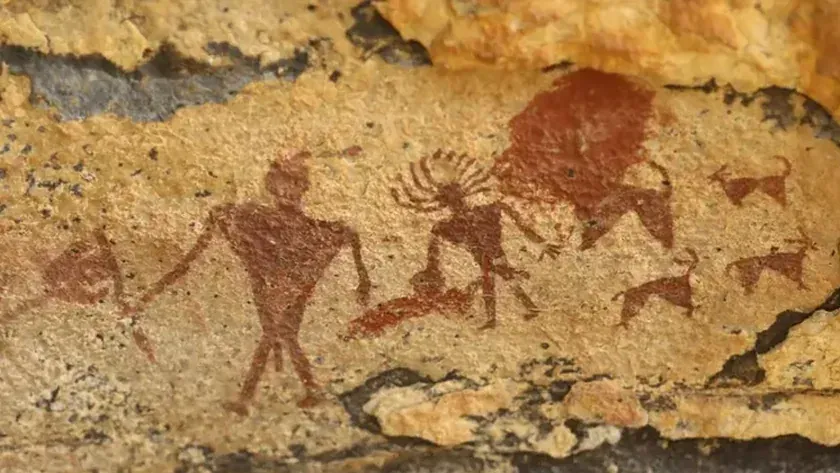
Famous Caves in Madhya Pradesh: Bhimbetka Rock Shelters: A Window to Prehistoric Times Source: Gandhi Sagar Forest Retreat
During the 1970s, Warli art began to be drawn out of this domain of tradition and into the art market. This was led by Jivya Soma Mashe whose fame reached even the international stage. Following his example and looking at the commercial viability of the art form, male artists from the community began practicing Warli art for commercial purposes. While women remained connected to Warli art in the context of ritualistic tradition, the commercial success of Warli art is widely attributed to male artists. With time, male artists began to replace the ‘sanvasins’ or ‘suvasins’ for creating the ‘lagna chauks’ which were traditionally created by the ‘suvasins.’ And non-Adivasi men and artists also took to Warli painting, often losing the context of what was being painted as they were not familiar with Warli folklore and traditions.
Warli Before Jivya: the tradition as it existed before outside attention; who made it, where, for what purpose; why it was painted on walls and not on portable surfaces; what would have been lost if it had remained only there
Warli Art - A Warli Tradition
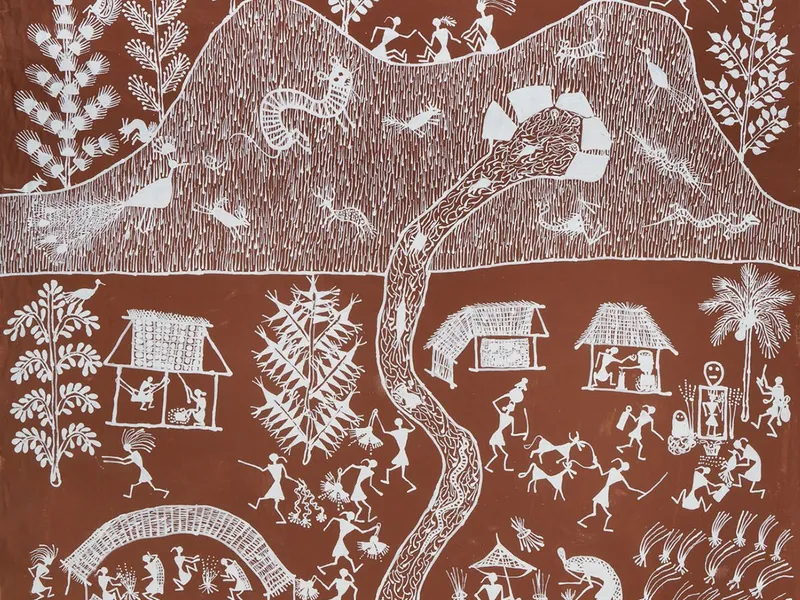
In the case of Warli art, it was practised as a marriage ritual where traditionally married women known as ‘suvasins’ or ‘sanvasins’ painted this art form on the kitchen walls of the bride to mark the occasion of her wedding. The particular composition was called the ‘lagna chauk’ or the wedding square. This ‘chauk’ would also depict the family and other deities. Widowed women known as Dholaveri, who acted as marriage officiants of the tribe, would then sing traditional songs to invoke the blessings of the gods on this special occassion. The walls on which these paintings were created were plastered with cow dung with a surface coat of ‘geru’ or red earth rich in iron oxide. White rice paste would be used as paint with bamboo sticks and sticks from the date tree as brushes. As such, Warli art was an intrinsic part of female identity in the Warli community.
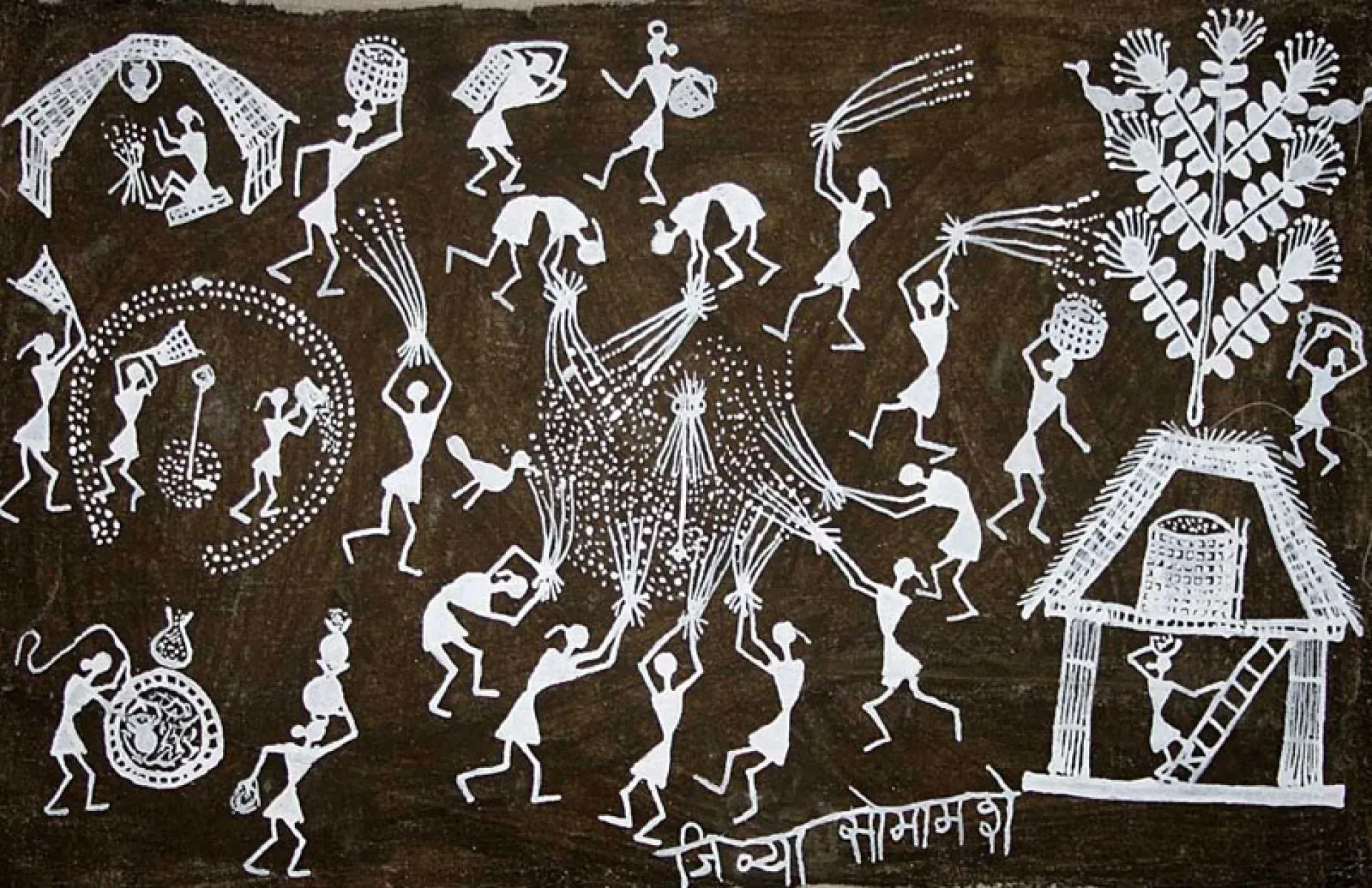
Warli art, in essence, derives it’s identity from Warli cultural practice. The traditional compositions depict motifs are inspired from the daily life and customs of the Warli people. Traditional motifs include gods and goddesses, as well as instruments of use. For example, the linear pattern of alternating white and red squares in a ‘chauk’ is said to represent the Mother Goddess Pophala. The traditional ‘chauk’ has a square at the centre, which houses the deity Palghata, who is considered the supreme mother goddess and the goddess of marriage and fertility by the Warlis. Triangular patterns are used to represent the ‘dhak’, a musical instrument played at weddings. The circle represents the sun and the moon, and circular patterns represent the circle of life. Trees and mountains are depicted using triangles. Since square forms are not readily found in nature, they are used to indicate sacred lands and enclosures. Each line in Warli painting is said to symbolise something deeper.
The motifs are combined together to create compositions that usually tell a story or communicate a message. Therefore, Warli art is a narrative tradition and is also regarded as a script or a ‘lipi’ that is used to communicate and hand down generational knowledge. Along with ritualistic painting of weddings, tribal dances and other festivities, ancestral lands are also depicted in Warli landscape paintings along with daily occupational activities such as plowing, sowing and harvesting. Warli paintings then further go on to depict the very nature in which the community lives along with it’s flora and fauna.
Jivya Soma Mashe: the Artist and the Man: his background in the Warli community of Palghar, Maharashtra; how he came to paint on paper, who first noticed his work, and how it entered the art world; what made his particular vision of Warli distinctive among his contemporaries
Jivya Soma Mashe, the Man and the Artist
Jivya Soma Mashe, a Warli master artist who is known to be the first one of his kind to gain national and international renown, is also regarded as the ‘Father of Warli Art.’ Mashe lived and worked in the Ganjad village of Dahanu sub-district in the Palghar district of Maharashtra, India.
Mashe lost his mother at a young age of seven and was brought up by his elder sister. Due to the shock incurred upon the loss of his mother, Mashe lost his speech. During this time, he took to communicating with drawings made in mud. Gradually, his sense of speech returned as he grew up. By then, art had taken root in his life, and he had understood the significance of the communicative power of art. As a person, he was a keen observer of nature and his surroundings, and preferred to be alone. He loved farming and farm animals and birds. His interest in art soon found an outlet as he started assisting the ‘suvasins’ in painting the ‘lagna chauks.’ The ‘suvasin’ women used to traditionally begin painting the ‘chauks’ and then would let Mashe take over to complete the work. Thus, Mashe learnt to create Warli paintings by watching the ‘suvasins’ paint. The ‘suvasins’ painted on the internal walls while he painted on the external walls of the house. He learnt to paint Warli paintings by watching the ‘suvasins’ paint. The ‘suvasins’ painted on internal walls while he recreated the paintings on external walls.
As a Warli tribesperson, Jivya understood not only the importance of art but also the deep symbolism behind the motifs and patterns used in Warli art that imparted a special meaning to what was being painted. Mashe then started painting the ‘dev chaukat’ or the ‘lagna chauk’ in his regular art practice as well. For this, he faced opposition from the traditional and rudimentary Warli community initially.
Then Mashe was discovered by Bhaskar Kulkarni, a contemporary artist from Mumbai who was also associated with the Indian Handloom Board. He became a mentor to Mashe. It was under his mentorship that Mashe first painted Warli art on paper. Subsequently, he started painting on cloth and canvas as well. Mashe became the first Warli artist to paint on portable media such as paper and canvas. Kulkarni arranged for Mashe’s works to be exhibited at Pragati Maidan in New Delhi in 1973 and at Chemould Gallery (now Chemould Prescott Road) in Mumbai in 1975. Kulkarni also arranged for a meeting between Mashe and the then Prime Minister Indira Gandhi. Upon meeting Mashe, Gandhi felt that Warli art needs to be brought before the world and that the preservation and propagation of this art form, local and tribal artists from rural India could be supported in a meaningful and sustainable way.
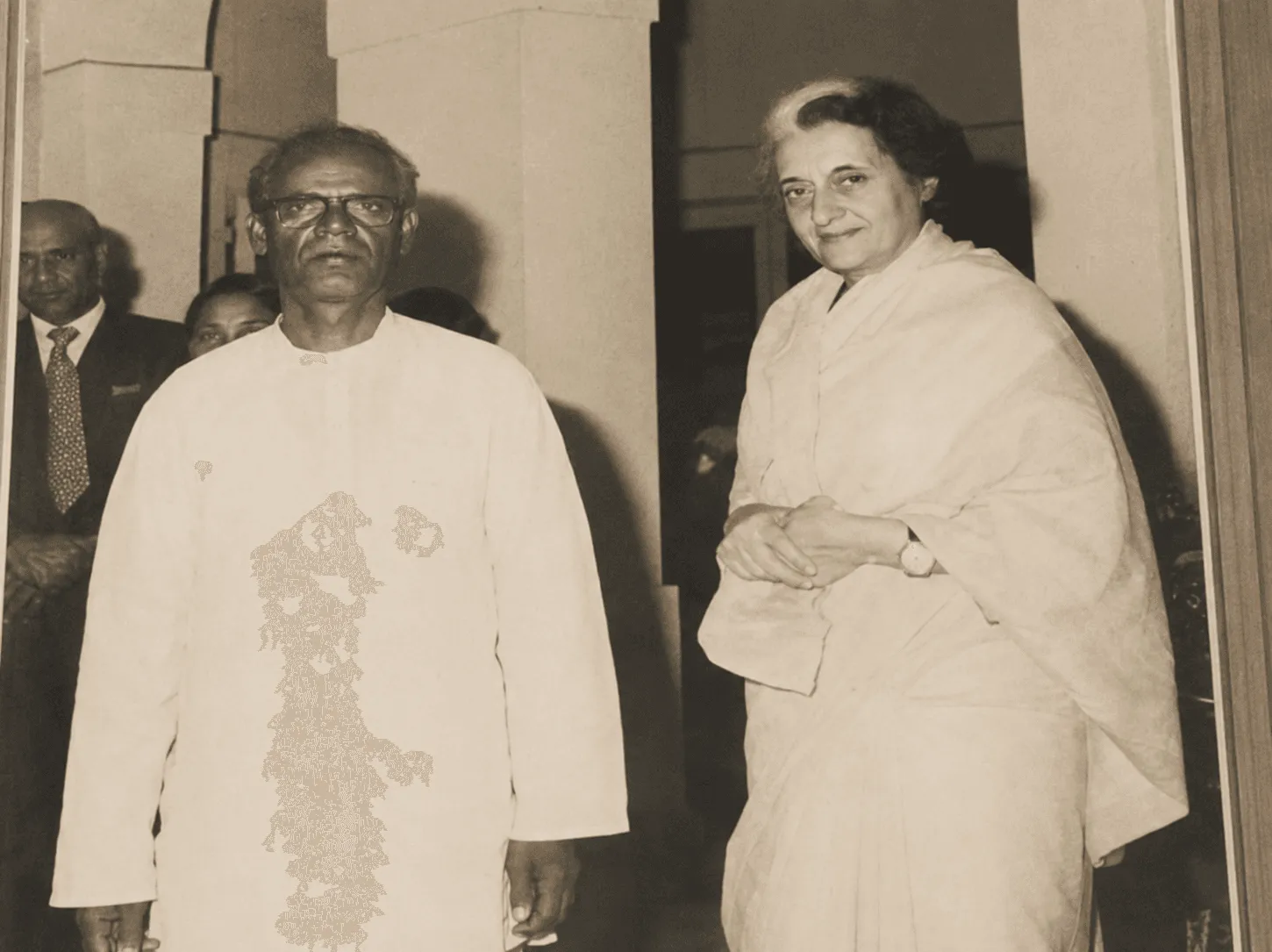
image source: Doordarshan Sahyadri
The exhibition at Chemould was a landmark exhibition which brought Warli art into the mainstream and into the space of contemporary art. The success of the Delhi exhibition also contributed to make Mashe popular. Mashe then went on to exhibit twice at Jehangir Art Gallery in Mumbai, a space that is reserved for and where some of the best artists have exhibited their works. Mashe’s first international exhibition was at Palais de Carnoles in France in 1976. Mashe was called to exhibit his works and conduct workshops on Warli art from around the world. Some of the places he visited include Japan, Germany, United States, the United Kingdom, China, Russia and various countries in Europe. He was also invited to the royal wedding of Prince Charles and Princess Diana which he attended. His large murals and collaborations exhibited in Japan and Europe found the most acclaim. His international exhibitions helped place Warli art on the global art map. His works also sold at auctions. His work ‘Mahalakshmi Gadh’ sold for USD 21,647 at an auction held by Pundole’s in 2026.
Mashe and His Art
Indeed, Mashe was so drawn to his art as an artist that he started to paint not just on ritual occasions but on a daily basis. As mentioned earlier, he was a keen observer of life and had grown up listening to the stories and folklore of his tribe since his childhood days. As such, Mashe commonly painted daily Warli community life, including farming and hunting scenes, ceremonial occasions such as harvest festivals, weddings, celebratory dances, as well as Warli myths and legends. He also painted scenes from the forest and wild animals in his paintings. He also painted his observations of the fast-changing world around him in Warli style. The newer motifs seen in his paintings include bicycles, steam engine trains, the hullabaloo of people at railway stations and fishing nets. Thus, he crafted a new visual vocabulary for Warli art to depict the changes in the society he lived in. Each of his paintings were unique, and a composition was only repeated if commissioned.
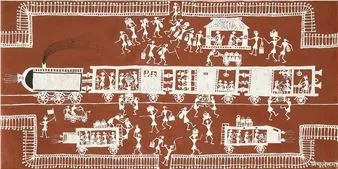
Jivya Soma Mashe Untitled Train (Source: Mutual Art)
The beauty of Mashe’s works is his precise linework, intricate details and the movement and rhythm of his compositions. But it is also the fact that while he shifted from painting on walls to cloth, he continued to use young bamboo sticks to paint his works. His mastery was such that even with these, he was able to create high-quality line work and a wide variety of patterns that denoted different textures within the composition and imparted to it a highly expressive visual elegance. His paintings are often characterised as those with great movement and rhythm, with each figure pulsating with a unique energy. He is quoted as saying, “Life is movement.” He continued to paint with bamboo sticks while his wife, Pavani, continued to grind rice paste for him to paint with. Mashe believed that after his wife came into his life, his art flourished.
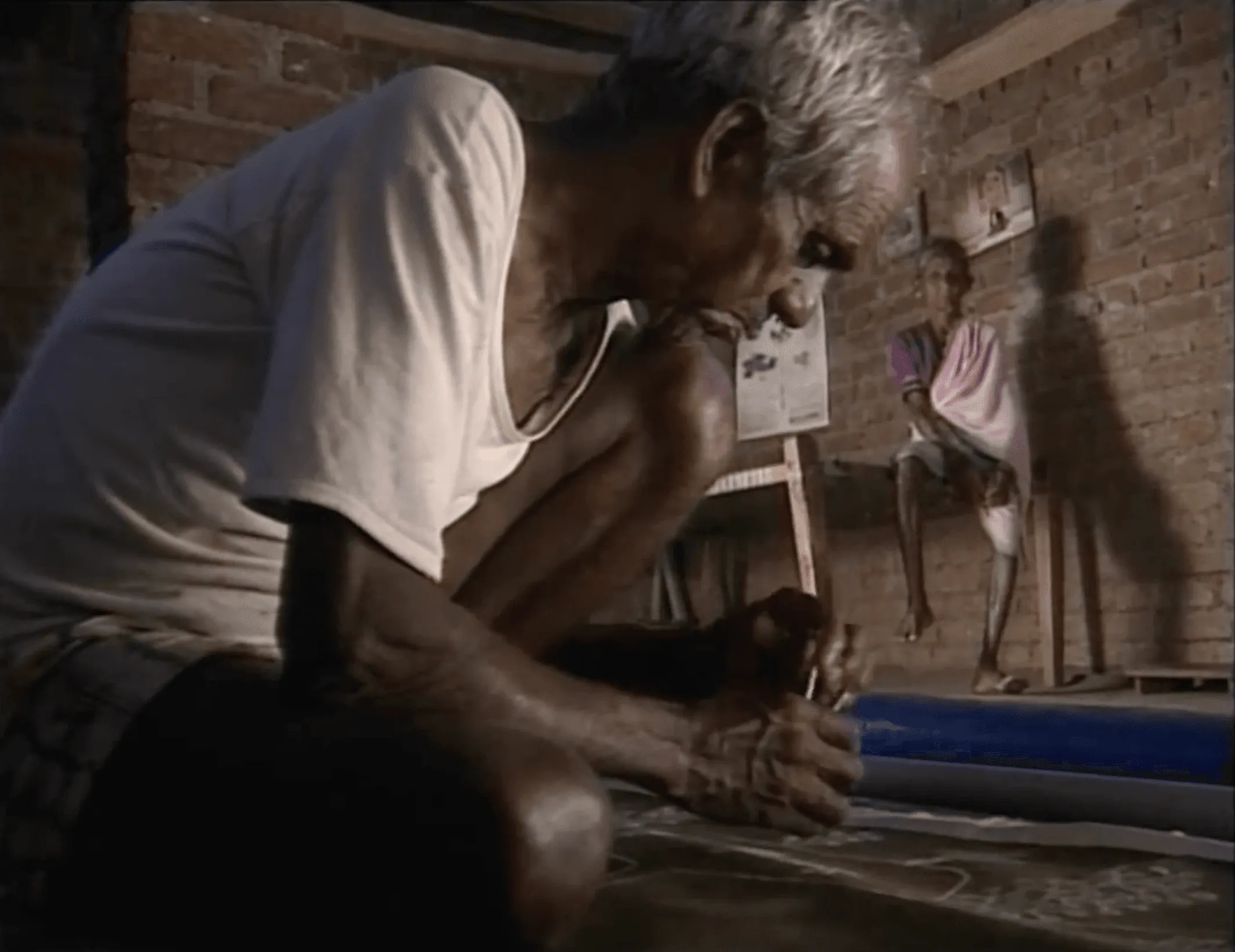
पालघर जिल्ह्यातील एकमेव पद्मश्री पुरस्कार विजेते वारली चित्रकार जीवा सोमा म्हसे
Along with the intrinsic simplicity of the Warli style itself, Mashe created thoughtful compositions that told a story as well as those that were easy to understand even by the lay audience. The composition flowed in clean lines and, even with the intricate detailing, did not overwhelm the viewer. His use of space in his compositions and the adaptation of motifs had a contemporary resonance. He created landscapes and integrated compositions that moved away from the traditional ‘chauk’ paintings. This was an inherently fine art approach, though created in Warli style. He even painted the local flora and fauna of Dahanu in Warli style in individual depictions and in the likeness of botanical illustrations. Some of his landscapes are also reminiscent of the landscapes seen in Phad paintings, the scroll painting tradition from Rajasthan.
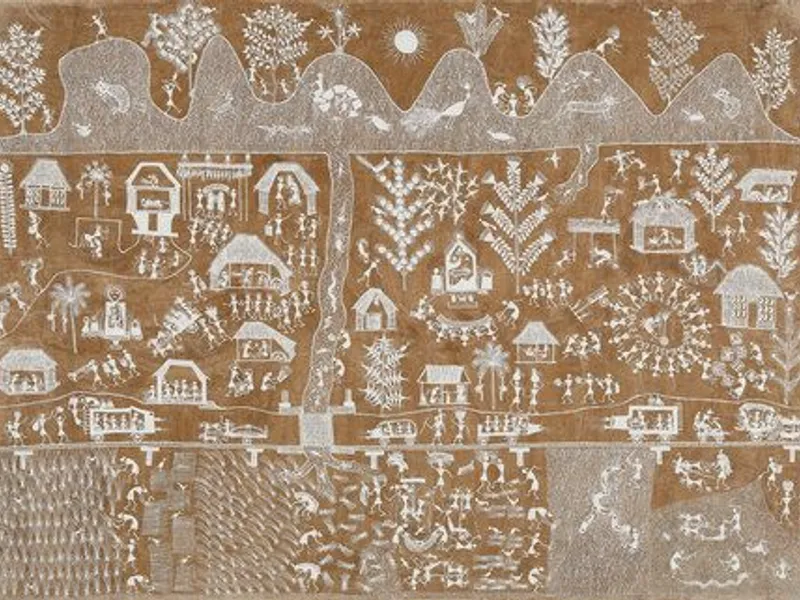
JIVYA SOMA MASHE (1934 - 2018)
There is a certain balance in the way Mashe divided the space between the painted area and the background. Largely, the compositional flow was arranged in a circular or rectangular pattern. Mashe understood how to work with the minimalistic Warli motifs and monochrome tonality to juxtapose solid coloured elements against multiple textures and tonalities created using dots, lines and strokes to stand out. The fineness of his line work and patterns is a testament to his true mastery over this art form.
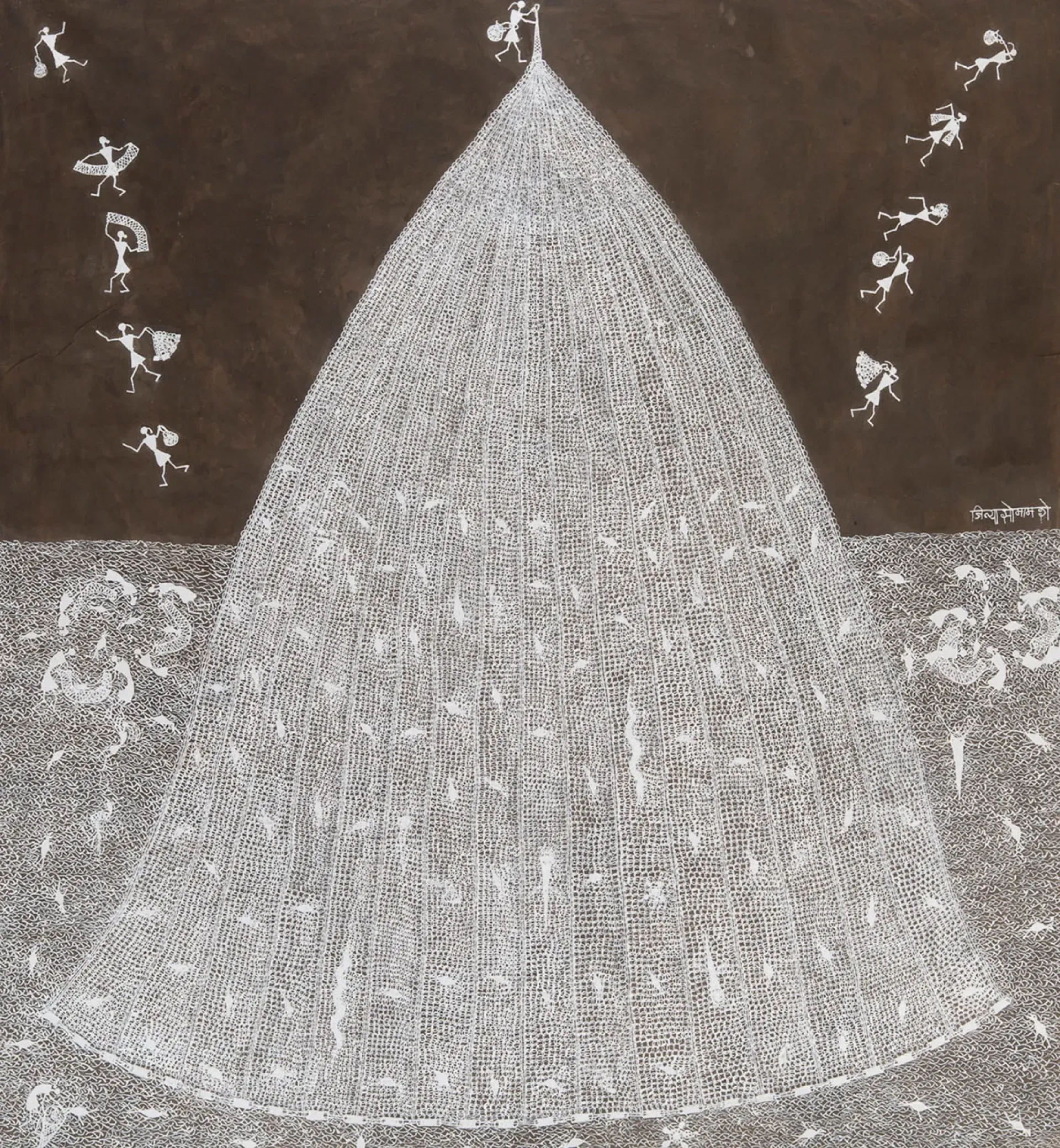
Jivya Soma Mashe promoted free expression through his visual art.
To retain the rustic quality of tribal artwork and wall painting, Mashe painted on a background of ‘geru’ or red earth or cow dung, which typically was brown. His dynamic human figures became an emblem of life and labour in rural Maharashtra. His works also became a testament to the harmonious living of the Warli community alongside nature, showing the cyclical interdependence between these elements. From walls, he had moved to create paintings in a large format, typically taking a month to complete these.
Recognition and Legacy: the national and international recognition Jivya received; the Padma Shri, the exhibitions, the collectors; what it meant for the Warli community to see one of their own at that level
Recognising the Master
Mashe’s popularity made him the recipient of various state-level, national and international honours. He was awarded the National Award for Tribal Art in 1976. He also received the Shilpa Guru award in 2002 and the Prince Claus award in 2009. He was awarded the Padma Shree from the Government of India in 2011.
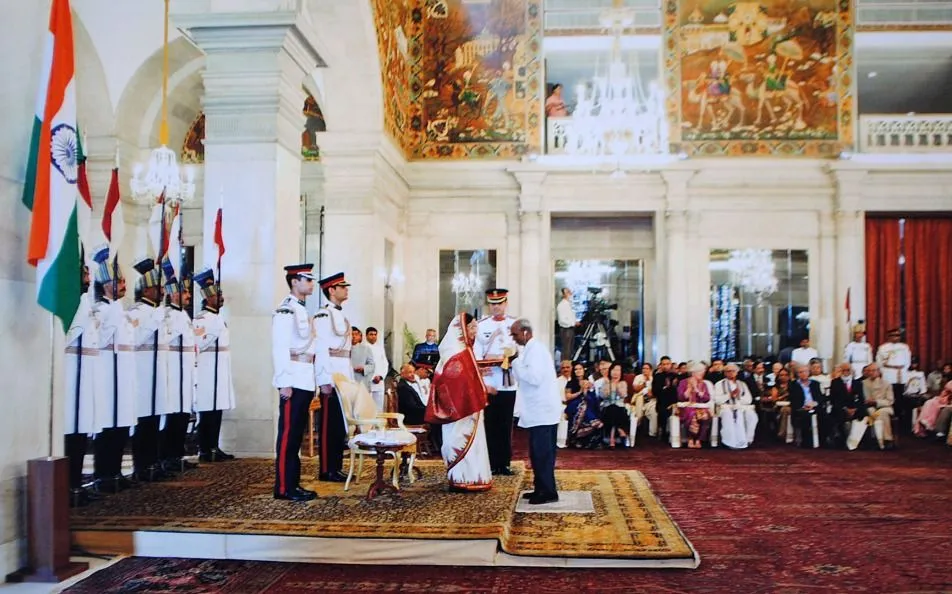
His international exhibitions include shows at the Palais de Carnoles, France (1976), ‘Magiciens de la Terre’ at Centre Pompidou, France, a joint show with Richard Long at Museum Kunst Palast, Germany, an exhibition at Padiglione d’Arte Contemporanea, Italy, the show at Shippensburg University, USA and the exhibition at Halle Saint-Pierre, France. The Fondation Cartier has also acquired six of his works and has exhibited them in exhibitions titled ‘Histoires de voir’ in 2012 and Memoires Vives in 2014.
Moreover, Mashe has featured in several publications, which include ‘The Warlis: Tribal Paintings and Legends’ by Chemould Publications and ‘The Painted World of the Warlis’ by Yashodhara Dalmia. Besides these, Mashe has also been featured in articles for ArtDaily, Art Review, CAFA Art Info and an article titled ‘Aboriginal in the Alps: “ROOTS” at Fondation Opale written for Art Asia Pacific in April 2026.
- The Mashe Family After Jivya: how his sons and grandchildren have carried the tradition forward; what each generation has done with the inheritance; how the family navigates the tension between staying true to Jivya's vision and developing their own
- Warli Today: What the Mashe Legacy Means: how the visibility Jivya created has affected the broader Warli community of artists; the risks of commercialisation and the opportunities of recognition; what the Mashe family's continued practice means for the tradition's integrity
- Closing: Jivya Soma Mashe did not just make great paintings. He made it possible for a tradition to survive contact with the outside world without being consumed by it. Where to find Mashe family works through Rooftop, and how engaging with their art connects you to that larger story.
An Artistic Legacy Continues
Jivya Soma Mashe passed away on May 15, 2018, at the age of 84 in Ganjad village. He is survived by his two sons, Sadashiv Mashe and Balu Mashe and a daughter. Sadashiv and Balu both have followed in the footsteps of their father and are practising as Warli artists. Both learnt Warli painting and Warli folklore from their father. Sadashiv also accompanied his father on international trips.
Both Sadashiv and Balu are Warli artists of renown in their own right. A notable and unique work by Sadashiv, acquired by Pundole Art Gallery in Mumbai, portrays the life of his father in Ganjad, painting artworks, practising agriculture and animal rearing and being interviewed by media crews arriving with their recording equipment, an unusual activity in a small hamlet like Ganjad where Mashe lived. An apt homage to a master Warli artist by his son.
Mashe conducted workshops on Warli painting all over the world. But he also trained and mentored young men from the Warli community to paint, making them independent artists while also ensuring the promotion and preservation of the art form and his techniques. Mashe’s own popularity and success motivated the artists who took to practising the art from him. Mashe is known, after all, as ‘the Father of Warli Art.’ Mashe had carved a niche for Warli art in the art market as well as a path for those who came after him to walk on.
The popularisation of Warli art has led to it receiving the GI Tag in 2014. This encouraged the artists to register as ‘Authorised Users’ and set standards for the production of Warli art not only as paintings but also for decorative products such as books, stationery, furniture, decorative items and clothes. This also brings up the question of intellectual property rights pertaining to artworks and the rights of the community in promoting their own art and creating more efficient legal systems for the protection of the same.
However, a trend that was observed with the increasing commercialisation of the art form was the entry of male players into a domain that was traditionally considered to belong to women. Male artists began to now take place of the ‘suvasins’ to create the ‘lagna chauk’ paintings. The women pointed out that the symbolic meaning of the art was being lost as traditional motifs were being replaced by more decorative forms to appease the masses, something that the women attributed to the growing number of male artists, even those not from the Adivasi and Warli community, who had begun practising this art. For example, the traditional ‘chauk’, which was a square now depicted as a square with a triangular form on top that resembles the mainstream Hindu temples.
Commercialisation has led to changes in the materials as well, such as the use of acrylic and poster colours. In the face of this, one remembers Mashe’s insistence on painting with rice paste and bamboo sticks, adapting to cloth but retaining the essence of traditional Warli painting and the generational knowledge that it embodied, embracing change only as much as was necessary. Thus, Mashe not only created masterpieces but also made it possible for a tradition to survive contact with the outside world without being consumed by it.
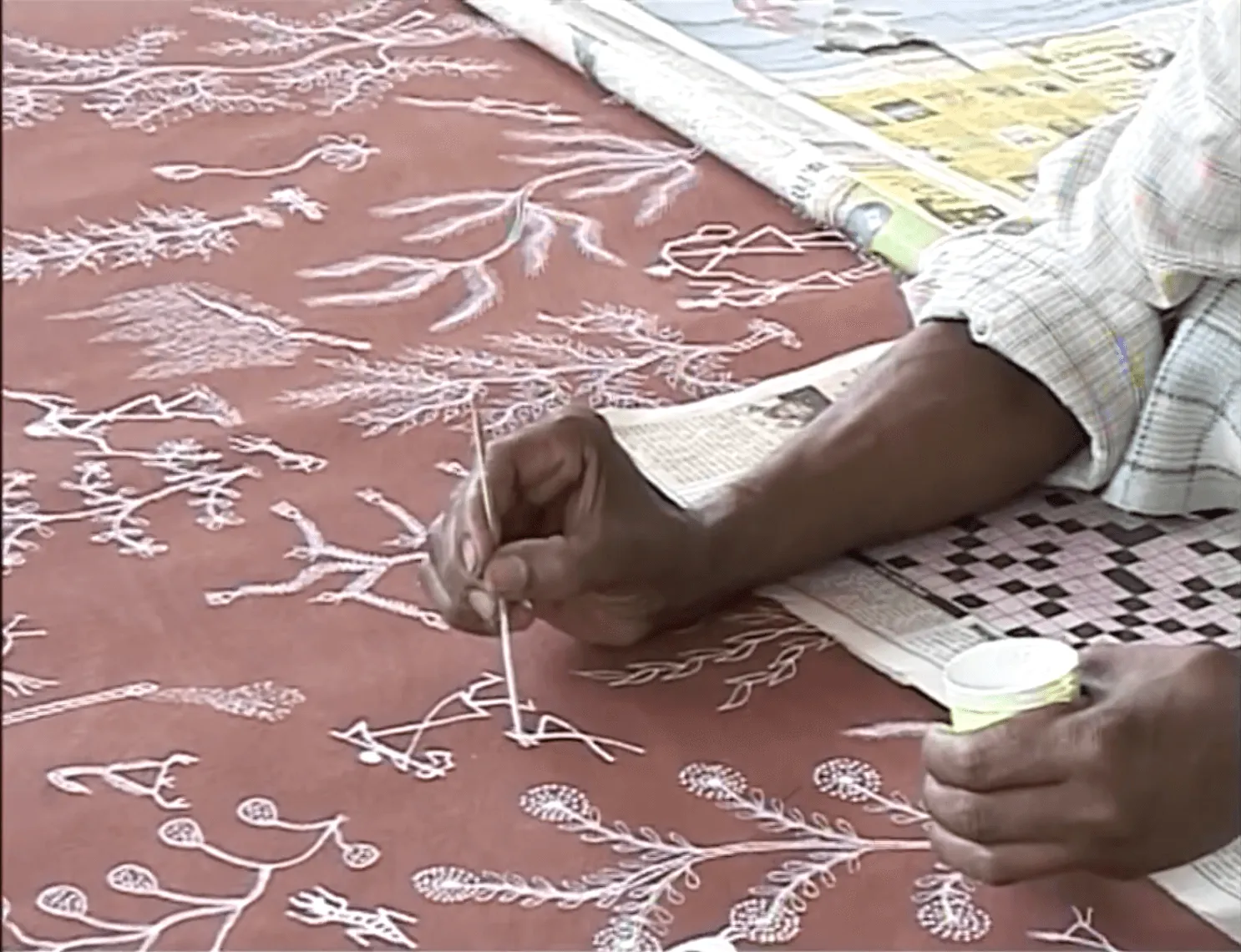
दूरदर्शनच्या संग्रहातील व्यक्तिमत्त्वावर आधारीत लघुपट-वारली चित्रकार जिवा सोमा म्हसे
Want to own an authentic Warli artwork for yourself? Check out the Warli art collection on Rooftop today. Own authentic Warli art by prominent Warli artists, including the Mhase family.