

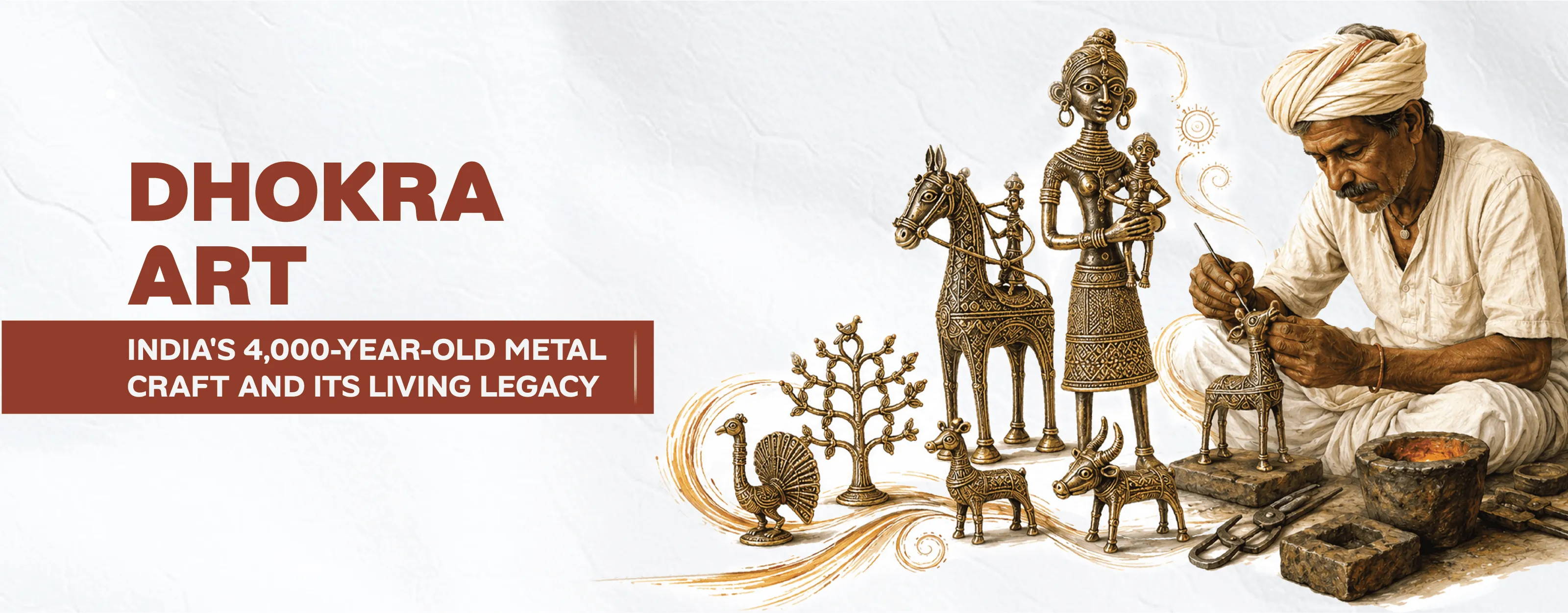
Dhokra Art: India's 4,000-Year-Old Metal Craft and Its Living Legacy
Dhokra art uses the same lost-wax casting that made the Dancing Girl of Mohenjo-daro. Here is how this 4,000-year-old Indian folk art survives, and how to buy it well.

Rooftop
Author
In a glass case in the National Museum in New Delhi stands a small bronze figure barely ten centimetres tall. She is known as the Dancing Girl, and she was cast in the Indus Valley city of Mohenjo-daro around 2500 BCE. That makes her roughly four and a half thousand years old. What almost no one mentions when they stop to admire her is that the method used to make her never died. The same technique is being used this morning, in workshops in Bastar and Bengal, by the craftspeople who make Dhokra.
That is the quiet and astonishing fact at the centre of Dhokra art. Dhokra, also spelt Dokra, is a form of metal casting built on the lost-wax method. It is not a revival and not a reconstruction. It is a living thread of practice that runs from one of the world's oldest civilisations straight into the present day. Among all the art forms of India, very few can claim a line this long. To hold a piece of Dhokra is to hold the end of that line.
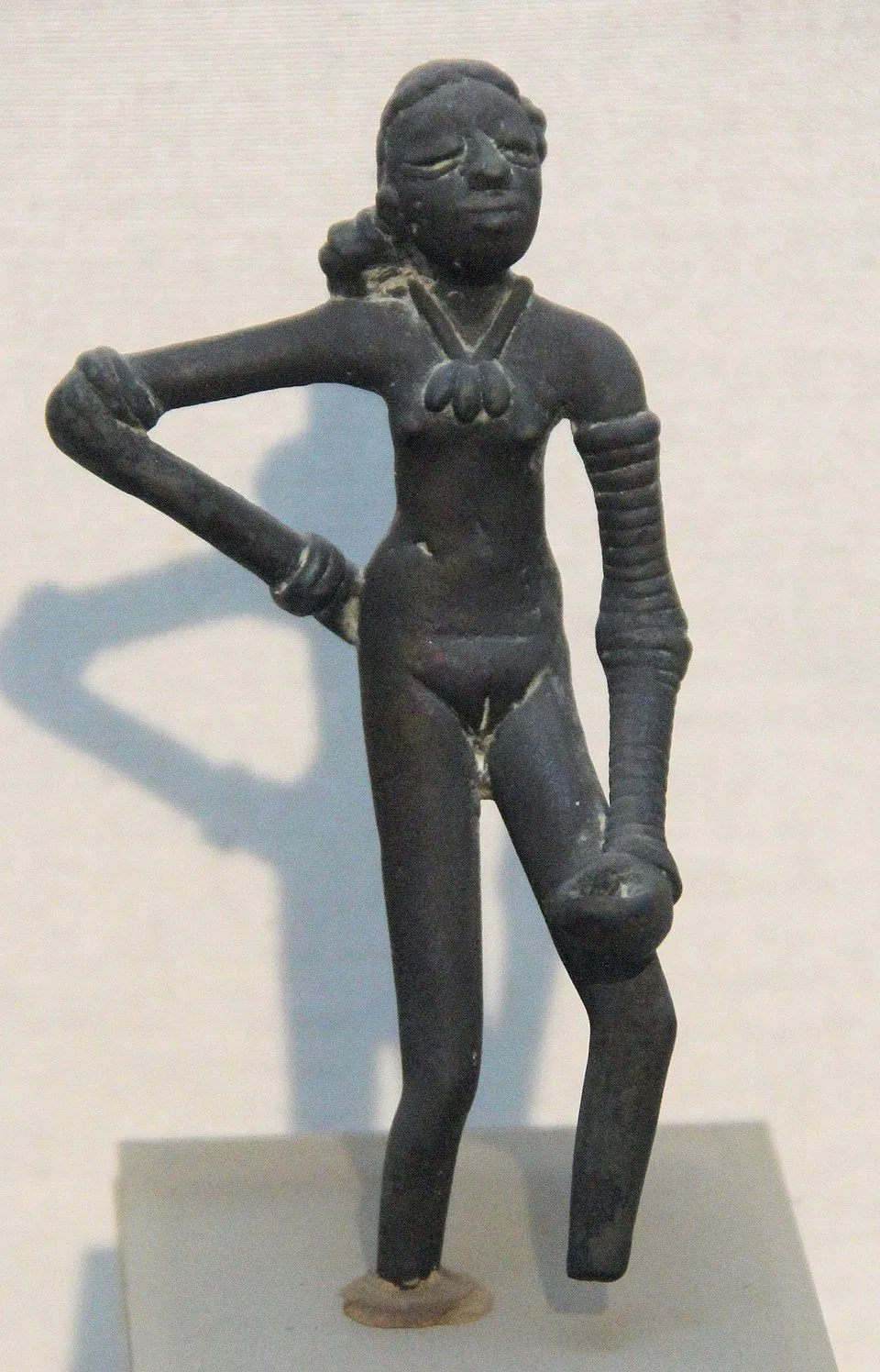
The Dancing Girl of Mohenjo-daro, an early lost-wax casting now in the National Museum, New Delhi. Source: Wikimedia Commons (Dancing Girl)

The Lost-Wax Process and Its Ancient Origins
The technique behind Dhokra has a French name that craftspeople rarely use but historians always do. It is called cire perdue, or lost wax, and it is one of the oldest ways humans ever found to turn soft material into hard metal. The idea is simple to state and hard to master. You build a model in wax, you wrap it in clay, you melt the wax out, and you pour metal into the empty space it leaves behind. The metal becomes an exact copy of the wax, down to the last fingerprint.
What makes the Indian story remarkable is the unbroken run. The Dancing Girl proves the method was already in confident use in the Indus Valley. Centuries later it was written down in Sanskrit treatises on craft and architecture, including the Manasara, the Manasollasa and the Shilparatna. Rooftop's detailed encyclopedia entry on Dhokra traces these sources, and the thread they describe was never cut. The Indus cities fell, empires rose and collapsed, colonial rule came and went, factories arrived, and through all of it the lost-wax process simply carried on in the hands of village metalsmiths.
About 4,500 years of continuous practice
Scholars link the lost-wax process described in ancient Sanskrit texts and used for the Dancing Girl of Mohenjo-daro, dated to around 2500 BCE, with the same method Dhokra artisans use today. That places the technique's recorded use at roughly 4,500 years.
Did you know? Dhokra craftspeople rarely buy fresh metal. The raw material is usually scrap brass, gathered from old utensils and household discards, then melted down and poured into the clay mould. The craft has been recycling metal for thousands of years.
Who the Dhokra Craftspeople Are and Where They Work
The craft takes its name from the people who carried it. The word Dhokra comes from the Dhokra Damar, a community of travelling metal artisans associated with West Bengal and Odisha, who are recorded in the academic literature as the original practitioners. Their nomadic habits matter to the story. A craft carried by itinerant smiths could move with them, which is one reason the technique spread so widely and survived in so many separate places.
In Chhattisgarh, the craft is practised mainly by the Ghadwa community of the Bastar region, with Kondagaon and Jagdalpur as its two main centres. Bastar Dhokra is the best known cluster, but it is far from the only one. The tradition is also alive in Bankura and Bardhaman in West Bengal, in Dhenkanal and Mayurbhanj in Odisha, around Ranchi in Jharkhand, and in Adilabad in Telangana. Each group shares the same core method while developing its own visual character, so a trained eye can often tell a Bengal piece from a Bastar one at a glance.
Those regional signatures are worth knowing. Bengal Dokra, centred on Bankura and Bardhaman, tends toward slender, elongated figures and a wealth of folk deities, jewellery and the long-necked horse the region is famous for. Bastar work from Chhattisgarh leans into sturdier animals, tribal gods and ritual objects, often with a rawer, more elemental finish. Odisha and Jharkhand bring their own preferences in subject and proportion. The shared technique is the grammar, and each cluster speaks it with its own accent.
These are not anonymous hands. Jaidev Baghel of Kondagaon became one of the most celebrated Dhokra masters of the twentieth century, and his work entered major museum collections, including the Victoria and Albert Museum in London and the Museum of Art and Photography in Bengaluru. Naming the makers matters, because the value of a Dhokra piece rests on the person who cast it.
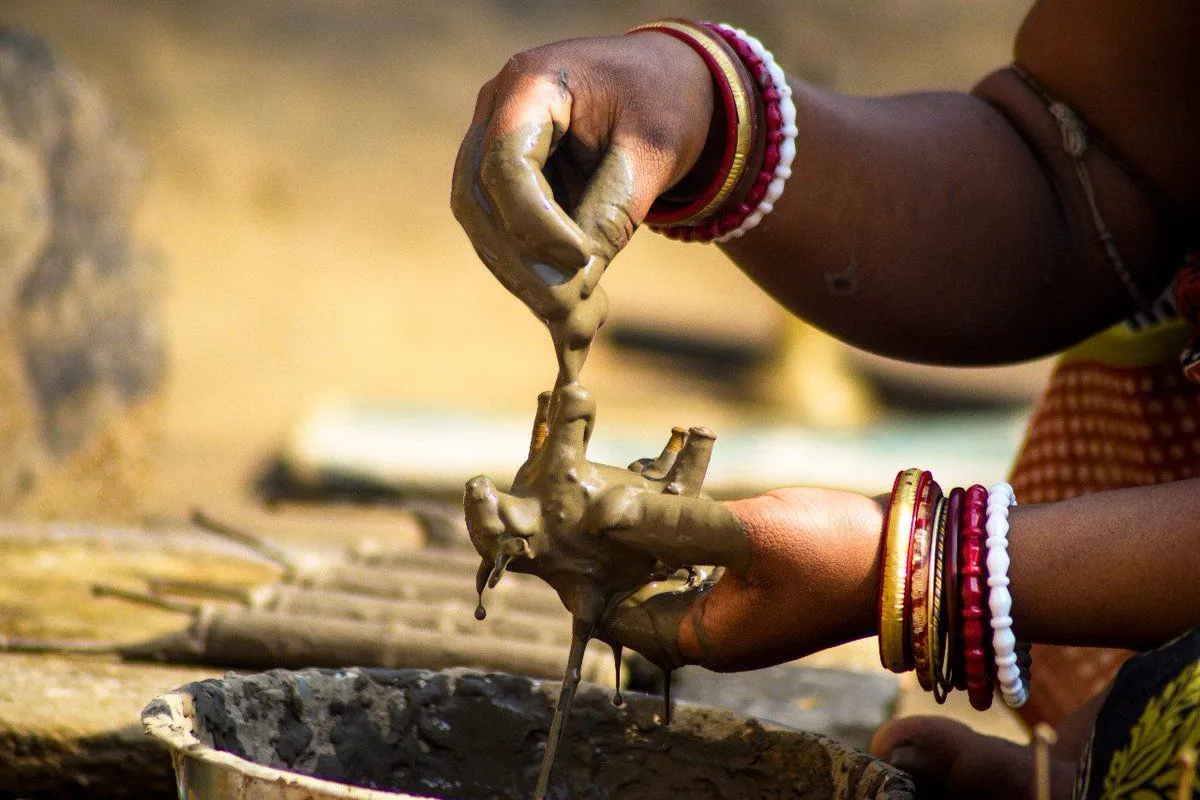

The Making of a Dhokra Object: From Wax to Metal
The process rewards patience and punishes shortcuts. A single figure can take many days, and almost every stage is done by hand. Here is how a piece comes into being:
- The artisan shapes a rough clay core, roughly the size and form of the final object, and lets it dry hard. This core gives the finished casting its hollow centre.
- Over the core, the maker lays threads of pure beeswax mixed with tree resin and a little oil. The whole surface design, every coil, face and limb, is built up in this soft wax by hand.
- The wax model is covered in fine clay, which captures every detail as a negative impression, then wrapped in coarser clay to build a strong outer mould. Narrow channels are left open for the wax to escape.
- The mould is heated. The wax runs out through the channels, leaving a hollow space in the exact shape of the design. This is the lost wax that gives the method its name.
- Molten brass or bronze is poured into the empty mould. When the metal cools, the clay shell is broken away and the piece is cleaned and polished.
There is one detail in that final step worth pausing on. The mould has to be broken to release the casting, so it can never be used again. Every Dhokra object is therefore a one-time event. Two figures by the same hand will always differ in small ways, because each one destroyed the mould that made it. This is the opposite of factory production, and it is the heart of what makes the craft precious.
Each mould is made once and broken once. No two Dhokra pieces are ever truly identical.
The defining rule of lost-wax casting.
The Visual World of Dhokra: Subjects, Symbols, and Form
Step into the world of Dhokra subjects and you meet the village and its gods. Elephants and horses appear again and again, along with peacocks, owls and other animals drawn from the forest. There are human figures carrying pots, playing instruments and dancing. There are deities too, from the goddess Lakshmi to local tribal gods, and a steady supply of ritual objects such as lamps, measuring bowls and small shrines. These are not decorative inventions. They are the spiritual and daily life of the communities that make and use them, cast into metal.
Form follows the method in a way that is easy to miss. Because the design is laid down as wax thread, many Dhokra pieces have an open, latticed quality, with coils and lines that let light pass through rather than sitting on a solid block of metal. A Dhokra horse is often more drawing than sculpture, a body sketched in metal wire and left deliberately airy. This is why the craft can feel ancient and oddly modern at the same time, closer to line art than to the heavy cast bronze of classical statuary.
The surface is where Dhokra gives itself away. Because the design is built from threads of wax, the finished metal carries a distinctive texture of fine raised lines and a grain that looks almost woven. Smooth, machine-cast metal cannot reproduce this honestly. That woven surface, together with the warm golden tone of the brass, is the signature that collectors learn to read. It is also the first thing a careful buyer should look for, which brings us to a problem success has created.
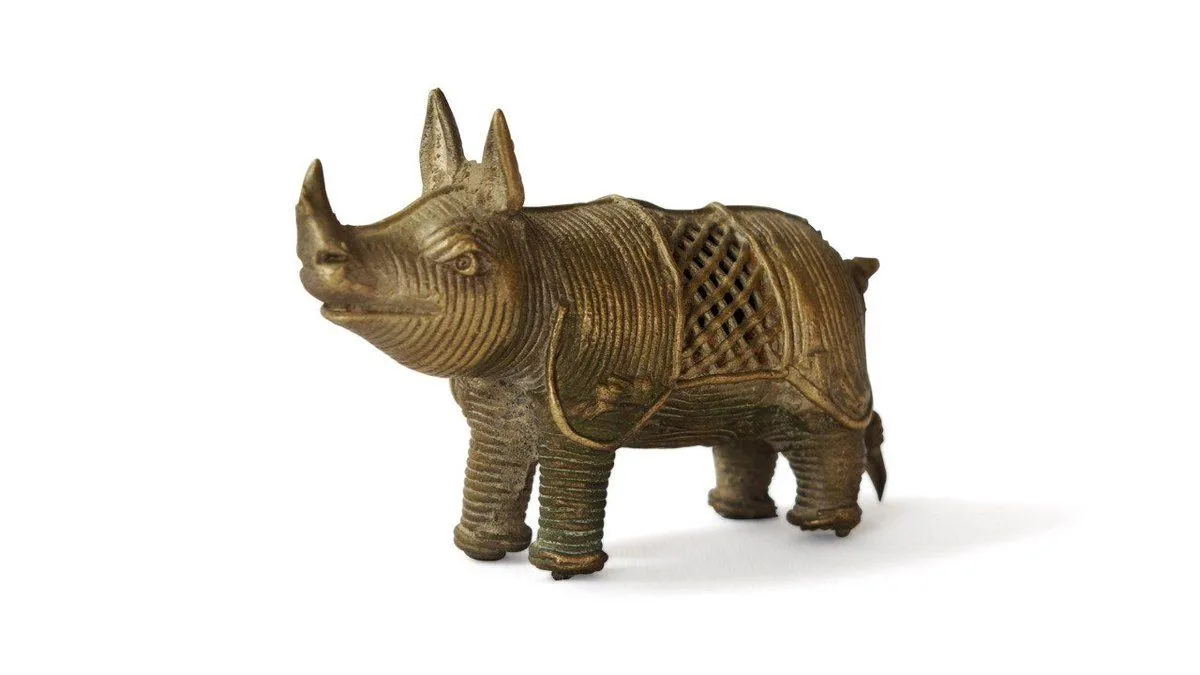

A good example of how this looks in a finished work is the certified Dhokra Sculpture: A Tribal King Stands, a brass figure by a master tribal artist where the thread lattice across the body is easy to see and impossible to fake by machine.
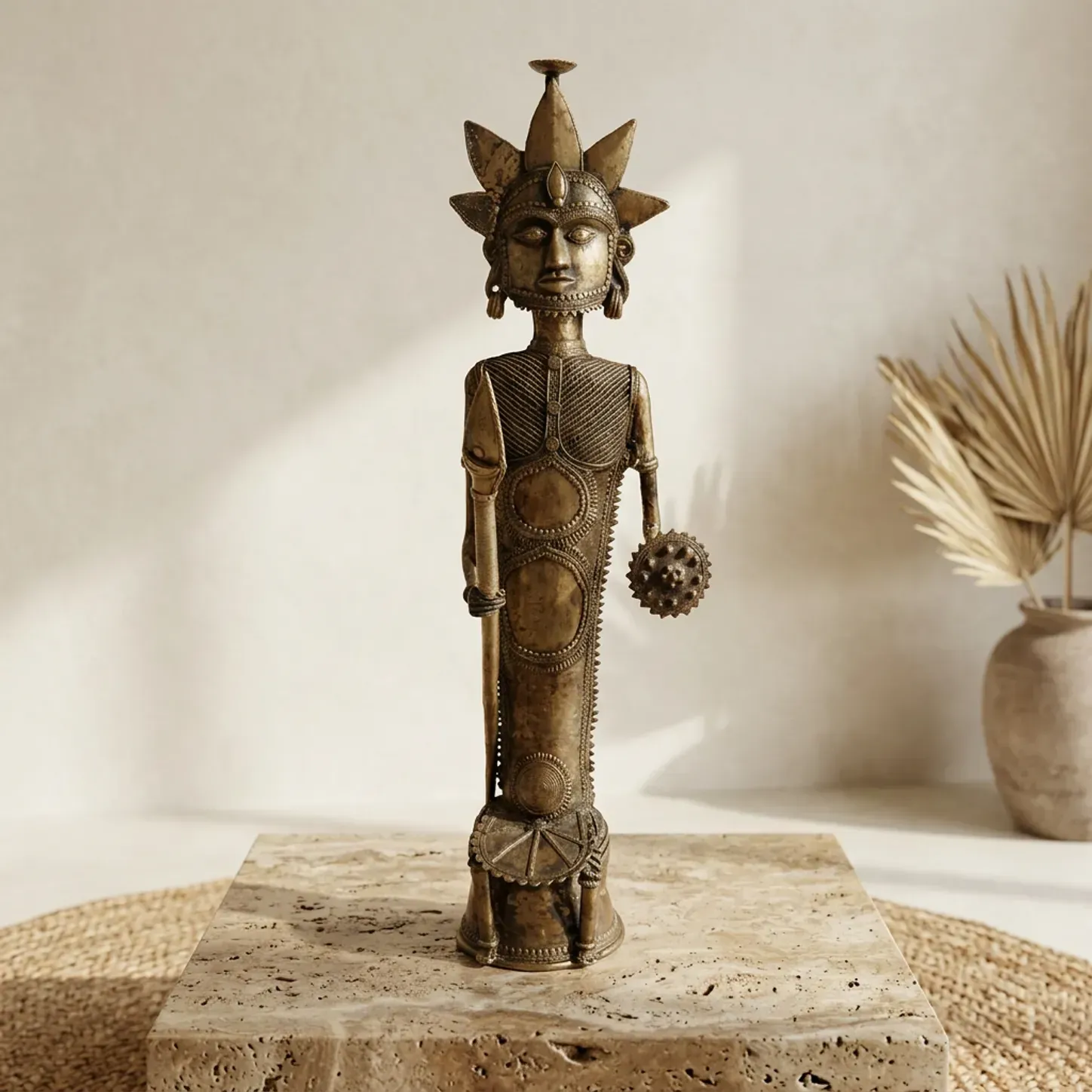
Dhokra Sculpture: A Tribal King Stands, a certified brass casting. View on Rooftop
Dhokra in the Contemporary Market and the Risks of Success
Dhokra has become fashionable, and that is a mixed blessing. Designers feature it, collectors seek it out, and urban buyers like the rustic warmth it brings to a modern room. Demand has lifted some craftspeople into a real income for the first time. It has also drawn in imitators. As soon as a craft sells, copies appear that wear its name without doing its work.
The most common fakes are sand-cast or resin pieces finished to look like brass, made quickly and in bulk, with the texture stamped or moulded rather than built thread by thread. They carry the word Dhokra on the label, but they are not lost-wax castings, and they pay nothing back to the communities that own the tradition. The distinction is not snobbery. It is the difference between supporting a living craft and quietly hollowing it out. If you know what to check, telling the two apart is not hard.
How to tell genuine lost-wax Dhokra from a copy
✓ Look for the woven surface. Real Dhokra shows fine raised threads and a slightly irregular grain. A perfectly smooth or sharply uniform surface usually means a moulded copy. ✓ Expect small differences. Because the mould is broken after each cast, no two genuine pieces match exactly. Identical items sold in quantity are a warning sign. ✓ Feel the weight and check the metal. Authentic pieces are cast in brass, bronze or bell metal and have real heft. Light, hollow-sounding resin gives itself away in the hand. ✓ Ask for the maker and the place. A real seller can name the artisan and the cluster, whether Bastar, Bankura or Odisha. Vague answers point to mass production. ✓ Look for certification or a GI tag. Geographical Indication recognition and seller certification both signal that a piece comes from where it claims to.
Supporting the Living Tradition: Where Provenance Matters
The single most useful thing a buyer can do is care about provenance. Where did this piece come from, and who made it? Direct sourcing and cooperatives have become important precisely because they keep that answer clear and keep a fair share of the price with the artisan rather than a middle layer of resellers. The stakes are not abstract. In the Bastar region alone, craft is a livelihood for thousands of families.
10,000+ Bastar families, GI tags from 2014: Records cited by Rooftop note that more than 10,000 families in the Bastar region depend on craft for their living, with Dhokra among the foremost. Bastar Dhokra received a Geographical Indication tag in 2014, and Bengal Dokra and Adilabad Dokra followed in 2018.
Cooperatives and direct platforms also smooth out the brutal unevenness of craft income. A caster who once sold to a passing trader for a fraction of the final price can, through a fair channel, earn closer to what the work is worth and plan beyond the next sale. That stability is what lets a young person in a Ghadwa family decide the craft is still worth learning, which is the only thing that keeps any tradition alive past one more generation.
Formal recognition has helped. The Geographical Indication tags give buyers a way to verify origin, and museum collections from Delhi to London have raised the craft's standing. None of this protects the tradition on its own. What protects it is people choosing the real thing and being willing to pay what honest, slow, handmade work costs.
This is the gap Rooftop tries to close by working with practising craftspeople and certifying what it sells. The Dhokra Sculpture: A Family Rides, cast by a master tribal artist, is a good illustration, sold with its maker and method named rather than hidden.
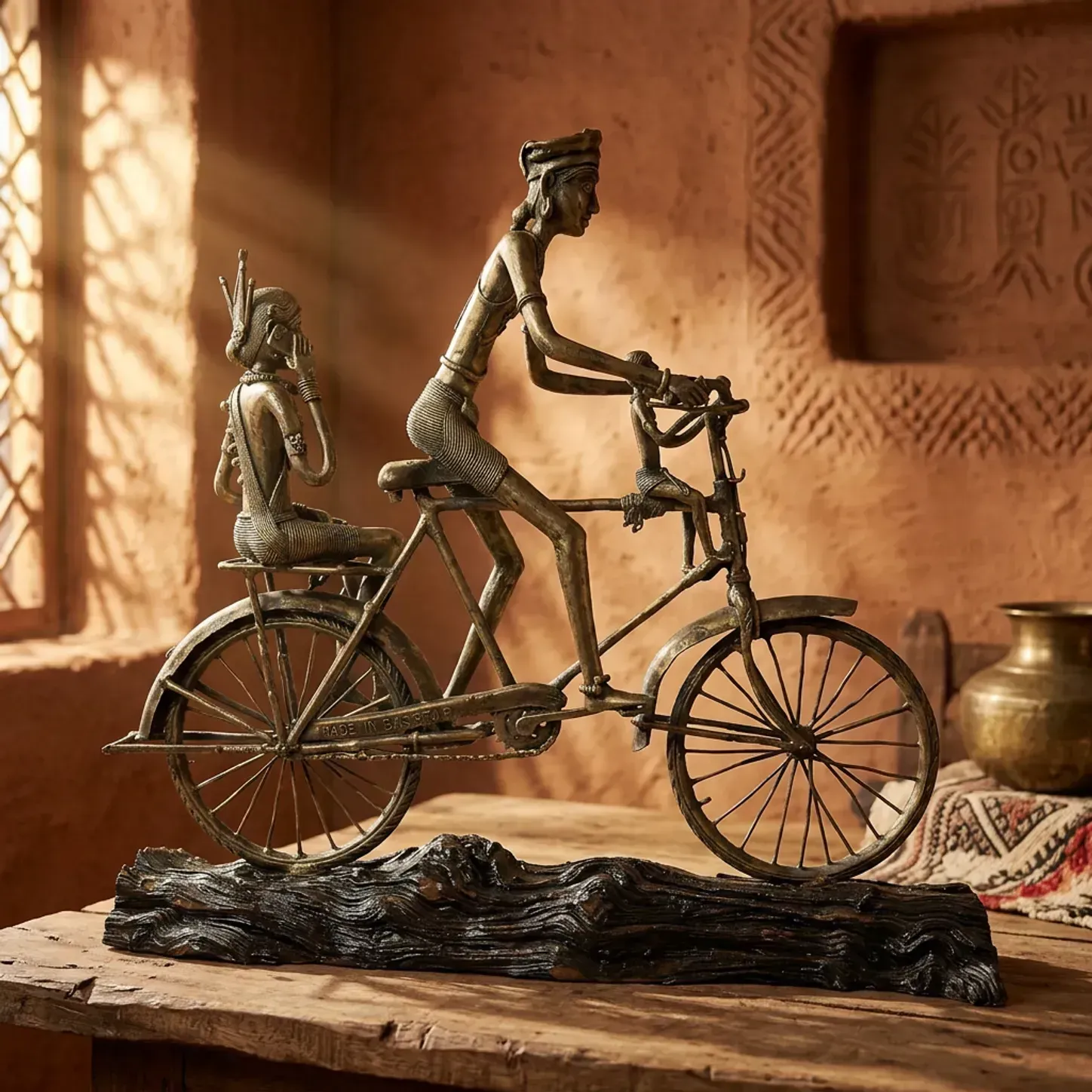
Dhokra Sculpture: A Family Rides, a certified piece by a master artisan. View on Rooftop
Holding Four Thousand Years
There is a particular feeling that comes with holding a real piece of Dhokra. It is heavier than you expect, warm in tone, and covered in threads laid down one at a time by a person who learned the method from someone who learned it from someone else, back and back across forty centuries to a small bronze dancer in an Indus Valley city. That is not a metaphor. It is the literal history in your hand. If you want to meet that history through the people who keep it alive, you can explore Rooftop's collection of authentic Dhokra art, sourced directly from the craftspeople who still cast it the old way.