
Malwai Giddha - The Folk Dance Tradition of Punjab
From village gatherings to cultural festivals, explore the evolution and enduring significance of Malwai Giddha in Punjab's folk traditions.
Introduction
Malwai Giddha is a folk dance of the male community of the Malwa region of Punjab, India. It is distinguished from both women's Giddha and from Bhangra by its emphasis on the performance of boliyan (folk poetry and song) by the dancers themselves, who simultaneously play the folk instruments they carry. The form originated as a dance of elderly men and is also called Babeyan da Giddha (the Giddha of old men), though in contemporary practice it is performed by younger men as well. Malwai Giddha is a relatively specialized form with limited academic documentation but has been identified by researchers including Anjali Gera Roy as a culturally significant alternative expression of Punjabi masculinity, distinct from the dominant Bhangra tradition.
Etymology
The name Malwai refers to the Malwa sub-region of Punjab, the southern and southwestern part of the state encompassing the districts of Muktsar, Bathinda, Faridkot, Sangrur, Ferozpur, Mansa, and Patiala. The word Malwa is understood to derive from the geographic and cultural identity of the plains south of the Sutlej river, distinct from the Majha (central Punjab) and Doaba (trans-Sutlej eastern Punjab) sub-regions. Giddha is the Punjabi word for the ring dance tradition in this context adapted by men. The combination thus designates the male ring dance tradition of the Malwa plains.
Origin
Location: Malwa region of Punjab, India; associated with districts including Muktsar, Bathinda, Faridkot, Sangrur, Ferozpur, Mansa, and Patiala Community: Male community members of the Malwa region; traditionally elderly men, now including younger performers Relevance: A distinct male folk form of Punjab that expresses a softer and more intergenerational Punjabi masculinity compared to Bhangra; an important carrier of Punjabi folk poetry
History
Background
Malwai Giddha originated in the Malwa region of Punjab, with the most specific documented account tracing it to Village Chattha in Sangrur district, from which it spread across the Malwa sub-region. In some oral tradition accounts, the form is described as having originated from Multan (in present-day Pakistan), travelling through the Doaba region before being adopted and developed in Malwa. A practitioner account by Ravi Chand of Bathinda, a government teacher and experienced Malwai Giddha performer, is recorded in The Tribune as documenting this Multan-to-Doaba-to-Malwa transmission route. The tradition was historically performed by veteran bachelors and elderly men, earning it the alternate name Babeyan da Giddha. The form emphasizes self-accompaniment, with each performer playing a folk instrument while singing and dancing, a characteristic that distinguishes it from Bhangra and women's Giddha.
Culture and Societies
Malwai Giddha occupies a culturally distinct position in Punjab's folk dance ecology. As noted by researcher Anjali Gera Roy, the form presents an alternative model of Punjabi masculinity compared to the vigorous and high-energy Bhangra tradition. Malwai Giddha foregrounds verbal wit, intergenerational male bonding, satirical teasing of community members through boliyan, and a physically restrained aesthetic that relies on subtle movements rather than acrobatics or high-energy leaps. The boliyan in Malwai Giddha cover broader social and political themes in addition to the domestic and romantic themes common to women's Giddha. Contemporary performers including Ravi Chand of Bathinda have written Malwai Giddha compositions addressing stubble burning, political rights, and gender equality, extending the tradition's function as a vehicle for public commentary.
Religious Significance
No formal religious significance has been documented for Malwai Giddha. The dance is performed at community gatherings, village fairs, weddings, and cultural festivals. The opening bolly of Malwai Giddha traditionally invokes God's name ('Pehlan nam rabb da dhaiye'), which is an expression of customary religious respect rather than a formal ritual association. The form has no documented connection to temple worship, deity veneration, or religious ritual contexts.
Understanding the Art
Style
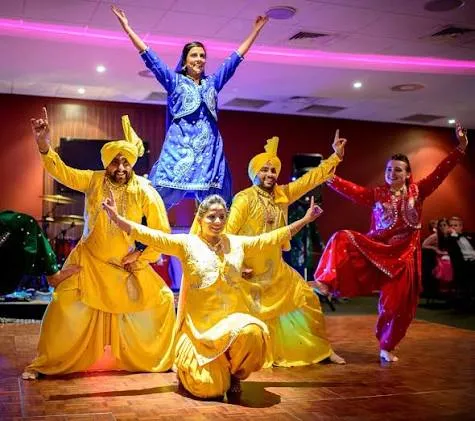
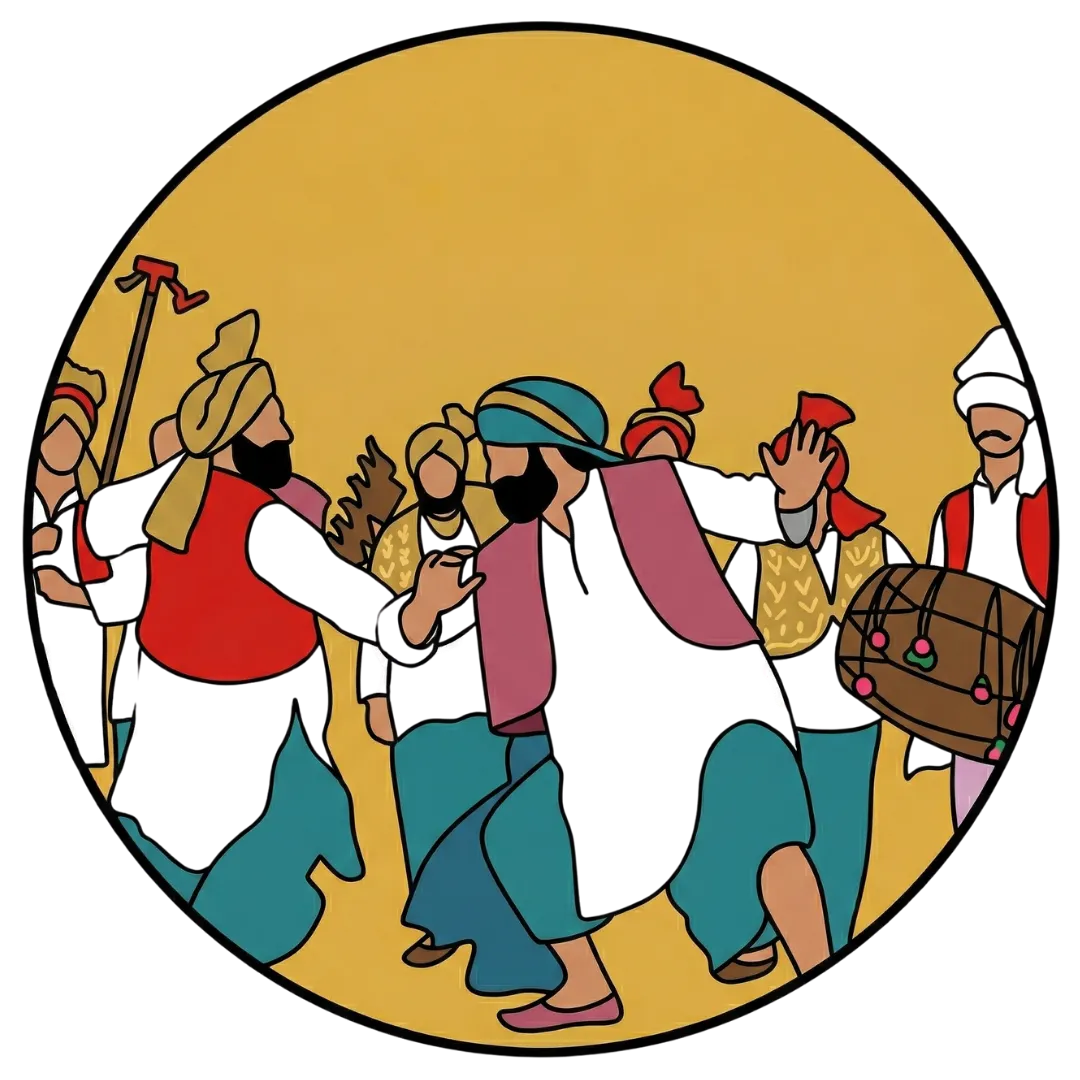
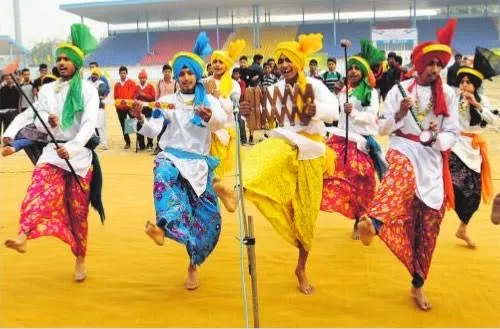
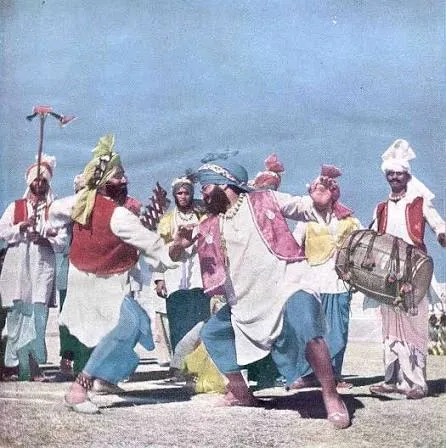
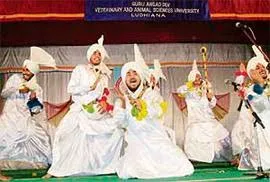
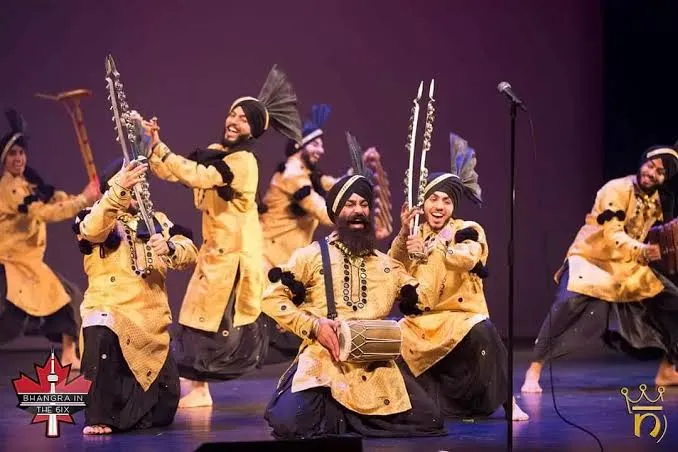
Malwai Giddha is performed in a circle by men who simultaneously play folk instruments and dance. The form does not involve the high leaps, spins, or acrobatics of Bhangra. Movements are more contained and expressive, oriented toward the boliyan being sung. A central performer voices a statement in Punjabi dialect, and the surrounding performers respond with energetic shouting, affirmative responses, and synchronized movement. Two performers may emerge from the group to perform a duet exchange. The instruments played by the performers are decorated and serve both a musical and visual function.
Central Motifs and Their Significance
The boliyan are the central element of Malwai Giddha, as they are in women's Giddha. In Malwai Giddha, however, the boliyan are distinguished by a different tonal quality and rhythmic cadence, and frequently adopt perspectives that challenge or tease masculine norms. Some boliyan are written from women's points of view, reflecting an awareness of gender dynamics that is uncommon in Bhangra. The tradition includes teasing of community members, humorous social commentary, and in contemporary performance, addresses to contemporary Punjabi social issues. The instruments themselves form a motif: decorated folk instruments carried and played by the performers signal the form's self-sufficient performance character.
Process
Malwai Giddha is performed without pre-composed choreography; the structure is determined by the sequence of boliyan introduced by performers. Each performer must know both how to play their instrument and how to carry it appropriately as part of the visual performance. Performances take place at village fairs called melas, at weddings, and at community celebrations. The Chhappar Mela of Village Chhappar in Punjab is a documented gathering where multiple Malwai Giddha teams perform. The form is transmitted through community participation and practice rather than formal institutional training.
Mediums Used
Folk instruments are central to Malwai Giddha, with each performer carrying and playing an instrument while dancing and singing. Typical instruments include the chimta (metallic tongs with jingling discs), the dhol or dholak, the tumbi (single-stringed high-pitched instrument), and other locally associated folk instruments. No external amplification or accompaniment is used; all music is generated by the performers themselves, making Malwai Giddha formally self-contained. This self-sufficiency is a defining characteristic of the form.
New Outlook
Malwai Giddha has received limited formal institutional support compared to Bhangra and women's Giddha, and faces risks of further decline. The Tribune's 2025 reporting by journalist Kamaljit Sandhu documented the quiet disappearance of the form from public occasions, where it has been replaced in some contexts by marching bands at rural weddings. Contemporary practitioners including Ravi Chand of Bathinda are actively working to adapt the form to contemporary social themes to maintain its relevance. The form has been identified by researchers as an undervalued part of Punjab's folk heritage that expresses values of intergenerational male community and verbal wit not represented in dominant forms.
Learn Malwai Giddha
Bibliography
Sources
“Folk Dances of Punjab.” Wikipedia.
“Malwai Giddha.” SikhiWiki, https://www.sikhiwiki.org/.
“Malwai Giddha.” Wikipedia.
Roy, Anjali Gera. Bhangra Moves: From Ludhiana to London and Beyond. Ashgate Publishing, 2010.
“The Quiet Disappearance of Malwai Giddha.” The Tribune, June 2025.
Image Sources
“Book Lezim Dance Artists.” Black Hat Talent, https://blackhattalent.com/talent/book-lezim-dance-artists/. Accessed 4 July 2026.
“Malwai Giddha.” GoSahin, https://www.gosahin.com/places-to-visit/malwai-giddha/. Accessed 4 July 2026.
“Malwai Giddha.” Malwai Giddha, https://malwaigiddha.weebly.com/. Accessed 4 July 2026.
“Malwai Giddha.” SikhiWiki, https://www.sikhiwiki.org/index.php/Malwai_Giddha. Accessed 4 July 2026. “Boys Perform Malwai Giddha During the Junior Championship League at Multi-Purpose Sports Stadium in Bathinda.” 4to40, https://www.4to40.com/photo-gallery/indian-dance-images/attachment/boys-perform-malwai-giddha-during-the-junior-championship-league-at-multi-purpose-sports-stadium-in-bathinda/. Accessed 4 July 2026.
“Malwai Gidha Live Performance Starting from Group of Seven.” Shaan Punjab Dee, https://shaanpunjabdee.com/malwai-gidha-live-performance-starting-from-group-of-seven/. Accessed 4 July 2026.