
Giddha - The Folk Dance Tradition of Punjab
Explore the history, cultural significance, performance traditions, music, costumes, and enduring legacy of Giddha, Punjab's celebrated women's folk dance.
Introduction
Giddha is a folk dance of women in the Punjab region of India and Pakistan. It is performed in group settings at festivals, weddings, and seasonal celebrations, and is structured around the singing of boliyan, short rhyming couplets that serve as the primary vehicle of lyrical and social expression within the dance. Giddha is considered the female counterpart to the male Bhangra tradition, though scholars including Gibb Schreffler note that this classification as a simple complement to Bhangra does not fully account for the form's distinct social function and independent history. Giddha functions simultaneously as celebration, oral literature, community storytelling, and women's social commentary, providing a historically significant platform for female expression in Punjabi society.
Etymology
The word Giddha is of Punjabi origin. The dance is also known in some contexts as Lokh Naach (people's dance). The form is documented as having evolved from an ancient ring dance tradition dominant in Punjab, in which participants formed circles and performed communal movement. No single Sanskrit or Persian root for the word Giddha has been established in available scholarly literature; the term appears to be a vernacular Punjabi designation for the form.
Origin
Location: Punjab region of India and Pakistan; most prominently associated in India with Amritsar, and in Pakistan with Lahore and surrounding areas Community: Punjabi women across agricultural, urban, and diaspora communities Relevance: One of the primary folk dance traditions of Punjab; significant as an archive of Punjabi oral literature through the boliyan tradition
History
Background
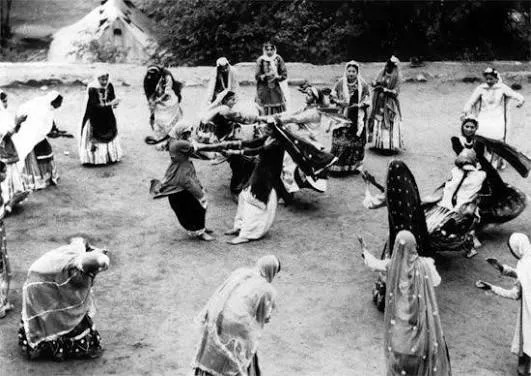
Giddha is documented as having evolved from the ancient ring dance tradition of Punjab. The precise historical origin has not been formally dated in academic literature, but the form predates the Partition of India in 1947, with evidence of its practice at community festivals and agricultural celebrations for multiple generations. As a folk tradition primarily transmitted orally among women, Giddha has not generated the institutional and archival record that would allow for more precise historical tracing. Following Partition in 1947, Punjab's folk dance traditions on both sides of the border were consolidated, codified, and promoted as cultural identity markers. Bhangra and Giddha competitions became popular in Punjab and within the Punjabi diaspora from the 1960s onward, and collegiate-level dance troupes in Punjab included Giddha from the same period. South Asian student groups in the United States, United Kingdom, and Canada established Giddha practice from the 1980s onward.
Culture and Societies
Giddha has historically served as a communal space for Punjabi women to gather, express emotion, and address shared concerns. The boliyan sung during Giddha address topics including the excess and carelessness of husbands and mothers-in-law, romantic longing, the joy of seasonal festivals, and satirical commentary on social customs and gender norms. Singer Kamaljit Neeru has documented that Giddha provides women with a medium to air concerns and outrage in a satirical way without social repercussion. Giddha movements frequently depict village life activities including spinning cotton, fetching water from a well, and grinding grain, encoding women's domestic experience in the body of the dance. Mimicry is a standard performance element within Giddha, with women playing both male and female characters in enacted scenes.
Religious Significance
No formal religious significance is documented for Giddha as a whole. The dance is performed at Baisakhi, which has Sikh religious significance as it marks the founding of the Khalsa, but Giddha's participation in that festival is cultural and celebratory rather than specifically devotional. The dance is also performed at Teeyan (a festival celebrating womanhood and the arrival of the monsoon), Lohri, and at weddings. These are cultural occasions rather than strictly religious ones. No established ritual function, deity association, or scriptural connection for Giddha has been documented in available academic sources.
Understanding the Art
Style
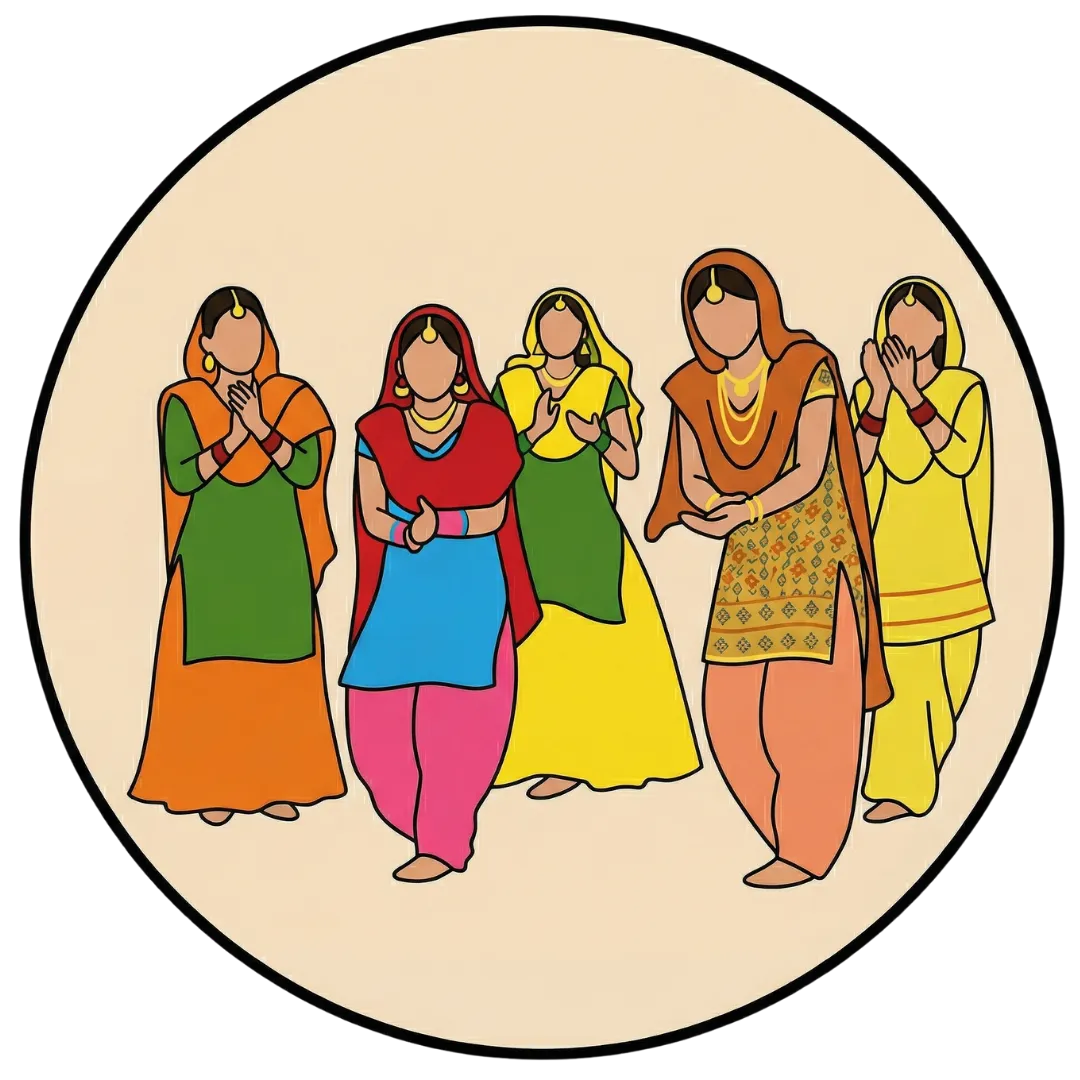
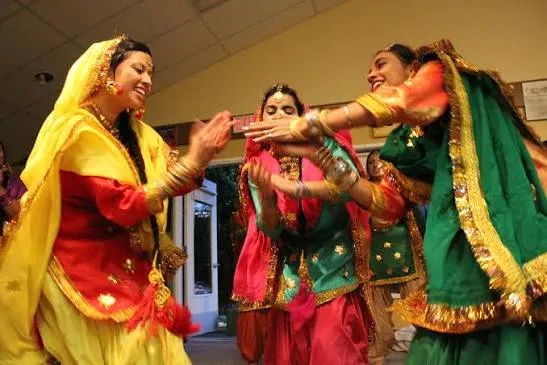
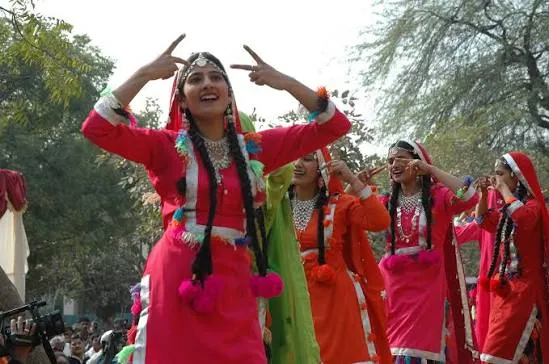
Giddha lacks a rigid choreographic structure and is characterized by a freestyle and spontaneous quality that distinguishes it from more formalized dance forms. Typically, a group of women forms a circle or semi-circle. One or two lead dancers perform at the center while the remaining women clap rhythmically and sing boliyan, providing the natural rhythmic bed for the performance. The lead dancers rotate as each boli is introduced. Movements include brisk swirling and spinning, graceful hand gestures, exaggerated facial expressions, and body language that illustrates the themes of the boliyan. Footwork is significant, and the hand claps of the surrounding performers create the foundational rhythm. The dholak (a smaller drum) or the ghadda (a clay pot used as a percussion instrument by striking a ring or stone against it) may supplement the percussion.
Central Motifs and Their Significance
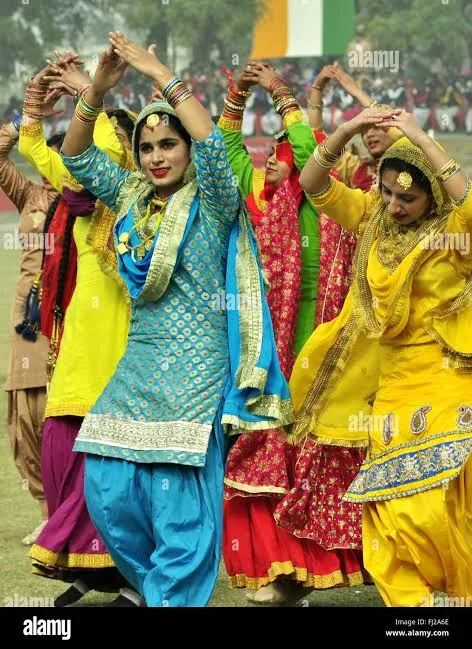
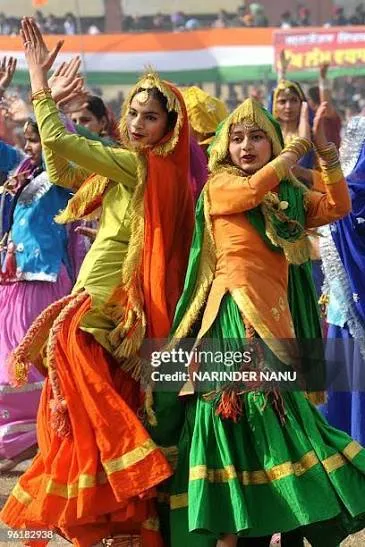
The boliyan are the heart of Giddha. They are rhyming couplets typically composed of two or four lines, introduced by a lead singer and repeated by the chorus. Their themes span the full range of Punjabi women's social experience: festivity, romance, familial relationships, in-law dynamics, agricultural seasons, and social satire. They preserve Punjabi dialect vocabulary, proverbs, and folk wisdom across generations. Giddha movements reflect elements of nature including the swinging of trees, sowing of seeds, and movement of birds, expressing a close connection with the agricultural environment of Punjab. Traditional attire for Giddha consists of the salwar kameez or Ghagra in bright colors with dupatta, complemented by jhumkas, matha pattis, tikkas, paranda (colorful hair extensions), and churas (bangles).
Process
Giddha is performed without formalized institutional training in its traditional community context, transmitted from older to younger women through participation at festivals and weddings. In contemporary urban and diaspora contexts, Giddha is taught in structured classes and workshops. A lead performer introduces a boli, which the chorus repeats. Then the lead dancer performs at the center while the group provides rhythmic support. The performance typically takes place outdoors or in courtyards at communal events.
Mediums Used
The dholak (a small double-headed drum played with hands) and the ghadda (clay pot used as a percussion instrument) are the traditional instruments associated with Giddha. Unlike Bhangra, which requires the large dhol, Giddha does not rely on a specific instrumental requirement and is often performed with only hand clapping as percussion. The chimta (metallic tongs with jingling bells) may be incorporated in some performances. Vocal singing of boliyan is the defining sonic medium of Giddha.
New Outlook
Giddha has gained substantial international visibility through Punjabi diaspora communities in Canada, the United Kingdom, and the United States, where its practice serves as a mode of cultural connection and intergenerational transmission. As documented by CBC News reporting from 2022 and 2023, institutions like the Shan-E-Punjab Arts Club in Canada actively teach Giddha as a pathway to Punjabi language and cultural literacy. Giddha performances appear in Indian cinema including Punjabi and Bollywood films. The competitive institutionalization of Giddha at university level has formalized its transmission in India. Some scholars have noted that Bhangra's global dominance has inadvertently reduced awareness of women's Punjabi dance traditions including Giddha and Sammi.
Learn Giddha
Bibliography
Sources
Folk Dances of Punjab. Wikipedia.
Roy, Anjali Gera. Bhangra Moves: From Ludhiana to London and Beyond. Ashgate Publishing, 2010.
Schreffler, Gibb. Scholarship on Punjabi Folk Dances and Partition-Era Codification.
South Asian Arts Music and Knowledge Centre. “Giddha Boliyan.” SAA-UK.org.
Image Sources
“Giddha.” Simple English Wikipedia, https://simple.wikipedia.org/wiki/Giddha. Accessed 4 July 2026.
Giddha Dance.” Getty Images, https://www.gettyimages.com/photos/giddha-dance. Accessed 4 July 2026.
“Gidha.” Alamy, https://www.alamy.com/stock-photo/gidha.html. Accessed 4 July 2026.
“Photograph of Punjabi Village Girls and Women Performing a Group Giddha Dance in the 1920's.” Wikimedia Commons, https://commons.wikimedia.org/wiki/File:Photograph_of_Punjabi_village_girls_and_women_performing_a_group_Giddha_dance_in_the_1920%27s.jpg. Accessed 4 July 2026.
“Giddha Dance Teeyan Punjab Teej India 2.” Wikimedia Commons, https://commons.wikimedia.org/wiki/File:Giddha_dance_Teeyan_Punjab_Teej_India_2.jpg. Accessed 4 July 2026.