
Chamba Dance - The Folk Dance Tradition of Himachal Pradesh
Explore the enduring legacy of Chamba Dance, a vibrant expression of Himachal Pradesh's rich heritage.
Introduction
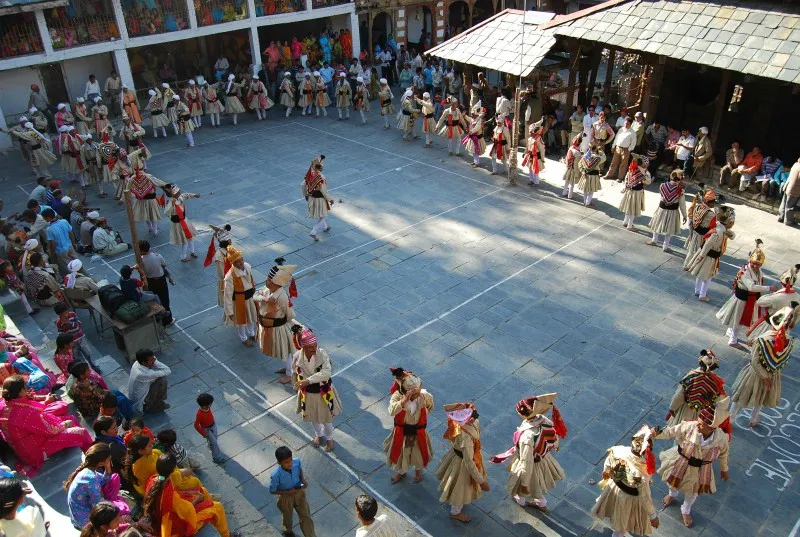
Chamba Dance refers to the body of folk dance traditions practiced in Chamba district, a mountainous region in the western part of Himachal Pradesh. The term encompasses several distinct dance forms specific to the communities of Chamba, including the Dangi dance performed by Gaddi women, the Jhanjar dance performed by the broader community of Chamba, the Dandras dance of Gaddi men, and the Ghurei dance performed during religious and cultural events. These forms are associated with the festivals, agricultural calendar, and religious traditions of Chamba, particularly the Minjar Mela and the Suhi Mata Mela. Chamba's folk dance culture is closely connected to the syncretic religious tradition of the region, which blends Shaivite Hinduism with local animistic practices centered on the veneration of devtas and devis (local deities).
Etymology
The name 'Chamba' refers to the Chamba district and the town of the same name, which was the capital of the historic Chamba kingdom. According to Wikipedia's documentation of Chamba, Himachal Pradesh, the town was named after Champavati, the daughter of Raja Sahil Varman, when the Chamba kingdom's capital was shifted to this location in 920 CE. The dance traditions of Chamba are collectively referred to by their region of origin rather than a single unifying name. Specific forms have their own names: 'Dangi' derives from folk tales, 'Jhanjar' refers to the ankle bells or rhythmic tinkling associated with the dance, and 'Dandras' takes its name from the danda (sticks) used in the performance.
Origin
The folk dance traditions of Chamba district are indigenous to its various communities, particularly the Gaddi tribe. The Gaddi are a semi-nomadic pastoral community whose primary settlements are in the Bharmaur area of Chamba district and in parts of Kangra district. Historical records of the Chamba region trace the earliest ruling dynasties to the Kolian tribes in the 2nd century BCE and place the founding of the Maru dynasty around 500 CE. The cultural traditions of the Gaddi and other Chamba communities developed within this long history of settlement and are documented in the folk literature, songs, and dance practices transmitted across generations. The Minjar Mela, one of Chamba's principal festivals, dates its own origin to a victory of the Chamba raja over the ruler of Trigarta in 935 CE, and folk performances including dance have been associated with this event for at least several centuries.
Location
Chamba dance traditions are practiced in Chamba district, which is one of the most remote and mountainous districts of Himachal Pradesh. The primary communities are in Chamba town and its environs, the Bharmaur region (the historic home of the Gaddi), and the Ravi River valley. Some forms, particularly Nati (which has a regional Chamba variant), are also practiced in neighboring Kangra and Mandi districts.
Community
The primary communities associated with Chamba dance traditions are the Gaddi tribe (Dangi, Dandras), the broader Hindu Chamba community (Jhanjar), and various occupational and caste groups who participate in the major festivals. The Gaddi are described in available sources as attached to their traditional dance forms and to celebrations including the Sui Mela, Minjar Mela, and Bharmaur Jatra. Women predominantly perform Dangi, while Dandras is an exclusively male Gaddi dance. Jhanjar is performed by both men and women.
Relevance
Chamba's folk dances are a significant component of the cultural heritage of Himachal Pradesh and are tied to the district's distinctive history as an isolated mountain kingdom with a continuous cultural tradition spanning over a millennium. The Minjar Mela, the Suhi Mata Mela, and the Bharmaur Jatra provide annual performance contexts for these traditions. The forms are part of the living practice of Chamba's communities rather than revivalist projects, though urbanization and migration present ongoing challenges.
History
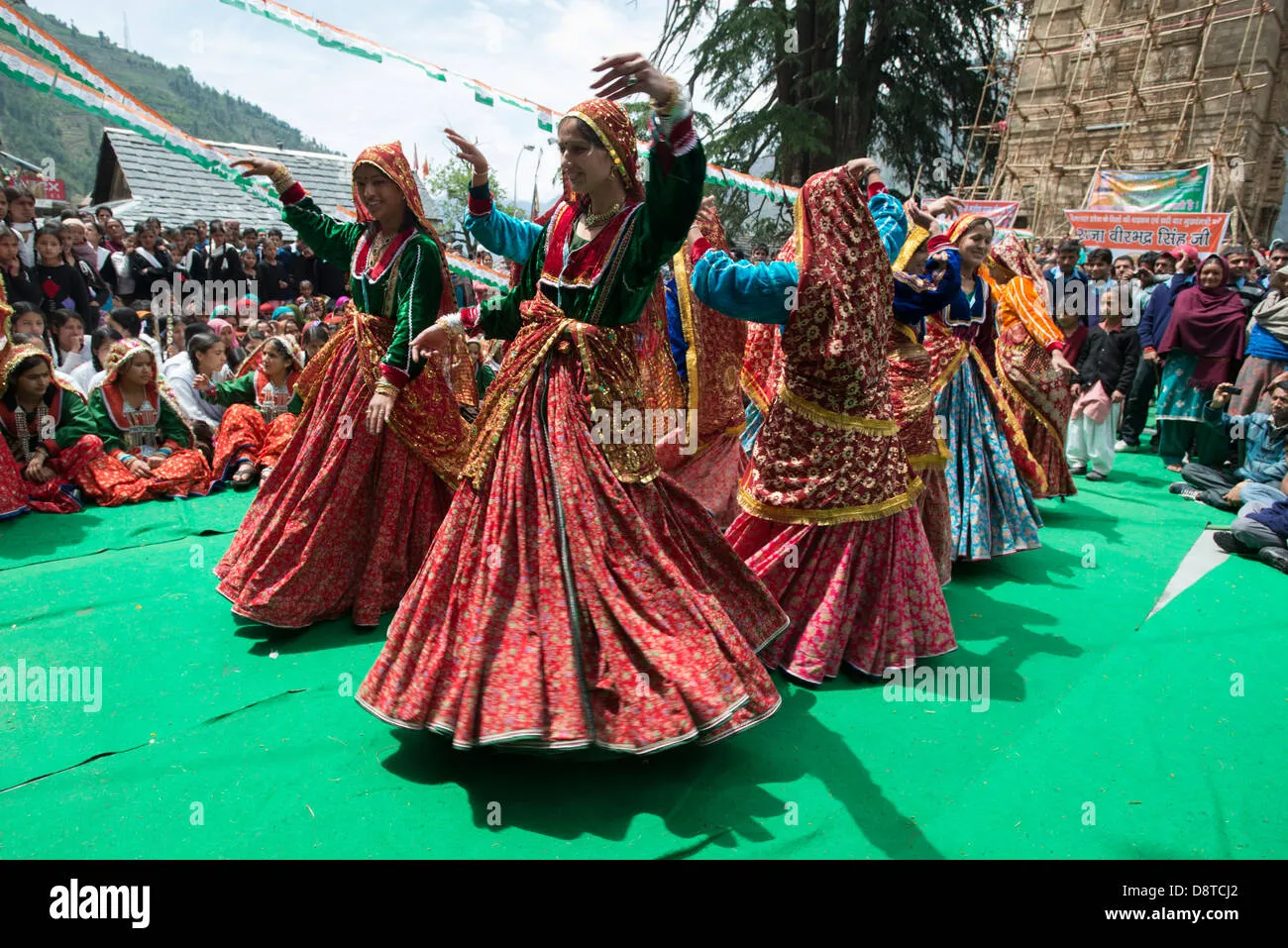
The historical depth of Chamba's folk dance traditions is tied to the history of the Chamba kingdom and its ruling Rajput dynasty, which maintained a cultural court tradition that included folk performances, Pahari miniature painting, and Chamba Rumal embroidery. The Minjar Mela's origin in the 935 CE military victory of the Chamba raja provides a historical anchor for at least the festival context of these dances. The Gaddi tribe's presence in the Bharmaur area is documented from at least the medieval period. Ethnographic documentation of Chamba's folk traditions has been undertaken by regional scholars and by state cultural bodies, though comprehensive academic treatment of the specific dance forms remains limited in the published literature. Culture and Societies The Dangi dance is performed at the Naina Devi temple during the harvest season and at weddings, festivals, and Jataras (folk festivals associated with local deities). It is primarily a female dance and draws on ancient folk tales, including the love story of Bhukhu and Sunni, which provides lyrical content for the songs. The Jhanjar dance is performed by both men and women on festive occasions; it begins slowly and builds to an exciting climax, reflecting the general pattern of Himachali folk dance. The Dandras is performed by Gaddi men using small sticks and can continue for several hours, reflecting the endurance tradition of pastoral male dance performance. The Ghurei dance features complex footwork during religious and cultural events. All these forms are performed at the Minjar Mela, which includes processions of more than two hundred deities carried in chariots, folk music performances of 'Kunjari Malhar,' and several days of communal celebration.
Religious Significance
Chamba's folk dances have significant religious dimensions. Dangi is performed at the temple of Goddess Naina Devi and at Jataras, which are festivals of local deities. The Nuala dance, another Chamba form, is explicitly dedicated to Lord Shiva and involves possession rituals conducted by the chela (chief devotee). The Minjar Mela, at which many Chamba dances are performed, is a festival that includes the procession of the deity Lord Raghuvira and more than two hundred other local deities. The Bharmaur Jatra is dedicated to the deities of the Chaurasi temple complex, which includes shrines to Harihar (Shiva-Vishnu), Narsinghji, and Ganesh. The religious context of Chamba's folk performances is thus pervasive.
Understanding the Art
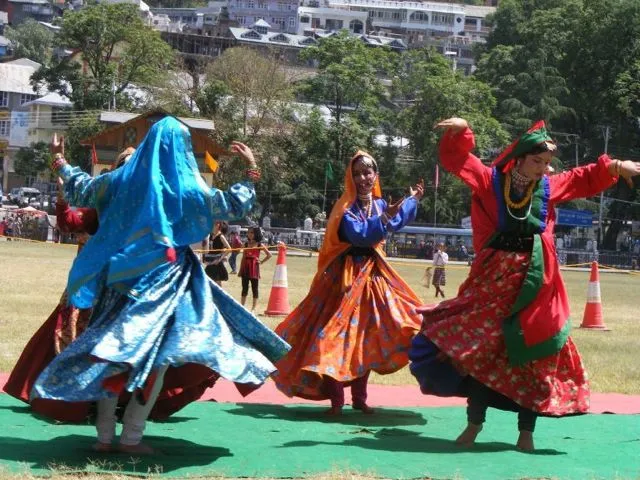
Chamba dance forms share the general Himachali folk dance aesthetic of interconnected circular or linear formations, call-and-response song structures, and progressive acceleration from a slow to a fast tempo. Dangi is performed in a semi-circular formation with dancers joining hands, beginning with slow steps to love ballads and concluding with a graceful dissolution of the circular pattern. Jhanjar begins slowly and builds to an intense climax. Dandras is performed with sticks by Gaddi men and can extend for hours, emphasizing endurance and rhythmic precision. Ghurei features complex footwork as its defining characteristic.
Central Motifs and Their Significance
The central motifs of Chamba's dance traditions include the themes of Gaddi pastoral life (encoded in the endurance and stick-play of Dandras), the love stories of Chamba's oral tradition (Bhukhu and Sunni, Kunju and Chanchlo), and the devotional relationship with local deities. The songs of the Minjar Mela, particularly Kunjari Malhar, celebrate the monsoon season and the agricultural abundance of the region. The Dangi dance preserves love narratives from the folk literature of Chamba that are otherwise inaccessible in written form.
Process
Each Chamba dance form has its own performance structure. Dangi gathers women in a semi-circular arrangement, with a lead singer beginning the call-and-response song cycle; the dance begins slowly and accelerates toward a conclusion. Dandras positions Gaddi men in a line or loose formation, with small sticks used as props; the dance can continue through the night at extended Gaddi community events. Jhanjar involves mixed-gender participation, with the tempo progression from slow to fast marking the dance's emotional arc. All Chamba dances are accompanied by instruments specific to the Pahari tradition.
Mediums Used
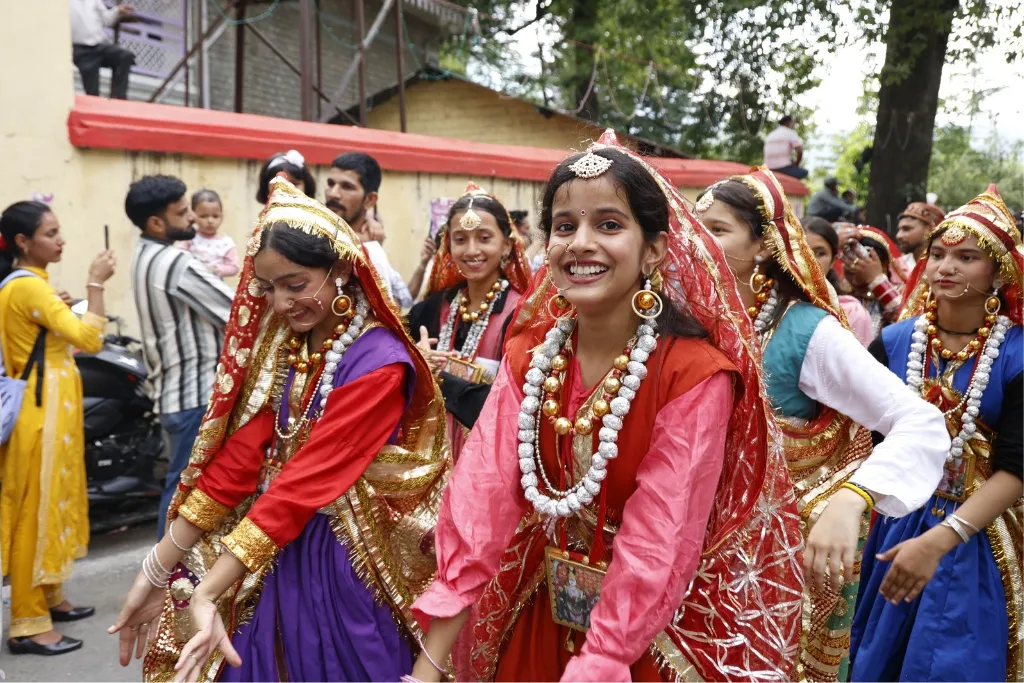
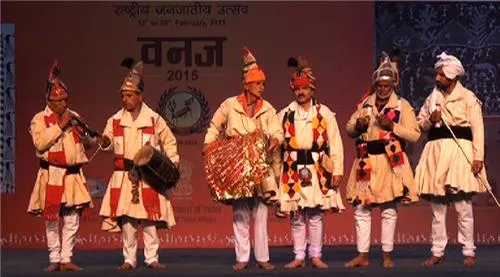
Musical instruments used in Chamba dance performances include dhol, dholak, nagara, shehnai, and flute, which are standard across the Himachali Pahari tradition. The Dandras dance uses small sticks as props. Women's traditional dress in Chamba includes colorful ghaghra (skirts) paired with choli (blouses) and traditional Chamba jewelry. Gaddi men's dress includes chola (a long woolen coat) and dora (a cummerbund), worn with the community's distinctive turbans. The Gaddi community's traditional woolen attire, made from the wool of their own herds, is a marker of the pastoral identity that is reflected in the dance traditions.
New Outlook
Chamba's folk dance traditions are classified as low-visibility and vulnerable. The geographic isolation of Chamba district has historically protected these forms from rapid cultural change, but migration, urbanization, and the influence of standardized Himachali Nati culture present ongoing challenges. The Himachal Pradesh government and cultural bodies have included Chamba dance forms in state festival programming, but comprehensive documentation and training programs specifically for Chamba forms are limited. The annual festivals, particularly the Minjar Mela, provide sustaining performance contexts, and the Gaddi community's continued pastoral identity supports the continuation of specifically Gaddi forms. Academic treatment of the individual Chamba dance forms remains underdeveloped in the English-language literature.
Learn Chamba Dance
Bibliography
Sources
Himachal Pradesh State Gazetteer. Kangra and Chamba Cultural Documentation. Government of Himachal Pradesh, various volumes.
Hutchison, John, and Jean-Marie Vogel. History of the Panjab Hill States. Government Printing Punjab, 1933.
Majumdar, D. N. Himalayan Polyandry. Asia Publishing House, 1962.
Sharma, M. M., et al. Cultural Heritage of Himachal Pradesh. Himachal Pradesh Government Publications, various editions.
Image Sources
“Chamba.” Himachal Pradesh Tourism, https://himachaltourism.gov.in/destination/chamba/. Accessed 4 July 2026.
“Dancing the Garba of Gujarat.” Village Square. https://villagesquare.in/chambas-minjar-a-celebration-of-tradition-harvest-and-culture/. Accessed 4 July 2026.
“Folk Songs and Dances of Chamba.” Chamba Online, https://www.chambaonline.in/guide/folk-songs-and-dances-of-chamba. Accessed 4 July 2026.
“Himachal Day: Chamba.” Hill Post, https://hillpost.in/2010/04/himachal-day-chamba/19534/. Accessed 4 July 2026.
“A Troupe of Gaddi Tribeswomen Perform a Local Folk Dance in the Chamba Region.” Alamy, https://www.alamy.com/stock-photo-a-troupe-of-gaddi-tribeswomen-perform-a-local-folk-dance-in-the-chamba-57085114.html. Accessed 4 July 2026.