
Bhavai - The Folk Dance Tradition of Rajasthan
Delve into the traditions, music, costumes, and breathtaking performances that define the timeless appeal of Bhavai.
Introduction
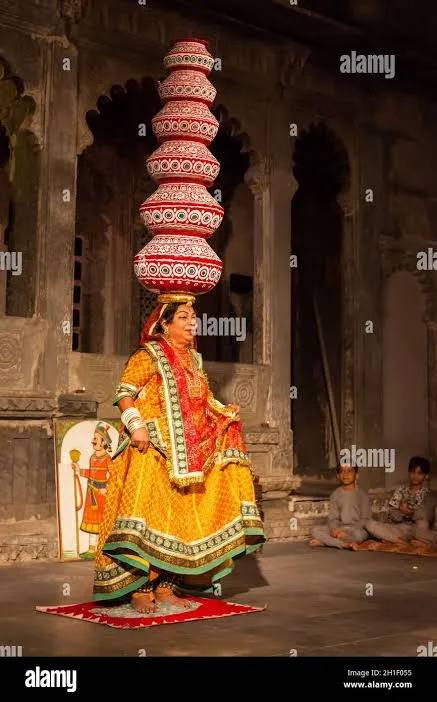
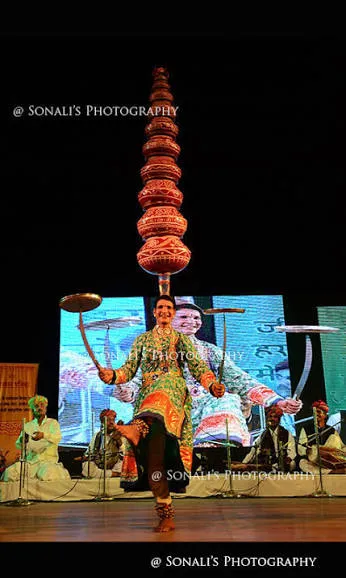
Bhavai is a folk dance form primarily practiced in Rajasthan, India, in which solo performers, typically women, balance a number of earthen pots, brass pitchers, or metal vessels on their heads while executing complex dance movements. The performance includes dancing on the edge of a sword, on the rim of a brass plate (thali), on glass bottles, or on broken glass, creating a high-stakes display of balance, concentration, and physical control. Bhavai is associated with the Kalbelia, Jat, Bhil, Raigar, Meena, Kumhar, and other tribal and artisan communities of Rajasthan. A distinct form of Bhavai exists in Gujarat as a folk theatre tradition with a seven-hundred-year history, which shares the name and is connected by some cultural history but represents a formally separate performance genre.
Etymology
The word Bhavai is understood to derive from multiple possible Sanskrit roots. The most cited derivation connects it to the Sanskrit word Bhava, meaning emotion or expression, connecting the form to the concept of emotional conveyance through performance. An alternate derivation offered by Sahapedia's documentation understands Bhavai as a compound of Bhav (universe or emotion) and Vahini (carrier or bearer), meaning an art form that carries or conveys emotion. In the context of the Gujarati folk theatre tradition, the form is also associated with the Hindu goddess Amba (Ambaji), with Bhav meaning universe and Aai meaning mother, yielding the sense of the Mother of the Universe. The occurrence of the term Bhavai in the sense of show or spectacle in thirteenth-century Apabhramsa Jain religious verse has been noted by scholars, establishing a documented historical linguistic precedent.
Origin
Location: Rajasthan, India; primarily associated with Jodhpur, Jaipur, and desert regions; related Bhavai folk theatre centered in Gujarat (Kutchh, Kathiawar, and Mehsana areas) Community: Kalbelia (snake charmer community), Jat, Bhil, Raigar, Meena, Kumhar communities of Rajasthan; Bhavaiyya (also known as Taragala, Vyas, Nayak, or Bhojak) community of Gujarat for the theatre tradition Relevance: Rajasthan's most distinctive acrobatic folk dance; associated with UNESCO-recognized Rajasthani cultural traditions; significant for its demonstration of physical skill embedded in cultural practice
History
Background
The Rajasthani Bhavai dance and the Gujarati Bhavai folk theatre share a name and some cultural connections but represent distinct performance traditions. The Gujarati Bhavai theatre is the historically better-documented of the two. According to accounts preserved in the Wikipedia article on Bhavai and in the Sahapedia brief introduction, the Gujarati tradition is credited to Asaita Thakar, a Brahmin priest who founded the form in the fourteenth century. The founding legend involves Asaita Thakar rescuing Ganga, the daughter of a village headman of Unjha, who had been taken by a Muslim subedar. His actions resulted in his excommunication from the Brahmin community, and he subsequently founded a performance caste called Taragala or Bhavaiyya, which performed Bhavai as both entertainment and ritual offering to Goddess Amba. The word Bhavai in the sense of show occurs in thirteenth-century Jain Apabhramsa verse, and Abul Fazal's sixteenth-century Ain-e-Akbari mentions Bhavai while discussing certain communities of the region.
The Rajasthani Bhavai dance is believed by multiple sources to have originated in Gujarat before being adopted by tribal communities of Rajasthan who developed it into the distinctive pot-balancing acrobatic form as it is currently practiced. The Kalbelia community of snake charmers in Rajasthan is identified as the community most proficient in the balancing technique. Mrs. Krishna Vyas Chhangani, born in Jodhpur, is documented as the first notable Bhavai dancer of India. The Bhawai Lok Kala Sansthan of Rajasthan is a nonprofit organization established to preserve this art form. In the context of the Gujarati theatre tradition, the form underwent revival in the post-Independence era through the epic musicals Mena Gurjari (1975) and Sati Jasma Odan (1976) by theatre practitioners Dina Gandhi and Shanta Gandhi, and through Ketan Desai's Bhavni Bhavai (1980), which brought the form to mainstream national attention.
Culture and Societies
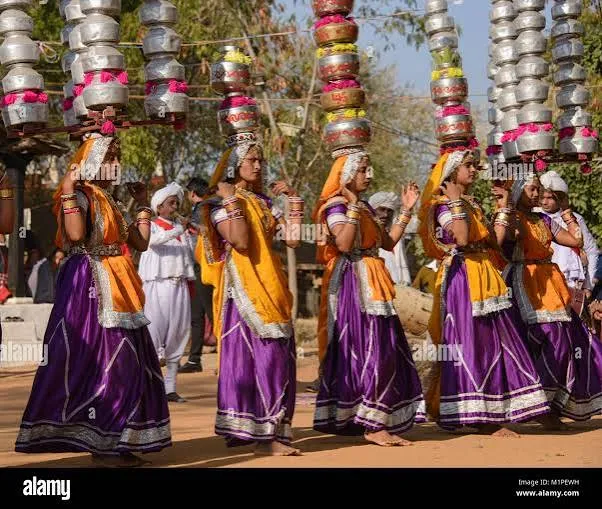
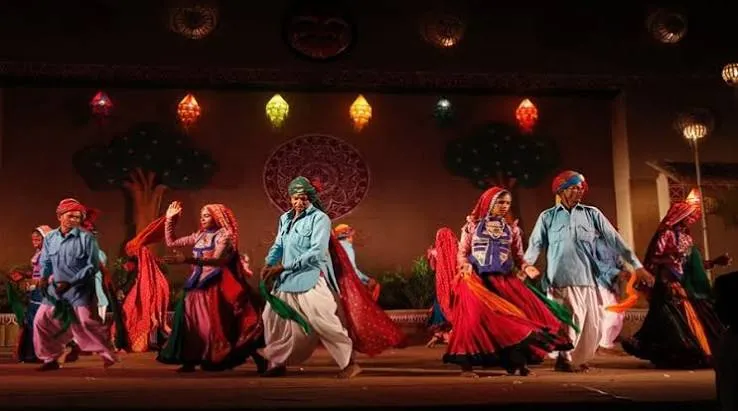
The Bhavai dance tradition in Rajasthan is connected to the practical skills of women in arid desert communities who travel significant distances carrying multiple water pots on their heads. The dance is understood as an artistic transformation of this everyday necessity of desert life into a performance of skill and grace. The Kalbelia community, traditionally associated with snake charming, has incorporated Bhavai into its broader performance repertoire. Multiple Rajasthani communities including the Jat, Bhil, Raigar, Meena, and Kumhar also practice the form. In the Gujarati folk theatre tradition, the Bhavaiyya community has maintained historical claim to the art for multiple centuries, with performances structured as community ritual offerings to Goddess Amba at temple courtyards including the Ambaji temple near Mount Abu, particularly during Navratri.
Religious Significance
The Gujarati Bhavai theatre tradition has a documented and substantial religious dimension. The performance is understood partly as entertainment and partly as a ritual offering to Goddess Amba (Ambaji). The performance structure begins with the Nayak (chief of the troupe) marking the arena, offering kumkum to a torch or earthen lamp representing Amba, and singing devotional prayer songs. The figure of Lord Ganesha enters to remove obstacles, followed by Goddess Kali, and then the secular dramatic content begins. In the Rajasthani Bhavai dance tradition, no equivalent formal religious ritual structure is documented, though the form is performed at festivals and celebrations that may have a general religious cultural context. The Kalbelia community's own cultural and spiritual practices intersect with their performance tradition, but no specific documented ritual function for Bhavai dance as an offering to a particular deity has been established in scholarly sources for the Rajasthani form.
Understanding the Art
Style
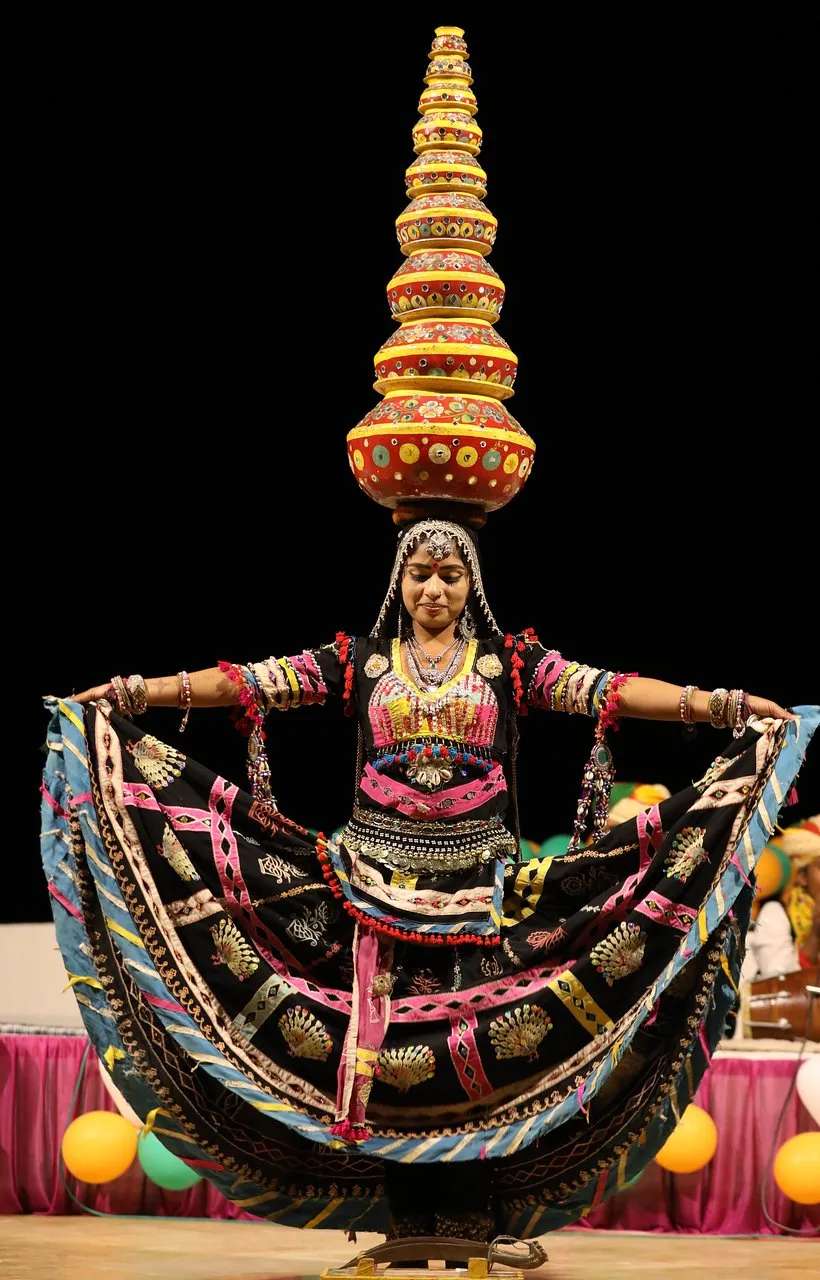
The defining characteristic of Bhavai dance is the balancing of multiple vessels on the head while performing dance movements. The number of vessels typically ranges from seven to twenty-two, depending on the skill level of the performer. The dancer executes pirouettes, swaying movements, and rhythmic footwork while maintaining the balanced stack, often while veiled. The most challenging elements involve placing the feet on the edge of a sword, on the rim of a brass thali balanced on brass tumblers, on glass bottles, or on broken glass, all while the stack of pots remains undisturbed. Some performances include balancing a fire-lit pot at the top of the stack. The performance is executed solo and is accompanied by male musicians who sing melodious Rajasthani folk songs and play traditional instruments.
Central Motifs and Their Significance
The central motif of Bhavai dance is the tension between apparent danger and perfect physical control: the dancer appears to be in constant jeopardy from the weight above and the unstable surface below, yet maintains composure and grace throughout. This motif is understood as a demonstration of feminine strength, concentration, and the physical discipline cultivated by women in demanding desert conditions. The performance creates a spectacle of suspense that engages audiences in a direct visceral way. Costume enhances the visual contrast: elaborate Rajasthani ghagra-choli with mirror work and gota patti, heavy silver jewelry, bangles, anklets, armlets, and traditional nose rings, all worn by a veiled performer managing extreme physical demands.
Process
The performer begins with a manageable number of vessels and adds additional pots progressively as the performance proceeds, building the spectacle incrementally. The feet are placed first on the floor, then transitioned to the challenging surfaces as confidence and audience anticipation build. The male musicians' performance provides rhythmic and melodic continuity throughout. Training begins in childhood for performers from traditional communities, with the balancing skill developed over years of practice. Performances are held at weddings, festivals, cultural events, and in contemporary settings at tourist performances and cultural presentations.
Mediums Used
The instruments accompanying Bhavai dance include the pakhawaj (a two-headed drum similar to the mridangam), the dholak (a smaller double-headed drum), the jhanjhar (metallic ankle bells worn by the dancer), the sarangi (a bowed string instrument), and the harmonium. A bhungal (a long horn) is also used in some performances. The vessels balanced by the dancer are typically earthen pots, brass or metal pitchers, and in some performances, thalis (flat plates). The dancer's costume of ghagra-choli in embroidered cotton or silk with mirror work, the dupatta (veil), and extensive silver jewelry are integral to the form.
New Outlook
Bhavai is classified as a vulnerable folk form, reflecting the difficulty of sustaining a physically demanding acrobatic tradition that requires years of training and specialized skill. The Bhawai Lok Kala Sansthan of Rajasthan, as a dedicated non-profit preservation organization, works to document and support practitioners. Rajasthan Tourism has incorporated Bhavai performances into cultural tourism programs, providing economic opportunities for practitioners while also raising authenticity questions. Contemporary performers continue to extend the tradition through festival and competition appearances at the national and international level. The Gujarati Bhavai theatre tradition has received renewed academic attention through Sahapedia's documentation project and through performances at national cultural festivals.
Learn Bhavai
Bibliography
Sources
Jhaveri, Krishnalal. Further Milestones in Gujarati Literature. 1924.
Sahapedia. “A Brief Introduction to Bhavai.” Sahapedia, https://www.sahapedia.org/. Accessed 4 July 2026.
Varadpande, M. L. History of Indian Theatre. Abhinav Publications, 1987.
“Bhavai.” Wikipedia.
“Bhavai Dance.” Wikipedia.
Image Sources
“Bhavai Folk Dance.” Gujarat Expert, https://www.gujaratexpert.com/blog/bhavai-folk-dance/. Accessed 4 July 2026.
“Bhavai.” Alamy, https://www.alamy.com/stock-photo/bhavai.html. Accessed 4 July 2026.
“Bhavai Folk Dance.” Alamy, https://www.alamy.com/stock-photo/bhavai-folk-dance.html?pseudoid=F8A92026-0BB7-4AFD-81DE-C9BE6CFBDBBF. Accessed 4 July 2026.
“Bhavai Performance.” Flickr, https://www.flickr.com/photos/54918532@N02/13529290134. Accessed 4 July 2026.
“Traditional Bhavai Performance.” Tripadvisor, https://www.tripadvisor.in/LocationPhotoDirectLink-g1918377-d7317713-i451436115-Desert_Springs_Resort-Sam_Jaisalmer_District_Rajasthan.html. Accessed 4 July 2026.