
Bhangra - The Folk Dance Tradition of Punjab
An exploration of Bhangra, the lively folk dance that embodies the spirit of Punjab.
Introduction
Bhangra is a folk dance and music tradition originating in the Punjab region of the Indian subcontinent, historically practiced in the agricultural districts spanning present-day northwestern India and northeastern Pakistan. The term originally designated a specific harvest dance performed by Sikh and Muslim men of farming communities in the Punjab during the Baisakhi season, and has since expanded to encompass a broader set of Punjabi folk dance forms as well as the popular music genre that emerged from it in the mid-to-late twentieth century. Bhangra is the most widely recognized folk cultural form associated with the Punjabi identity globally, and its diaspora evolution has made it an international music and dance form.
Etymology
The word Bhangra is derived from the word bhang, referring to hemp (Cannabis sativa), one of the major agricultural products of the Punjab region during the historical period in which the dance developed. The harvest dance was named after one of the crops of the Vaisakhi harvest season. The term bhangra originally designated only one specific dance form among multiple Punjabi folk dances including Jhummar, Sammi, Luddi, Dhamaal, and Giddha. Over time, through post-Partition cultural consolidation and international dissemination, the term Bhangra was extended as an umbrella designation for the broader tradition of Punjabi folk dance and music.
Origin
Location: Punjab region; specifically associated with the Sialkot, Gujranwala, and Gurdaspur districts of historical Punjab, now straddling India and Pakistan Community: Punjabi farming communities; historically associated with Muslim and Sikh agricultural communities of the Majha and Malwa sub-regions Relevance: Global marker of Punjabi cultural identity; UNESCO recognition of related cultural traditions; significant presence in Bollywood, British Asian music, and international popular music
History
Background
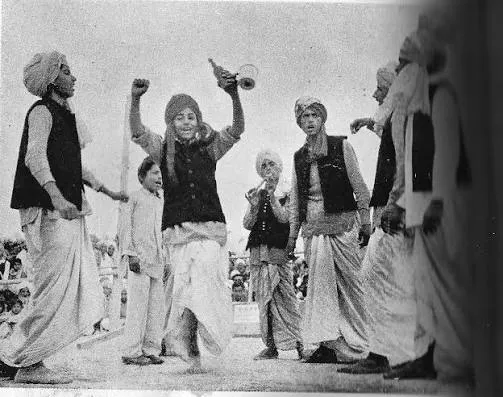
The precise historical origin of Bhangra as a dance practice is not comprehensively documented. Historians and scholars speculate that Punjabi farmers may have performed bhangra-like movements while working in fields as early as the fourteenth or fifteenth century, though documentary evidence from that period is limited. The earliest verifiable historical references to Bhangra as a distinct dance entity appear in records from the late nineteenth century. According to scholar Harjap Singh Aujla, published by the Academy of Punjab in North America, it was Muslim farmers of the Sialkot-Gujranwala-Narowal area who first developed the foundational form of Bhangra, with Sikh farmers subsequently adopting and extensively developing it. The dance was associated primarily with the Baisakhi spring harvest festival, through which farmers celebrated the completion of the wheat harvest while performing vigorous kicks, leaps, and body movements to the syncopated beat of the dhol drum.
Post-Partition consolidation in the 1940s is widely understood by scholars as the period during which the modern composite form of Bhangra was assembled from multiple regional Punjabi dance traditions including Jhummar, Dhamaal, and Luddi. The Maharaja of Patiala requested a staged Bhangra performance in 1953, which formalized the tradition for competition and stage contexts. Dance troupes including those led by brothers from the Deepak family of Sunam and dhol player Bhana Ram Sunami were among the first significant developers of the staged style. Bhangra competitions have been held at educational institutions in Punjab since at least the 1950s, with Mohindra College in Patiala a historically significant venue. Khalsa College in Amritsar had Bhangra teams dating to the 1920s. Following Partition-era migration, Bhangra spread globally with Punjabi communities in the United Kingdom, where the Bhujhangy Group, founded in Smethwick by the Khanpur brothers in 1967, established the first UK Bhangra recording tradition. In 1979, the Southall group Alaap released Teri Chunni De Sitare, combining Bhangra with disco, catalyzing the Southall Sound that launched British Asian bhangra as a global popular music genre.
Culture and Societies
Bhangra historically expressed the masculine values of agrarian Punjabi communities: labor, self-sufficiency, loyalty, bravery in military and personal contexts, and the cultivation of physical vigor. The long staff (khunda) carried by male Bhangra dancers is reminiscent of martial dances including the Bagha, from which Bhangra's roots have been traced. The dance was traditionally an exclusively male form; as scholar Gibb Schreffler documents, women's Giddha, with its emphasis on grace, storytelling, and expression, was the complementary female tradition. In diaspora contexts from the 1970s onward, many Punjabi women incorporated Bhangra, motivated by modern gender equality values. Bhangra competitions in the United Kingdom, United States, and Canada grew into a significant competitive institution involving teams from universities and community organizations.
Religious Significance
Bhangra is not intrinsically a religious dance form. It originated as an agricultural celebration associated with the Baisakhi harvest festival. Baisakhi additionally marks the Sikh New Year and commemorates the founding of the Khalsa in 1699 by Guru Gobind Singh, lending the festival and by extension Bhangra a degree of Sikh religious association in cultural terms. The Bhangra tradition has no formal ritual function, no obligatory religious context, and no documented connection to any specific deity or temple worship. No established religious framework governs its performance. Its cultural associations with the Sikh community are strong in terms of identity and social practice, but do not constitute a formal religious affiliation of the art form.
Understanding the Art
Style
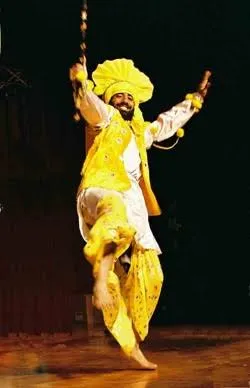
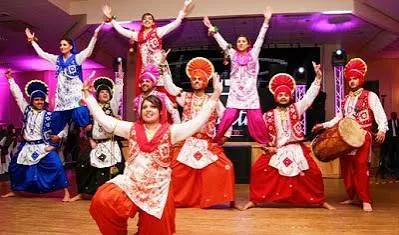
In traditional form, Bhangra is performed in a circle with multiple dancers executing vigorous kicks, leaps, and bends of the body, often with upraised, thrusting arm or shoulder movements, to the syncopated rhythm of the dhol drum. The hallmark rhythmic character of Bhangra music is syncopated, with accents placed on weak beats creating a swinging, propulsive drive. In staged performance, Bhangra incorporates elements from other Punjabi dances including Jhummar segments, Dhamaal sequences, and boliyan (short vocal folk songs). The Sialkoti substyle, associated with the Sialkot region, is performed with one leg in the air. Jhummar, from the Jhang-Sial region, follows a sixteen-beat dhol cycle and involves circular group movement around the dhol player. Dhamaal is a high-energy form involving raised arms and rapid shoulder and head movements.
Central Motifs and Their Significance
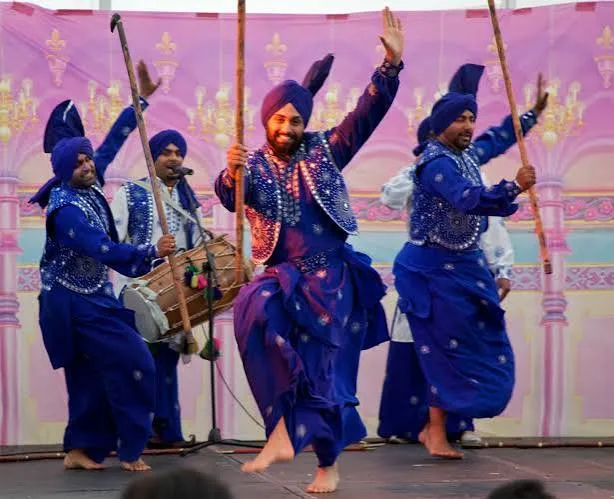
The boliyan (short folk songs) that accompany Bhangra address themes of love, agricultural life, patriotism, strength, celebration, and social comment. The physical movements of traditional Bhangra mimic agricultural activities including sowing, harvesting, and tilling, encoding the occupational life of Punjabi farmers in the body of the dance. The khunda (long bamboo staff) is a recurring prop linking Bhangra to Punjab's martial traditions. Contemporary Bhangra has incorporated themes of immigration, bicultural identity, and popular romance, particularly in diaspora contexts.
Process
Traditional Bhangra performances take place at festivals, weddings, and community gatherings, and do not require a formal stage or fixed context. The dhol player anchors the ensemble, with additional instruments supporting as needed. In competitive contexts, Bhangra teams train over months with structured choreography, formations, and synchronized movements. In the UK and North America, intercollegiate competitions have established a substantial competitive performance tradition with formal judging criteria.
Mediums Used
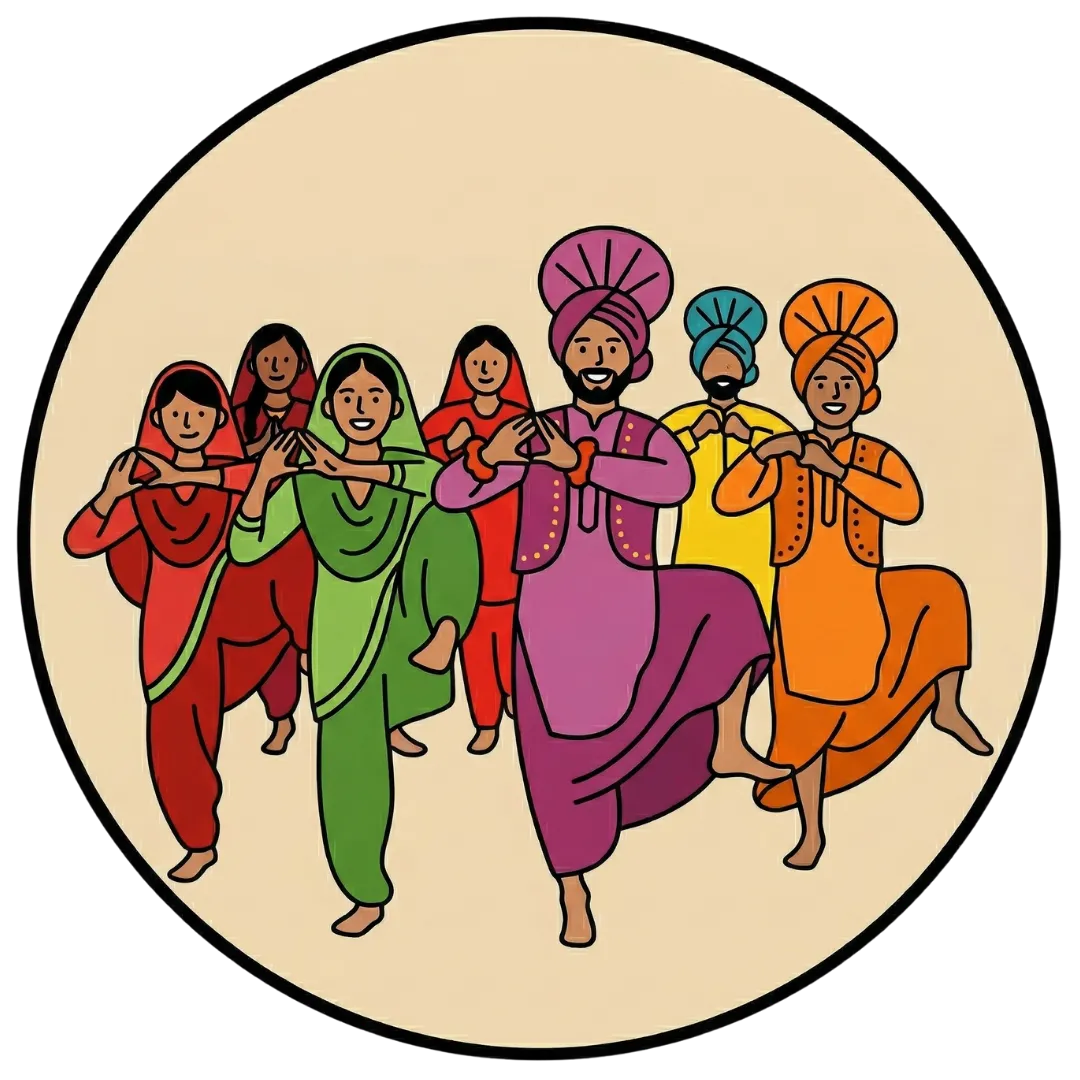
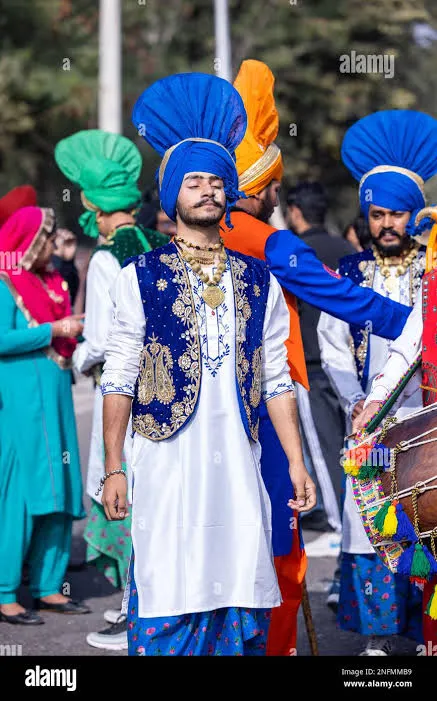
The dhol (a large double-headed barrel drum struck with a heavy beater on one side and a lighter stick on the other) is the essential and defining instrument of Bhangra. Additional traditional instruments include the Chimta (metallic tongs with jingling discs), the Dhad (smaller high-pitched drum), the Tumbi (single-stringed high-pitched plucked instrument), the Alogozey (double flute), the Saaps (X-shaped wooden clapper), and the Khunda (long bamboo staff used as a prop). In contemporary Bhangra music, guitar, mandolin, saxophone, synthesizer, tabla, harmonium, and electronic instruments have been incorporated. Male costumes include the bright kurta, lungi or chaadra (dhoti-style cloth), colorful turban (pagri), and waistcoat. Female Bhangra costumes (in contexts where women perform) include salwar kameez with dupatta in bright colors.
New Outlook
Bhangra occupies a unique position among Indian folk dance forms in having achieved genuine global mainstream recognition. It is featured in Bollywood films, international popular music, fitness culture, and intercollegiate competitive circuits across North America and the United Kingdom. In its region of origin in Pakistan's Punjab, Bhangra has faced significant decline due to limited institutional support, a concern documented by Aujla and others. In Indian Punjab, the form thrives institutionally through university and college competitions, government cultural programming, and private cultural organizations. The broader dance culture of Punjab has seen revivals of forms including Jhummar and Sammi that were historically overshadowed by Bhangra's dominant position.
Learn Bhangra
Bibliography
Sources
Aujla, Harjap Singh. “Bhangra as an Art Is Flourishing in India and Appears to Be on the Verge of Extinction in Pakistan.” Academy of Punjab in North America (APNA), Apna.org.
Encyclopaedia Britannica. “Bhangra.” Encyclopaedia Britannica Online, 1998, updated.
Ganhar, J. N. Jammu and Kashmir Dance Forms. 1975.
Manuel, Peter. “Music in the Punjabi Diaspora.” 2001.
Roy, Anjali Gera. Bhangra Moves: From Ludhiana to London and Beyond. Ashgate Publishing, 2010.
Image Sources
“Bhangra.” Encyclopaedia Britannica, https://www.britannica.com/art/bhangra. Accessed 4 July 2026.
“Bhangra.” Chandrakantha.com, https://chandrakantha.com/music-and-dance/film-and-pop/bhangra/. Accessed 4 July 2026.
“Bhangra (Dance).” Wikipedia, https://en.wikipedia.org/wiki/Bhangra_(dance). Accessed 4 July 2026.
“Punjabi Bhangra: Retrato de Joven Sikh Masculino en Tradicional Punjabi Colorido Vestido y Turbante Realizando Danza Bhangra con Sonrisa en Festival de Camello.” Alamy, https://www.alamy.com/punjabi-bhangra-retrato-de-joven-sikh-masculino-en-tradicional-punjabi-colorido-vestido-y-turbante-realizando-danza-bhangra-con-sonrisa-en-festival-de-camello-image525985917.html. Accessed 4 July 2026.
“A Visual History of Bhangra.” Bhangra Teams Forum, https://bhangrateamsforum.com/a/threads/a-visual-history-of-bhangra.20023/. Accessed 4 July 2026.